Asia’s robot revolution redraws the factory floor—but can workers keep up?
The gist
Asia’s robot-powered manufacturing surge—driven by cheap humanoid robots, AI-smarts, and deep supply chain control—is upending global factory dynamics and rewriting the rulebook for workers, companies, and entire economies.
What to know
- China-led Asia now fields 4.6 million industrial robots worldwide, selling humanoids at roughly a third of Western prices thanks to state subsidies and supply chain muscle.
- New AI tools are capturing skilled workers’ know-how, letting less experienced staff boost productivity and slashing factory lead times for companies like CloudNC and Light Source AI.
- As factories shift from chasing cheap labor to chasing cheap electricity, unions and governments scramble to address job displacement and economic equity in a rapidly automated world.
China’s Robotics Price War
Chinese robot makers leverage state-backed supply chains and low margins to flood global factories with affordable humanoids, challenging Western dominance and exposing new geopolitical vulnerabilities.
By early 2026, Asia—led decisively by China—had cemented its role as the global powerhouse in robotics manufacturing and supply chains, leveraging massive state subsidies to undercut Western competitors on price and scale. Companies like Unitree, Agibot, Fourier, and UBTECH exemplify this trend, shipping humanoid robots at costs far below Western offerings, a strategy reminiscent of China’s prior dominance in EVs, solar panels, and drones. This aggressive scaling is reflected in the doubling of global robot density to 162 robots per 10,000 employees and a total of 4.6 million industrial robots operational worldwide, underscoring Asia’s rapid industrial adoption even before humanoid robots reached commercial maturity.
Asia’s dominance extends beyond manufacturing scale to deep control over critical robotics supply chain components such as actuators, sensors, rare earth magnets, and AI compute hardware, mirroring the regional consolidation seen previously in smartphones and electric vehicles. This integrated ecosystem enables rapid iteration and cost reduction, as highlighted by Niko Ciminelli’s observation that Chinese firms’ willingness to operate at low margins early—unlike Western counterparts—allows companies like Unitree to offer robots with 80% of the capabilities at roughly a third of the price. Such hardware innovation, particularly in specialized parts like quasi-direct-drive actuators, remains a decisive competitive edge over AI software alone.
While China leads in manufacturing scale and deployment density, the robotics ecosystem remains globally interconnected, with the U.S. excelling in AI research and Europe maintaining strengths in industrial automation and embedded systems. This geographic distribution of competitive advantages suggests that the most investable companies will be those that transcend regional boundaries to operate across the entire robotics ecosystem. However, this interdependence also exposes strategic vulnerabilities, as reliance on China’s supply chains amid geopolitical tensions and export restrictions could disrupt access to critical components, raising concerns about the resilience of Western robotics industries.



AI Codifies Shop Floor Wisdom
Factory AI systems are capturing and scaling the tacit expertise of veteran machinists, transforming manufacturing productivity and bridging the skilled labor gap.
By early 2026, it became clear that the most significant bottleneck in American manufacturing was not the machines themselves but the tacit, experience-based knowledge held by skilled workers—knowledge that is notoriously difficult to scale or transfer. Companies like CloudNC demonstrated that embedding domain-specific AI systems, which 'think like a machinist,' into real workflows can codify this tribal knowledge, making best practices consistent and enabling less experienced workers to perform at higher levels. This approach not only alleviates skilled labor shortages but also frees senior experts from repetitive tasks, thereby increasing factory productivity without simply expanding the workforce.
The critical role of AI-driven knowledge capture extends beyond programming to encompass quoting, process planning, scheduling, setup, and inspection, transforming how factories operate by reducing lead times and costs while improving uptime. Industrial service leaders like Peak International Group, represented by Mike Hughes, emphasize a frontline-first modernization strategy where targeted AI applications—such as remote diagnostics and first-time fix improvements—help preserve institutional knowledge lost as experienced engineers retire. This targeted deployment is essential to maintaining operational performance amid the skilled labor crisis.
The automotive sector's experience, particularly Tesla’s Model 3 production scale-up, highlighted the urgent need for integrated, real-time collaboration tools that bridge engineering, procurement, and suppliers. Light Source AI, founded by Spencer Penn, addresses this gap by focusing on direct materials procurement tied to the bill of materials, replacing manual processes like emails and spreadsheets with AI-driven platforms that capture and operationalize tacit manufacturing expertise. This innovation accelerates time to market and reduces costs, illustrating how AI can unify fragmented workflows in complex manufacturing ecosystems.
Capturing tacit knowledge is not only vital for addressing skilled labor shortages but also for fostering a closer, culturally embedded connection between design and manufacturing—a relationship often missing in Western supply chains. In China, for example, electrical engineers design PCBs with intimate manufacturing knowledge, accepting trade-offs to optimize production, whereas Western designs tend to be abstracted from manufacturing realities. AI tools like Claude are now being used to iteratively improve designs for manufacturability, compensating for this disconnect by embedding expert judgment into the design process and enabling smarter, more scalable factory operations.





From Cheap Labor to Cheap Power
Automation is shifting manufacturing’s competitive edge from labor costs to electricity prices, with robots enabling high-wage countries to outcompete low-wage rivals.
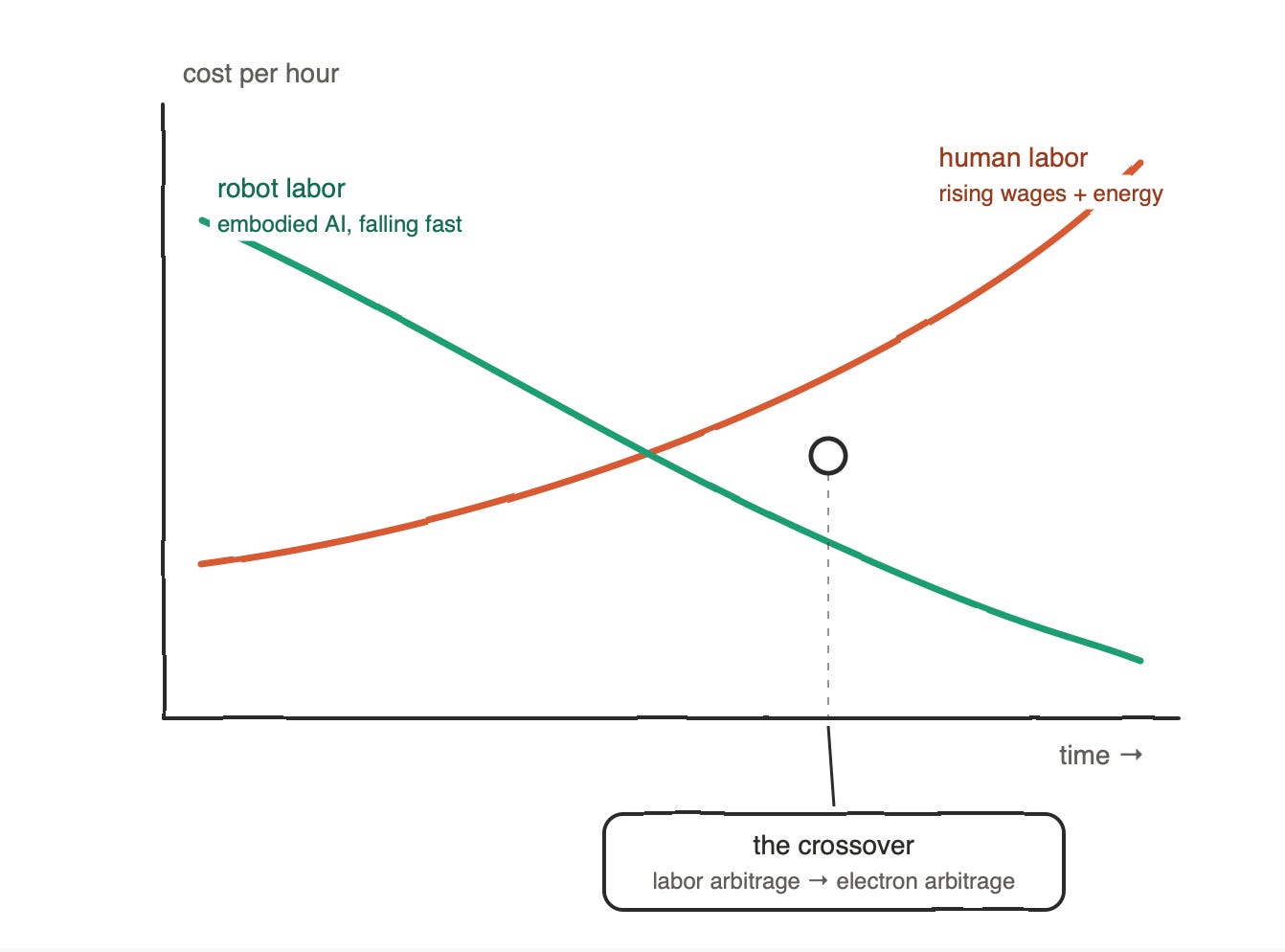
Manufacturing economics are undergoing a profound transformation from labor arbitrage—where production was located based on the availability of cheap human labor—to electron arbitrage, which prioritizes energy costs and robotic labor as the primary determinants of manufacturing strategy. This shift is encapsulated by the insight that for four decades, globalization hinged on finding the cheapest workers, but with the rise of affordable automation, the decisive question now is where to find the cheapest, most reliable electrons to power robotic production lines. German industry’s electricity costs, which are roughly double those in the U.S. and significantly higher than in China or India, exemplify how energy prices are reshaping global competitiveness once labor costs become negligible.
The plummeting cost of robotic labor has redefined the economics of manufacturing labor itself, with industrial humanoid robots like the Unitree G1 costing between $13,000 and $16,000 upfront and leasing for about $500 monthly, translating to an effective hourly labor cost in the low single digits over continuous operation. This utility-like pricing model for robots eliminates the complex overhead associated with human workers, fundamentally altering the cost calculus and enabling factories to operate profitably in high-wage regions by substituting human labor with automation.
Tesla’s automotive manufacturing exemplifies the electron arbitrage paradigm by leveraging advanced automation techniques such as Giga-Casting and the Unboxed Process, which consolidate hundreds of traditional assembly steps into single, rapid operations. For instance, Tesla’s colossal press casts the entire rear underbody in about ninety seconds, replacing seventy to a hundred parts and eliminating thousands of human labor hours and hundreds of welding robots. This contrasts sharply with legacy automakers like Volkswagen and Stellantis, which continue to rely on relocating production to low-wage countries such as Morocco, Serbia, and Poland, reflecting an outdated labor arbitrage mindset that assumes human labor remains indispensable.
Tesla’s Factory as a Product
Tesla’s radical integration of AI, robotics, and parallel assembly lines is redefining automotive manufacturing, making the factory itself a scalable, automated engine of innovation.
Tesla's approach to automotive manufacturing epitomizes the transformative power of AI-driven factory automation, where the factory itself is treated as a product to be engineered for rapid scalability and efficiency. Elon Musk's candid acknowledgment of the challenges in meeting aggressive production schedules—such as the impossible initial Model 3 release date due to complex supply chains—underscores the fundamental importance of manufacturing as the backbone of technological progress. Tesla’s philosophy that 'if we don't make stuff, there's no stuff' highlights a broader industry realization that exponential production growth demands not only ambition but also innovative integration of AI and robotics to overcome traditional bottlenecks.
The automotive sector is accelerating its smart factory investments, leveraging AI, robotics, and integrated digital platforms to meet the complexities of electric vehicle production and beyond. This shift from isolated automation to connected manufacturing ecosystems enables real-time decision-making, predictive maintenance, and energy optimization, resulting in up to 50% reductions in unplanned downtime and throughput gains of 5-7%. As Edgar Faler from CAR notes, the industry has moved past questioning the value of AI, focusing instead on strategic deployment to manage complexity and secure competitive advantage, though this creates a widening divide among manufacturers based on their adoption pace.
Tesla’s disruptive innovations, such as Giga-Casting—which replaces hundreds of assembly steps with a single massive aluminum casting—and the Unboxed Process that assembles car modules in parallel, exemplify a radical departure from legacy automakers’ labor-intensive methods. Operating in high-wage environments like Fremont and Giga Texas, Tesla eschews the traditional search for cheaper labor, instead pioneering 'electron arbitrage' by eliminating human hands where possible. This paradigm shift not only boosts production efficiency but also signals a future where humanoid robots, like Tesla’s Optimus units already deployed in large numbers, may fully replace human labor in complex assembly tasks.
As automakers race to integrate humanoid robots into manufacturing, economic and social challenges loom large. While companies like Hyundai, Mercedes, and BMW pursue varied strategies—from leveraging Boston Dynamics’ robotics to partnering with startups and Chinese firms—the rise of 'dark factories' fully operated by AI and robots by 2030 raises concerns about job displacement and consumer purchasing power. Labor unions such as the UAW are proactively negotiating to ensure robotics enhance rather than eliminate jobs, while policy discussions around measures like a 'robot tax' gain traction. Despite rapid advances, industry experts caution that humanoid robotics remain a long-term horizon, with some projections placing their economic dominance beyond 2050.

Unions and Lawmakers Face Robots
As humanoid robots reshape factories, labor unions and governments are racing to ensure automation delivers shared prosperity—debating robot taxes, legal protections, and the future of work.
By mid-2026, the integration of robotics and AI in manufacturing has sparked profound debates about the evolving social contract and economic equity. A landmark Chinese court ruling underscored that AI cannot unilaterally demote or undercut workers, signaling a legal recognition of workers' rights amid automation. Experts like Peter emphasize the urgent need to craft governance frameworks and incentive models that ensure AI-driven advancements uplift humanity rather than deepen societal fractures, highlighting the delicate balance between innovation and social cohesion.
Europe's robotics renaissance, propelled by AI breakthroughs and acute labor shortages, exemplifies the complex socio-economic dynamics at play. As younger generations eschew factory work, companies like BMW, Mercedes Benz, and Volvo are piloting AI-enabled robots that transcend repetitive tasks to collaborate alongside humans, signaling a shift toward versatile automation. Yet, this transition raises economic paradoxes famously encapsulated by UAW President Walter Reuther’s quip about robots paying union dues and buying cars, underscoring concerns about income displacement and consumer demand.
Labor unions and policymakers are actively grappling with the disruptive potential of humanoid robots in manufacturing. The UAW’s push to integrate robotics into collective bargaining aims to ensure automation enhances rather than eliminates jobs, with productivity gains equitably shared. Concurrently, governments face dilemmas exemplified by Canada’s bid to attract fully automated 'dark factories'—ventures promising economic activity but scant employment—prompting calls for innovative policy responses like a 'robot tax' to offset job losses and sustain social welfare.
While humanoid robots offer promising applications in sectors like home health care, their encroachment into manufacturing threatens vast swaths of low-education, physically demanding jobs that currently employ many workers. These roles, characterized by repetitive tasks and injury risks, are ideal for automation but pose significant societal challenges as displaced workers face uncertain futures. This tension spotlights the urgent need for comprehensive strategies that address both technological progress and the livelihoods of vulnerable labor segments.


