Avalanche’s tokenized credit boom faces regulatory roadblocks
The gist
Avalanche’s breakout in tokenized private credit is running headlong into regulatory speed bumps—just as its DeFi rails hit record growth.
What to know
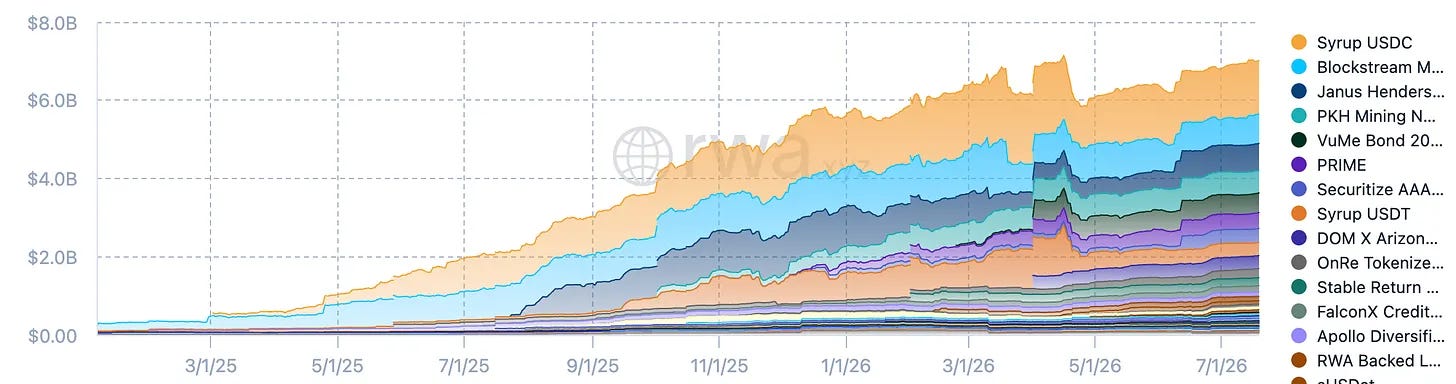
- Aave V4’s launch on Avalanche sent institutional tokenized asset TVL surging 60% to $2.1B in 30 days, integrating $13.7B in real-world assets.
- The first-ever institutional secondary trade on Avalanche set a legal precedent for transferring tokenized private credit on-chain—no loan unwinding required.
- Despite tech breakthroughs, regulatory uncertainty and a lack of sanctioned exchanges are keeping secondary market liquidity locked in the slow lane.
Avalanche’s DeFi Powerhouse
Aave V4’s Hub & Spoke architecture is fueling a surge in institutional real-world asset inflows, enabling Avalanche to handle billions in tokenized private credit with robust security and liquidity.
The launch of Aave V4 on Avalanche marks a pivotal advancement in DeFi infrastructure, introducing a unified Hub & Spoke architecture that isolates asset risk while leveraging shared core liquidity pools. This design not only enhances security but also enables scalable institutional real-world asset (RWA) markets, as evidenced by the integration of over $13.7 billion in institutional RWAs, including the $11 billion Bridgetower mining project and Japan’s ¥452 billion security tokens via Progmat. These substantial inflows propelled Avalanche’s on-chain tokenized asset value locked (TVL) to $2.1 billion, reflecting a remarkable 60.47% surge within just 30 days, underscoring the platform’s growing liquidity and market depth for tokenized private credit.
Aave V4’s advanced DeFi framework further supports specialized permissioned institutional sub-markets through decoupled credit lines, effectively preventing capital fragmentation and facilitating the secure scaling of tokenized private credit markets. This architecture accommodates diverse asset classes via distinct market spokes—ranging from liquid staking and stablecoin cross-collateralization to traditional digital assets—thereby creating a robust ecosystem that underpins liquidity and efficient settlement mechanisms essential for on-chain credit trading.
Institutional adoption is exemplified by products like BlackRock’s BUIDL tokenized treasury fund, which has surpassed $900 million in assets under management on Avalanche, alongside tokenized U.S. Treasuries that enable institutions to deposit low-risk, yield-bearing treasury tokens and borrow stablecoins. These developments highlight Avalanche’s capacity to handle structured credit markets and low-risk yield assets, critical components for the maturation and expansion of tokenized private credit within the DeFi landscape.
Regulation Stalls Market Growth
Regulatory inertia and the absence of approved exchanges are sidelining secondary market liquidity, keeping advanced tokenization infrastructure from reaching its full potential.
Despite the maturation of blockchain infrastructure and custody solutions, regulatory approval remains the critical bottleneck in scaling secondary markets for tokenized real-world assets. As industry insiders emphasize, regulators must develop greater comfort with the entire fund flow ecosystem to enable effective participation across stakeholders. This regulatory hesitancy directly impedes the establishment of fully functional secondary trading environments, leaving promising technologies underutilized.
The absence of regulator-sanctioned exchanges specifically approved to lease tokenized assets, such as tokenized commodities, further stifles secondary market development. Market participants are actively engaged in dialogues with regulators, awaiting formal approval to operate these exchanges, which are essential for efficient price discovery and liquidity. This regulatory gap underscores the urgent need for sanctioned trading venues to unlock the full potential of tokenized asset distribution and trading.

Blueprint for On-Chain Credit Trades
Avalanche’s first institutional secondary trade established a legal and technical template for compliant, on-chain private credit transfers—without unwinding underlying loans.
The inaugural institutional secondary trade on Avalanche, executed by Ocean RWA Finance, Symphony Digital Assets, and Alpha Jaguar Capital, serves as a pioneering blueprint for tokenized private credit markets by demonstrating a viable legal and operational framework. This transaction notably established that tokenized credit exposures can be transferred between regulated entities on-chain without unwinding the underlying loans, a critical infrastructure element that future market makers and automated liquidity pools will rely upon to foster seamless secondary market activity.
Avalanche’s subnet architecture played a strategic role in enabling this trade by providing permissioned, compliance-customizable environments anchored to a public chain, balancing institutional regulatory requirements with blockchain transparency. This design has attracted multiple real-world asset pilots, positioning Avalanche as a preferred venue for institutional secondary trading of tokenized private credit, where bespoke compliance rules can be enforced without sacrificing the benefits of decentralized settlement.
The trade’s execution as a bilateral over-the-counter (OTC) settlement without a centralized exchange or public order book highlights an emerging market structure where bespoke OTC desks and peer-to-peer protocols facilitate sizeable secondary transactions. While this approach underscores the nascent stage of liquidity and price transparency—given the absence of automated market makers or public order books—it also reflects a pragmatic pathway for large tokenized credit positions to change hands securely and compliantly in the current decentralized finance landscape.
Although this single trade represents a modest transaction within the broader $20 billion tokenized asset sector, its significance lies in providing a foundational operational and legal template that could reduce friction and unlock liquidity in tokenized private credit markets. However, scaling such secondary market activity to attract third-party market makers and achieve robust price discovery remains challenged by regulatory uncertainties and liquidity fragmentation across multiple blockchain platforms, including Ethereum layer-2s, Cosmos app-chains, and proprietary networks.

Tokenized Credit’s Rapid Ascent
By embedding loan mechanics on-chain and slashing investment minimums, tokenized private credit is unlocking real-time liquidity and democratizing access to a $20B+ market.
Tokenized private credit is rapidly becoming the largest and fastest-growing segment within the tokenization market, with active loan values soaring to $20.48 billion by late 2025—a 56% increase from the previous year—highlighting its robust expansion and investor appetite. This growth is fueled by the technology's ability to drastically reduce settlement times from days or weeks to near real-time, which is particularly transformative for SMEs facing a global $2.5 trillion trade finance shortfall. By accelerating funding cycles and enabling swift secondary transfers and refinancing, tokenized private credit platforms are poised to unlock significant liquidity and efficiency gains in a traditionally slow and opaque market.
True tokenization transcends mere digitization of fund shares by embedding the loan’s core elements—collateral, repayments, covenants—directly on-chain, thereby automating servicing and enhancing transparency. Platforms like 8lends exemplify this approach by pairing onchain distribution with regulated underwriting and enforceable collateral claims, effectively addressing Europe's €39 billion SME funding gap. This model not only ensures legal enforceability through local collateral registries but also streamlines capital flows and repayments via smart contracts, fostering trust and operational efficiency in private credit markets.
Tokenization democratizes access to private credit by enabling fractional investments with low minimums—as little as 100 USDC on 8lends—thereby opening a market once dominated by accredited investors with high entry barriers, such as Centrifuge’s $500,000 minimum. This inclusivity, combined with reduced liquidity constraints and lower protocol fees (0.2-0.4% of AUM versus traditional slices), directly addresses the concerns of 70% of wealth and asset managers who cite liquidity and fees as barriers to greater private credit allocation. Consequently, tokenized private credit not only broadens investor participation but also enhances market liquidity through T+0 redemptions and efficient secondary trading.