China flexes tech muscle, launches global AI governance push
The gist
China is shaking up the global tech order with record-breaking profits, a new AI governance bloc, and a strategic pivot away from the U.S. market.
What to know
- High-tech industrial profits in China soared 47.4% in early 2026 as Beijing doubled down on AI, semiconductors, and biotech self-reliance.
- China launched WAICO—an AI governance alliance with 29 countries—positioning itself as the multilateral alternative to U.S.-led tech rules.
- Trade with ASEAN, Africa, and the EU surged, pushing China’s trade surplus past $1 trillion while it deepens regional ties and sets new global tech standards.
China’s High-Tech Power Play
Targeted supply-side reforms and aggressive innovation policies have propelled China’s domestic tech giants to global leadership, signaling a decisive break from foreign technology dependence.
China’s 2025-2026 economic transformation is anchored in supply-side structural reforms that aim to optimize domestic supply chains and productivity through the creation of a unified national market. While the government acknowledges the persistent tension between strong domestic supply and weak demand, it is gradually shifting towards balancing these forces by expanding domestic consumption alongside supply-side improvements, as reflected in the CEWC’s emphasis on developing “new quality productive forces” and a special action plan to boost domestic demand from 2026 to 2030.
Technological self-reliance and innovation-driven growth stand at the core of China’s long-term strategy, with the 15th Five-Year Plan (2026–2030) explicitly prioritizing sectors such as AI, semiconductors, high-tech manufacturing, and biotech. The government is fostering R&D clusters in Beijing, Shanghai, and the Greater Bay Area, advancing initiatives like “AI Plus,” and supporting domestic champions and 'little giants' through tax incentives and talent programs. This focus has already yielded a 47.4% surge in high-tech industrial profits in early 2026, led by breakthroughs in AI and semiconductor industries, underscoring China’s commitment to reducing foreign technology dependence.
China has strategically leapfrogged traditional technologies to dominate emerging sectors such as electric vehicles, robotics, and semiconductor manufacturing. By 2025, domestic firms like BYD have surpassed Tesla in the Chinese EV market, which now accounts for 50% of new car sales, while DJI leads the global civilian drone market and Unitree Robotics prepares for IPO. Despite ongoing US export controls and technological gaps, China has advanced to producing 7nm and moving toward 5nm chips, leveraging government support and innovation to accelerate semiconductor self-sufficiency and global competitiveness.
China’s economic and technological transformation is deeply intertwined with its green and digital infrastructure ambitions, positioning the country as a global leader in renewable energy and digital connectivity. By 2024, China had installed more solar capacity than the rest of the world combined, halving solar panel costs and electrifying communities in Africa and Southeast Asia. Its digital infrastructure includes over 4.5 million 5G base stations—over 60% of the global total—and plans for major computing hubs under the 'Eastern Data, Western Computing' initiative, all supported by world-class ultra-high-voltage power grids that facilitate clean energy transmission.




Trade Wars Reshape Alliances
China’s pivot from the U.S. to emerging markets and its rare earth leverage have fundamentally redrawn global supply chains and economic alliances amid escalating trade conflict.
By early 2026, China's economic growth revealed a complex shift amid US-China tensions, with a 5% GDP increase driven predominantly by exports and services rather than the anticipated rebound in domestic consumption and investment. Despite a 25.5% plunge in exports to the US since April 2025, China strategically pivoted toward alternative markets such as ASEAN (+16.9%), the EU (+8.9%), Africa (+32.7%), and Latin America (+5.7%), resulting in a record trade surplus exceeding $1 trillion. However, the consumer sector remained subdued due to persistent challenges in the property market and household incomes, limiting the domestic demand crucial for China's economic transition.
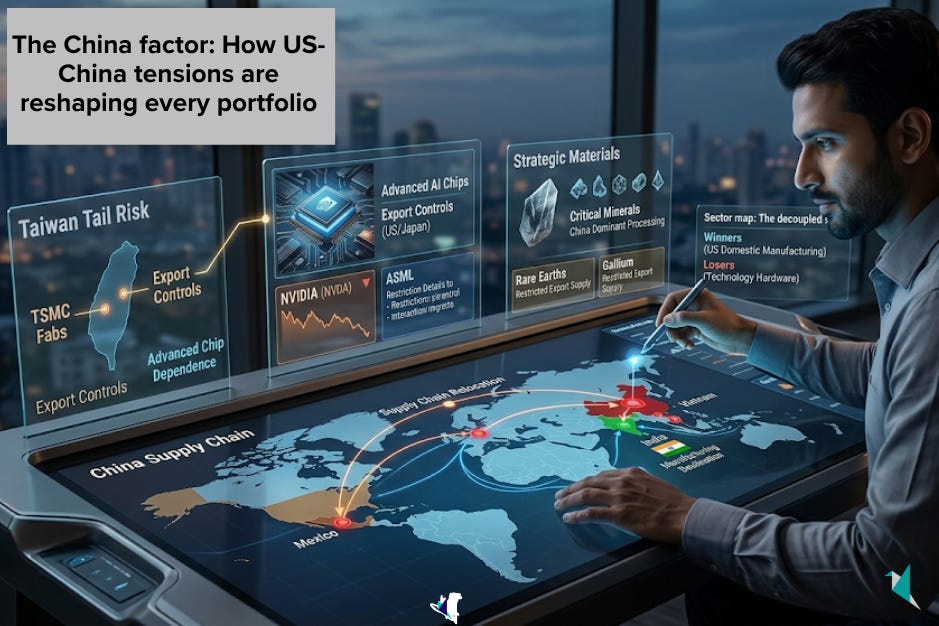
The intensifying US-China trade conflict has structurally decoupled their economic relationship, marked by escalating tariffs reaching multidecade highs and progressively tighter export controls on advanced semiconductors and chip-making equipment, with allies like the Netherlands and Japan joining the restrictions. This decoupling, accelerated through milestones such as the 2018–2019 trade war, the COVID-19 pandemic, and the 2025 Liberation Day tariff regime, has reshaped global supply chains and semiconductor industry dynamics. China has retaliated by imposing export controls on critical minerals and rare earth elements—key inputs for defense and EVs—leveraging its dominant processing capacity to counterbalance US restrictions and geopolitical risks surrounding Taiwan's semiconductor manufacturing dominance.
In response to export controls and supply chain realignments, China has accelerated its push for semiconductor self-sufficiency and emerged as a global leader in electric vehicles, robotics, and drone technology. Domestic firms like BYD have surpassed Tesla in the Chinese EV market, while DJI dominates civilian drones and companies such as Unitree Robotics and Ubtech advance robotics innovation. Despite still lagging behind leaders like Taiwan's TSMC and Nvidia in cutting-edge semiconductor nodes (7nm and 5nm), China leverages techniques like AI model distillation to leapfrog legacy technologies, exemplified by DeepSeek's cost-effective AI breakthroughs that stunned Silicon Valley in early 2025.
Global supply chains are undergoing a strategic transformation from a globalized model to a multipolar structure, with manufacturing relocating into regional blocks across Asia, Europe, and North America. This shift, driven by persistent geopolitical instability and trade fragmentation, compels companies to prioritize resilience and optionality over traditional just-in-time logistics despite higher costs. Nearshoring and multi-hub sourcing strategies are gaining traction in regions like Mexico's Laredo corridor, Southeast Asia, and South Asia, supported by digital transformation investments that enable real-time visibility and proactive disruption management. However, tensions between supply chain leaders seeking inventory buffers and CFOs demanding leaner costs underscore the ongoing complexity of adapting to this new multipolar trade environment.


ASEAN’s Geopolitical Balancing Act
Internal divisions and strategic hedging among ASEAN members are testing the bloc’s cohesion as it navigates intensifying U.S.-China rivalry and competition for foreign investment.
Since early 2025, ASEAN has grappled with the global shift from a rules-based order to power politics, exposing governance gaps and institutional weaknesses that undermine its reliability as a partner. This fragility is compounded by internal disparities in political stability and enforcement capacity, which risk intra-bloc competition for foreign direct investment (FDI). Countries like Thailand, Vietnam, Indonesia, and Malaysia stand to attract more FDI by improving infrastructure and governance, while less-prepared members may lose out, highlighting ASEAN’s uneven readiness amid intensifying geopolitical tensions.
ASEAN’s internal cohesion faces significant tests in 2026, particularly under the Philippines’ chairmanship, as longstanding disputes over the South China Sea and border conflicts—such as Cambodia’s tensions with the Philippines, China, and Thailand—persist without resolution. While about 70% of the ASEAN-China Code of Conduct draft has been agreed, disagreements over its scope and enforcement reflect deep regional divisions and great power rivalry. Analysts urge strict adherence to ASEAN protocols and international law like UNCLOS, emphasizing neutrality and transparency to navigate these complex disputes.
Amid geopolitical pressures, ASEAN member states exhibit divergent strategic responses that reshape regional cooperation. Vietnam exemplifies this by deepening economic ties with China through manufacturing and infrastructure projects while maintaining strategic autonomy via 'bamboo diplomacy' with the US, including strengthening ties with Laos through initiatives like a Vietnamese university and the Vientiane–Vung Ang railway. Meanwhile, Malaysia emerges as a regional tech hub, attracting over US$2 billion in investments from Intel and Google, signaling adaptive economic integration despite geopolitical frictions.
ASEAN’s institutional constraints and internal divisions are starkly evident in its handling of the Myanmar crisis, where the Five-Point Consensus (5PC) established in 2021 has seen little progress. Member states remain split between prioritizing political accountability and practical concerns like border security and humanitarian access, while Myanmar’s military accuses ASEAN of discrimination. China’s influential role with Myanmar’s military and ethnic armed groups further complicates collective action. Despite these challenges, ASEAN leaders like Philippine President Marcos emphasize regional cohesion, framing Myanmar as part of the ASEAN family, even as the bloc struggles to reconcile its principles with limited operational effectiveness.


China’s Multilateral Trade Ambitions
Beijing is doubling down on institutional openness and high-level economic diplomacy, using trade liberalization and regional integration to counter global protectionism and assert rulemaking authority.
China’s global governance strategy is anchored in promoting openness and multilateralism through initiatives like 'China Opportunity 2.0,' which emphasizes innovation-driven, high-quality development to expand global business access to advanced technologies and shared growth. By expanding pilot free-trade zones, building the Hainan Free Trade Port, and broadening market access in sectors such as education, finance, and healthcare, China is advancing institutional opening-up to foster stable international relations and counter rising protectionism. This approach is complemented by a 15-measure action plan aimed at facilitating foreign investment through expanded market access, streamlined procedures, and enhanced service guarantees, signaling a proactive diplomatic and economic posture to attract multinational cooperation.
China’s commitment to multilateral engagement is reflected in its robust trade liberalization policies, including zero-tariff treatment for 63 countries and maintaining the world’s second-largest import volume for 17 consecutive years, with imports surging 20.5% year-on-year in early 2026. Despite US protectionist measures, China’s trade with the US grew about 20%, even as the US share of China’s total trade declined from 21.5% in 2002 to 11% in 2025, illustrating China’s strategic diversification of trade partnerships and resilience amid global trade turbulence. Concurrently, China prioritizes deeper Asian integration through frameworks like RCEP and seeks accession to CPTPP, positioning Asia as a new engine for multilateral trade governance and sustainable economic recovery.
High-level economic dialogues, particularly between China and the United States, play a pivotal role in China’s multilateral engagement strategy by managing economic decoupling cautiously and fostering cooperation on global challenges such as AI governance, climate change, and financial stability. Figures like Henry Paulson emphasize the importance of mutual recognition of great power status and maintaining guardrails to prevent military or economic conflicts, while ongoing meetings between senior officials underscore a commitment to stabilizing bilateral economic relations despite geopolitical tensions. However, Chinese businesses face regulatory hurdles abroad, especially in the US, highlighting the complex interplay between openness and geopolitical risk in global economic engagement.
China’s advocacy for open, fair, and multilateral global industrial cooperation centers on pragmatic collaboration to expand the global development 'pie,' leveraging the new industrial revolution in green, low-carbon sectors, AI, and biomanufacturing to invigorate sustained economic recovery. It calls for addressing imbalances between developed and developing economies by enhancing industrial, trade, and investment cooperation to accelerate modernization in developing countries, while warning against politicizing economic issues such as security and diversification, which distort market logic and hinder growth. China urges major economies to strengthen communication, reject unilateralism and protectionism, and uphold transparency through regular policy exchanges, criticizing economic restrictions imposed by Europe and the US as detrimental to mutual trust and global industrial cooperation.

WAICO: China’s AI Governance Gambit
China’s launch of WAICO and strategic AI partnerships with the Global South challenge U.S.-centric tech rules by promoting a multipolar, open-source approach to global AI governance.
In July 2026, China took a decisive step in shaping global AI governance by launching the World Artificial Intelligence Cooperation Organization (WAICO) with 29 founding countries, including Pakistan, Russia, Malaysia, and Indonesia, headquartered in Shanghai. President Xi Jinping framed this initiative as a “symphony of international cooperation,” emphasizing openness, inclusiveness, and a people-centered approach that contrasts sharply with the U.S. model of controlled AI access and securitized technology restrictions. By advocating for multilateralism under the United Nations framework, China positions WAICO as a counterweight to U.S.-led AI initiatives, promoting a governance philosophy that rejects dominance by a few advanced nations and instead fosters a multipolar, consensus-driven AI ecosystem.
China’s AI diplomacy extends beyond governance rhetoric into concrete capacity-building efforts aimed at bridging the digital divide between developed and developing countries. Over the next five years, China pledged 5,000 AI training and seminar slots for developing nations and expanded access to its AI-powered meteorological warning system to 30 countries, signaling a strategic investment in Global South empowerment. These initiatives are coupled with plans to establish international AI cooperation centers in partnership with regional blocs such as ASEAN, the African Union, and BRICS, underscoring China’s intent to embed itself as a central node in the global AI development network and to counteract the fragmentation feared by emerging markets.
China’s approach to AI governance explicitly challenges the U.S. narrative by opposing the overgeneralization of national security concerns that underpin American technology export controls and restrictions. While Xi Jinping criticizes these measures as overstretching security concepts and hindering global cooperation, China simultaneously securitizes its own critical economic and technological assets, revealing a nuanced and strategic posture. This duality allows China to advocate for open-source development and international cooperation—leveraging its comparative advantage in open-source foundation models—while promoting a governance framework that prioritizes mutual learning among civilizations and resists geopolitical weaponization of AI.


Multipolar Era, Pragmatic Strategy
China’s calculated mix of resilience, regional integration, and proactive AI diplomacy aims to secure leadership in a volatile multipolar world—despite persistent skepticism over its global governance agenda.
By early 2026, China’s strategic outlook in the multipolar global era is marked by pragmatic resilience and balanced competition, navigating intense U.S.-China rivalry and global volatility with a focus on long-term stability. This approach is exemplified by the resolution of tariff tensions and rare earth agreements that reflect mutual concessions, as highlighted in RANE’s forecasts and China’s macroeconomic strategies emphasizing technological self-reliance and regional integration through consumption incentives. Henry Paulson’s remarks further underscore the importance of maintaining economic and security 'guardrails' to prevent conflict, advocating for ongoing high-level dialogues and two-way investment to foster stability amid competition.
China is actively transitioning from a historically inward economic model to a globally integrated one, investing heavily in critical minerals, electric vehicle technologies, and AI talent to secure its position in the multipolar order. Jensen Huang’s observation that 50% of global AI talent originates from China illustrates this shift, while China’s strategic emphasis on nuclear energy anticipates future technological bottlenecks. Concurrently, China leverages regional integration, with ASEAN now its largest trading partner, and multilateral frameworks like RCEP and CPTPP gaining prominence, signaling Asia’s emergence as a new anchor of global economic growth and governance amid Western institutional setbacks.
Despite increasing geopolitical fragmentation and selective decoupling, China’s multipolar strategy embraces multilateralism and cooperation, advocating for new global regulatory frameworks such as an AI Global Council to manage revolutionary technologies before risks spiral out of control. President Xi Jinping’s 2026 World AI Conference keynote and the establishment of the World Artificial Intelligence Cooperation Organization illustrate China’s pragmatic effort to position itself as a responsible AI governance leader, even as it opposes U.S. technology restrictions and pursues strategic securitization of trade and data. However, the effectiveness of these initiatives remains uncertain given past limited uptake of China-led global treaties.
The evolving multipolar landscape is characterized by regionalized supply chains and economic blocs, with manufacturing shifting into distinct centers across Asia, Europe, and North America, prioritizing resilience over traditional efficiency despite higher costs. This shift challenges corporate strategies, as CFOs often resist increased inventory buffers despite supply chain officers’ calls for flexibility and optionality. China’s strategic outlook integrates AI and digital technologies as critical enablers of supply chain resilience and productivity, reflecting a broader theme of adapting to constant geopolitical instability through innovation and flexible economic integration.