China ramps up maritime muscle as Taiwan, allies respond
The gist
China is flexing its maritime might east of Taiwan, escalating confrontations and rewriting the rules of engagement as the U.S., Taiwan, and allies scramble to counter Beijing’s bold new normal.
What to know
- Chinese Coast Guard and military have ramped up aggressive ship interrogations, physical altercations with the Philippine Navy, and missile tests across regional exclusive economic zones.
- Taiwan is turbocharging its drone production—aiming for 100,000 per month by 2030—while Japan and the Philippines deepen U.S.-backed defense partnerships and joint military exercises.
- Washington is doubling down with sanctions on China’s Iran-linked firms, expanded naval presence, and major congressional funding to fortify Taiwan and regional allies against Beijing’s maritime pressure.
China’s Maritime Encirclement Tactics
Beijing is methodically asserting control over international waters near Taiwan through aggressive ship interrogations, violent confrontations, and regional naval partnerships, challenging global maritime norms and testing U.S. resolve.
China has launched an unprecedented campaign of maritime coercion east of Taiwan, conducting intrusive interrogations of commercial and military vessels on the high seas—asking about their activities and destinations—as if exercising sovereign authority beyond its territorial waters. This aggressive posture represents a strategic incremental encirclement of Taiwan, akin to Iran’s control tactics in the Strait of Hormuz, signaling Beijing’s intent to annex international waters in the Pacific and reshape maritime norms to its advantage.
China’s maritime assertiveness extends beyond verbal challenges to physical confrontations and provocative military maneuvers in contested waters, including the South China Sea and areas east of Taiwan. Notably, Chinese Coast Guard vessels have violently obstructed Philippine Navy personnel resupplying the grounded Sierra Madre at Second Thomas Shoal, employing tactics like poking sailors with poles and escalating to physical assaults. These actions coincide with the 10th anniversary of the 2016 Hague ruling that invalidated China’s expansive 'nine-dash line' claims, underscoring Beijing’s deliberate rejection of international legal frameworks and its use of coercion to enforce de facto control.
China’s maritime coercion is not conducted in isolation but is bolstered by tacit regional cooperation, as evidenced by joint naval exercises such as the passing exercise between the PLA Navy and an Indonesian warship east of Taiwan. This collaboration signals Beijing’s efforts to legitimize its maritime claims and consolidate influence in the region, complicating responses from Taiwan and its allies. Meanwhile, the U.S. Navy faces operational strain with extended carrier deployments and resource depletion amid global conflicts, potentially limiting its capacity to counter China’s growing maritime assertiveness effectively.
China’s recent ballistic missile tests launched from a new class of PLA Navy submarine over multiple regional exclusive economic zones—including those of the Philippines, Japan, Palau, and the Marianas—serve as deliberate provocations designed to test regional responses and assert maritime dominance east of Taiwan. Coupled with joint live-fire drills with Russia inside Japan’s exclusive economic zone, these actions reflect a coordinated strategy to challenge international maritime norms and intimidate neighboring states, reinforcing China’s broader campaign to reshape the regional security landscape through incremental but persistent pressure.

Dual-Track Pressure Campaign
China decouples economic diplomacy from military aggression, escalating coercive maneuvers around Taiwan regardless of trade negotiations or U.S. arms sales, aiming to normalize its assertive presence as the new status quo.
China has adopted a deliberate strategy of decoupling its economic negotiations with the United States from its military coercion around Taiwan, maintaining aggressive actions even amid ongoing trade talks. Despite efforts like the 2019 Busan summit trade truce between Trump and Xi, which aimed at trade détente, Beijing intensified military exercises shortly thereafter, signaling that economic engagement does not temper its strategic goals regarding Taiwan. As Jack Burnham highlights, Beijing separates economic trade truces from its aggressive objective to subjugate the island, underscoring a calculated dual-track approach in its diplomacy and military posture.
China’s military provocations, including frequent Coast Guard patrols east of Taiwan and flights over the median line, are part of a broader campaign to normalize these actions within regional security dynamics. From Beijing’s perspective, such operations have become the 'new normal,' even as the United States rejects this framing. This normalization effort reflects a strategic intent to gradually erode established boundaries without linking provocations to specific timelines or calendar events, thereby increasing operational complexity and signaling growing Chinese willingness and capability to conduct sustained pressure.
Contrary to assumptions that reducing U.S. arms sales to Taiwan might ease tensions, China’s military coercion persists independently of such triggers, demonstrating a persistent and proactive posture. The December 2025 launch of 'Justice Mission 2025,' a large-scale exercise simulating blockades and practicing 'all-dimensional deterrence' following an $11 billion U.S. arms package, exemplifies Beijing’s readiness to escalate regardless of diplomatic or economic signals. This underscores that China’s aggressive actions are part of a broader, ongoing coercive strategy rather than reactive responses to U.S. policy shifts.

Allied Tech and Deterrence Surge
Taiwan’s massive drone ramp-up and Japan-Philippines defense upgrades form a multilayered shield, leveraging U.S. support and joint operations to offset China’s military edge and reinforce regional deterrence.
Taiwan is aggressively modernizing its defense posture by drawing lessons from Ukraine’s experience, focusing on deploying vast fleets of aerial and naval drones to offset China's military advantages. With ambitions to produce up to 100,000 drones monthly by 2030 and a burgeoning export market—already hitting US$115 million in early 2026 primarily to Czechia—Taiwan integrates these unmanned systems within its Littoral Combat Command, combining drones, mobile missiles, and artillery into a cohesive defensive shield. This technological pivot is complemented by doctrinal reforms emphasizing electronic warfare resilience and swarm tactics, reflecting a sophisticated asymmetric warfare strategy.
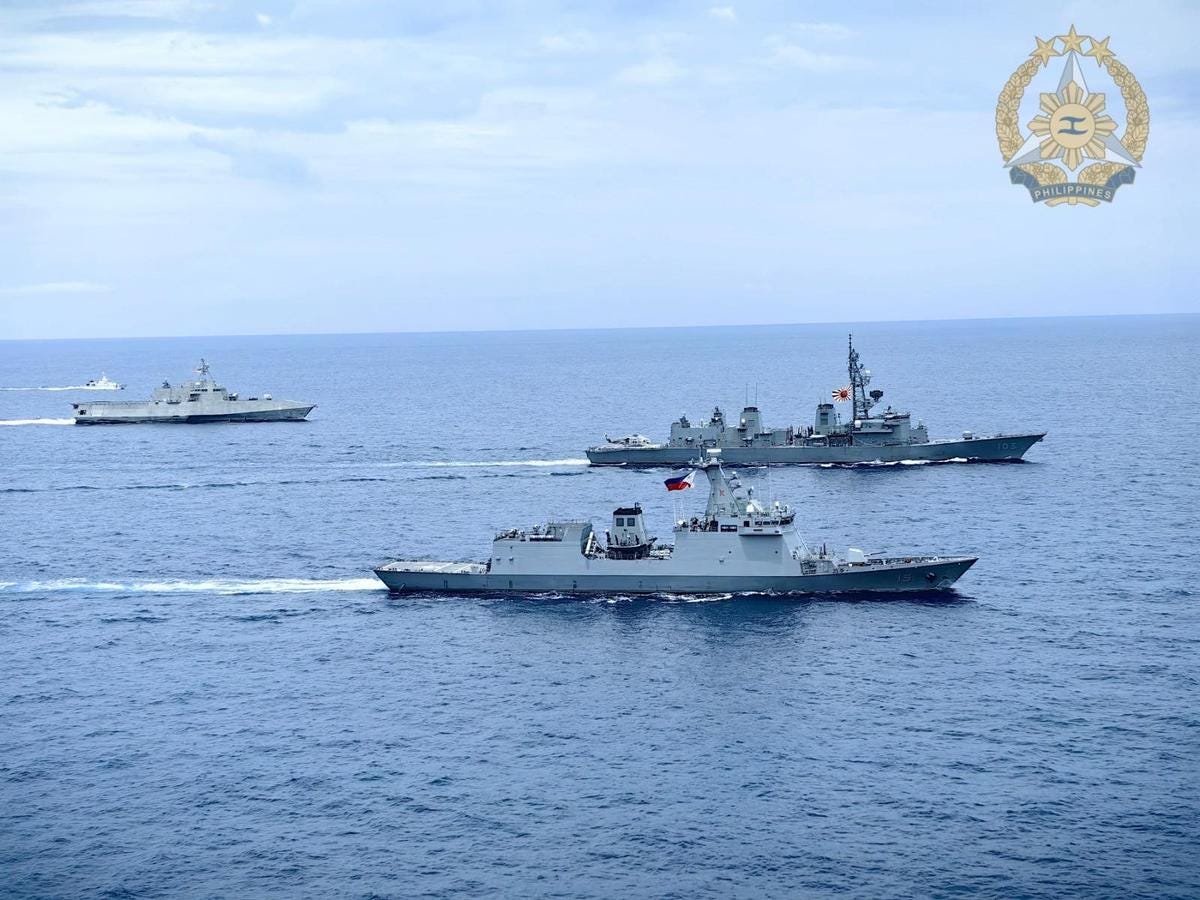
Regional allies such as Japan and the Philippines are enhancing their defense cooperation with the U.S. to counterbalance China’s maritime coercion, adopting a posture of quiet but firm deterrence. Japan, while cautiously avoiding explicit references to Taiwan in official documents, has ramped up defense spending to $58 billion for fiscal 2026—its twelfth consecutive record increase—and is developing drone capabilities aligned with U.S. strategic priorities. Meanwhile, the Philippines acknowledges its inevitable involvement in any Taiwan conflict, deepening ties through joint exercises, intelligence sharing, and Japanese technology transfers to modernize its surface fleet, all underpinned by the U.S.-Philippines mutual defense treaty that signals a red line should Filipino personnel be harmed.
The U.S. Navy maintains a robust and visible presence in the South China Sea, regularly deploying aircraft carrier strike groups and conducting multilateral exercises with Japan and the Philippines to reinforce deterrence against Chinese provocations. This operational posture directly counters China’s aggressive actions, including bullying at Second Thomas Shoal and joint drills with Russia, while signaling to Beijing that any attempt to seize territory or enforce blockades will provoke a strong, coordinated response. Congressional support, such as the $144 million appropriated for Enhanced Defense Cooperation Agreement infrastructure, further solidifies this commitment, ensuring that allied naval forces remain interoperable and ready.

Sanctions, Oil, and Shifting Sentiment
U.S. sanctions targeting China’s Iran ties, public skepticism in Taiwan, and Beijing’s strained access to critical oil supplies are reshaping the strategic balance and limiting China’s ability to sustain maritime pressure.
The United States has strategically leveraged sanctions targeting Chinese entities involved with Iran to contain Beijing's expanding influence, signaling a long-term approach that intertwines economic pressure with military and diplomatic strategies. By extending sanctions to firms engaged in Iran's oil trade and financial networks, the U.S. aims to exploit China's economic vulnerabilities amid its domestic challenges and trade tensions, thereby complicating Beijing's military calculus regarding Taiwan and reshaping the regional security environment.
China is capitalizing on the waning U.S. global leadership and the West's preoccupation with conflicts in Ukraine and the Middle East to strengthen its strategic initiative on Taiwan, effectively narrowing the Democratic Progressive Party's room to maneuver for independence. This shift is reflected in Taiwanese public opinion, where over half the population expresses reluctance to sacrifice lives to prevent reunification, and a majority favors resuming cross-Strait negotiations, indicating a pragmatic skepticism toward U.S. support that may dampen alliance dynamics and influence Taiwan’s defense posture.
Recent geopolitical developments have strained China's alliances with Russia and Iran, limiting its access to critical oil supplies essential for sustaining naval operations like a blockade of Taiwan and forcing Beijing to defend unexpected fronts. Coupled with Western electronic warfare superiority demonstrated in Syria, these vulnerabilities complicate China's military readiness and power projection, underscoring the importance of U.S. strategic decisions and alliance management in maintaining the balance of power in the Taiwan Strait.
China's tightening cybersecurity and border control regulations, which increase legal risks for Taiwanese individuals and authorize extraterritorial claims, exemplify Beijing's broader strategy of transnational repression aimed at suppressing dissent and exerting control beyond its borders. In response, Taiwan is bolstering its defense posture through legislative initiatives criminalizing facilitation of such repression and deepening intelligence cooperation with democratic allies, reflecting a proactive stance to safeguard its citizens and complicate China's regional influence amid escalating tensions.