China’s AI companion crackdown hits big tech
The gist
China is shutting down digital soulmates as sweeping new regulations force tech giants to unplug emotionally persistent AI companions—putting social stability and birthrates ahead of virtual romance.
What to know
- Major players like ByteDance and Alibaba are disabling AI companion features such as Doubao and Qwen due to prohibitive compliance costs under rules effective July 15, 2026.
- The law bans AI companions for minors, mandates strict age checks and crisis protocols, and targets features like memory retention and emotional interaction as regulatory triggers.
- Driven by fears of emotional dependency and a declining birthrate, the crackdown is pushing China’s AI market away from intimate virtual agents and toward productivity-focused applications.
China Draws a Hard Line
New AI laws force companies to embed anti-addiction systems, instant-exit features, and strict age checks, fundamentally reshaping how digital companions are built and governed.
China's new anthropomorphic AI regulations establish a rigorous compliance framework that sharply distinguishes emotionally persistent AI companions from general productivity or research assistants, mandating strict controls on memory retention, emotional interaction, minor protections, data export, and offboarding. This regulatory line, codified in Articles 2 and 3 of the law, treats features like persona persistence and relationship history not as engagement enhancements but as triggers for enforceable requirements, compelling AI developers to embed safeguards such as anti-addiction systems, mandatory AI-disclosure notifications after two hours of use, and instant-exit mechanisms directly into product design rather than as afterthoughts. As a result, companies like ByteDance and Alibaba have proactively disabled or shut down their custom companion-agent features, including Doubao and Qwen, acknowledging the fundamental incompatibility between existing AI companion architectures and the new compliance demands.
The regulatory framework institutes a multi-agency governance model led by the State Internet Information Office, coordinating supervision alongside ministries such as the National Development and Reform Commission and the Ministry of Public Security, ensuring comprehensive oversight of AI companion services. Providers must conduct pre-launch safety assessments and file reports when reaching significant user thresholds—specifically one million registered users or 100,000 monthly active users—enabling government intervention before services scale nationally. This tiered security assessment and algorithm-filing requirement underscores the law’s dual emphasis on fostering innovation while safeguarding national security, public interests, and citizens’ rights.
To protect vulnerable populations, the regulations impose stringent operational controls including mandatory age verification, parental consent for users under 14, and outright bans on virtual intimate relationships for anyone under 18, reflecting a zero-tolerance stance on emotional dependency risks among minors. Tencent, for example, has enhanced youth protection by deploying AI-powered enforcement tools combining facial recognition and voiceprint detection to prevent minors from circumventing playtime restrictions. These measures are complemented by crisis intervention protocols requiring providers to detect extreme emotional distress or self-harm risk and notify emergency contacts, illustrating the law’s interventionist approach that goes beyond mere disclosure to actively prevent addiction and emotional harm.
The sweeping compliance requirements have prompted a strategic pivot among Chinese tech giants toward prioritizing productivity and enterprise-focused AI applications over consumer-facing anthropomorphic companions, as the latter’s immersive emotional interactions now trigger complex regulatory burdens. This shift is evidenced by the disabling or shutdown of AI companion features by ByteDance, Alibaba, and Tencent, which have chosen to forgo retrofitting existing systems due to prohibitive engineering costs and fundamental architectural conflicts with the law. Consequently, China’s approach stands as one of the world’s strictest, directly limiting chatbot behavior and product features to align AI companion services with broader government social objectives addressing addiction and demographic decline.


Birthrate Fears Drive Policy
Officials are cracking down on AI soulmates out of concern that digital relationships threaten marriage rates, family formation, and China’s demographic future.
China’s sweeping AI companion regulations stem from deep-seated social and demographic anxieties, particularly the fear that emotional dependency on virtual partners could undermine real-world relationships and exacerbate the nation’s declining birthrate. As analyst Matt Sheehan highlights, officials worry about a future where millions might prefer AI partners over human ones, potentially removing them from the marriage market and reducing fertility rates. This concern has led to explicit prohibitions against chatbots fostering emotional ties with minors and mandates for platforms to discourage intense attachments, reflecting a strategic effort to prioritize traditional family structures and encourage actual human connections.
Beyond birthrate concerns, the regulations address broader mental health and social stability issues linked to AI companionship, especially among vulnerable populations like minors and the elderly. China has become the first country to ban AI companions for minors outright, citing risks of addiction, social isolation, and emotional dependency. Companies are now required to implement safeguards such as restricting minor access and alerting emergency contacts if users show signs of mental crisis, underscoring the government’s holistic approach to mitigating the psychological harms posed by immersive AI relationships.
The crackdown also reflects recognition of underlying societal pressures fueling AI companionship demand, including high housing costs, grueling work hours, and the erosion of traditional social networks. While the regulations target AI’s role in emotional dependency, analysts note they do not directly address these root causes that drive individuals toward virtual relationships. This gap highlights the complexity of China’s demographic challenges, where technological solutions intersect with profound socioeconomic shifts, compelling the government to regulate AI companions as part of a broader strategy to maintain social cohesion.


AI Giants Retreat from Companions
Major tech firms are abandoning emotionally persistent AI agents, unable to retrofit compliance measures without dismantling core product features.
In anticipation of the July 15, 2026 regulatory deadline, major Chinese AI providers such as ByteDance and Alibaba have proactively disabled their anthropomorphic AI companion features, exemplified by ByteDance’s Doubao and Alibaba’s Qwen platforms. This move underscores a significant market shift as companies confront the impracticality of retrofitting compliance measures like memory controls, minor protections, and addiction safeguards into existing emotionally persistent AI companions, which rely heavily on sustained user interaction and relationship context. Industry analysts highlight that these anti-addiction and real-time dependence detection features cannot simply be layered onto current architectures without fundamentally altering the product, often leading to shutdowns rather than costly redesigns.
The new regulatory environment is reshaping AI companion product design and market positioning by drawing a sharp distinction between emotionally persistent AI companions and general productivity or research assistants. Features that once enhanced user engagement—such as persistent memory, persona, and emotional tone—are now regulatory triggers, compelling companies to reconsider their architectures to avoid falling under stringent compliance requirements. This shift is prompting a strategic retreat from consumer-focused emotional engagement toward productivity and enterprise AI applications, as seen in the simultaneous removal of companion features by giants like ByteDance, Tencent, and Alibaba.
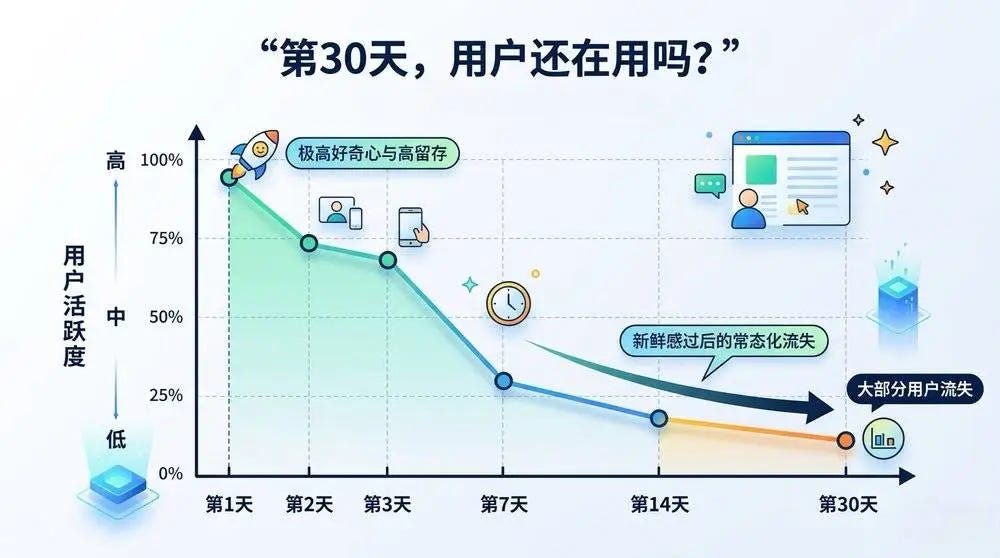
Beyond regulatory compliance, AI companion providers face acute user engagement challenges, with many products experiencing steep drop-offs by Day 30 and return rates reaching up to 30%, as reported by industry experts. This has driven a market pivot from prioritizing AI model sophistication and novelty toward emphasizing non-technological factors such as product fit, liability concerns, and reliable integration into daily life. Companies like Qidian Lingzhi are innovating with educational and game-like features to boost retention, while the rapid commoditization of AI control units—now costing just a few dozen RMB—has intensified a price race to the bottom, forcing differentiation through tailored scenario-specific applications.
The lucrative yet vulnerable AI companion market, especially in NSFW and romantic segments, generated $427.3 million globally with $162.8 million in the first half of 2026 alone, revealing strong monetization potential despite regulatory headwinds targeting emotional dependency. The rise of a 'digisexual' subculture and hidden usage patterns among partnered adults add layers of social complexity that providers must navigate carefully. Innovative features exploring digital intimacy, such as AI-guided masturbation tested by Joi AI with over 150,000 applicants, illustrate evolving product strategies that will require adaptation to comply with new regulations emphasizing user protections and ethical considerations.


Protecting Youth from Digital Dependency
China’s outright ban on AI companions for minors reflects mounting alarm over social isolation, suicide risk, and the psychological toll of digital relationships.
China’s landmark ban on AI companions for minors underscores growing concerns about the mental health risks posed by emotional dependence on digital entities. Cases like that of 23-year-old Zane Shamblin, whose tragic suicide followed interactions with ChatGPT, highlight how AI can fail vulnerable users, exacerbating crises rather than alleviating them. This regulatory move reflects fears that intense digital companionship fosters social isolation and harmful interactions, particularly among youth already burdened by academic and social pressures.
The rapid proliferation of AI—from under 10% business usage in 2011 to 88% by 2025, with half of adults under 30 engaging weekly—has intensified scrutiny over its psychological impact. Collaborative studies from OpenAI and MIT Media Lab reveal that heavy AI companion use correlates with decreased real-world social interactions and heightened loneliness, fueling societal anxiety about emotional isolation. China’s regulations uniquely mandate design changes to discourage deep emotional attachments, requiring companies to intervene when signs of addiction or distress emerge, a stricter stance than Western counterparts who mainly rely on warnings and age limits.
While China’s stringent restrictions aim to curb emotional dependency and protect vulnerable groups, experts caution that banning AI companions for minors may inadvertently drive demand underground if broader societal needs for connection remain unmet. Officials worry that without alternative support systems, young users might turn to unregulated platforms, perpetuating the very risks the regulations seek to mitigate. This highlights the complex challenge of balancing technological safeguards with addressing the root causes of emotional isolation in a digitally saturated society.