Chinese EVs surge in Korea, squeezing hyundai and kia
The gist
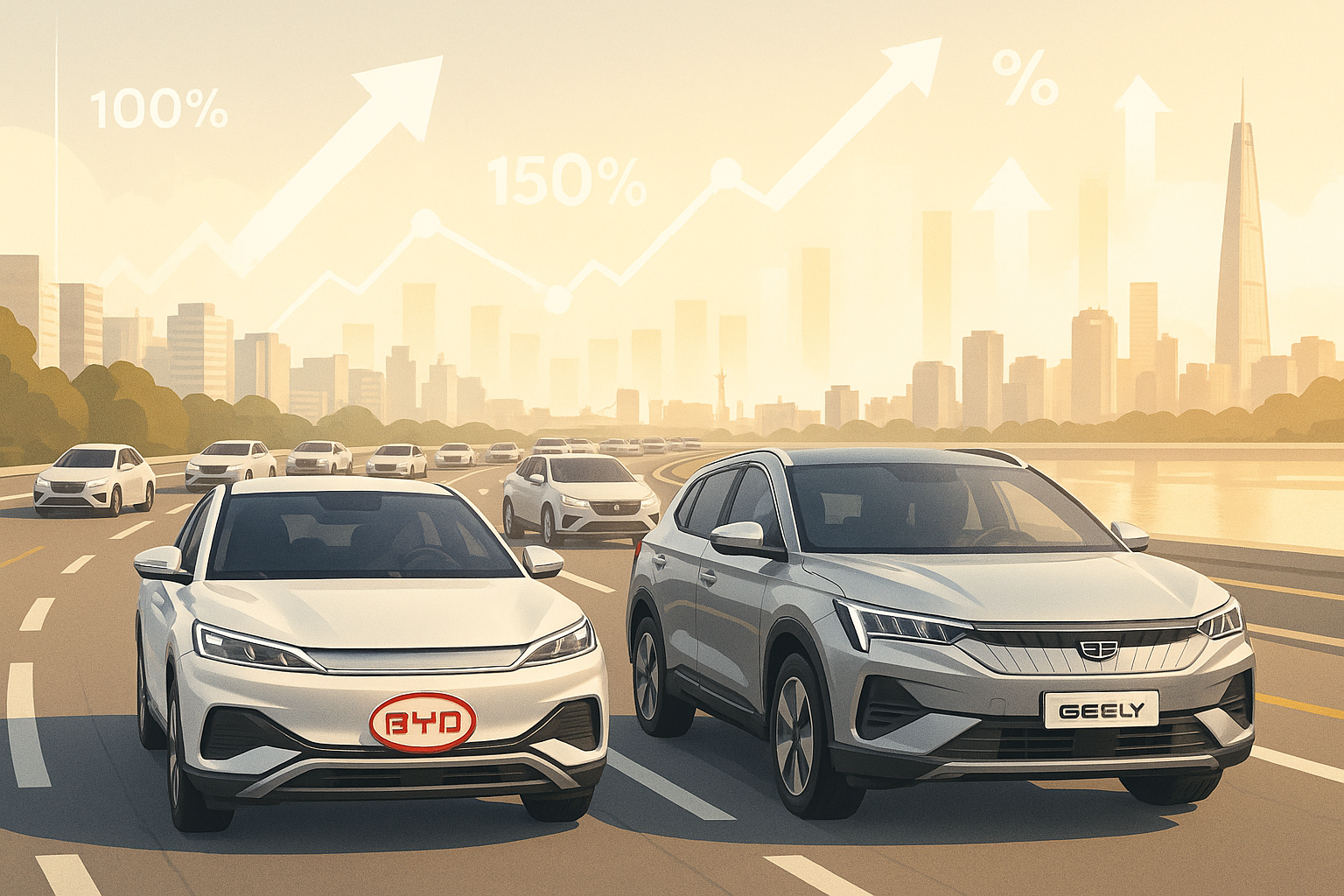
Chinese electric vehicles have stormed South Korea’s market, capturing up to 40% share in 2026 and putting Hyundai and Kia on the defensive.
What to know
- BYD led Chinese brands to an eight-fold sales jump, topping 14,500 units in H1 2026, thanks to cutthroat pricing and just an 8% tariff.
- Chinese automakers like Chery and Geely are buying into Korean firms and supply chains, deepening their long-term footprint beyond just exports.
- With Chinese EVs undercutting local rivals and South Korea’s tax policy offering little relief, Hyundai and Kia’s EV market share has tumbled from 63.9% to 57.5% in a year.
Chinese EVs Redefine Value
Aggressive pricing and a broad model lineup have vaulted Chinese EVs—led by BYD—into a dominant force in Korea, capturing up to 40% market share and challenging local brands on both cost and technology.
Chinese electric vehicles have surged in South Korea, capturing over 35% to 40% of the EV market in the first half of 2026, with sales soaring by nearly 179% year-on-year to approximately 69,500 units. This rapid expansion is led by key players like BYD and Tesla, whose aggressive pricing and broad product ranges—from affordable hatchbacks to luxury models—have resonated strongly with Korean consumers.
BYD stands out as the dominant Chinese brand, achieving an eight-fold increase in sales to over 14,500 units by July 2026 and ranking among the top imported car models in South Korea. Its Dolphin model, priced at an accessible 24.5 million won ($17,321), undercuts domestic competitors such as Hyundai’s Casper Electric and Kia’s EV3, illustrating how strategic pricing fueled by vertical integration and a mature battery supply chain enables Chinese EVs to offer high performance at significantly lower costs.
South Korea’s relatively low tariff on Chinese EVs—just 8% compared to the US and EU’s steep 45% to 127% tariffs—has created a favorable trade environment that accelerates Chinese market penetration. However, this advantage has intensified competitive pressures on domestic automakers, whose EV market share has declined amid limited government incentives and the exclusion of EVs from domestic production tax credits, contrasting sharply with the robust state-backed subsidies supporting Chinese manufacturers.
Strategic Stakes Reshape Auto Ties
Chinese automakers are embedding themselves in Korea’s automotive ecosystem through joint ventures, equity stakes, and battery supply chain dominance, setting the stage for deeper market integration and direct brand launches.
Chinese automakers are solidifying a long-term presence in South Korea through strategic investments that go well beyond simple exports. Notably, Chery Automobile's $75 million investment in KG Mobility, which includes a 10% stake via convertible bonds, exemplifies this trend, with plans to jointly develop and launch the SE10 SUV by January 2027. This move aligns with China's broader dominance in critical supply chains, especially battery materials, where firms like CATL lead globally, thereby amplifying Chinese influence over Korea’s automotive ecosystem.
Geely’s substantial 34.02% ownership in Renault Korea highlights a strategic approach to leveraging South Korea’s manufacturing prowess and trade advantages. By producing vehicles such as the Polestar 4 electric SUV at the Busan plant for export to North America, Geely not only mitigates tariff barriers imposed by the US and Europe but also taps into South Korea’s skilled labor force and robust supplier networks. This strategy enhances supply chain resilience and positions Chinese firms to benefit from Korea’s favorable trade agreements amid escalating global trade tensions.
Industry insiders suggest that these strategic footholds could pave the way for Chinese brands like Chery to enter the Korean market directly, contingent on the success of early launches by brands such as Zeekr and Xpeng. This potential shift from partnership to direct brand presence signals a deeper integration of Chinese automakers into Korea’s automotive landscape, reflecting a calculated move to capitalize on growing consumer demand and the country’s evolving EV market dynamics.
Korean Giants Lose Their Grip
Hyundai and Kia’s market share is shrinking as Chinese EVs undercut them on price and scale, exposing the limits of Korea’s subsidy policies and threatening domestic automakers’ ability to invest in next-generation technologies.
The rapid influx of competitively priced Chinese electric vehicles, such as BYD’s Dolphin priced at 24.5 million won compared to Hyundai’s Casper Electric at 28.47 million won, has eroded the domestic market share of Korean automakers like Hyundai and Kia from 63.9% to 57.5% within a year. Chinese firms leverage their vertically integrated battery supply chains and scale economies to offer both affordable and premium EV models at prices that Korean automakers struggle to match, intensifying price competition and challenging the traditional dominance of domestic brands.
South Korea’s exclusion of electric vehicles from its domestic production tax credit—its version of the Inflation Reduction Act—has significantly weakened the competitive position of Hyundai and Kia. While the government argues that the domestic EV production base is sound and existing purchase subsidies suffice, industry experts warn that purchase subsidies alone cannot counter the Chinese offensive. This policy gap denies Korean automakers a critical lever to reduce unit costs and improve profitability, especially as they face rising manufacturing expenses from semiconductor price hikes and raw material inflation.
The combination of low tariffs on Chinese EV imports—only 8% in South Korea compared to 45%-127% in the US and EU—and the phased reduction of consumer tax benefits further erodes the profitability of Korean EV makers. With operating margins on EVs as low as 2.5%, far below the 10% margins on internal combustion engine vehicles, Hyundai and Kia are caught in a squeeze that threatens their ability to invest in future technologies like software-defined vehicles and autonomous driving. Industry voices, including Lee Hang-gu, emphasize that China’s cost advantage of over 30% makes it structurally difficult for domestic firms to catch up without direct policy support.
The growing market share of Chinese EVs in South Korea also poses a threat to the domestic battery industry, which supplies local automakers with NCM batteries. Chinese EVs increasingly use lithium iron phosphate (LFP) batteries from companies like CATL and BYD, potentially reducing demand for batteries from LG Energy Solution, Samsung SDI, and SK On. This shift underscores the broader competitive pressures facing the Korean automotive ecosystem, extending beyond vehicle assembly to critical component suppliers.
Tariffs Redraw the EV Map
Divergent tariff and investment policies have made Korea a welcoming gateway for Chinese EVs, while high barriers in the US and India keep their markets closed—reshaping global competition and accelerating China’s EV export surge.
South Korea's relatively low tariff rate of 8% and a more open investment screening regime have facilitated a rapid surge in Chinese EV market share, which soared from 4.7% in 2022 to 36.5% by Q1 2024. This openness contrasts sharply with markets like India, where combined tariffs exceed 110%—including a 70% base rate plus a 40% agriculture infrastructure cess—and stringent prior government approval requirements have blocked major Chinese investments such as BYD's $1 billion factory proposal. South Korea's narrower focus on managerial control in foreign investment reviews has allowed Chinese automakers like Chery to acquire significant stakes in domestic firms, underscoring a more permissive trade and investment environment that fuels Chinese EV expansion.
In stark contrast, the United States has erected formidable trade and regulatory barriers that have effectively blocked Chinese EV penetration, with tariffs reaching a staggering 127.5%—a combination of a 2.5% base tariff, a 100% Section 301 tariff, and a 25% Section 232 tariff. Beyond tariffs, the US government is deploying non-tariff barriers targeting connected vehicle technologies linked to China, exemplified by restrictions on Polestar, controlled by China's Geely, and legislative efforts to ban circumvention exports by companies with Chinese capital. These layered defenses reflect a strategic intent to shield domestic automakers from Chinese competition, resulting in virtually zero Chinese EV market share in the US despite Chinese automakers’ attempts to circumvent tariffs by expanding manufacturing in Hungary, Spain, Brazil, and Southeast Asia.
This divergence in trade policies has created a geographic realignment in the global EV market, where regions with supportive trade policies and incentives, like South Korea and parts of Europe and Japan, see accelerated Chinese EV adoption—evidenced by Chinese EV shares climbing to 25.6% in Japan and 20.9% in Europe—while markets such as the US and India remain largely closed. The removal of US federal EV tax credits precipitated a 27% year-over-year sales drop, highlighting how tariff and subsidy environments critically shape market dynamics. Meanwhile, China exports over 500,000 electrified vehicles monthly to developing markets with fewer trade barriers, underscoring how tariff regimes and regulatory frameworks decisively influence the global footprint of Chinese EVs.