Christian nationalist power grab sparks backlash
The gist
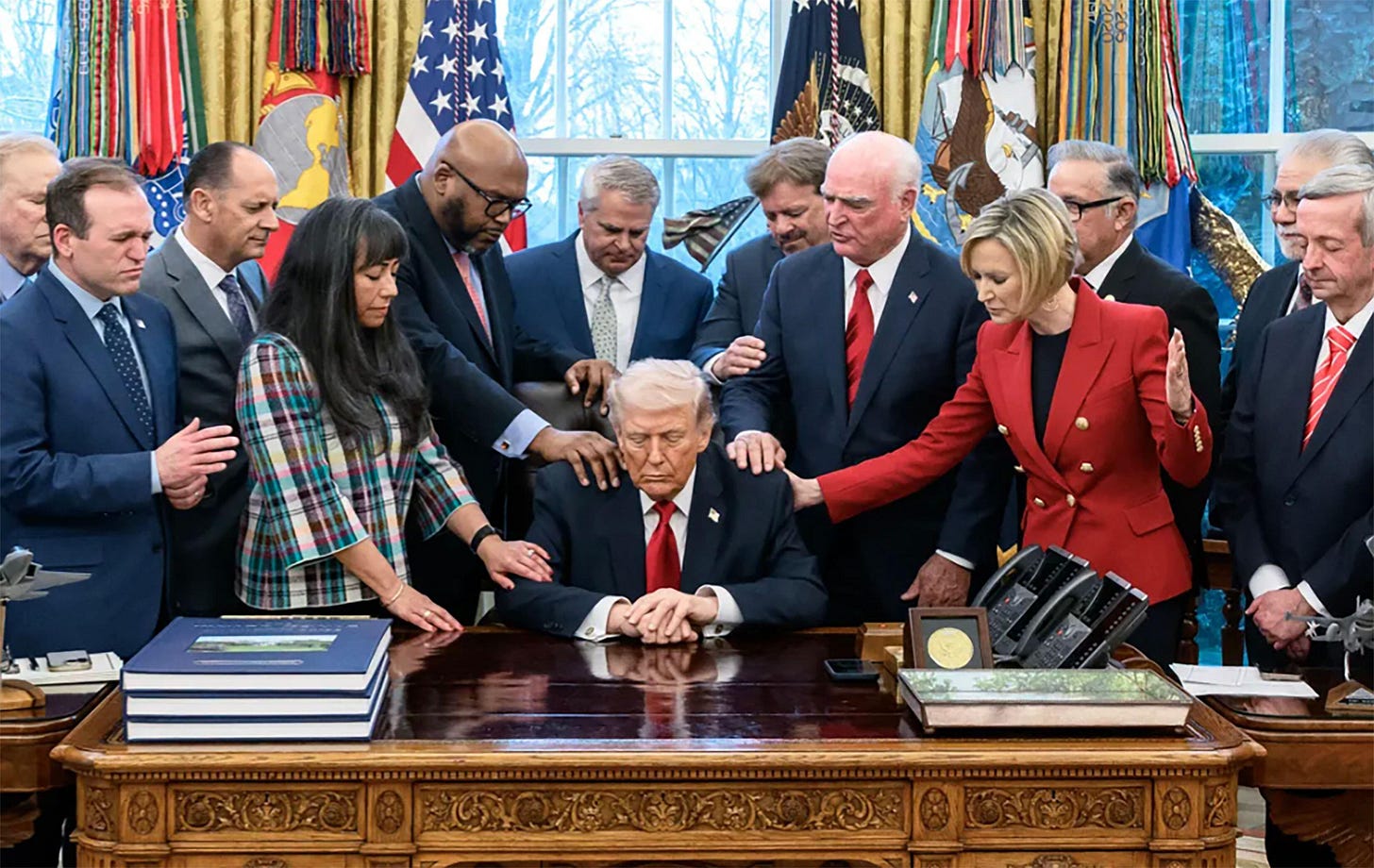
Christian nationalism’s aggressive rise in 2026 is colliding with fierce resistance, as faith-fueled authoritarianism sparks legal, theological, and cultural backlash across the U.S.
What to know
- Powerful Christian nationalist figures like Pete Hegseth and Paula White-Cain entrenched patriarchal, white supremacist agendas in government, the military, and public policy using the 'Seven Mountain Mandate.'
- Government agencies, led by leaders like Marco Rubio, openly promoted Christian messaging while weaponizing religious symbolism to justify militarism and immigration crackdowns, igniting lawsuits over church-state separation.
- Progressive faith leaders, Black denominations, and media watchdogs like A Public Witness have rallied against this movement, exposing abuses, challenging exclusionary policies, and defending religious freedom for all.
Patriarchy and Power in Uniform
Christian nationalist leaders fused religious zealotry with institutional authority, fueling a culture of misogyny and impunity—especially in the military—while weaponizing patriarchal theology to justify violence and strip women of rights.
By early 2026, white Christian extremism, personified by figures such as Pete Hegseth, has entrenched patriarchal control and misogyny under the guise of familiar white male religiosity. This brand of zealotry, which cynically seeks to control women in ways stereotypically attributed to Muslim men, masks a dangerous agenda that perpetuates fascist violence and sexual assault, especially within institutions like the military where Hegseth holds leadership despite serious misconduct allegations. With nearly one in four U.S. servicewomen reporting sexual assault, this dynamic fuels a culture of impunity and harm that disproportionately targets women.
The rise of a white supremacist Christian theocracy, architected by movements like the New Apostolic Reformation (NAR) and leaders such as Paula White-Cain, has strategically pursued societal domination through the 'Seven Mountain Mandate,' aiming to impose Christian supremacy across government, media, and culture. This theological framework underpinned the January 6 insurrection and Christian Trumpism, facilitating a Faustian political alliance with Donald Trump that prioritized patriarchal goals like overturning Roe v Wade. Trump's judicial coup not only stripped women of bodily autonomy but also exemplified how religious zealotry can weaponize authoritarian figures to dismantle social justice.
The elevation of Donald Trump as a prophesied savior by Christian nationalist leaders reveals a perilous fusion of religious fanaticism and authoritarianism that undermines democratic institutions and fuels fascist violence. Trump's internalization of this messianic narrative, especially after surviving an assassination attempt in Butler, Pennsylvania, has emboldened his blasphemous and violent rhetoric—such as his Easter message invoking Satanic imagery and threats—that starkly illustrates the toxic patriarchal extremism threatening social cohesion and justice in the United States.
One of the most insidious aspects of white Christian zealotry is its camouflage within the familiar, making it difficult to recognize and confront. As many white Americans know a 'Crusader Pete' in their own families or workplaces, this normalized visage of fascism and zealotry operates under the radar, complicating efforts to reckon with the white supremacist Christian theocracy that has aggressively dismantled abortion rights and broader social justice protections.

Faith as Policy Weapon
Government agencies and political events openly harnessed Christian symbolism and rhetoric to legitimize exclusionary immigration policies and military aggression, sparking fierce legal and ethical backlash.
By early 2026, Christian nationalist rhetoric had become deeply embedded in U.S. government communication and policy, with Secretary Marco Rubio’s State Department actively promoting Christian messaging while downplaying diversity on social media. This religious framing extended into political events such as closed Turning Point USA rallies at Baylor University, where speakers like podcaster Benny Johnson and Border Czar Tom Homan openly espoused Christian nationalist views and boasted about strict immigration enforcement, illustrating how faith-based nationalism was used to justify exclusionary policies. Critics like Svante Myrick of People For the American Way warned that such policies—shutting doors to refugees and manipulating systems for corruption—clash with moral teachings from the Old Testament prophets, highlighting the ethical tensions in this politicized religious narrative.
Christian nationalism’s influence permeated federal institutions, with organized Christian worship services held within agencies like the Pentagon and Department of Labor, sparking legal challenges from groups such as Americans United for Separation of Church and State. The Department of Homeland Security’s misuse of religious symbolism—co-opting the Bible and Christmas—and aggressive targeting of immigrant communities and church leaders, including deportations and violence against clergy protesting peacefully, underscored how faith was weaponized to enforce immigration policies and suppress dissent. These actions reveal a troubling fusion of religious nationalism with government power, often at the expense of constitutional church-state separation and immigrant rights.
Religious symbolism was also exploited in military and political arenas, with the Pentagon and Israeli leaders misusing the Bible to justify warfare, while figures like President Donald Trump made profane pro-war claims that framed conflict in explicitly Christian nationalist terms. Pentagon press briefings led by Pete Hegseth invoked biblical narratives, comparing journalists to Pharisees and casting war as a holy crusade, a tactic sharply criticized by Pope Leo for manipulating religion to serve political and military agendas. This weaponization of faith extended to a revisionist American history promoted by Christian nationalist groups, which included inaccurate Christian teachings in schools, anti-Muslim bigotry by lawmakers, and efforts to mandate edited Ten Commandments displays, all reinforcing an exclusionary national identity.
The Trump administration’s deployment of religious rhetoric revealed a stark double standard and an effort to control the Christian nationalist narrative, as seen when Trump threatened Iran’s civilian infrastructure on Easter Sunday while invoking 'praise Allah'—a phrase that would have been politically damaging if uttered by previous leaders like Obama. The administration’s baseless attacks on Pope Leo, accusing him of being soft on crime, further demonstrated their discomfort with external criticism and their reliance on tightly managing religious discourse to maintain political power. This dynamic illustrates how Christian nationalism is not only a tool for policy and symbolism but also a contested battleground for narrative control within U.S. politics.

Theology vs. Authoritarianism
A growing chorus of Christian thinkers and religious leaders is challenging the hijacking of faith for authoritarian ends, exposing the internal schism over Trump's messianic image and the distortion of gospel teachings.
By early 2026, Christian nationalism’s theological foundation faced sharp critique for enabling a Faustian bargain where religious leaders, captivated by figures like Donald Trump who appeared to dominate multiple societal spheres, overlooked blatant un-Christian behaviors. Dr. Matthew Taylor’s analysis highlights how the New Apostolic Reformation (NAR), through strategies like the 'Seven Mountain Mandate,' orchestrated a pervasive Christian supremacist agenda infiltrating government, education, and media, thus distorting gospel teachings into authoritarian dominionism. However, this manipulation sparked a theological backlash within Christianity, as emerging voices, including Taylor’s forthcoming work 'Defying Tyrants,' urged believers to reject the false messiah narrative and reclaim Jesus’s radical anti-authoritarian message.
Prominent Christian leaders and theologians grappled with the contradictions between Trump’s blasphemous conduct—such as profane Easter social media posts—and core Christian doctrines, signaling a deepening internal resistance against the conflation of faith with political power. This tension culminated in the Pope’s explicit condemnation of the Trump administration’s Christian nationalist rhetoric, notably targeting figures like Pete Hegseth who framed war as a holy crusade. The Pope’s vocal opposition exposed the administration’s manipulative double standards, contrasting Trump’s threats against Iran’s civilian infrastructure with the harsher scrutiny former President Obama would have faced for similar language, thereby challenging the control over the Christian nationalist narrative and embodying a courageous theological resistance within global Christianity.
Watchdogs and Satire Strike Back
Media watchdogs, comedians, and lawmakers ramped up scrutiny and ridicule of Christian nationalist overreach, transforming public and political discourse into a battleground for accountability and religious freedom.
By April 2026, the Family Research Council (FRC) vocally condemned the Biden administration following a Department of Justice report that alleged pervasive anti-Christian bias, particularly targeting policies on marriage, family, sexuality, and life issues. FRC President Tony Perkins accused the administration of weaponizing government resources and collaborating with abortion and LGBT groups to push an agenda they deemed anti-family and anti-faith, urging the implementation of legal safeguards across federal, state, and local levels to protect religious freedom and uphold First Amendment rights. Perkins also emphasized the necessity for Christians to actively practice their faith as a bulwark against cultural hostility and governmental targeting.
A Public Witness emerged as a critical media watchdog by May 2026, uniquely exposing government-endorsed Christian worship practices and Christian nationalist narratives often overlooked by mainstream outlets. Their investigative reporting not only shed light on federal agencies organizing Christian prayer services but also played a direct role in inspiring lawsuits from Americans United for Separation of Church and State challenging these practices. Beyond worship services, A Public Witness highlighted the misuse of Christian symbolism by government bodies such as DHS and the Pentagon to justify immigration crackdowns and militarism, while also unpacking efforts by Christian nationalists to rewrite history and promote exclusionary policies, including anti-Muslim bigotry and inaccurate Christian history curricula.
In addition to journalistic scrutiny, satirical media and formal political discourse increasingly confronted Christian nationalist narratives by early May 2026. Shows like Saturday Night Live, with Colin Jost’s portrayal of Pete Hegseth mocking his fabricated Bible verse and excessive drinking, alongside jokes from Seth Meyers, Jimmy Kimmel, and Stephen Colbert about the viral 'Pulp Fiction prayer' incident, amplified public awareness and critique. This cultural pushback permeated institutional arenas as well, with Democratic Representative Salud Carbajal referencing the 'Pulp Fiction' prayer during congressional hearings, signaling that Christian nationalism had become a recognized and contested issue within formal political accountability frameworks.

Black Churches Lead Resistance
Black denominations and progressive faith voices are at the forefront of confronting Christian nationalism’s racialized policies, mobilizing communities to defend voting rights, maternal health, and true religious liberty.
By early 2026, Black denominational leaders have emerged as pivotal actors in confronting the racialized political challenges intensified by Christian nationalism, particularly following the U.S. Supreme Court's rollback of minority voter protections. Figures like Haleluya Hadero highlight how the Black church mobilizes its congregations not only to defend voting rights but also to address pressing social justice concerns such as maternal health disparities, exemplified by initiatives like “Healthy Moms, Healthy Babies America.” This activism underscores the church’s enduring role as a bastion against systemic inequities intertwined with Christian nationalist agendas.
Christian nationalism’s entanglement with discriminatory legislation and exclusionary policies has drawn sharp criticism from religious leaders and advocates who emphasize the threat such measures pose to social justice and religious freedom. Amanda Tyler’s testimony against 'anti-Sharia law' bills illustrates how targeting religious minorities, particularly Muslim communities, not only violates constitutional commitments but also fuels a broader culture of discrimination. This resistance is echoed by voices like ELCA Bishop Shelley Bryan and public figures such as Rick Steves, who warn that Christian nationalism undermines inclusion and the foundational principle that religious freedom for one strengthens freedom for all.
The tension within religious communities over Christian nationalism is palpable, as leaders like Svante Myrick of People For the American Way invoke prophetic critiques from the Old Testament to challenge government policies that exacerbate economic inequality and refugee exclusion. This internal religious dissent reveals a complex landscape where Christian nationalism’s alignment with racialized power structures is contested not only politically but theologically, highlighting a struggle over the moral direction of faith communities amid rising social injustices.