Duolingo’s AI bet divides Wall Street after wild stock swings
The gist
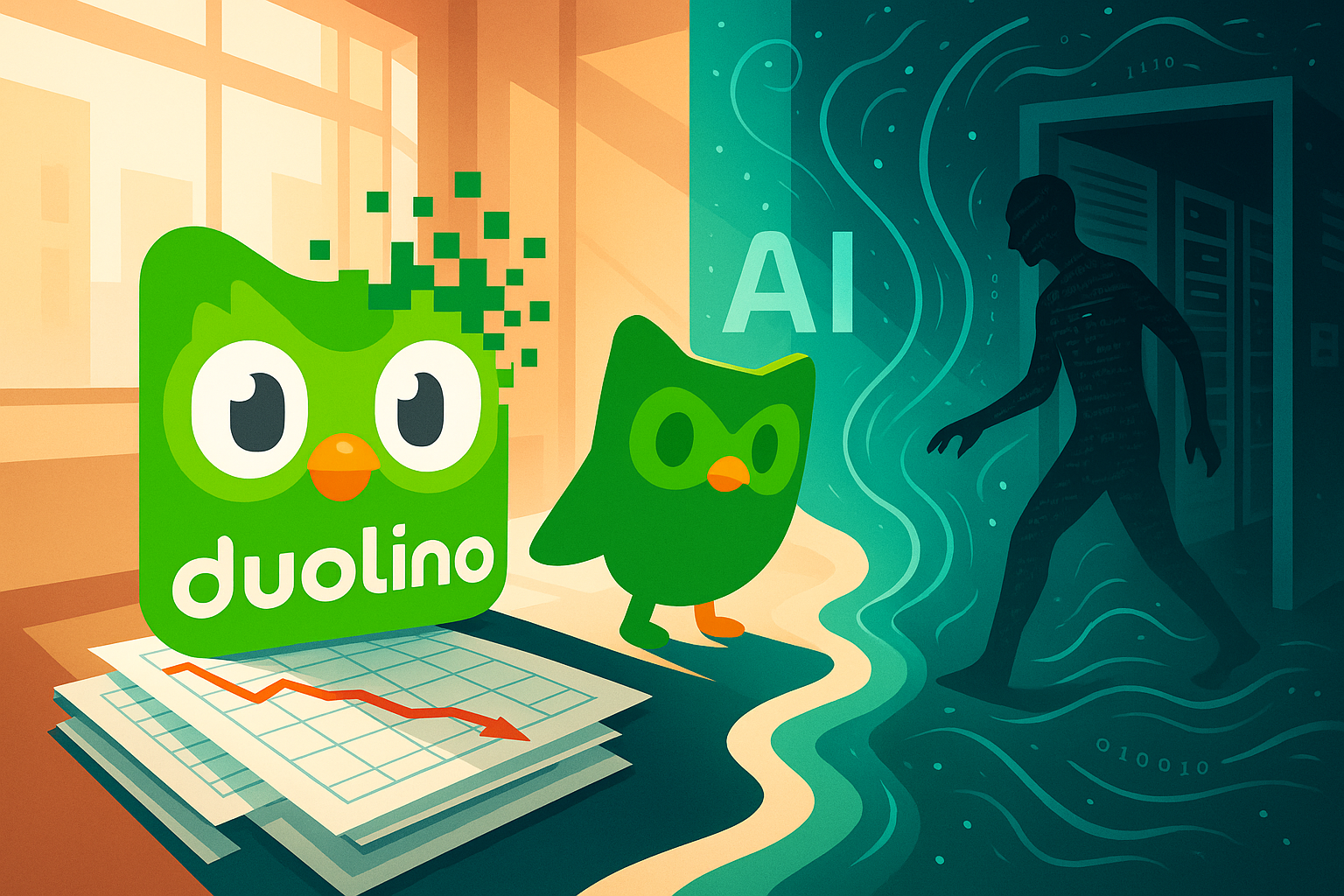
Duolingo’s bold AI-powered push has investors fiercely split, with wild stock swings despite record-breaking user engagement and revenue.
What to know
- Duolingo’s stock tumbled up to 9% after strong Q2 earnings ($298.5M revenue, $0.71 EPS), as Wall Street wrestles with slow monetization despite surging daily users.
- AI tools like Duolingo Max and GPT-4 chatbots are driving engagement among 17-to-25-year-olds to 1.5-year highs, fueling premium growth but stoking fears of competition from free AI translators.
- Valuation models are all over the map—earnings-based estimates say the stock’s overvalued near $114, while DCF models peg it as undervalued at $259—leaving investors divided.
Technical Turbulence Unpacked
Duolingo’s stock swings reflect a tug-of-war between bullish user growth and skepticism over slow monetization, with traders treating current highs as overbought despite record engagement.
Duolingo's stock has exhibited notable volatility recently, with sharp declines of nearly 5% and around 9% following strong earnings reports that showcased solid revenue of $298.454 million and positive earnings per share of $0.71. This paradoxical market reaction highlights the influence of mixed technical trading signals, where bullish momentum is tempered by investor caution amid a disconnect between robust user engagement and slower monetization progress. Despite improvements in daily active users and AI-driven cost savings, the stock's inability to fully reset the monetization narrative has led traders to interpret current price levels as overbought, triggering profit-taking and resistance around the $120-$125 range.
AI Engagement: Double-Edged Sword
AI-powered features are driving unprecedented stickiness among young users but stoking investor anxiety over whether free AI tools will undermine Duolingo’s premium pricing power.
Duolingo’s strategic integration of AI, particularly through its GPT-4 powered Duolingo Max subscription tier and AI chatbots, is significantly boosting engagement among its core 17-to-25-year-old demographic. According to Apptopia’s July 2026 data, average daily time spent by this age group reached its highest level since January 2025, with heavy AI chatbot users exhibiting even greater app engagement. This AI-driven stickiness not only complements the traditional language learning experience but also underpins Duolingo’s premium subscription growth narrative by deepening user interaction within the app.
While the surge in AI-powered engagement supports Duolingo’s long-term revenue and earnings outlook, investor concerns linger regarding competitive pressures from large tech firms offering free or low-cost AI translation tools. These alternatives could disrupt Duolingo’s paid learning model and potentially erode pricing power. However, the increased time spent by heavy AI chatbot users helps mitigate fears that generative AI might cannibalize language learning demand, reframing AI from a threat into a potential ecosystem advantage that could sustain average revenue per user (ARPU) growth if the trend endures.

Valuation Models at War
A dramatic split between earnings and cash flow valuations has left Duolingo’s stock caught between value skeptics and growth believers, fueling intense debate over its true worth.
Valuation models for Duolingo reveal a stark divergence, with earnings-based fair value estimates placing the stock slightly overvalued around $114.49 compared to recent prices above $122, while discounted cash flow (DCF) analyses, such as the SWS model, suggest a substantial undervaluation with fair values near $259. This gap underscores the market’s uncertainty about how to weigh Duolingo’s current earnings against its future cash flow potential, reflecting contrasting investor expectations about growth sustainability and profitability.
Despite Duolingo’s impressive milestone of surpassing $1 billion in revenue and a 367% surge in net earnings, its trailing P/E ratio remains unusually low—hovering between 11x and 13.9x—levels typically associated with mature, slow-growth industries rather than a leading EdTech platform boasting 50 million daily active users. This anomaly fuels debate among investors: some view the stock as undervalued given its growth trajectory and user engagement, while others caution that the valuation premium hinges precariously on the company’s ability to convert engagement into durable monetization amid intensifying competition and strategic spending under Vision 2026.
Investor sentiment remains deeply mixed as Duolingo navigates the tension between strong user growth—marked by a 23% year-over-year increase in daily active users and record-high retention—and challenges in monetization, with Q3 guidance signaling modest revenue growth in the low teens. The approximately 9% stock drop post-earnings reflects disappointment that improved engagement and AI-driven cost savings have yet to translate into a convincing monetization uplift, intensifying debates over whether the current market cap of $12.5 billion fairly prices in both the company’s growth potential and the risks posed by AI competition and executive selling.
Overall, the valuation discourse around Duolingo is a tug-of-war between viewing the recent share price declines and stretched multiples as either a reset opportunity or a signal of a valuation ceiling. While the stock trades below industry P/E averages, it remains above some fair value benchmarks like Simply Wall St’s 8.3x estimate, suggesting investors are paying a premium based on growth expectations that must be met or exceeded to justify current prices. This split in community and analyst perspectives highlights the precarious balance between optimism for Duolingo’s future and caution over execution risks.
Brand Power Beyond the App
Duolingo’s Luckin Coffee partnership is a strategic play to embed language learning into Gen Z lifestyles and counterbalance its recent shift from growth to value stock status.
Duolingo's strategic partnership with Luckin Coffee serves as a deliberate effort to deepen engagement with Gen Z users by embedding language learning into everyday routines, such as coffee breaks, thereby extending its brand presence beyond the app. This move is less about immediate financial returns and more focused on reinforcing Duolingo’s cultural relevance among younger demographics, highlighting the company’s intent to integrate learning seamlessly into daily life. By aligning with Luckin Coffee, Duolingo taps into a lifestyle-oriented touchpoint that resonates strongly with students, strengthening its appeal within this key market segment.
Beyond its direct consumer impact, the Luckin Coffee collaboration signals Duolingo’s broader strategy to enhance market perception by leveraging brand partnerships as a tool to maintain relevance amid shifting investor narratives. This is particularly significant given Duolingo’s recent reclassification from growth to value indices, such as its removal from growth benchmarks and addition to value-oriented Russell indices, which may lead shareholders to reassess the company’s user engagement efforts through a more value-centric lens. The partnership thus acts as a counterbalance to this narrative shift, showcasing Duolingo’s ongoing commitment to dynamic brand positioning that transcends near-term financial metrics and highlights its enduring brand power.