EU crypto crackdown squeezes russia’s sanctions evasion playbook
The gist
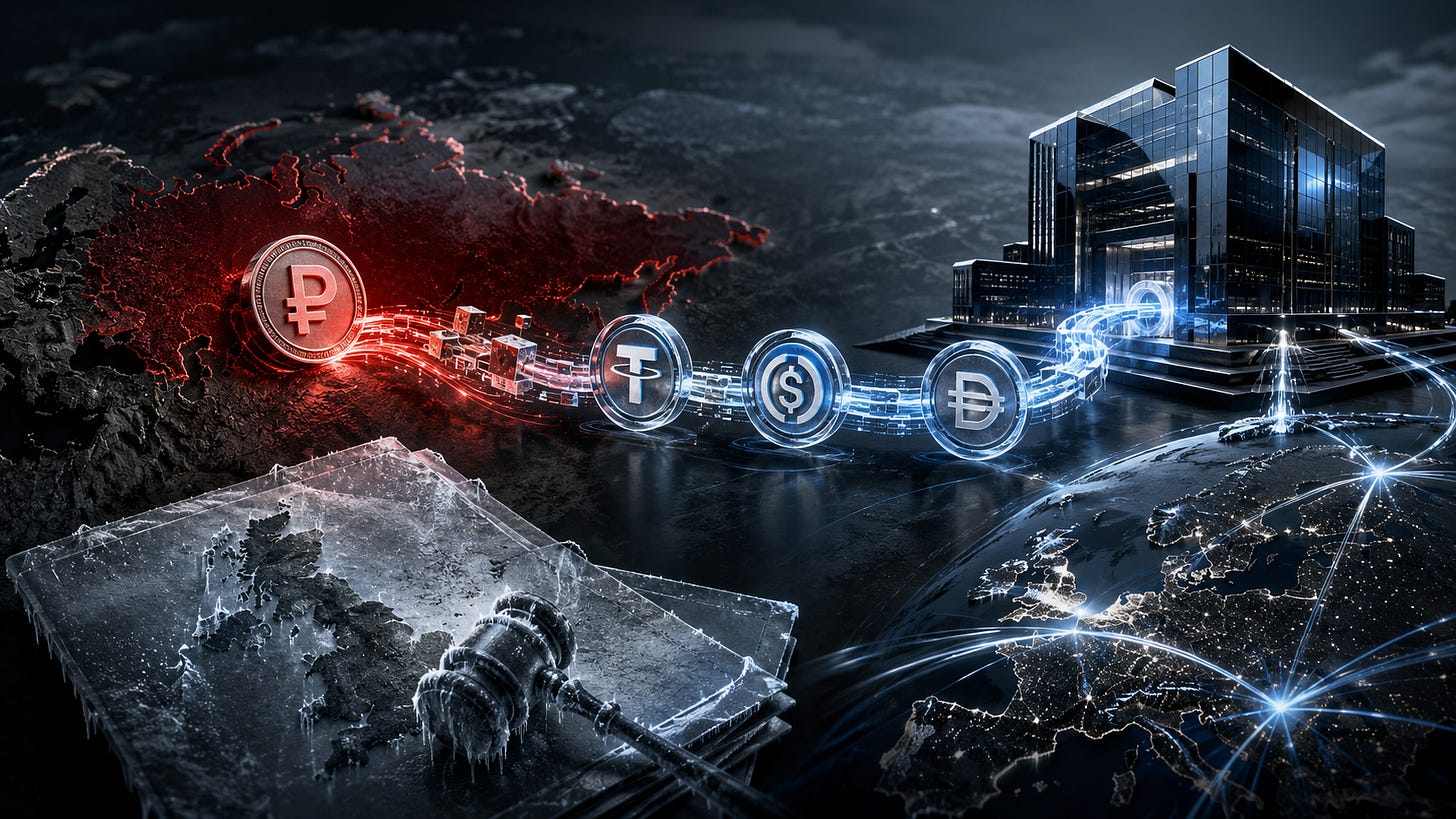
The EU just slammed the door on Russia’s crypto escape routes, launching an unprecedented country-wide ban on Russian digital asset platforms and stablecoins.
What to know
- In 2026, the EU imposed its first-ever national ban on Russian crypto platforms—including Justin Sun’s HTX—targeting 14 exchanges across multiple jurisdictions.
- July 2026 saw the crackdown expand: 94 Russian banks and 11 more crypto platforms landed on the blacklist, as the EU used its new legal powers to target evasive stablecoins like the $100B ruble-pegged A7A5.
- The UK joined the fray in May 2026 by sanctioning HUOBI GLOBAL SA, signaling a seismic shift in enforcement that hammered Russia’s digital finance lifelines and sent A7A5 volumes crashing by 96%.
EU’s Crypto Sanctions Surge
The EU’s strategic pivot to sanction entire Russian crypto platforms marks an unprecedented escalation in financial warfare, targeting both digital and traditional assets to undermine Russia’s war economy.
By early 2026, the European Union escalated its financial warfare against Russia with its 21st sanctions package, marking a historic first in targeting Russian crypto platforms at a country-wide level. This comprehensive crackdown included the blacklisting of Justin Sun–owned HTX and 13 other crypto platforms operating across jurisdictions like the UAE, Panama, Georgia, and Belarus, signaling the EU’s intent to sever Russia’s access to digital assets beyond traditional finance. European Commission President Ursula von der Leyen underscored the strategic aim of these measures to 'weaken the economic foundations of Russia’s war effort' by simultaneously targeting conventional banks and emerging crypto channels, reflecting a nuanced understanding of Russia’s evolving financial tactics.
The July 2026 expansion of the sanctions package intensified the EU’s clampdown by adding 94 Russian banks—including the pivotal Moscow Exchange—to the transaction ban list, alongside 11 crypto platforms suspected of facilitating sanctions evasion. This escalation not only broadened the scope of financial restrictions but also represented the EU’s first structured country-level crypto bans designed to disrupt Russia’s increasing reliance on cryptocurrencies for international transactions. These measures dovetail with the EU’s Markets in Crypto-Assets (MiCA) regulatory framework, highlighting a tightening enforcement posture against crypto-asset services operating in regulatory grey zones and underscoring the bloc’s commitment to closing loopholes exploited by sanctioned entities.
Targeting Russia’s $120B Network
The EU’s crackdown on the vast A7 crypto network and its African ties exposes the global reach and complexity of Russia’s digital sanctions evasion machinery.
In July 2026, the European Union escalated its campaign against Russia's sanctions evasion by unveiling its 21st sanctions package, specifically targeting the sprawling $120 billion A7 crypto network. This move marked a significant intensification in regulatory efforts, reflecting growing concerns over Russia's sophisticated use of crypto assets to circumvent traditional financial restrictions. By focusing on such a vast network, the EU aimed to disrupt a critical artery in Russia's sanctions evasion strategy.
The sanctions package not only targeted the core A7 network but also expanded its reach by designating four new entities linked to the network, notably highlighting its increasing connections to Africa. This geographic broadening underscores the evolving complexity of Russia's crypto operations and the EU's recognition of emerging regional hubs facilitating illicit transactions. Complementing these designations, the EU imposed bans on transactions across 14 unnamed crypto-related service platforms, effectively choking off multiple channels that Russia had been exploiting to maintain its crypto liquidity and evade sanctions.

Legal Power to Ban Nations
Annex LVII’s sweeping authority allows the EU to block whole national crypto sectors, closing loopholes that let Russia’s stablecoins like A7A5 move billions beyond regulatory reach.
On July 23, 2026, the EU enacted a groundbreaking legal authority under Annex LVII of Regulation 833/2014, empowering it to ban entire national cryptocurrency sectors from interacting with European operators. This decisive move emerged after the bloc’s previous strategy—targeting individual platforms—proved ineffective against sophisticated evasion tactics. By early 2026, the scale of the challenge was underscored by the A7A5 stablecoin, a ruble-pegged token issued from Kyrgyzstan, which had already processed over $100 billion in cumulative on-chain transactions, making it the largest non-dollar stablecoin globally.
The EU’s new country-level ban authority directly addresses the loopholes exploited by successor platforms and stablecoins like A7A5, which was deliberately engineered without a freeze function to evade law enforcement immobilization. This structural innovation marks a strategic shift from piecemeal sanctions to comprehensive national crypto sector prohibitions, closing the gaps that allowed Russia’s $120 billion evasion ring to flourish despite earlier sanctions targeting individual exchanges.
Russia’s Stablecoin Counteroffensive
Russia’s launch of the A7A5 stablecoin in early 2025 was a calculated move to build an alternative payment system and shield trade from Western sanctions.
In January 2025, Russia strategically launched the ruble-pegged stablecoin A7A5 as part of a broader state-licensed crypto framework aimed at circumventing Western sanctions. This move was designed to enable Russian businesses to conduct crypto payments and maintain trade settlements despite the tightening global restrictions, signaling a significant evolution in Russia's financial countermeasures against sanctions.
Sanctions Cut Crypto Lifelines
Coordinated Western actions and forensic blockchain analysis forced Russian stablecoin volumes to collapse, while the UK’s blacklisting of mainstream exchanges like HTX signaled a new era of enforcement.
Despite claims by Russian stablecoins of processing billions in transactions, blockchain analytics reveal a sharp decline in activity throughout 2026, underscoring the tangible impact of coordinated multilateral sanctions and enhanced regulatory scrutiny. This discrepancy between reported volumes and actual on-chain data not only highlights enforcement challenges inherent in crypto markets but also fuels legislative momentum, as seen in the push for the Clarity Act in Congress to bolster oversight of digital assets.
The UK’s unprecedented designation of HUOBI GLOBAL SA (HTX’s Seychelles-based entity) on its Russia sanctions list in May 2026 marks a watershed moment in targeting mainstream crypto platforms implicated in Russian money laundering. Unlike prior sanctions focused on gray-market or darknet exchanges such as Garantex and Hydra, this move against HTX illustrates both the complexities and partial successes of enforcement efforts aiming to disrupt illicit financial flows through top-tier centralized exchanges.
The Russian ruble-pegged stablecoin A7A5 exemplifies how sanctions, when combined with sophisticated blockchain analytics and multilateral cooperation, can effectively strangle a crypto pipeline. From a peak in mid-2025 to June 2026, A7A5’s daily transaction volume plummeted by 96%, driven by asset freezes, warnings against involvement, and pressure on exchanges and conversion points by the US, UK, and EU. Although the underlying Ethereum and Tron smart contracts remained operational, practical utility was crippled as platforms flagged or froze assets swapped into USDT, and domestic Russian measures—including central bank restrictions and a major trading platform breach—further eroded liquidity and trust.

A7A5’s Collapse: Anatomy of Failure
A7A5’s daily volumes crashed 96% as international pressure, asset freezes, and domestic crackdowns crippled Russia’s once-thriving ruble stablecoin empire.
A7A5’s daily volumes crashed 96% as international pressure, asset freezes, and domestic crackdowns crippled Russia’s once-thriving ruble stablecoin empire.