EU fast-tracks billions as Ukraine scrambles for missile defenses
The gist
The EU is unleashing over €6.1 billion to supercharge Ukraine’s missile defenses, breaking procurement taboos as Russian strikes outpace Kyiv’s ability to shoot them down.
What to know
- A new EU policy lets Ukraine spend loan funds on interceptor missiles from non-EU countries to plug urgent air defense gaps.
- Ukraine intercepted just 24 of 74 Iskander missiles on July 2—and none on July 6—exposing a critical shortage as Russia fires up to 100 missiles a month.
- European firms and a US-Ukraine partnership are racing to mass-produce affordable interceptors and upgrade S-300 systems, with NATO pledging €70 billion and Germany bankrolling 50,000 AI drones.
EU's Billions, Fast-Tracked
The EU is not just funding Ukraine’s missile defense with €6.1 billion—it's breaking precedent by letting Kyiv buy interceptors from outside Europe and accelerating deliveries to counter Russia’s escalating attacks.
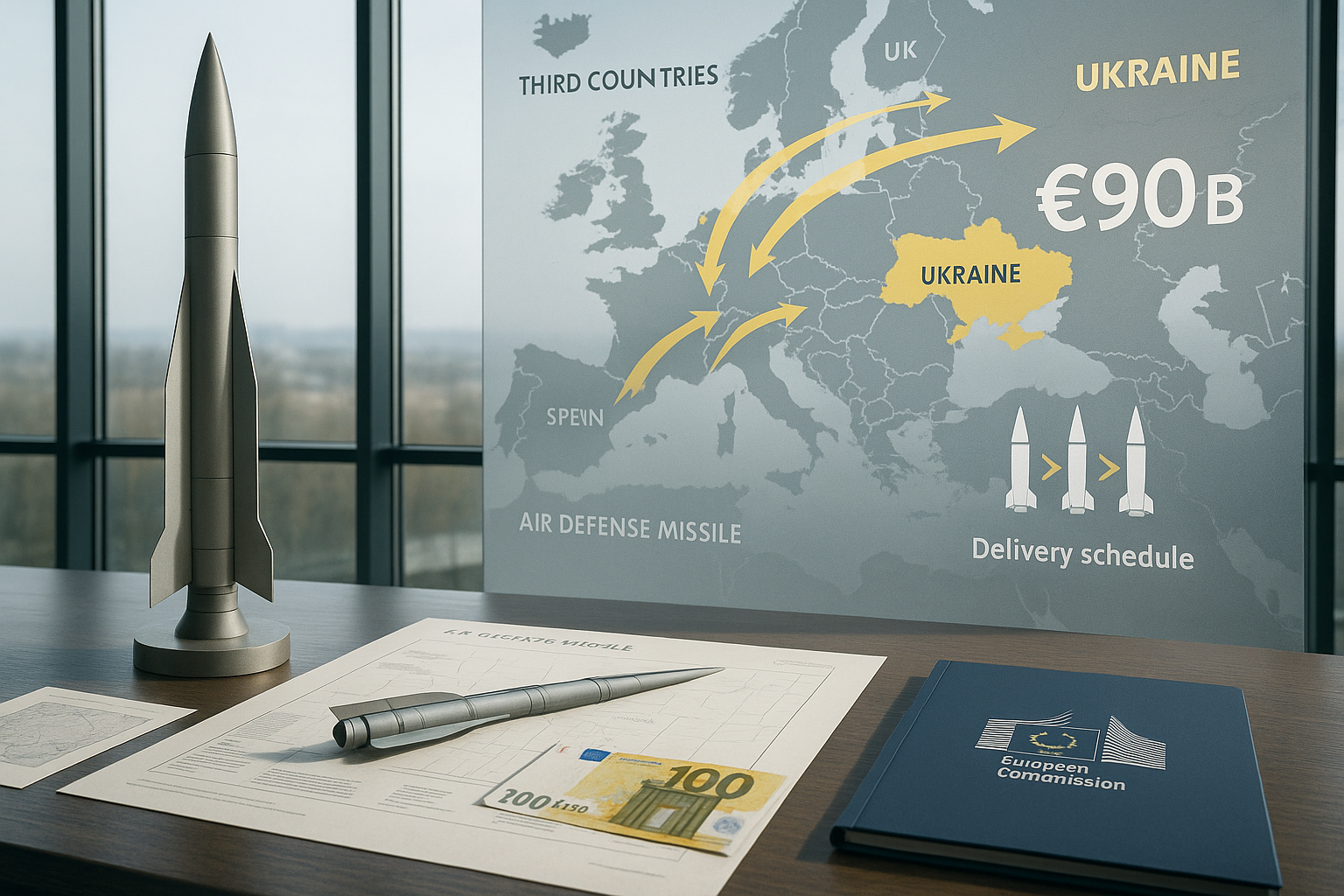
In 2026, the European Union approved and began disbursing over €6.1 billion specifically to bolster Ukraine's air and missile defense capabilities, including systems, missiles, ammunition, and radars. This funding is a critical component of the broader €90 billion Ukraine Support Loan (UASL), which allocates €60 billion for defense across 2026–2027, underscoring the EU’s sustained and substantial commitment to Ukraine’s security amid escalating Russian missile and drone attacks. European Commission President Ursula von der Leyen emphasized the symbolic timing of the approval on Ukraine’s Independence Day, reaffirming Europe’s unwavering and concrete support.
The EU’s procurement framework requires Ukraine to submit signed contracts with defense companies for Commission review before funds are released, ensuring transparency and adherence to agreed terms. While the majority of procurements are sourced from European defense firms, a pivotal policy shift now permits Ukraine to use EU loan funds to purchase critical interceptor missiles from non-EU third countries. This flexibility addresses urgent shortages of ballistic missile interceptors, such as Patriot systems, which have been constrained by US supply limitations amid its own military commitments.
To meet Ukraine’s urgent defense needs amid intensified Russian missile strikes—recorded at 376 in July 2026 alone—the EU is not only providing substantial funding but also accelerating delivery through destocking, reprioritizing orders, and ramping up production within European defense industries. This multi-pronged approach ensures rapid reinforcement of Ukraine’s air defense capabilities, reflecting a dynamic and responsive procurement strategy designed to keep pace with the evolving threat landscape.
Interceptor Shortage Crisis
Ukraine’s inability to stop waves of Russian missiles has forced a scramble for cheaper, mass-produced interceptors as European defense giants race to fill the widening air defense gap.
Ukraine faces a critical shortage of missile interceptors amid intensified Russian missile attacks, which has led to significant failures in intercepting high-speed ballistic missiles during deadly strikes on Kyiv. For instance, during the July 2 mass strike, only 24 of 74 Iskander missiles were intercepted, and on July 6, none of the 29 ballistic missiles launched were stopped, highlighting the operational gap in Ukraine’s air defense capabilities.
Russia’s sustained high production rate, capable of launching about 100 missiles monthly without depleting stockpiles, exacerbates Ukraine’s interceptor shortage and underscores the urgent need for scalable and cost-effective missile defense solutions. This relentless missile barrage demands rapid development and deployment of new systems, compressing typical defense program timelines from decades to just a few years, as Ukrainian officials strive to keep pace with the evolving threat.
In response, Ukraine and European partners have launched the Freyja missile defense project, aiming to produce ballistic interceptors at less than €1 million each—roughly a quarter to a sixth of the cost of American Patriot missiles. This initiative involves collaboration with major defense firms such as Germany’s Hensoldt, Sweden’s Saab, and France’s Thales and Safran, seeking to create a scalable, affordable alternative to expensive U.S. systems, which are limited by production capacity and high unit costs.
Washington’s decision to license Ukraine to produce Patriot interceptors represents a dual-track strategy: maintaining access to advanced but costly American missile defense systems while simultaneously fostering the development of more affordable European-Ukrainian alternatives. This approach leverages Ukraine’s four years of combat experience against Russian ballistic and hypersonic weapons, providing invaluable operational insights that inform the adaptation and improvement of missile defense technologies.
Modernizing Defense, Shifting Burdens
US-Ukraine partnerships are repurposing Soviet-era systems and pioneering AI drone warfare, while NATO’s financial support grows increasingly reliant on a handful of key countries.
Amid a global shortage of Patriot missiles driven by competing demands in the Middle East and Indo-Pacific, the US and Ukraine have embarked on a strategic collaboration to modernize and domestically produce interceptor missiles for Ukraine’s Soviet-era S-300 air defense systems. This initiative aims to leverage Ukraine’s existing launch infrastructure and trained personnel to create a complementary layered air defense architecture that conserves scarce Western interceptors for high-end threats, with initial operational capability targeted by late 2026. Despite political skepticism and intellectual property concerns, this joint effort exemplifies how NATO and US-Ukraine cooperation is adapting legacy systems to sustain Ukraine's defense amid intensified Russian missile attacks.
NATO’s evolving role in supporting Ukraine extends beyond traditional missile systems to include cutting-edge technologies such as Germany’s funding for 50,000 advanced AI-guided drones capable of coordinated swarm attacks, which are redefining battlefield tactics by creating specialized drone operator units separate from frontline troops. This technological infusion, combined with the US offering to transfer Patriot missile system intellectual property for local production in Ukraine, signals a strategic shift where Ukraine transitions from a security consumer to a security contributor, innovating in drone warfare and missile defense with programs like Freya and TrophyLab that harness battlefield feedback to advance military technology.
The strategic cooperation between NATO members in supporting Ukraine’s defense modernization is marked by significant financial commitments and a shifting donor landscape, with a €70 billion pledge for 2026 and 2027 underscoring NATO’s long-term commitment. However, this burden is increasingly concentrated among fewer countries—Germany and the UK alone accounted for nearly two-thirds of European military aid in early 2026—while smaller Nordic and Baltic states contribute disproportionately relative to their GDP, reflecting regional security priorities. Mechanisms like the Prioritised Ukraine Requirements List enable countries without strong defense industries to effectively participate by procuring US-made weapons, facilitating a coordinated and sustainable approach to Ukraine’s air defense modernization.
The geopolitical implications of NATO’s enhanced military aid and the US push for Ukraine’s NATO membership continue to exacerbate tensions with Russia, perpetuating a prolonged conflict shaped by strategic Western policies. This dynamic underscores the complex balance NATO faces between urgently bolstering Ukraine’s defense capabilities with advanced technologies and managing the broader risks of escalating confrontation, as Russia increasingly perceives Ukraine as a permanent adversary fueled by Western integration efforts.