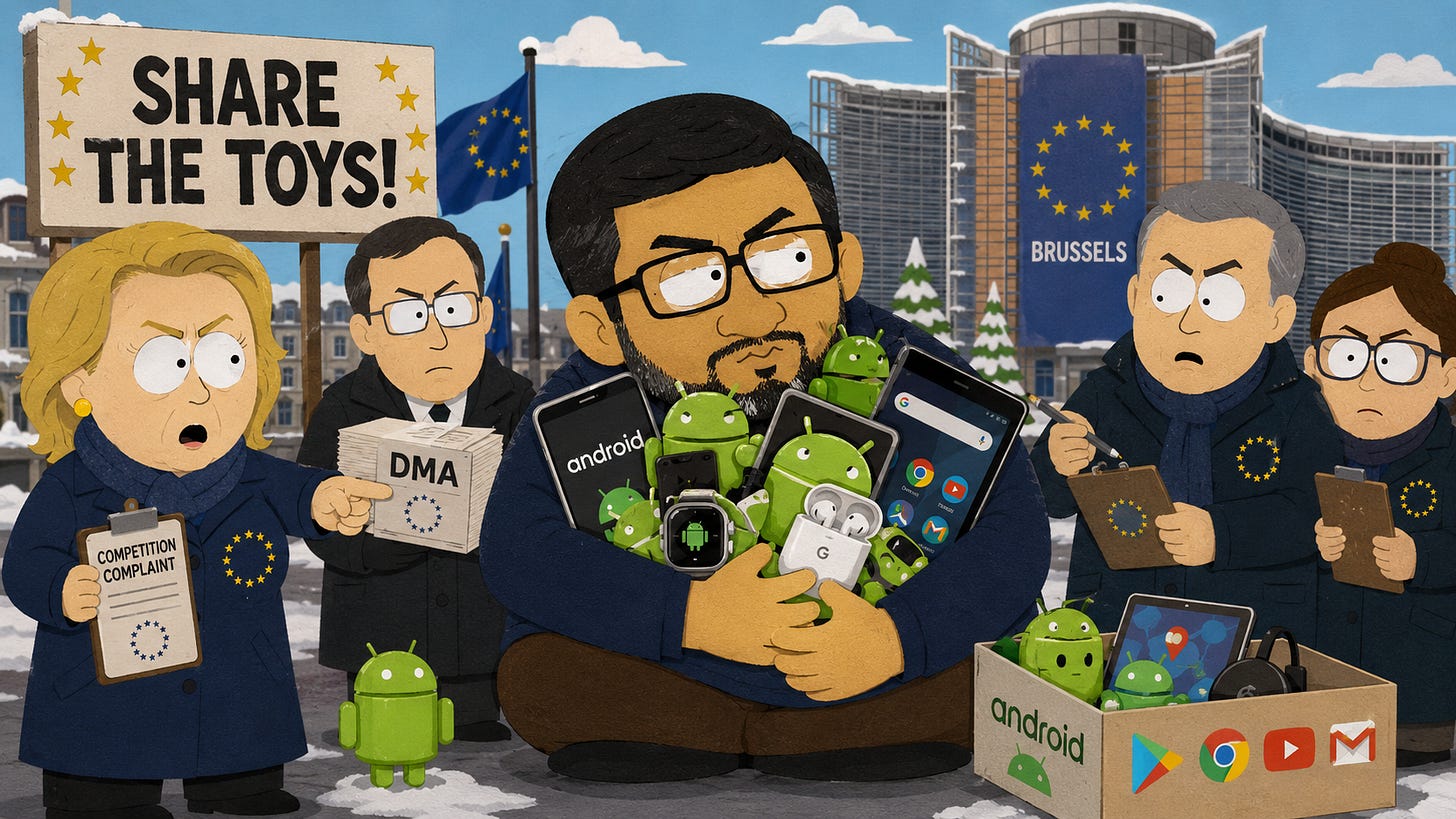
EU pushes Google to open android, sparks privacy showdown
The gist
The EU is forcing Google to unlock Android and share anonymized search data with rivals, igniting a high-stakes battle over privacy, competition, and control of Europe’s digital future.
What to know
- The EU’s Digital Markets Act compels Google to open 11 core Android features—including on-device AI—and share anonymized search data with competitors like OpenAI and DuckDuckGo by 2027-2028.
- Google warns the mandates could put millions of European users at risk, citing threats to privacy, security, and the potential for misuse by third-party AI assistants.
- A €4.1 billion court-backed fine cements the EU’s power to regulate tech giants, while delays in Google’s Gemini AI rollout create new openings for rivals like Microsoft and Meta in Europe.
Android's Forced Openness
Google must grant rivals deep access to key Android features and anonymized search data, reshaping the AI assistant landscape and ending its exclusive grip on mobile innovation in Europe.
The EU Digital Markets Act imposes binding mandates on Google to share anonymized search data and open core Android features to rival AI firms, aiming to dismantle Google's entrenched dominance in search and mobile operating systems. Specifically, Google must provide ongoing access to aggregated anonymized search data—including ranking, query, click, and view metrics—to qualified competitors such as OpenAI and DuckDuckGo under fair, reasonable, and non-discriminatory (FRAND) terms, while safeguarding user privacy through a combination of technical and contractual measures. This data sharing excludes proprietary technologies like Google's ranking algorithms or FastSearch, ensuring competition without compromising trade secrets.
In parallel, Google is required to enable interoperability by opening 11 key Android system features grouped into invocation, context access, cross-application actions, and resource utilization—including access to Google’s on-device AI models—to rival AI assistants free of charge. This interoperability mandates comprehensive developer support, including documentation, technical assistance, and testing access, across the entire Android ecosystem, encompassing devices from other manufacturers. Notably, users must be able to switch from Google Assistant to third-party assistants via voice command, enhancing user choice and competitive parity.
The compliance timeline extends through 2027-2028, reflecting a phased and structural policy shift rather than a short-term adjustment. Most interoperability features must be implemented by August 1, 2027, coinciding with Android 18’s release, while concurrent wake-word support for multiple assistants has a later deadline of August 1, 2028. This extended timeline affords Google a window to enhance its Gemini AI while competitors gain equivalent access, potentially influencing Google's AI investment allocation, pricing strategies, and long-term margin targets tied to search-centric AI products.
To qualify for access to Google’s anonymized search data, competitors must meet eligibility criteria including a minimum of 50,000 monthly EU users and undergo rigorous security inspections and independent audits, underscoring the EU’s commitment to balancing data utility with robust privacy safeguards. Additionally, the DMA explicitly restricts how shared data can be used—prohibiting its use for AI training or direct replication of Google’s results—ensuring that competition fosters innovation without enabling unfair appropriation of Google’s search quality.

Privacy Risks Ignite Tensions
Google and Apple warn that mandated interoperability could expose millions to new privacy and security threats, as expanded AI access opens the door to novel cyberattacks and contested oversight.
Google has raised significant alarms over the European Commission's mandates requiring data sharing and opening Android to AI competitors, emphasizing that these measures could expose millions of European users to privacy and security risks. Kent Walker, Google's president of global affairs, warned that private searches might be accessed by unfamiliar companies "without adequate consent or anonymization," threatening not only user privacy but also trade secrets and national security. While the EU proposes safeguards such as user consent, eligibility criteria for sensitive capabilities, and independent certification of third-party assistants, Google remains skeptical about their effectiveness, highlighting challenges in user comprehension and the evolving nature of security vulnerabilities.
Opening Android to third-party AI assistants significantly expands the attack surface, creating new vectors for malicious exploitation. Analysts note that AI agents with access to messages, location, microphones, and background processes become attractive targets for prompt injection attacks that could manipulate user actions without consent. Michael Stokes of Veilant cautioned that AI assistants with delegated user authority might perform unintended actions, underscoring the security vulnerabilities inherent in mandated openness. Apple’s Craig Federighi echoed these concerns, explaining that the EU rules would require granting any assistant direct access to private data and control over applications, a risk so severe that Apple chose to withhold Siri AI from iPhones and iPads in the EU.
The European Commission insists that privacy and security protections will be robust, highlighting a multi-layered anonymization process for search data developed with data protection experts and allowing Google to vet recipients for security risks prior to data transfer. However, privacy advocates like Calli Schroeder from the Electronic Privacy Information Center caution that tech giants’ privacy objections surfaced primarily after the ruling impacted their business interests, suggesting that concerns may be as much about competitive disadvantage as genuine user protection. This tension reflects the broader conflict between the EU’s push for AI platform openness and Google’s struggle to maintain ecosystem security amid reduced control.
Competitive Shakeup for Big Tech
The DMA’s sweeping mandates and Google’s delayed AI rollout are triggering a power shift, giving Microsoft, Meta, and others a rare chance to challenge Google’s dominance in Europe’s AI market.
The EU's Digital Markets Act (DMA) fundamentally challenges Google's entrenched dominance in mobile operating systems and search by mandating the sharing of anonymized search data and opening 11 core Android features to rival AI firms like OpenAI. This structural policy shift reduces Google's ability to leverage default settings and proprietary AI features to steer users, compelling Alphabet to rethink its monetization strategies and AI investment allocation between Google-branded services and external developer tools. As a result, Alphabet faces a complex balancing act to maintain competitive positioning while complying with the DMA's requirements by 2027, with Kent Walker lamenting that compliance forces the removal of beloved real-time search features, potentially degrading product utility and market share in Europe.
The timing of the DMA rulings coincides with delays in Google's Gemini 3.5 Pro AI rollout, providing a strategic opening for competitors such as Microsoft, Amazon, and Meta to capture enterprise AI customers in Europe. While Google contends that regulatory complexity is slowing innovation—Karen Massin noting engineers must defer product launches—the mandated interoperability and data sharing simultaneously lower barriers for third-party AI developers, potentially fostering a more vibrant ecosystem on Google's cloud infrastructure despite heightened competition. This dynamic underscores a paradox where enforced openness may erode Google's market control but also stimulate broader AI development within its infrastructure.
The DMA's enforcement extends beyond Google, exemplified by Apple's decision to delay Siri AI in Europe after the EU rejected its proposal for an 18-month exclusivity window, signaling a robust regulatory stance that prioritizes immediate competitor access and interoperability. This approach not only curtails unilateral control by American tech giants over feature rollouts but also sets a precedent likely to influence global markets as other countries monitor the EU's assertive regulatory framework. Consequently, the DMA is reshaping competitive dynamics by institutionalizing fair platform access and interoperability mandates, thereby fostering a more level playing field for AI and search engine providers across Europe and potentially worldwide.
Google's framing of the DMA-driven changes as a threat to security and user safety—highlighted by Karen Massin's concerns about bypassing core safeguards exposing millions of Android users to malware—adds a contentious layer to the competitive landscape. Furthermore, Kent Walker's assertion that the rulings benefit a small group of complainants at the expense of European consumers and businesses reflects Google's narrative that these regulatory interventions may inadvertently harm local market visibility and product quality. This tension between regulatory objectives and Google's security and market concerns underscores the complex interplay shaping Europe's AI and search market evolution.
Regulators Gain Legal Muscle
A landmark €4.1 billion court victory arms the EU with unprecedented authority to punish tech giants, as critics and civil society groups demand even tougher, faster enforcement against Google.
The European Court of Justice's upholding of the €4.1 billion fine against Google marks a pivotal legal precedent that lowers the European Commission's burden of proof in abuse of dominance cases, particularly in digital markets characterized by network effects and high entry barriers. By rejecting the necessity to prove exclusion of an 'as-efficient competitor,' the court reinforced the Commission's authority to enforce the Digital Markets Act (DMA) robustly, despite Google's partial procedural win regarding revenue-sharing contracts. This judgment signals strong judicial backing for stringent regulatory actions against dominant digital platforms like Google.
Google's response to the DMA enforcement has been to challenge fines—such as the €890 million penalty—arguing that compliance degrades key search features and compromises user safety, with Kent Walker lamenting the loss of real-time search functionalities and Massin warning that mandated changes could expose millions of Android users to malware. The company also frames these regulatory actions as driven by a small group of self-serving complainants, claiming that European consumers and businesses bear the brunt of product degradation and innovation delays, as engineers defer launches to manage mounting compliance complexity.
Civil society groups, including the Open Markets Institute Europe, criticize the €890 million fine as a mere 'bare minimum' given Google's massive revenues exceeding $400 billion, urging the European Commission to accelerate enforcement and leverage its full powers under Article 8 of the DMA to compel swift compliance. These advocates stress that prolonged investigations—taking over two years—are too slow and warn that mere dialogue over Google's AI services is insufficient, calling for decisive action to prevent the entrenchment of monopolies in emerging AI markets reliant on Google's dominant Search and Android platforms.
The recent definitive ruling by the Court of Justice of the European Union against Google's Android contractual restrictions underscores the Commission's commitment to dismantling platform dominance, pushing Google to pivot from contractual control to managing trust through its developer verification system launching in September 2026. While Google and other incumbents invoke security and privacy concerns to resist DMA-mandated interoperability, regulatory bodies and civil society reject security as a blanket justification for restricting competition, emphasizing that less restrictive, interoperable alternatives exist and that centralized control under the guise of security must be scrutinized carefully.