Europe’s cloud sovereignty push hits the ground
The gist
Europe’s cloud sovereignty fight is moving from political posturing to real investments, new rules—and homegrown AI infrastructure.
What to know
- By late 2026, nearly 75% of Europe’s public companies still depended on U.S. tech for critical infrastructure, but new EU laws now force governments to confront and cut foreign reliance.
- The EU’s Tech Sovereignty Package and CADA will triple European data-center capacity over 5–7 years, with €200 billion in mostly private investment fueling domestic control.
- Germany’s Fraunhofer IGD just launched the Baltic Brain AI cluster—three nodes, 24 NVIDIA B200s—anchoring sensitive compute inside national borders, not U.S.-owned clouds.
AI Sovereignty Gets Physical
Europe is embedding sovereignty into every layer of the AI stack, turning legal mandates into procurement rules and demanding physical control over infrastructure, not just data location.
By late 2026, sovereignty no longer meant only keeping data in Europe; it meant codified control over the AI stack itself. In August, Computer Weekly said choosing a cloud region from a drop-down list does not make data sovereign, and SAP News Center linked the urgency to dependence, citing Proton research that around 75% of publicly listed European companies rely on U.S. tech services for critical infrastructure. Christine Lagarde had already warned in November 2025 that Europe must avoid single points of failure in critical areas such as data centers and compute capacity.
The global response showed sovereignty becoming physical as well as legal. HUMAIN announced a strategic partnership with NVIDIA targeting up to 500 megawatts of AI factory capacity in Saudi Arabia, including several hundred thousand NVIDIA GPUs over five years and an initial phase of 18,000. In Europe, the Commission’s EUR 180 million sovereign-cloud tender, awarded on April 17, 2026 under the Cloud III dynamic purchasing system, showed sovereignty entering formal buying rules, while The Sovereign AI Stack said every veto point in the stack is becoming a procurement specification, citing Brookings-based data that potential U.S. federal AI contracts for 2026 reached USD 91.8 billion, with USD 90.7 billion at the Department of Defense, up 1,605% from 2024.

From Renting to Owning Cloud
Sovereignty now means European governments must inventory foreign tech dependencies and invest billions in building, owning, and auditing their own critical digital infrastructure.
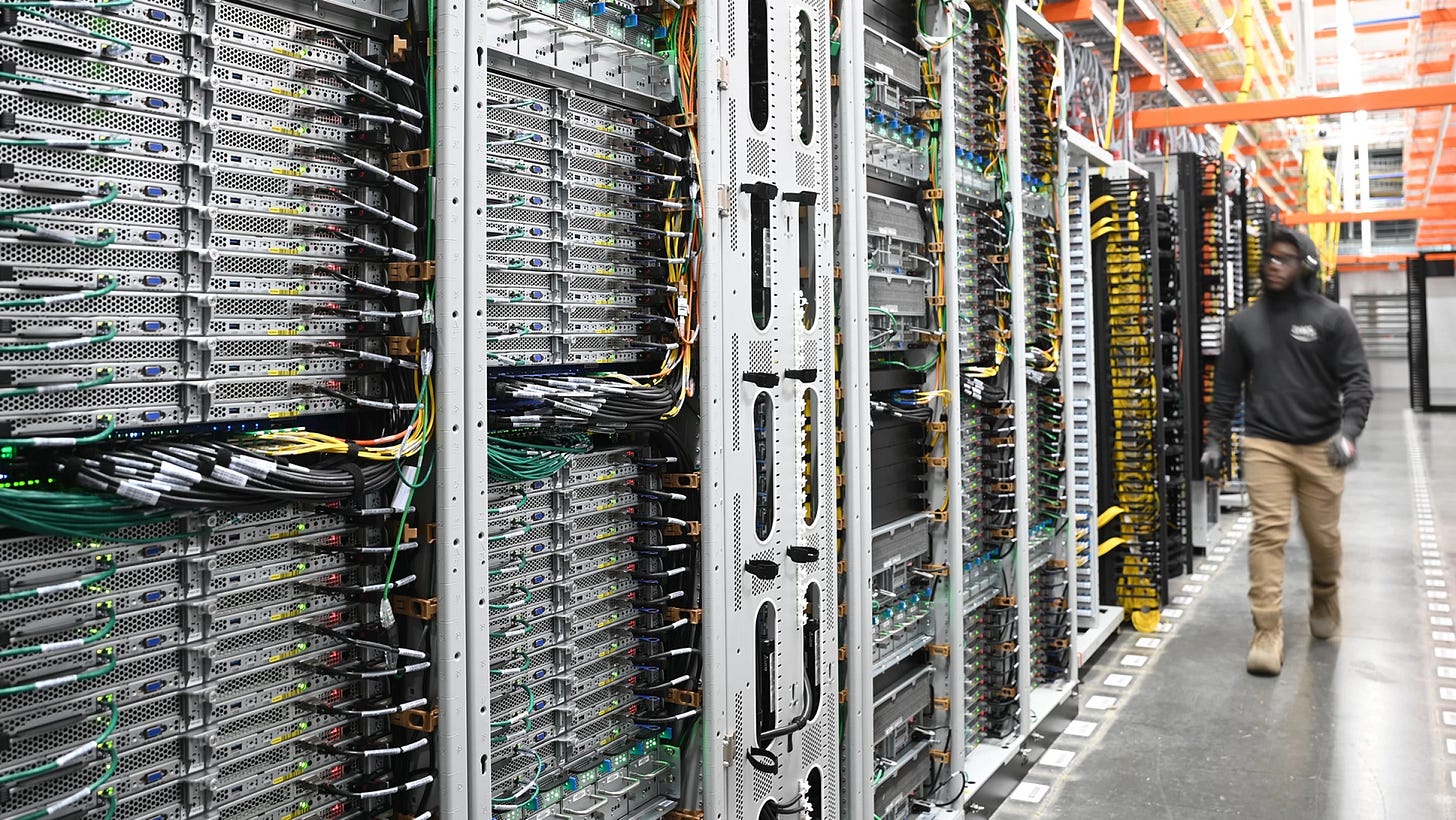
By late 2026, sovereignty had become something organizations could buy, build, and audit rather than merely endorse. According to the Centre for European Policy Network, the EU’s Tech Sovereignty Package requires member states to inventory and classify public-sector dependence on foreign cloud and then procure by sovereignty level, while CADA aims to triple EU data centre capacity in the next 5-7 years, requiring around €200 billion in mostly private investment, turning legal and operational control into capital allocation and owned infrastructure.
That operational turn runs from compute inputs to model-access risk. The Centre for European Policy Network says Chips Act 2.0 proposes the first EU open foundry for sub-3nm manufacturing, with pilot production planned for 2030-33, plus Demand Accelerators linking producers to buyers through offtake agreements, while Sifted framed the urgency as a foreign-provider digital kill switch risk that can disrupt access to critical AI models, pushing organizations to reduce reliance on rented external AI. The same shift appears in compliance and budgeting: The Register tied sovereignty to the EU Cyber Resilience Act, with reporting obligations for actively exploited vulnerabilities and severe security incidents beginning last month and main requirements applying from December 2027, while The Tech Download linked control to predictable returns and higher ROI.


Germany’s Baltic Brain Breakthrough
The Baltic Brain cluster keeps sensitive AI training entirely within German borders, marking a shift toward nationally operated, self-contained compute for healthcare, industry, and government data.
Europe’s sovereignty push is already materializing as domestically controlled compute: Germany's Fraunhofer Institute for Computer Graphics Research (IGD) commissioned the “Baltic Brain” GPU cluster on August 11, 2026, and it enables training on sensitive healthcare, industrial, and public-administration data without routing any of it through US-operated cloud infrastructure. Just as importantly, it is co-located inside the Green IT Cube at GSI/FAIR in Darmstadt, anchoring the system in a nationally operated site rather than a foreign cloud region and keeping sensitive workloads physically and operationally inside German control.
That domestic control is backed by infrastructure built to keep training self-contained: Baltic Brain is “a three-node, 24-NVIDIA B200 system” and “the cluster consists of three NVIDIA DGX B200 systems forming a single DGX POD,” with an “NVLink fabric” and “NVLink's role across the full 24-GPU cluster” so it can “function as a single coordinated training environment rather than three independent nodes.” Tech Times reported that “At 1.8 TB/s per-GPU interconnect, gradients and activations can flow between all 24 GPUs,” while the Green IT Cube “replaces air cooling with water cooling integrated directly into rack-level heat exchangers,” and “cooling energy corresponds to less than 7 percent of the electrical power used for computing,” helping sustain local operation; each node houses eight B200 GPUs, and “a 70-billion-parameter model can sit in a single B200's memory at full precision.” The same pattern is appearing in institutional software and government architecture, not just in AI training hardware. The Register reported that the European Commission is deploying a self-hosted alternative to Microsoft Teams by configuring Element Pro on the Commission’s own infrastructure as an internal backup for messaging, calls, file transfers, and project rooms, while WSO2’s Mifan Careem described a sovereign government model built around a national data exchange with consent, authorization, unified authentication, and audit layers so agency-to-agency data flows remain inside governed domestic systems.
U.S. Tech Still Runs Europe
Despite sovereignty ambitions, U.S. firms control the vast majority of Europe’s cloud and chip supply, making even small moves away from American vendors a major strategic pivot.
Europe’s sovereignty push starts from a market structure in which key digital layers are already concentrated outside Europe, not from a desire to fine-tune procurement. Cybernews says “Three American tech giants currently control approximately 70% of the European cloud market,” while “As many as 74% of publicly listed European companies use US-based services such as Google and Microsoft for their email and other services”; CSIS makes the same point bluntly: “If you look at cloud service providers, for example, 70% of cloud services are American-made,” underscoring how deeply governments and companies are embedded in the American stack. That is why even symbolic procurement shifts are framed as sovereignty moves rather than routine vendor changes: in June of 2025, the Danish government began replacing Microsoft Office with Libre, which is open source, and the Austrian military has also announced replacing some of its Microsoft kit.
That dependence runs down into the hardware and software foundations of AI itself. Europe “produces fewer than 10 percent of the world’s chips” and “remains heavily dependent on U.S. designers and Asian manufacturers for the most advanced processors”; CEPS estimates “each planned AI factory site requires up to 25,000 advanced chips, while a gigafactory requires at least 100,000,” and “Almost all of those processors are expected to come from Nvidia,” as seen in Mistral’s 13,800 Nvidia GPUs near Paris and Deutsche Telekom’s nearly 10,000 Nvidia Blackwell GPUs in Munich, while Diginomica notes Europe “writes a lot of the code the open source world runs on - but it doesn't fund or govern it in proportion.”

Open AI Stacks as Insurance
European organizations are shifting to open-weight and self-hosted AI to escape the strategic and financial risks of foreign-controlled APIs and unpredictable cloud pricing.
The case for owning AI starts with veto risk: organizations do not want a core capability that a foreign provider can throttle, withdraw, or reprice without warning. Tech Informed documented how model access restrictions and outages can halt dependent workflows, while FOMO研究院電子報 argued that if a model sits behind a closed API, customers hold usage rights rather than real control because the provider governs versions and can unilaterally interrupt service; that is why private, open-weight deployment is increasingly treated as operational insurance, not just a technical preference. The same sovereignty logic appears outside model APIs: the text cites Bavaria’s Microsoft 365 contract, “estimé à près d’un milliard d’euros sur cinq ans,” which was sent “à la corbeille” after a standoff and replaced by a “poste de travail de base souverain” basé, underscoring how dependence on foreign software providers can become a strategic liability.
Cost volatility is pushing the same conclusion. In the July analysis, the speaker said “token maxing is just not sustainable” and that “the Big Fund from American Labs are heavily subsidizing token cost,” with the ratio “up to 1600 to 1,” making “control over cost” a procurement worry; Tech Informed similarly noted that “public API pricing is set by the provider, adjusted on the provider’s schedule… not the customer’s budget cycle,” while SiliconANGLE’s examples were starker still: Uber spent “a year's budget in one quarter on tokens,” Lindy’s “payroll was smaller” than its token bill, and “they had to shift a 100% of their anthropic traffic to to an open model.” Bavaria’s decision to discard a Microsoft 365 deal “estimé à près d’un milliard d’euros sur cinq ans” after a bras de fer likewise reinforces the budgetary case for sovereign stacks when external vendors can dictate terms over time.