Figma’s AI agents boost productivity—but are design teams losing their creative spark?
The gist
Figma’s AI agents are turbocharging design efficiency in 2026—but some teams worry they’re trading creative spark for speed and automation.
What to know
- Figma embedded AI-powered design agents into its canvas, letting designers automate tasks and iterate with natural language commands without leaving the workspace.
- AI boosts productivity and streamlines collaboration, but has led to less direct human interaction and a cultural shift toward treating AI prototypes as disposable drafts.
- As Figma eyes a potential 50% revenue jump, it faces fierce competition from platforms like Lovable and tough governance challenges—especially as 50% of designers now use AI for code generation.
AI Agents Redefine Workflow
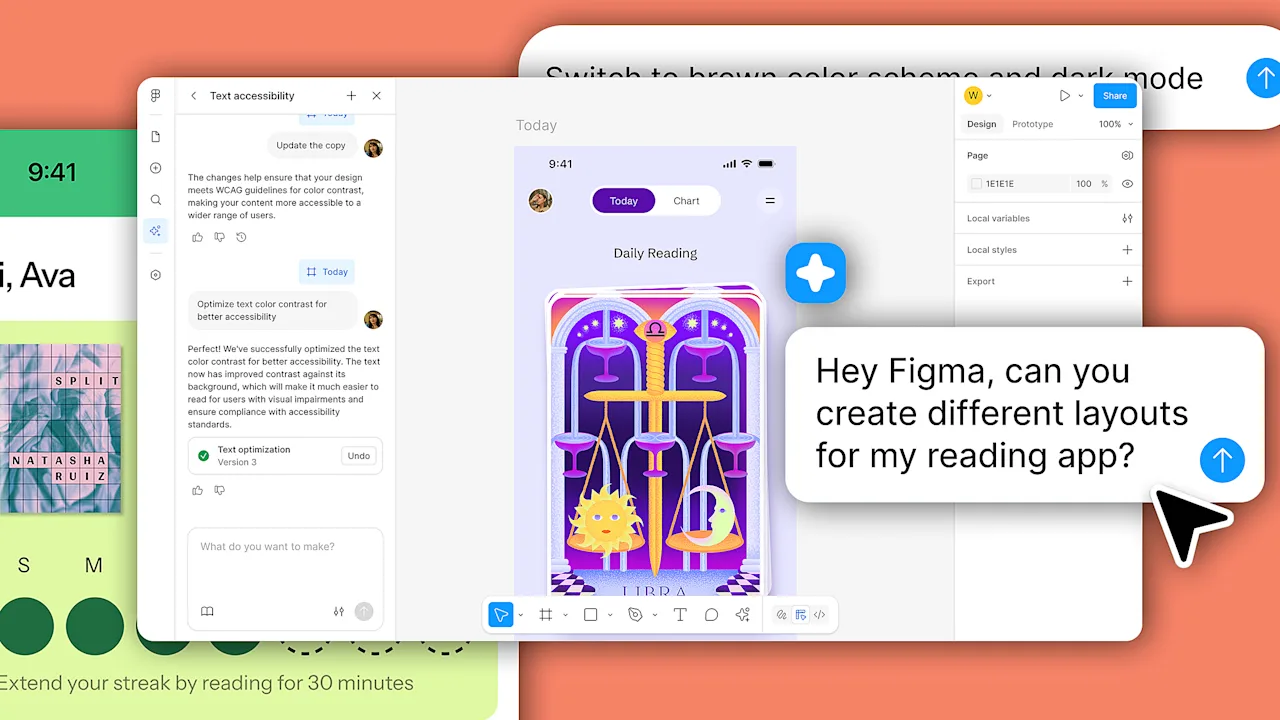
Figma’s AI agents now operate as context-aware collaborators, granting designers granular control and precision through conversational prompts embedded directly in the design canvas.
In 2026, Figma revolutionized design workflows by embedding AI-powered design agents directly into its collaborative canvas, enabling designers to interact with tools through natural language commands. This integration allows granular control over design elements, speeding up UI creation by letting users issue conversational prompts without leaving their workspace, a significant leap from previous separate AI tools.
Figma’s AI agents excel in multi-agent workflows and context-aware automation, streamlining routine tasks such as bulk edits, component swaps, and content population. By living alongside layers in the left rail, the agent accesses design systems, components, tokens, and team context natively, eliminating context switching and enhancing cross-functional collaboration within the same file where teams already work.
Precision is a core focus of Figma’s AI integration, allowing designers to mention specific components or tokens directly, which improves the accuracy of AI-driven tasks and addresses a common challenge in AI-assisted design. This capability supports rapid design exploration and iteration, empowering teams to generate multiple stylistic directions simultaneously and process team feedback by summarizing comments and identifying thematic insights.
By embedding powerful, context-aware automation directly into the collaborative canvas, Figma’s AI agents mark a major advancement in AI-driven product development and interface design for 2026. This shift not only redefines design workflows but also signals a broader transformation toward more seamless, intelligent, and integrated design processes that leverage AI’s full potential within collaborative environments.




Collaboration vs. Creative Solitude
Automated AI tools are accelerating prototyping but isolating designers, shifting team culture toward solitary work and treating AI drafts as disposable starting points.
By early 2026, AI-powered design agents like Figma Make and Claude have fundamentally reshaped workflows by automating routine, time-consuming tasks such as icon processing and early ideation, enabling designers to focus on creative judgment and refinement. As one designer explained, 'Being a designer is not about knowing which buttons to click... It’s about the endgame of what you’re trying to actually get done,' highlighting how AI clears away the busy work to accelerate prototyping and iteration. This shift has also allowed fractional product designers to seamlessly integrate AI with existing design systems, reducing setup friction and speeding up cross-functional collaboration by bridging knowledge gaps in complex technical domains.
While AI enhances efficiency and cross-functional communication—making prototypes more interactive and understandable to engineers—this technological leap has paradoxically led to reduced direct collaboration among colleagues, fostering more solitary work and a sense of loneliness. One interviewee reflected, 'I spend less time with my colleagues now because of AI... it’s felt not as fun as in the past,' underscoring a cultural trade-off as teams adapt to new collaboration dynamics where AI acts like a junior designer providing raw drafts for refinement rather than finished outputs.
The integration of AI is also prompting a maturation in design leadership and community attitudes, with leaders recalibrating expectations by treating AI-generated prototypes as disposable starting points rather than polished deliverables. As one trend observer noted, 'Leaders are learning to say... that was built by AI. So I'm happy to throw it away and start again,' reflecting a shift from speed to quality focus. Concurrently, Figma is expanding its platform to support design leaders through initiatives like Leadership Collectives, aiming to enhance decision-making and track design choices in this evolving AI-augmented landscape.
Despite AI’s growing capabilities, skilled designers remain indispensable for nuanced UI/UX decisions, with many viewing AI as a powerful complement rather than a replacement. One designer candidly stated, 'I consider myself way better than AI in terms of UI UX design,' emphasizing that mastering AI tools still requires significant expertise to harness their full potential effectively. This balance ensures that while AI accelerates early-stage work and routine tasks, human creativity and judgment continue to drive the quality and refinement of design outcomes.



Governance in the Hybrid Era
Figma’s push for AI-driven automation is running into tough governance and security challenges, demanding new frameworks to balance efficiency with real-world risks and creative accountability.
Agentic AI, as characterized in 2026 analyses, excels at automating tedious, repetitive tasks requiring 'infinite patience' but limited creativity, making it ill-suited for strategic or highly creative roles. This delineation underscores the necessity of hybrid workflows where humans provide judgment, creativity, and accountability, stepping in when AI reaches its limits. However, deploying these AI agents in production faces significant governance and security hurdles, such as risks from prompt injections and tool misuse, prompting companies like Figma to develop robust control planes like Prediction Guard to enforce organizational AI policies and maintain operational integrity.
Figma’s leadership, including CEO Dylan Field and CFO Praveer Melwani, highlights the complex balance between maximizing AI-driven automation and maintaining governance and cost efficiency as enterprises scale AI usage. By investing in infrastructure that routes queries based on task complexity and leverages model-agnostic architectures trained on Figma’s design corpus, the company aims to optimize AI performance while imposing necessary limits on AI spend and usage. This approach reflects a broader industry recognition that AI adoption is not simply about automation but requires sophisticated governance frameworks to control real-world risks and costs.
The evolution of AI-human collaboration in design is marked by a challenging 'messy middle' and 'false summit,' where early productivity gains from AI plateau as teams attempt to scale collaboration across functions. Over 80% of product teams remain stuck in initial phases where AI-driven efficiency does not yet translate into meaningful business outcomes, revealing the difficulty of integrating AI seamlessly into complex workflows. Figma’s emphasis on maintaining high-quality, real-time collaborative editing within an AI-enhanced canvas illustrates the technical and cultural complexities of hybrid workflows, as the industry shifts from developer-centric AI tools toward richer, more intuitive visual interfaces that better support human creativity.
Hybrid AI-human workflows foster a dynamic of mutual learning, where AI agents develop problem-solving approaches distinct from human methods, potentially inspiring new creative processes within organizations. This synergy challenges traditional role mappings—eschewing one-to-one human-to-agent replacements in favor of automating tasks humans would rather avoid due to scale or tedium. Such reimagined collaboration not only enhances efficiency but also encourages innovation, as AI agents’ unique strategies can reveal alternative pathways to solving design challenges, enriching human creativity rather than supplanting it.



AI Arms Race Heats Up
Surging AI adoption in design is fueling fierce competition and massive financial stakes, forcing Figma to innovate rapidly as new rivals and enterprise giants reshape the landscape.
Figma is strategically leveraging AI to deepen engagement with its existing customer base by integrating internal AI tools that analyze designs and suggest workflow improvements, thereby enhancing design efficiency and software building. However, despite these advances, Figma faces competitive pressure from emerging platforms like Lovable and Replet, which offer seamless transitions from design to production prototypes—a capability Figma currently lacks—posing a potential revenue leakage estimated at over $500 million. This dynamic underscores the critical need for Figma to innovate rapidly to maintain its market position amid a booming software ecosystem.
The rapid adoption of AI in product design is reshaping industry workflows, with 50% of designers now using AI for code generation—a dramatic increase from 19% just a year prior—and the average number of AI tools per design team more than doubling from three to seven. Large enterprises are leading this trend, with 74% of designers at companies exceeding 2,000 employees utilizing proprietary AI solutions, reflecting a strategic push toward customized AI integration to drive competitive advantage and operational scale.
The financial stakes of AI in design and engineering are monumental, as evidenced by leading AI providers Anthropic and OpenAI commanding nearly $80 billion in annualized revenue—an increase of 112% in six months—with enterprise giants like Salesforce committing upwards of $300 million to AI model investments. This influx of capital fuels a widening competitive gap, where 'frontier companies' demand 3.5 times more AI-driven intelligence per worker than typical firms, positioning themselves to harness AI for increasingly complex product design and engineering challenges.
Figma’s AI enhancements not only promise to improve design quality ethically but also have significant revenue implications, with projections suggesting the company could extract 50% or more additional revenue from its existing customers by embedding AI-driven efficiencies and insights directly into its collaborative canvas. This revenue potential highlights how AI is not just a productivity tool but a strategic lever for growth within the competitive landscape of design software.
