Forward deployed engineers become AI’s power brokers, redefining tech careers and enterprise adoption
The gist
Forward Deployed Engineers are fast becoming AI’s ultimate power brokers—blending tech, product, and business savvy to drive enterprise adoption and redefine what it means to shape the future of work.
What to know
- FDEs in 2026 are hands-on, full-stack engineers who own the entire AI solution lifecycle—from design to deployment—solving the notorious 'last-mile' problem across industries like aviation and consumer goods.
- Major players like Palantir and OpenAI now prize FDEs for their rare mix of coding chops, customer obsession, and executive presence, holding them accountable for real business impact over pure technical output.
- Instead of climbing traditional ladders, senior FDEs act as strategic partners to C-suites, embedding with clients to unlock 10x-100x productivity gains and codifying reusable AI patterns that supercharge product roadmaps.
The Hybrid AI Operator
FDEs fuse engineering, consulting, and risk management into a single role—owning the full AI solution lifecycle and bridging the gap between technical complexity and real-world enterprise needs.
Forward Deployed Engineers (FDEs) distinguish themselves from traditional Solutions Architects and Software Developers by embodying a hybrid role that combines deep engineering proficiency with architectural insight and customer engagement. Unlike Solutions Architects who primarily focus on whiteboarding and mentoring, FDEs actively build and deploy initial workloads in customer environments, leveraging advanced AI tools such as agentic and generative AI to demonstrate tangible solutions. This hands-on approach, exemplified by companies like Amazon utilizing AI-driven coding tools, underscores their broader accountability that extends beyond technical proximity to customers into full lifecycle involvement from design to deployment.
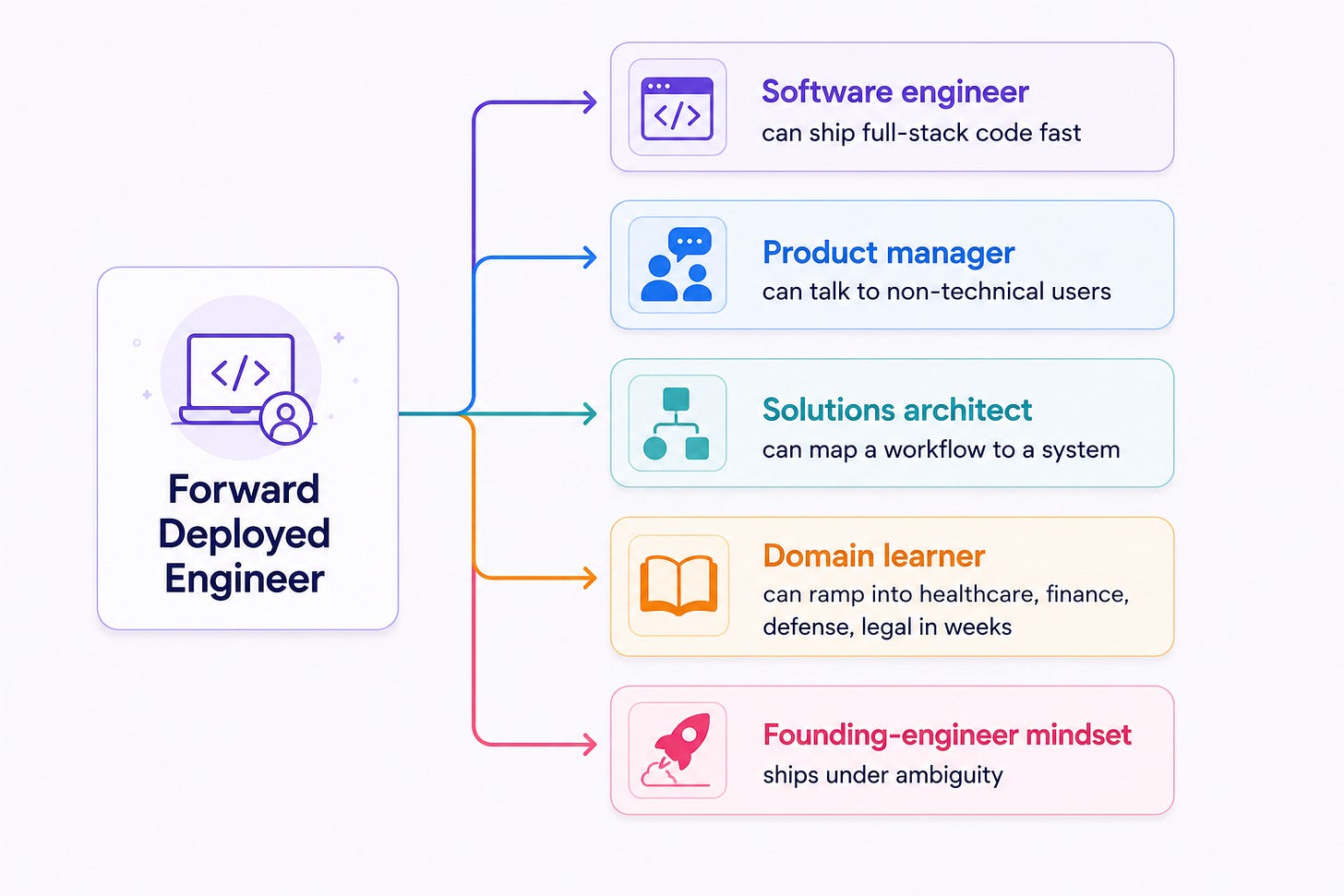
The FDE role is uniquely defined by its accountability to customers rather than a fixed skill set, evolving into a multifaceted position that blends consulting, product management, and engineering responsibilities. As Natalie Meurer articulates, FDEs operate at the intersection of these disciplines, often embodying all three roles simultaneously to translate complex AI technologies into actionable solutions tailored to non-technical enterprise clients. This convergence is reflected in specialized titles like Sierra’s 'agent engineer,' which emphasize both technical depth and customer obsession, highlighting the role’s critical function in bridging the AI last-mile problem by integrating systems, product understanding, and customer operations.
FDEs serve as essential translators and risk managers when deploying highly technical AI products to industries lacking deep technical expertise, such as consumer packaged goods or aviation. By working directly within customer non-production environments, they not only validate AI solutions but also establish necessary guardrails around security, ethical considerations, and human-in-the-loop decision-making. This comprehensive accountability, which includes developing artifacts to communicate operational constraints, sets FDEs apart from sales engineers or consultants, as they own the entire customer engagement lifecycle from discovery through delivery, producing bespoke software solutions rather than scalable products.
The FDE role demands a rare blend of technical versatility, customer empathy, and product vision, requiring practitioners to navigate high complexity and ambiguity akin to founder or design partnership roles. Candidates with hybrid backgrounds—such as technically adept product managers or engineers with product experience—are particularly well-suited, as the role entails managing '3x the failure surface' compared to traditional single-discipline positions. Organizations vary in how they structure the role, sometimes splitting consulting and engineering functions, but the most effective FDEs seamlessly integrate these hats to iteratively co-create solutions with customers in dynamic, uncertain environments.


Full-Stack, Full-Ownership
FDEs are measured by business impact, not just code, wielding startup-level autonomy to ship production AI solutions and drive customer outcomes from discovery to deployment.
Forward Deployed Engineers (FDEs) in 2026 embody a versatile 'jack of all trades' technical profile, requiring strong full-stack engineering skills that span backend services, data pipelines, API integrations, and advanced AI stacks such as RAG pipelines and LLM integration. Companies like Palantir, OpenAI, and Anthropic emphasize production-grade coding proficiency in languages like Python, Java, and TypeScript, alongside practical AI/ML application rather than deep algorithmic specialization. This breadth enables FDEs to ship real, customer-deployed solutions rather than prototypes, addressing the AI last-mile problem with robust, scalable code.
Beyond technical prowess, exceptional communication and product management skills distinguish successful FDEs, who must excel at active listening to uncover unspoken customer needs and translate complex technical trade-offs into accessible language for diverse stakeholders, including non-technical executives. Ramp’s characterization of their FDE team as 'the most cross-functional and comms-heavy engineering team in the org' underscores the criticality of these soft skills, which include conflict resolution, teaching, and maintaining low ego collaboration. Executive presence—defined less by extroversion and more by clarity, preparation, and audience-tailored messaging—is essential for engaging senior leadership and securing customer buy-in.
FDEs operate with founder-like autonomy and ownership, managing the entire project lifecycle from opportunity discovery through production deployment and customer adoption without handoffs to separate DevOps or QA teams. Palantir likens the role to a startup CTO, demanding grit, resilience, and a bias toward shipping 'gravel-road' solutions quickly rather than endless analysis. Success metrics extend beyond technical delivery to tangible business outcomes such as customer renewal and measurable workflow impact, reflecting the high agency and velocity mindset championed by AI labs like Anthropic and startups like Ramp.
Embedded for Enterprise Impact
By embedding with clients to automate and codify high-value workflows, FDEs accelerate AI adoption and transform field learnings into scalable product advantages.
Forward Deployed Engineers (FDEs) serve as embedded catalysts within enterprise clients, directly tackling the AI last-mile problem by working alongside users to identify, automate, and tailor AI-driven workflows that transform manual processes into efficient, scalable solutions. Companies like OpenAI and Evergreen deploy FDEs to sit with customers for weeks, enabling rapid iteration and hands-on customization that accelerates AI adoption, as seen in Evergreen’s success with manufacturers and engineering firms automating order-taking and blueprint data extraction. This deep embedding allows FDEs to map high-value workflows and codify reusable AI patterns that not only meet immediate needs but also drive product scalability across enterprises.
FDEs uniquely blend engineering, product management, and customer engagement roles to compress integration timelines from months to weeks, enabling rapid feedback loops that fuel continuous product iteration and expansion. As a16z analogizes, enterprises adopting AI are like 'your grandma getting an iPhone'—they need FDEs to set up and tailor solutions that work in complex environments. This role’s accountability extends beyond bespoke hacks to deciding when to generalize solutions for broader product roadmaps, a dynamic especially strong at companies like Ramp, Palantir, and OpenAI where FDEs rotate into core product teams to influence development directly.
The rise of loop engineering—where AI systems repeatedly reason, act, check, and improve—exemplifies the increasing complexity of AI workflows that FDEs must manage, requiring multi-step planning, error recovery, and human review. This evolution elevates the FDE role beyond simple prompt engineering to designing sophisticated AI workflows that integrate domain expertise across sectors like law, medicine, and finance. By codifying these workflows into repeatable sequences, FDEs accelerate enterprise AI adoption and product scalability, effectively turning field learnings into strategic assets that differentiate AI platforms from traditional consulting services.
FDEs drive a win-win transformation by amplifying human productivity rather than replacing it, fostering excitement among users who experience dramatic efficiency gains—sometimes 10x to 100x improvements—as they transition from clumsy manual workflows to agentic AI-driven processes. Evergreen’s approach of pairing technical and business-focused FDEs ensures rapid iteration and scalability across multiple clients, while engaging executives early aligns AI automation with strategic business outcomes, making AI adoption not just a technology upgrade but a fundamental workflow transformation that delivers clear ROI.




Career Rethink, Not a Silver Bullet
FDEs redefine tech careers through breadth and ownership, but long-term satisfaction depends on managing expectations as the role becomes the new standard across engineering and product disciplines.
While the Forward Deployed Engineer (FDE) role is undeniably distinctive and rewarding, it should be approached with realistic career expectations rather than as a cure-all for professional fulfillment. As highlighted in recruiting perspectives from 2026, even at prestigious firms like Palanteer—an industry veteran maintaining the FDE role for over two decades—some engineers report dissatisfaction, underscoring that this role, though special, remains 'just another job' within the broader AI ecosystem. The longevity of the FDE position in complex, non-technical customer environments attests to its sustainability, but managing expectations is crucial to long-term career satisfaction.
Career progression for FDEs often deviates from traditional hierarchical advancement, favoring expanded ownership over new titles. At Palanteer, for example, engineers may remain FDEs for over a decade, including those in senior commercial leadership roles, with growth measured by the breadth of customer accounts, industries, or geographies managed rather than formal promotions. This model reflects the FDE’s unique blend of engineering and business responsibilities, where individuals act as de facto CEOs or CTOs of their customer engagements, owning both the relationship and the delivery of tailored solutions.
By 2026, the FDE paradigm is increasingly becoming the standard across software, data, and AI engineering disciplines, with even product managers expected to meet FDE benchmarks. This evolution demands a hybrid skill set that integrates advanced architectural and design expertise—heightened by AI’s impact on coding and testing—with a novel form of product management that tightly couples technical decisions to business value, domain knowledge, and customer outcomes. Consequently, FDEs must navigate a complex intersection of technical and strategic considerations to effectively bridge innovation and enterprise adoption.
An emerging elite tier of FDEs is extending their influence beyond technical delivery to strategic executive engagement, requiring refined communication skills and executive presence. These high-end FDEs collaborate directly with C-level leaders to uncover significant growth opportunities during discovery phases, embodying a role that blends engineering acumen with business leadership. This shift signals the evolving landscape where FDEs not only solve the AI last-mile problem but also shape organizational strategy at the highest levels.