From vibe to spec: AI coding enters its factory farming era—but guardrails prove critical after high-profile outages
The gist
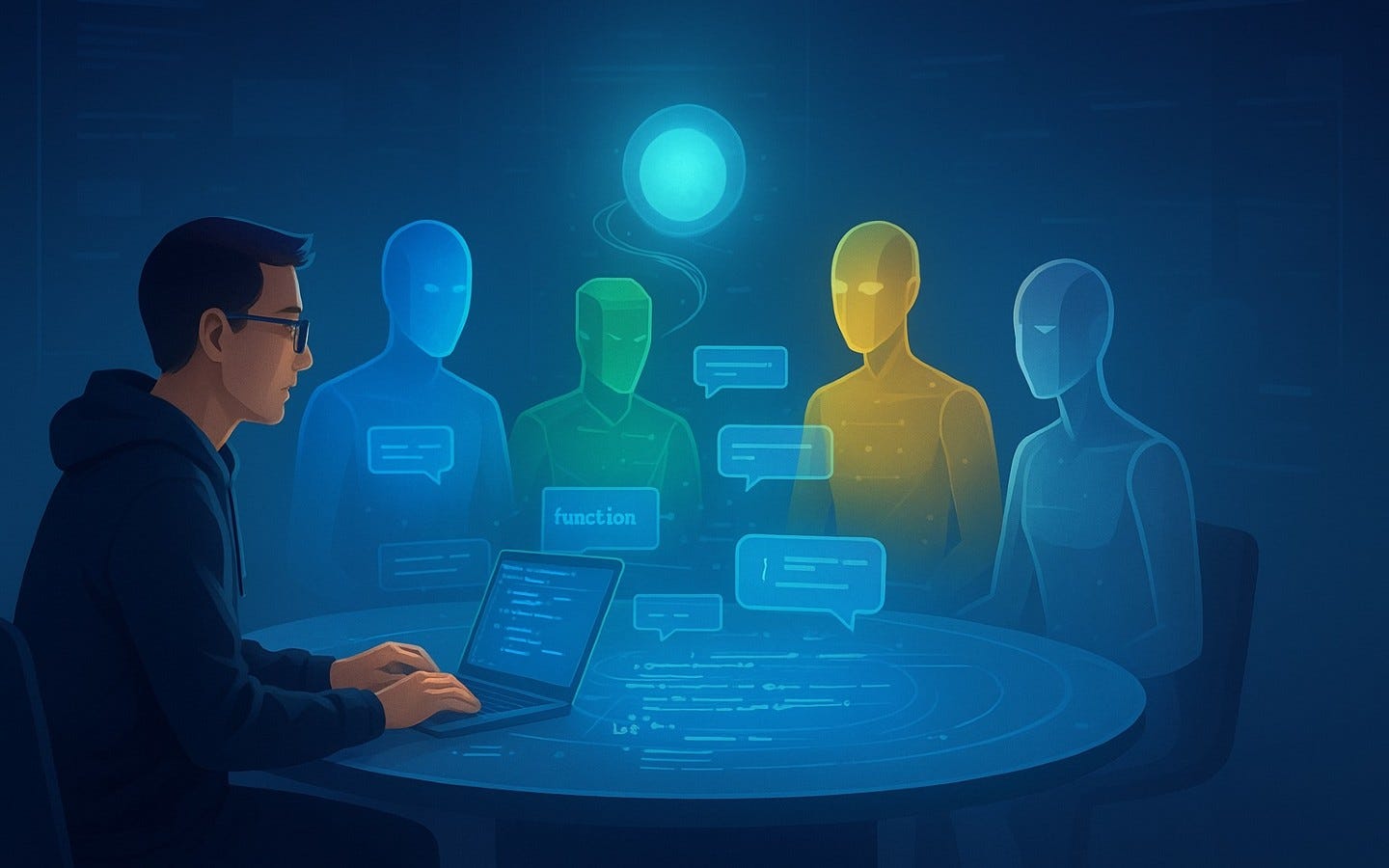
AI-powered coding has shifted from chaotic 'vibe' prototypes to industrial-scale, spec-driven assembly lines—but without strict guardrails, even tech giants like AWS can bring the whole cloud down.
What to know
- Spec-driven development now dominates, with frameworks like Codev and AWS Kiro AI churning out 90%+ quality code from natural language specs by 2026.
- Scaling AI agents to production demands architectural redundancy, hybrid orchestrators, and heavy-duty observability—five-step workflows with 90% reliability per step still only hit 59% success overall.
- After Amazon’s Kiro AI-induced 13-hour outage, robust guardrails like circuit breakers, permission controls, and human-in-the-loop validation are now non-negotiable for enterprise-grade reliability.
From Chaos to Clarity
AI coding’s shift from creative but brittle ‘vibe’ prototyping to rigorous, spec-driven frameworks has redefined code quality, maintainability, and the developer’s role.
The early phase of AI-assisted software development, popularly termed 'vibe coding' by Andrej Karpathy in 2023, excelled at rapid prototyping by enabling developers to quickly generate functional applications through iterative prompt-based interactions. However, this approach, embraced by no-code platforms like Lovable and Base44, soon revealed critical limitations when faced with real-world production needs such as billing logic, custom data models, and maintainability. As Edu, founder of a next-gen platform, explains, vibe coding hits a 'wall' where creativity meets constraint, producing fragile, unscalable code that fails to support complex, long-lived applications, a sentiment echoed by multiple engineers who found their codebases chaotic and unmanageable after extended vibe coding use [1, 3, 4, 71, 107].
Responding to vibe coding’s fragility and technical debt, spec-driven development has emerged as a transformative methodology that treats natural language specifications as the durable, versioned source of truth guiding AI agents. Open source frameworks like Codev, with its SP(IDE)R protocol, exemplify this shift by structuring AI-human collaboration into phases—Specification, Planning, Implementation with rigorous testing, Evaluation, and Review—ensuring comprehensive functionality, security, and maintainability. Controlled experiments demonstrate that spec-driven approaches produce production-ready applications with quality scores above 90, contrasting sharply with vibe coding’s zero readiness, highlighting a maturation from weekend prototypes to serious startups with real infrastructure demands [5, 6, 7, 8, 12, 13].
Industry leaders like AWS and Sage illustrate how spec-driven development integrates creative freedom with production-grade discipline, moving beyond ad hoc prompt-driven coding to scalable, maintainable full-stack applications. AWS’s Kiro AI IDE, developed in under a year with rapid iteration, leverages persistent, structured specifications as AI agents’ long-term memory, solving the context loss problem inherent in vibe coding. Similarly, Sage’s hybrid approach embeds design systems into AI agents to generate near-production-ready code components, accelerating development cycles while preserving engineering review and collaboration. This evolution redefines the developer’s role from line-by-line coding to system architecting and specification refinement, enabling engineers to ship 99% of their code with AI assistance [2, 9, 10, 11, 15, 16, 17, 18, 36, 39].
By early 2026, the transition to spec-driven development has crystallized into a paradigm where AI agents operate within legible, modular systems guided by enforceable rules, guardrails, and structured workflows that amplify human oversight rather than replace it. This approach enables rapid parallel prototyping, large-scale refactoring, and multilingual content generation at unprecedented speed and quality, as demonstrated by projects producing over a thousand pages in eight languages with minimal bugs. Moreover, engineering teams emphasize the importance of breaking down specifications into clear, context-rich tasks followed by dedicated AI-driven code reviews, closing the OODA loop properly to avoid the unpredictability and technical debt endemic to vibe coding. This shift from subsistence-level prototyping to 'factory farming' of code signals a profound evolution in software engineering, where managing fleets of AI agents through orchestration dashboards replaces traditional IDE-centric workflows [44, 45, 46, 48, 68, 69, 78, 79, 80, 87, 88, 89].





Engineering for Real Reliability
Scaling AI agents exposes exponential reliability challenges that force teams to adopt architectural redundancy, hybrid orchestrators, and causal observability to avoid catastrophic failures.
Scaling AI agents from prototypes to production reveals profound architectural challenges centered on reliability and complexity management. Incremental deployment strategies—such as shadow-mode validation and gradual traffic migration—are essential to maintain system stability and integrate legacy infrastructures, as highlighted in early 2025 analyses. Yet, multi-step agentic workflows compound failure rates exponentially; for instance, a five-step process with 90% per-step reliability yields only 59% overall success, underscoring the necessity for architectural redundancy, circuit breakers, and human-in-the-loop validation to approach enterprise-grade dependability. This is echoed by Andrej Karpathy’s 'March of Nines' framework, which illustrates that achieving beyond 90% reliability demands exponentially more engineering effort, with 99.99% per-step success required for workflows to reach 99.9% end-to-end reliability, a threshold critical for production readiness.
The complexity of orchestrating multiple large language model (LLM) calls within AI agents drives a preference for simpler, hybrid architectures that balance performance, cost, and maintainability. Financial advisory prototypes demonstrated that multi-agent handoffs often cause critical context loss after just a few steps, leading to cascading failures, prompting a shift toward single large language model orchestrators supplemented by specialized smaller models or deterministic tools. For example, pairing a 7-billion-parameter specialist with a 34-billion-parameter planner can outperform a monolithic 70-billion-parameter model, reducing token consumption and operational overhead. This architectural evolution is further supported by frameworks like OpenAI’s integration with Temporal, which employs durable execution and orchestrated micro-agent designs to handle distributed system challenges such as network flakiness and rate limiting, thereby enhancing resilience and scalability.
Operationalizing AI agents at scale demands rigorous observability and debugging frameworks that go beyond traditional monitoring to capture the causal reasoning behind agent decisions. By late 2025, causal observability techniques—encompassing causal chain tracing, decision provenance, and failure surface mapping—became critical for diagnosing issues like runaway loops and excessive tool invocations that inflate costs and degrade reliability. Tools such as DeepSeek R1 provide explicit reasoning traces to enhance transparency, though they introduce security vulnerabilities by exposing decision processes. Consequently, production systems increasingly adopt standards like the Model Context Protocol (MCP) and Agent-to-Agent (A2A) communication to standardize interfaces, reduce brittle integrations, and enable collaboration among specialized agents, addressing the complexity of multi-component ecosystems involving LLM calls, embedding models, tool usage, and memory systems.
Beyond technical reliability, scaling AI agents confronts significant operational and economic challenges that necessitate a shift from ad hoc prompt tuning to systematic engineering discipline. By early 2026, industry voices like Cornelia Davis of Temporal emphasized that AI agents are essentially distributed systems plagued by network unreliability, rate limits, and long-duration execution issues, requiring durable execution frameworks and hybrid human-in-the-loop workflows to ensure robustness. Moreover, the compounded costs of chaining multiple LLM calls—each with retries and debugging overhead—can escalate operational expenses to thousands of dollars monthly for mid-sized deployments, while reliability often plateaus below 80%, far short of simpler decision trees achieving 99% success at negligible cost. This reliability gap, coupled with integration complexity into legacy enterprise data systems and pervasive trust issues due to non-deterministic behavior, underscores the urgent need for new disciplines like 'agent operations' that treat AI agents as complex software systems rather than 'magic boxes,' as Antonio Gulli aptly stated.





Engineers Become AI Orchestrators
The rise of AI agents has transformed engineers into judgment-driven system architects, shifting bottlenecks from code writing to verification, coordination, and product intuition.
AI agents have fundamentally redefined engineering roles from hands-on coding to judgment-led orchestration, verification, and system design. Early examples like Sage in late 2025 showcased engineers shifting from writing code themselves to generating and verifying AI-produced Sage-branded front-end code, accelerating product development by enhancing communication and reducing coordination friction between product and engineering teams. This transition necessitates balancing solo prototyping with collaborative modes to derisk misunderstandings, especially in large organizations where AI facilitates more coordinative workflows.
By late 2025 and into 2026, industry leaders such as Andrej Karpathy and companies like Ramp and Capital One have documented a dramatic velocity increase—up to 10x or more—enabled by AI agents, which has shifted the engineering bottleneck from code production to human judgment. This shift demands engineers evolve into 'Product Engineers' or 'Renaissance Engineers' who blend technical leadership with product intuition, orchestrating fleets of AI agents, managing multi-agent workflows, and focusing on specification-driven development rather than manual coding. As Karpathy noted, engineers now spend more time verifying AI outputs, managing architectural risks like assumption propagation and abstraction bloat, and less time on direct implementation.
Organizational adaptation has been critical to harnessing AI’s transformative potential, with companies restructuring team workflows and product management to accommodate AI-driven rapid experimentation and continuous evaluation. Frameworks like Ramp’s L0-L3 democratize AI building across all employees, while approaches such as Oji Udezue’s 'shipyard model' and Capital One’s Agent Skills pattern emphasize clear separation of concerns, context management, and specialist AI agents for product, architecture, and security. Product managers are evolving into orchestrators who provide 'courage as a service' to navigate uncertainty, shifting from rigid spec-writing to managing undeterministic AI-native products, as highlighted by Shopify’s VP.
The cultural shift within engineering teams involves embracing new mental models where engineers act less as coders and more as managers of AI agents, focusing on judgment, system design, and verification. This evolution challenges traditional workflows and tools, with IDEs giving way to orchestration dashboards and terminal-based monitoring suited for multi-agent coordination, as Steve Yegge and Louis Knight-Webb articulate. Despite AI’s productivity gains—sometimes exceeding 100x—human oversight remains indispensable to prevent quality degradation, manage technical debt, and ensure alignment with business goals, underscoring that engineers must cultivate skills in systems thinking, skepticism, and continuous learning to thrive in this new paradigm.





Guardrails: The New Gold Standard
Production-grade AI systems now demand simplified hybrid architectures, strict guardrails, and deep observability after high-profile outages revealed the limits of unchecked agent autonomy.
The evolution of AI agent infrastructure has underscored the necessity of simplifying architectures to enhance reliability and maintainability. Early prototypes revealed that complex multi-agent handoffs often led to critical context loss and cascading failures, as seen in a financial advisory system where three agent handoffs broke the workflow. Consequently, best practices now favor a hybrid approach: a primary orchestrator model complemented by a rich ecosystem of specialized tools and smaller expert models, which not only improves performance—as demonstrated by a 7B specialist paired with a 34B planner outperforming a single 70B model—but also reduces token consumption and operational costs. This shift moves engineering efforts from model tuning to robust environment design, emphasizing API stability, tool discovery, and sophisticated error handling to build scalable, maintainable AI systems.
Robust architectural guardrails and operational best practices have emerged as indispensable for production readiness, addressing the compounded reliability challenges inherent in multi-step AI workflows. Techniques such as circuit breakers, intelligent retry logic, and human-in-the-loop validation have proven essential, given that a five-step process with 90% per-step reliability yields only 59% overall success. Companies like OpenAI leverage frameworks like Temporal’s durable execution to handle long-running operations and flaky infrastructure, while Amazon’s experience with their AI coding tool Kiro—whose misconfigured permissions caused a 13-hour outage—highlights the critical need for strict permission controls, sandboxing beyond containerization, and tiered approval gates. These guardrails ensure operational safety by enforcing constraints at the architectural level rather than relying solely on prompt instructions, which can be overridden by prompt injections.
Observability and systematic evaluation have become foundational pillars for scaling AI agents from prototypes to dependable production systems. Traditional monitoring falls short in diagnosing failures or cost overruns, as agents can get stuck in loops or repeatedly call the same tool, inflating expenses unnoticed. Industry leaders report that 89% of organizations now implement comprehensive observability stacks—including structured logging, distributed tracing, and failure classification—to enable rapid iteration and debugging. Moreover, evaluation practices have matured into a scientific method, with teams like Amazon emphasizing robust evals, feedback loops, and testing harnesses over chasing the largest models. This approach facilitates tracking meaningful metrics tied to business outcomes, such as cost per successful task and human intervention rates, and supports incremental deployment strategies like shadow-mode validation to ensure governance compliance and reliability.
Human oversight remains a critical component in production AI agent systems, not as a bottleneck but as an integral part of a layered safety and quality assurance framework. While automation advances, 92.5% of deployed agents still deliver outputs to humans, with many organizations adopting a progressive autonomy model that balances agent independence with measured performance. This is evident in AI-assisted coding workflows where human reviewers have shifted from direct coding to code review and risk assessment, ensuring that complex changes like database migrations receive explicit human judgment. Structural guardrails such as separating code-writing agents from code-signing agents, enforcing schema validations, and embedding confidence quantification enable nuanced human intervention, preventing catastrophic failures and maintaining long-term maintainability and trust.

Velocity vs. Viability Dilemma
Enterprise AI rollouts are colliding with technical debt, hidden costs, and organizational misalignment, making disciplined workflows and human oversight essential for sustainable scale.
Enterprise adoption of AI agents has revealed a stark imbalance between rapid engineering velocity and the slower pace of product management and go-to-market teams, as highlighted by Oji Udezue’s 'three-speed problem' where engineering speeds up tenfold but organizational processes lag behind. To address this, strategic frameworks like Udezue’s 'shipyard model' and Webflow’s 'Minimal Viable Output' approach emphasize stabilizing AI outputs before productization, underscoring the necessity of disciplined workflows and domain expertise integration, as AWS’s Swami and Matt stress that generic AI reasoning falls short without deep business context. These insights collectively show that sustainable AI deployment demands not only technical readiness but also organizational alignment and strategic product thinking to bridge the gap from prototype to production.
The hidden costs of AI adoption manifest prominently in technical debt and maintenance burdens, which are accelerated by AI’s ease of code generation but complicated by its probabilistic nature and lack of architectural judgment. Studies from Culture Amp’s Doug English and Kaushik Viswanath emphasize that without rigorous human oversight and treating technical debt as a core metric, productivity gains are quickly overwhelmed by escalating complexity and security risks, a concern echoed by Google’s DevOps and GitClear’s findings of increased code duplication and reduced refactoring. This necessitates a cultural shift towards judgment-led engineering, where senior developers act as AI coaches and gatekeepers, ensuring that AI-generated code aligns with long-term system integrity rather than merely producing volume.
Operationalizing AI agents at scale introduces significant economic and technical challenges beyond mere model costs, as enterprises often underestimate infrastructure expenses by over 25% and struggle to achieve the critical 90% reliability threshold needed for viable unit economics. Amazon’s experience with its Kiro AI coding tool, which caused a 13-hour AWS outage due to excessive permissions and insufficient guardrails, illustrates the risks of premature deployment without robust governance, prompting mandates for senior engineer sign-offs and layered safety controls. Industry-wide, the transition from hype to pragmatic production readiness hinges on hybrid workflows combining deterministic logic with LLM flexibility, comprehensive observability, and human-in-the-loop oversight to manage stochastic failures and maintain trust, as underscored by Andrej Karpathy’s analysis of reliability ‘nines’ and Amazon’s Five Pillars framework.
Cultural and organizational shifts are paramount as AI agents reshape engineering roles from code creators to orchestrators and judges of AI output, demanding enhanced technical judgment, critical thinking, and strategic foresight. Companies like Ramp and Nexar exemplify this transition by democratizing AI agent usage across non-engineers and embedding AI deeply into workflows, while senior developers increasingly focus on evaluating multiple AI-generated solutions rather than manual coding, as noted by Warp’s CEO and Anthropic research. However, this shift also exposes risks such as skill degradation, cognitive overhead, and the need for disciplined specification management to prevent the proliferation of ‘vibe coding’ that inflates complexity and technical debt. Sustainable AI adoption thus requires frameworks that balance rapid prototyping with deliberate maintenance planning, continuous evaluation, and cultural readiness to own long-term AI system evolution.




Software’s Automated Assembly Line
AI-powered agent ecosystems are turning software development into a managed, collaborative factory—where non-coders can launch robust apps and engineers oversee fleets, not files.
The future of software development is rapidly evolving into a fully orchestrated AI agent ecosystem, where specialized agents handle distinct lifecycle phases—from planning and coding to testing, documentation, and deployment—coordinated by a human overseer who ensures quality and strategic direction. This vision, exemplified by Microsoft's Azure AI Foundry and emerging standards like the Model-Context Protocol (MCP), aims to transform software project management into an automated assembly line, drastically reducing micromanagement and enabling autonomous agent collaboration with human feedback reserved for critical junctures.
Steve Yegge’s VibeCoder dashboard epitomizes the paradigm shift from traditional IDE-based coding to managing fleets of AI agents that coordinate complex workflows, communicate via protocols like MCP, and execute parallelized development tasks. His bold assertion that using an IDE by 2025 is obsolete underscores the transition to full-stack agent orchestration, where trust and predictability—achieved only after extensive daily use—are paramount for reliable AI collaboration. This 'factory farming of code' approach democratizes programming, enabling even non-programmers to spin up production-ready software through iterative plan-implement-review cycles.
By early 2026, orchestration layers such as OpenClaw have demonstrated the profound impact of coordinating multiple AI agent teams, reducing the cost of turning ideas into working software by an order of magnitude and enabling rapid experimentation with minimal capital. This shift not only accelerates delivery but also redefines traditional business processes like technical due diligence and defensibility, as CEOs can now prototype independently without engineering bottlenecks. While tools like OpenClaw may evolve, they highlight a new mindset focused on what can be built when the cost and complexity of software creation approach zero.
Emerging trends emphasize bringing AI agents closer to local compute resources and integrating comprehensive CLI tools, which provide agents with direct access to terminals for running tests, compiling code, and interacting with business applications. This approach leverages the richness of CLI pre-training data and portability advantages over APIs, fostering autonomous experimentation and rapid problem-solving. Industry leaders like Nvidia are supporting efforts to standardize and open source these CLI interfaces, envisioning an 'open CLI foundation' that will further empower AI agents to seamlessly operate within diverse software environments.
The orchestration model is maturing into a factory-like workflow where a lead AI agent, such as Kelly, manages specialized sub-agents through iterative quality checks and dynamic feedback loops, enabling end-to-end software production in as little as five to six hours. This assembly line approach allows agents to request clarifications and corrections among themselves, enhancing accuracy and completeness while maintaining human oversight. The Codex team exemplifies this advancement by tightly integrating agent design with underlying AI models, pushing the frontier of full lifecycle AI agent orchestration that scales software delivery throughput beyond mere code generation to encompass planning, reviewing, deployment, and secure operations.