Gatik’s $200m haul fuels driverless trucking boom
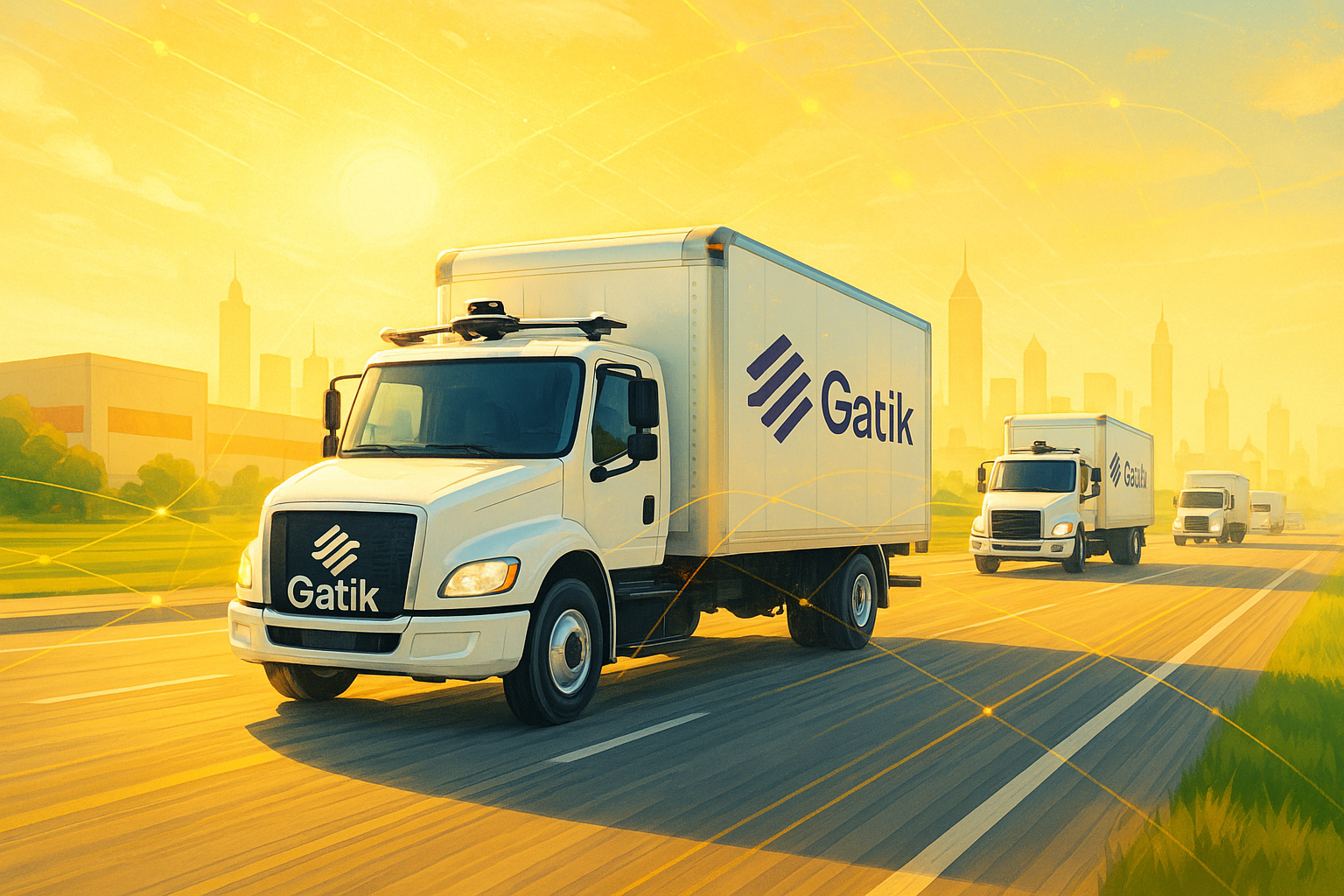
The gist
Gatik just turbocharged the driverless trucking race with a $200 million war chest, moving from pilot projects to real, revenue-generating freight contracts with industry giants like PepsiCo and Walmart.
What to know
- Gatik landed $200 million in Series D funding led by Qatar Investment Authority and Koch Disruptive Technologies, pushing its total freight contracts past $600 million.
- The company has completed 85,000 fully driverless deliveries—no safety drivers on board—with a 99% on-time rate across Texas, Arizona, Arkansas, and Ontario.
- Multi-year deals, including 41 autonomous trucks running PepsiCo’s Frito-Lay routes, spotlight Gatik’s dominance in repeatable, high-frequency middle-mile logistics.
Investor Confidence Surges
Gatik’s $200M funding signals a shift from pilot programs to real-world dominance, with major backers betting on its rapid expansion and deepening client relationships.
Gatik’s $200 million Series D funding round, led by heavyweight investors such as Qatar Investment Authority and Koch Disruptive Technologies, marks a significant financial endorsement of its commercial traction well beyond the pilot stage. This round, supported by other notable participants like Millennium Management and ARK Invest, underscores investor confidence in Gatik’s proven ability to secure over $600 million in freight contracts with major clients including PepsiCo and Walmart, reflecting deep customer demand and repeat business.
The company’s completion of 85,000 fully driverless deliveries with a 99% on-time rate provides tangible operational validation that complements its financial backing, signaling sustained commercial activity rather than mere pilot demonstrations. While these impressive metrics highlight Gatik’s real-world impact within Fortune 50 supply chains, the absence of disclosed audited financials leaves some questions about revenue recognition and profitability unanswered, illustrating the typical opacity in early-stage autonomous freight ventures.
Gatik’s leadership, including co-founder and CEO Gautam Narang, emphasizes that this capital infusion is not just a vote of confidence but a strategic enabler to rapidly scale operations, expand into new cities, and hire engineering talent. This funding round is positioned as a catalyst for transitioning from niche, fixed-route deployments to broader commercial-scale autonomous freight services, aiming to define the future of driverless logistics while maintaining disciplined growth.

Operational Proof at Scale
Surpassing 85,000 driverless deliveries, Gatik’s relentless focus on short-haul, high-frequency routes has turned autonomous trucking from a tech demo into a logistics workhorse.
By early 2026, Gatik had firmly established its commercial-scale autonomous freight operations, completing over 85,000 fully driverless deliveries with an impressive 99% on-time delivery rate. This level of operational reliability not only surpasses typical pilot demonstrations but also validates the company’s ability to meet rigorous commercial logistics demands, as reflected in its more than $600 million in contracted revenue from major clients like Walmart and PepsiCo.
Gatik’s strategic focus on short-haul, high-frequency regional routes between distribution centers and retail stores has been pivotal to its scalability and operational success. By concentrating on this narrower, more predictable operational design domain—often referred to as the middle mile—the company leverages the repetitive nature and time-sensitive complexity of these routes to optimize autonomous freight performance without human drivers or safety observers onboard.
Middle-Mile Mastery
By embedding fleets directly into Fortune 50 supply chains, Gatik’s fixed-route strategy delivers repeatable reliability—though the financial details behind these big contracts remain closely guarded.
Gatik AI has solidified its position in middle-mile logistics through multi-year contracts exceeding $600 million with major clients such as PepsiCo and Walmart, embedding its autonomous trucks into active consumer goods supply chains rather than isolated pilots. These agreements, including a notable deployment of 41 self-driving trucks on PepsiCo's Frito-Lay routes across Texas, Arizona, and Arkansas, highlight Gatik’s focus on repeatable, short-haul regional routes that serve roughly 250 retail locations, including Walmart and Dollar General. This strategic client base underscores Gatik’s niche in providing reliable, scalable autonomous freight services tailored to high-frequency, time-sensitive regional transportation networks.
Central to Gatik’s scalability strategy is its operational design domain, which prioritizes fixed and increasingly dynamic middle-mile routes between distribution centers and retail stores. By concentrating on repeatable, short-haul routes on highways and surface streets, Gatik achieves high-frequency, reliable deliveries—evidenced by over 85,000 fully driverless deliveries at a 99% on-time rate across Texas, Arkansas, Arizona, and Ontario. This focused approach not only enables seamless integration into active supply chain schedules but also supports incremental expansion into new cities, leveraging its AI-first technology to respond dynamically to changing demand and distribution center activity.
While Gatik’s substantial contracted revenue and operational milestones demonstrate strong commercial validation beyond proof-of-concept stages, the absence of detailed disclosures on contract economics, such as duration, termination clauses, and profitability metrics, leaves some uncertainty regarding the financial scalability of these partnerships. Nonetheless, the company’s steady progress in embedding autonomous trucks within major clients’ supply chains and its strategic focus on repeatable middle-mile routes position it well to capitalize on growing demand for automation-driven logistics efficiency.
A New Blueprint for Autonomy
Gatik’s disciplined, region-focused model—and patient, sovereign-backed funding—redefines autonomous trucking’s path to commercialization by prioritizing repeatable, economically viable operations over moonshot ambitions.
Gatik’s evolution from pilot projects to commercial-scale autonomous freight operations exemplifies a broader industry shift toward focusing on predictable, short-haul regional routes within tightly defined operational design domains. Unlike competitors chasing ambitious coast-to-coast or long-haul autonomy, Gatik has concentrated on high-frequency middle-mile routes between distribution centers and retail stores for clients like Walmart and PepsiCo, enabling safer, more scalable deployments without onboard safety drivers. This targeted approach has allowed the company to amass over 85,000 fully driverless deliveries with a 99% on-time rate, securing more than $600 million in freight contracts and demonstrating the viability of autonomous freight in real-world logistics networks.
The maturation of autonomous freight commercialization hinges on patient, long-term investment and regulatory navigation, as evidenced by Gatik’s capital strategy and operational milestones. Sovereign funds backing Gatik provide the financial runway necessary to endure multi-year regulatory approvals, fleet expansions, and rigorous route validation processes that cannot be rushed beyond data-driven safety thresholds. This contrasts with typical venture capital pressures and underscores how autonomous trucking’s path to commercial viability requires a deliberate, methodical scaling strategy focused on repeatable, economically viable operations within constrained environments.
The commercialization trajectory of autonomous freight mirrors the evolution of warehouse automation by initially targeting highly repetitive, bounded transportation tasks rather than attempting to automate every trucking scenario. By concentrating on middle-mile logistics—characterized by predictable, frequent routes—companies like Gatik can accumulate operational experience and deliver measurable improvements in supply chain reliability. This pragmatic focus on constrained operational design domains not only accelerates technology maturation but also provides logistics companies with critical evidence of autonomous fleets’ reliability, repeatability, and economic value in live transportation networks.