Gemma 4 pushes local AI further on devices
The gist
Google DeepMind’s new Gemma 4 model family throws down the gauntlet in AI by packing frontier-level performance into ultra-efficient, open-source tools built for on-device intelligence.
What to know
- Gemma 4 delivers benchmark-beating AI with just 26–31 billion parameters, rivaling models nearly ten times larger thanks to innovations like Per Layer Embeddings.
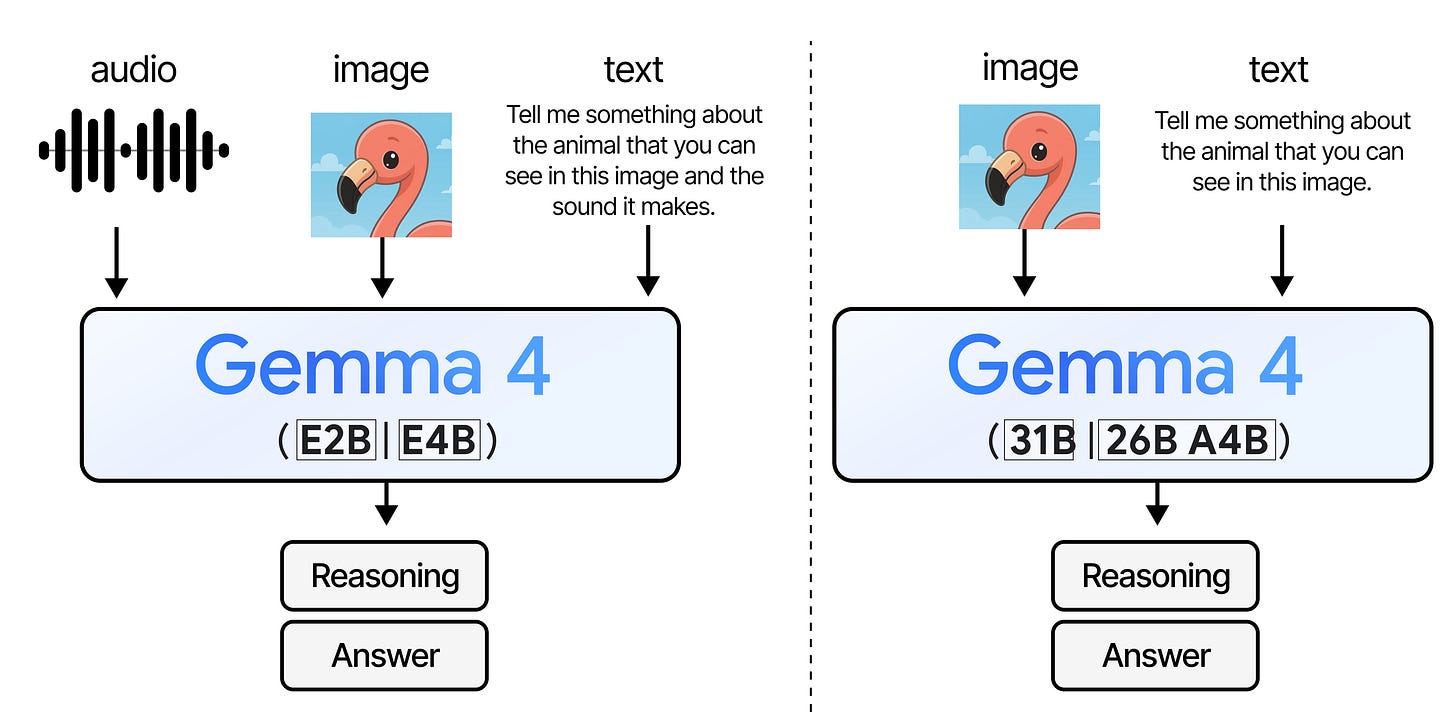
- Edge-friendly E2B and E4B variants offer native multimodal capabilities—think image, video, audio, and speech—optimized for offline use on smartphones and embedded devices.
- Gemma 4 is fully open-source under Apache 2.0, letting developers run powerful AI locally for free and shaking up the cloud-centric AI market.
Redefining AI Efficiency
Gemma 4’s Per Layer Embeddings and agentic workflows deliver frontier AI performance at a fraction of the size, enabling advanced local reasoning and multi-step planning without the computational burden of massive models.
Google DeepMind's Gemma 4 model family exemplifies a breakthrough in parameter efficiency, delivering frontier-level intelligence with significantly smaller model sizes optimized for consumer-grade GPUs. The 31 billion parameter dense and 26 billion parameter mixture of experts variants achieve benchmark performances comparable to models nearly ten times larger, such as Quen 3.5 with 397 billion parameters, enabling advanced local deployment without sacrificing capability. This efficiency is driven by innovations like Per Layer Embeddings (PLE), which assign each decoder layer its own small token embedding, reducing effective parameter counts while preserving model capacity, thus facilitating practical on-device AI.
Beyond raw efficiency, Gemma 4 marks a strategic pivot towards advanced reasoning and agentic workflows, integrating multi-step planning, deep logic, and native function-calling capabilities that empower autonomous agents to interact reliably with diverse tools and APIs. This architectural focus supports structured JSON outputs and system-level instruction handling, elevating the model from simple chatbots to versatile reasoning engines capable of complex logic and multi-turn workflows. As highlighted by Google, these models are 'purpose-built for advanced reasoning and agentic workflows,' reflecting a broader industry trend toward smaller, faster, and more capable open-source AI.
Gemma 4’s technical design also emphasizes scalability and deployment versatility, with a family of models ranging from effective 2B and 4B variants tailored for edge devices offering near-zero latency and low resource consumption, to larger 26B and 31B models optimized for high-end GPUs delivering frontier-level local reasoning and coding pipelines. This spectrum enables use cases from mobile and IoT devices with combined audio-visual inputs to powerful offline code generation assistants, all while preserving data privacy and offline functionality. The 31B model notably supports a large context window of up to 64k tokens, facilitating comprehensive codebase analysis and complex agentic tasks, underscoring its practical utility for developers and enterprises alike.
Gemma 4’s benchmark achievements underscore its intelligence per parameter as a gamechanger in open-source AI, with the 31B model ranking #3 globally on the Arena AI text leaderboard and achieving perfect tool calling scores across all variants. Despite having roughly 10 times fewer parameters than comparable frontier models like GLM5 and Kim K 2.5, Gemma 4 delivers equivalent reasoning and coding quality, making it 'essentially 10 times more efficient' and 'almost 20 times more efficient while maintaining that level of quality,' according to industry analyses. This shift from scale to efficiency redefines expectations for local AI deployment, positioning Gemma 4 as a leading model for privacy-conscious, offline-capable applications.




Multimodal AI at the Edge
Gemma 4’s E2B and E4B variants bring seamless image, video, and speech capabilities to smartphones and embedded devices, unlocking sophisticated offline AI tasks with minimal RAM and battery drain.
Google DeepMind's Gemma 4 edge models, particularly the E2B and E4B variants, exemplify a breakthrough in native multimodal AI by seamlessly integrating image, video, audio, and speech recognition capabilities within a compact parameter footprint optimized for mobile and edge devices. These models, with 2 billion and 4 billion parameters respectively, are engineered to preserve RAM and battery life, enabling sophisticated tasks such as OCR, chart understanding, and speech comprehension directly on devices like smartphones and embedded systems without cloud dependency.
The collaboration between Google DeepMind and hardware leaders including Qualcomm Technologies, MediaTek, and the Google Pixel team has resulted in Gemma 4 models that operate entirely offline with near-zero latency across a broad spectrum of edge hardware—from high-end Android phones and iPhones with M-series chips to embedded platforms like Raspberry Pi and Nvidia Jetson. This offline efficiency not only reduces reliance on costly cloud AI services but also supports scalable local AI deployment, empowering power users to run advanced multimodal AI workloads on personal devices.
Gemma 4’s scalability is underscored by its availability in multiple sizes—from lightweight 2 billion and 4 billion parameter models suitable for phones with 8GB RAM, to larger 26 billion and 31 billion parameter configurations designed for laptops and desktops—accompanied by plans for quantized versions that maintain quality while reducing model size. This flexibility ensures that even devices with limited resources can harness multimodal AI functionalities, although performance trade-offs exist for lower-end hardware such as older smartphones with 4 to 6 GB RAM.
Despite some current hardware compatibility challenges, such as limited optimization for Radeon-based Rock M processors, Gemma 4 demonstrates impressive local image recognition capabilities—including detailed scene analysis and license plate reading—with reasonable latency entirely on-device. This highlights the model’s potential to democratize advanced multimodal AI by enabling sophisticated, offline visual and audio processing on a wide range of edge devices, fostering broader adoption beyond traditional cloud-based AI paradigms.



Hardware Partnerships Drive Edge AI
DeepMind’s tight integration with chipmakers like Qualcomm and Apple positions Gemma 4 for near-zero latency on modern devices, but its full power remains out of reach for older or lower-end hardware.
Google DeepMind's Gemma 4 edge models, notably the E2B and E4B variants with 2 billion and 4 billion parameter footprints respectively, have been meticulously optimized for efficient offline deployment on mobile and edge devices, preserving RAM and battery life. This optimization was achieved through close collaboration with hardware leaders such as Qualcomm Technologies, MediaTek, and the Google Pixel team, enabling near-zero latency multimodal AI experiences across a diverse range of platforms including phones, Raspberry Pi, and Nvidia Jetson. Furthermore, Gemma 4's broad compatibility with ecosystems like HuggingFace, Llama CPP, and Nvidia Nims underscores its accessibility and scalability across various hardware environments, facilitating widespread adoption in the edge AI landscape.
Despite its versatility, Gemma 4 demands relatively recent and capable hardware to run effectively, with recommended devices including Android phones boasting at least 8 GB of RAM, iPhone 15 Pro and newer, and iPads equipped with M series chips and 8 to 16 GB of RAM. Older or lower-end devices, such as iPhone 13/14 models with 4 to 6 GB RAM, can only handle significantly smaller Gemma variants, highlighting ongoing challenges in achieving broad device compatibility. This delineation suggests that while Gemma 4 is pushing the boundaries of local AI, its full potential currently caters more to power users with high-end hardware.
Gemma 4's hardware compatibility is not without its limitations; for instance, the model struggles with Radeon-based processors like the Rock M, resulting in suboptimal performance on certain local processing rigs. In contrast, companies like Apple are strategically positioned to capitalize on this shift toward local AI by offering dedicated hardware explicitly designed to efficiently run models like Gemma 4, reinforcing their competitive edge in the evolving AI hardware market. This dynamic underscores the critical role of hardware-software co-optimization in advancing edge AI capabilities and shaping vendor positioning.
Open Source Disrupts Cloud AI
By releasing Gemma 4 under Apache 2.0, DeepMind intensifies the open-weight AI race, empowering developers with free, locally-run intelligence and pressuring rivals to compete on openness and cost.
Gemma 4's fully open-source Apache 2.0 licensing marks a pivotal shift in local AI deployment by enabling free download, modification, and commercial use, thereby democratizing access for developers, startups, and academics. This openness contrasts with competitors like Meta, which are trending toward more closed models, positioning DeepMind as a leader in fostering open science and innovation. As Demis Hassabis emphasized, these models are tailored for edge computing and smaller-scale applications, reflecting a strategic commitment to broadening AI accessibility beyond cloud-centric paradigms.
By optimizing Gemma 4 for local, offline use on devices ranging from smartphones to laptops, DeepMind challenges the prevailing cloud-dependent AI market structure, potentially driving down consumer costs by eliminating token usage fees. This shift empowers users with frontier-level intelligence directly on their hardware, as Omar Sanseviero noted, 'Being able to run those capabilities directly in the user’s hardware — that’s the future.' Such local deployment not only accelerates AI adoption in connectivity-challenged regions like India but also reshapes market competition by reducing reliance on costly cloud services.
Gemma 4 intensifies competition within the open-weight AI model landscape, standing alongside rivals like DeepSeek, Qwen, and Mistral by offering a potent combination of efficiency, scalability, and offline capability. This competitive pressure is driving down prices and encouraging innovation, as users increasingly favor free tokens and local execution over proprietary cloud models that charge premiums for reliability and ease of use. DeepMind’s strategy complements its proprietary Gemini models, creating a versatile ecosystem that balances open and closed tools to meet diverse developer needs.
The emergence of Gemma 4 signals a broader market transformation where foundational AI models in the cloud handle complex planning, but execution and interaction increasingly occur locally on edge devices. This hybrid architecture not only enhances speed and privacy but also threatens existing AI companies reliant solely on cloud-based software and services, as local models become the preferred choice for power users and early adopters. Companies like Apple, with dedicated hardware optimized for local AI, are strategically positioned to capitalize on this shift, underscoring the growing importance of hardware-software synergy in the evolving AI ecosystem.