GLM-5.2’s 1m-token push raises memory stakes
The gist
GLM-5.2’s open-source mega-model is shaking up the AI world, outpacing GPT-5.5 and Claude Opus 4.8 with a groundbreaking 1 million-token context window and 744 billion-parameter Mixture-of-Experts—while igniting fresh geopolitical and security anxieties.
What to know
- GLM-5.2 boasts a record-breaking 1 million-token context window and 744B-parameter MoE architecture, enabling ultra-long, high-quality outputs at lightning speed.
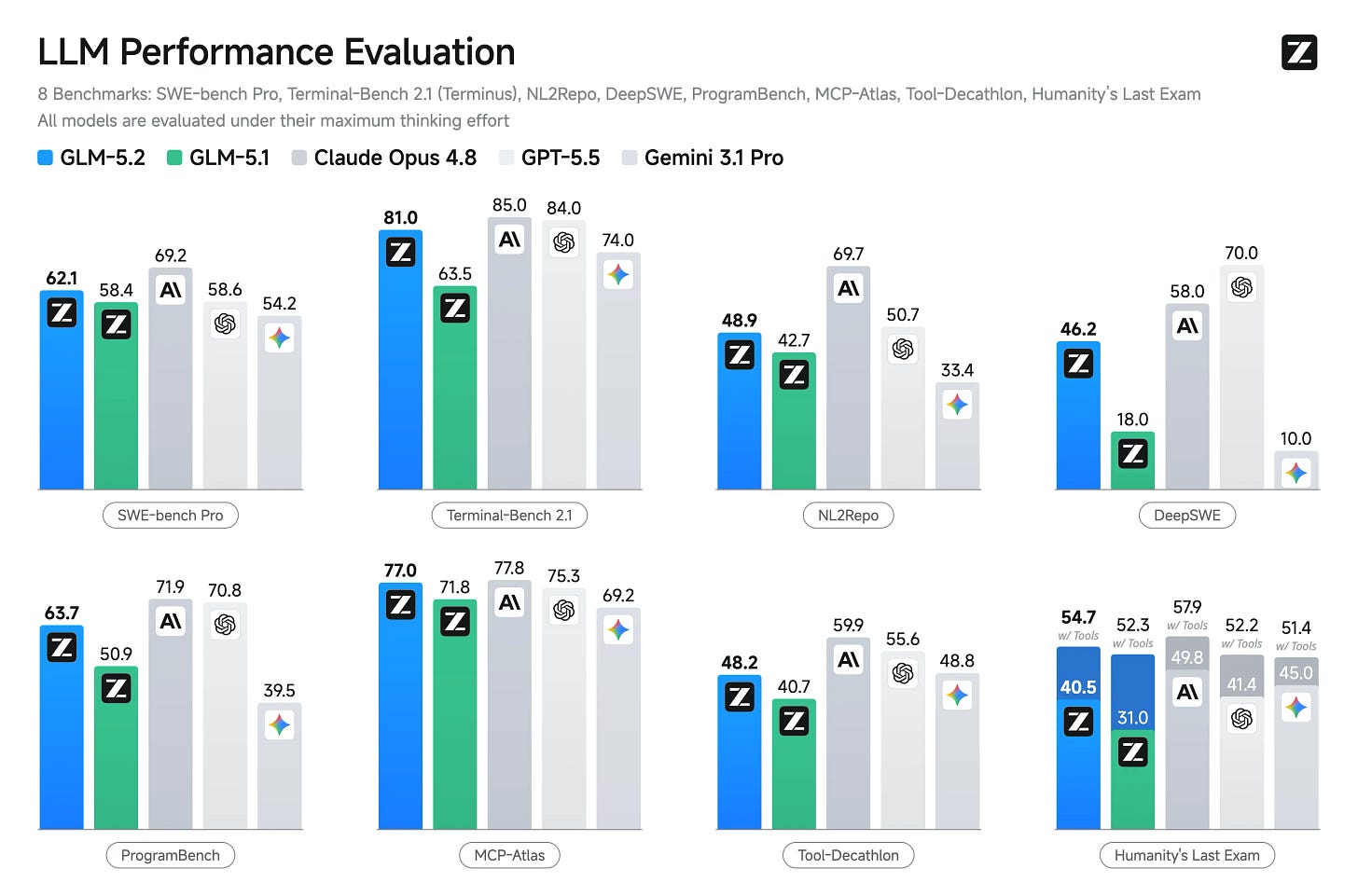
- On benchmarks like ARC-AGI and SWE-bench Pro, GLM-5.2 outperforms proprietary leaders, posting a SWE-bench Pro score of 62.1 versus GPT-5.5’s 58.6 and topping open-weight rankings.
- Released under an open-weight MIT license, GLM-5.2 lets enterprises self-host without cloud dependence—sparking rapid adoption, challenging U.S. AI dominance, and raising the stakes in global tech regulation.
Architectural Breakthroughs Unleashed
GLM-5.2’s 1M-token context window and novel sparse attention mechanisms redefine long-form AI coherence, setting a new bar for stable, high-speed agentic reasoning and coding performance.
GLM-5.2 sets a new standard in long-context AI with its robust 1 million-token context window, enabling stable and consistent performance across extended, complex coding tasks and agentic reasoning. This breakthrough, emphasized by Z.ai and user feedback, allows the model to maintain coherence from initial research phases through to final deliverables, effectively addressing degradation issues common in other large models.
At the architectural core, GLM-5.2 leverages a massive 744-billion parameter Mixture-of-Experts (MoE) framework combined with the novel IndexShare sparse attention mechanism, an evolution of DeepSeek Sparse Attention. This synergy enhances efficiency and scalability for ultra-long context processing, while innovations like KVShare integrated into the multi-token prediction (MTP) layer further boost token acceptance rates, enabling the model to predict and verify multiple tokens simultaneously with an average acceptance length surpassing 5 tokens.
GLM-5.2’s multi-token prediction advances, supported by end-to-end joint training with total variation loss, minimize distribution discrepancies between draft and target models, significantly accelerating output generation without sacrificing quality. This architectural refinement extends speculative decoding windows from 3 to 5 tokens, marking a substantial leap in generation efficiency that benefits coding and agentic workflows.
Despite its scale and complexity, GLM-5.2 demonstrates practical and efficient on-premise deployment, notably on consumer-grade hardware like the Mac Studio M3 Ultra. Early adopters such as @pcuenq and @agupta highlight the model’s open-weight nature enabling custom quantization, fine-tuning, and flexible serving paths unavailable in closed API models, while ecosystem support across inference stacks like Transformers and vLLM ensures broad accessibility and fast inference.



Open-Weight Model Tops Benchmarks
GLM-5.2 consistently outperforms closed-source giants on real-world coding and reasoning tasks, shrinking the innovation gap and proving open models can lead on both quality and cost-efficiency.
GLM-5.2 has firmly established itself as the premier open-weight AI model, consistently ranking near the top of multiple rigorous benchmarks and often outperforming proprietary heavyweights like GPT-5.5 and Claude Opus 4.8. With a leading score of 51 on the Artificial Analysis Intelligence Index—surpassing its predecessor GLM-5 and edging close to proprietary leaders such as Fable and Opus—GLM-5.2 demonstrates exceptional prowess in coding, reasoning, and agentic tasks. Notably, it achieved the highest verified scores for any open model on ARC-AGI benchmarks and topped coding benchmarks like SWE-bench Pro with a 62.1 score, outpacing GPT-5.5’s 58.6, underscoring its real-world deployment readiness and competitive positioning in the AI landscape.
A key driver of GLM-5.2’s benchmark dominance is its advanced architectural innovations, including a massive 1 million token context window—five times larger than its predecessor—and dual configurable reasoning modes that balance speed and depth. These features empower it to excel in complex, long-horizon coding and agentic tasks, such as topping the Terminal-Bench 2.1 with an 81% score, a milestone for open models, and securing second place on the Vending-Bench 2 against all Google and OpenAI models except Claude Opus 4.7. This combination of scale and efficiency, supported by 744 billion parameters and IndexShare optimization, enables GLM-5.2 to maintain coherent, economically consequential strategies over extended tasks, setting new standards for open AI agents.
While GLM-5.2 narrows the performance gap with proprietary giants, it still trails the absolute frontier models like Gemini 3.1 Pro on the most complex compositional reasoning benchmarks, such as ARC-AGI-2, where it scored 22.8% compared to Gemini’s 77.1%. Nevertheless, this gap has shrunk dramatically to a matter of months rather than years, signaling rapid progress in open-weight AI development. Experts like Håvard Ihle highlight GLM-5.2 as a significant milestone in Chinese AI, forecasting even more competitive models soon. Moreover, GLM-5.2’s cost-effectiveness—completing complex tasks like machine learning paper reproduction at a fraction of the cost of proprietary models—further strengthens its competitive positioning and practical appeal.

Enterprise Control Goes On-Prem
GLM-5.2’s MIT license and robust self-hosting options are driving a shift from cloud dependence to in-house AI infrastructure, fueling a surge in adoption and cost savings across industries.
GLM-5.2’s open-weight MIT license fundamentally reshapes AI deployment by granting enterprises full autonomy to download, modify, and self-host the model on-premise without reliance on private APIs or cloud providers. This level of user control empowers organizations to own their AI infrastructure outright, sidestepping recurring cloud fees and regulatory uncertainties that have recently constrained U.S.-based closed-source models like those from Anthropic and OpenAI. As noted in multiple analyses, this open licensing model not only democratizes access but also positions GLM-5.2 as a resilient alternative amid tightening federal restrictions, making it a strategic choice for businesses prioritizing sovereignty and uninterrupted AI access.
The open-source deployment of GLM-5.2 has catalyzed rapid community adoption and robust ecosystem growth, with platforms like OpenRouter reporting it among the top 10 most used AI models and experiencing token traffic surges surpassing previous landmark launches such as DeepSeek V4. This momentum reflects the model’s appeal as a cost-efficient alternative to closed-source APIs, enabling developers and enterprises to tailor the model across diverse sizes and platforms. As one community member enthused, the collaborative development around GLM-5.2 exemplifies “amazing work” that strengthens the open AI ecosystem and fosters a sense of collective ownership.
The shift toward on-premise self-hosting of GLM-5.2 aligns with broader industry trends where CFOs and IT leaders seek to regain control over AI infrastructure spending by investing in physical hardware rather than renting expensive cloud GPU time. Reports indicate Nvidia server rentals have dropped by 22% week-over-week as capital reallocates to bare-metal purchases, reflecting a strategic pivot to cost predictability and operational sovereignty. Businesses switching from proprietary models like Opus 4.8 to GLM-5.2 report no perceptible performance loss, underscoring the model’s viability as a scalable, affordable, and flexible AI backbone for enterprises.
While GLM-5.2’s open-weight architecture offers unparalleled freedom and ownership, it also introduces security considerations, as unrestricted access can be exploited by malicious actors seeking to run AI models covertly. Additionally, users must weigh the model’s higher token consumption—sometimes two to ten times greater than alternatives—when calculating operational costs despite savings from avoiding cloud fees. These trade-offs highlight the nuanced balance between democratizing AI control and managing the practical implications of resource usage and potential misuse in an increasingly decentralized AI landscape.





Global AI Power Shift Accelerates
GLM-5.2’s open-source release is shaking up the geopolitical AI landscape, intensifying regulatory debates and signaling China’s rapid advance toward parity with Western AI leaders.
GLM-5.2's open-weight architecture fundamentally disrupts the entrenched dominance of closed-source AI models from U.S. companies like OpenAI and Anthropic by enabling unrestricted on-premise deployment without reliance on APIs or private vendors. This democratization of cutting-edge AI technology not only accelerates China's timeline to reach Fable-level intelligence—potentially as soon as Q1 2027, according to Elon Musk and J Tang—but also reshapes global AI market competition by offering cheaper, more accessible alternatives that reduce vendor lock-in and challenge narratives of Western technological superiority.
The open-source release of GLM-5.2 intensifies governance and security concerns as its powerful capabilities can be exploited by malicious actors operating in the shadows, complicating oversight and shifting safety responsibilities onto end users. Analysts warn that if Fable/Myth-level intelligence is considered too dangerous for public release, the open availability of GLM-5.2 at this threshold almost guarantees the emergence of new open-source AI regulations to mitigate risks of abuse, exfiltration, and unsafe deployment in sensitive workflows.
GLM-5.2's competitive edge in cybersecurity benchmarks, such as bug detection where it rivals leading U.S. models like Anthropic's Opus 4.8, underscores China's rapidly advancing AI capabilities and heightens geopolitical tensions. Its growing popularity on platforms like OpenRouter and recognition by outlets like The Wall Street Journal highlight how this open-weight model is not only narrowing the performance gap with expensive rented AI but also accelerating China's strategic positioning in the global AI race.
The emergence of GLM-5.2 reignites the broader geopolitical debate over open-source versus closed-source AI development, spotlighting concerns about national security, market control, and the shifting balance of AI leadership. While the competition is often framed as China versus the West, the more consequential narrative is the rapid democratization of high-quality AI technology that challenges existing market monopolies and forces policymakers worldwide to reconsider regulatory frameworks in an increasingly multipolar AI landscape.