Golden ballrooms, broken guardrails: trump’s imperial presidency becomes the new normal
The gist
Trump’s second term is redefining U.S. democracy with imperial excess, shattered guardrails, and a new normal where unchecked power and elite self-enrichment reign.
What to know
- By 2026, the Trump administration used a $1.776 billion Justice Department fund to compensate January 6 insurrectionists and launched unauthorized military strikes, undermining constitutional checks and balances.
- Lavish projects like a $330 million gilded White House ballroom and costly monuments highlight elite detachment as millions of Americans face economic hardship.
- Partisan loyalty now trumps shared moral standards, turning accountability into a selective weapon and fueling societal cynicism as critics warn of a dangerous slide toward an imperial presidency.
Unchecked Power, Shattered Norms
Trump’s inner circle has dismantled constitutional guardrails, openly violating the rule of law and setting a precedent for presidential impunity.
By early 2026, the Trump administration has dramatically eroded constitutional accountability by operating with fewer constraints and a fiercely loyal team willing to push presidential power beyond traditional limits. This shift raises alarms about the United States sliding toward an imperial presidency, where the essential system of checks and balances is undermined, threatening the foundational rule of law that sustains democratic governance.
The administration’s blatant disregard for constitutional norms is starkly illustrated by its use of a $1.776 billion Justice Department fund to compensate Trump allies implicated in the January 6 insurrection, directly contravening the Fourteenth Amendment’s prohibition against assuming debts incurred in rebellion. This unprecedented move signals a dangerous normalization of lawlessness, where legal boundaries are not just tested but openly violated to protect political allies.
Further compounding this breakdown, the Trump administration has unilaterally engaged in unauthorized military action, notably bombing Iran without Congressional approval, thereby violating Article I of the Constitution and the War Powers Act. Such actions flagrantly undermine the separation of powers, demonstrating a pattern of executive overreach that erodes constitutional governance and sets a perilous precedent for future administrations.
Together, these developments reveal an administration entrenched in an open assault on truth and democratic norms, where criminality and corruption have become normalized rather than exceptional. As critics have noted, this is arguably the most corrupt and lawless administration in American history, one that routinely flouts legal constraints and 'gets away with almost all of it,' signaling a systemic breakdown in constitutional accountability.
Authoritarianism by Stealth
Democratic institutions are being quietly hollowed out as authoritarian practices become routine, embedding undemocratic control without dramatic upheaval.
By early 2026, analysts emphasized that the gravest threat to democracy is not the rise of a singular authoritarian figure but the gradual institutionalization of authoritarian governance practices that transform democratic institutions into self-sustaining ecosystems. This erosion is often subtle, unfolding through administrative, bureaucratic, procedural, and legalistic changes that evade public scrutiny and emotional recognition, allowing these anti-democratic systems to embed deeply without dramatic upheaval.
The advancement of authoritarianism operates through mechanisms such as loyalty enforcement, retaliation against dissent, ideological control, and the concentration of executive power, which collectively reshape democratic institutions incrementally rather than through overt violence or sudden collapse. This slow recalibration of power structures enables the system to begin reshaping itself automatically, embedding undemocratic control within the very fabric of governance.
Perhaps most perilous is the normalization phase, where public perception shifts to accept authoritarian governance as the new status quo, encapsulated in the resigned mindset: 'Well…this is just how things are now.' This acceptance cements the ecosystem’s durability, making democratic restoration increasingly difficult as authoritarian loyalty and governance become entrenched and self-perpetuating beyond any single leader’s tenure.

Spectacle Over Substance
Trump’s obsession with grandiose monuments and public theatrics deflects scrutiny from crises and erodes faith in democratic governance.
By early 2026, President Trump’s penchant for vanity projects—such as commissioning a no-bid $6.9 million contract to paint the Reflecting Pool blue and erecting oversized monuments like a gigantic arch—served as deliberate distractions from pressing national crises like the war in Iran and soaring gas prices. His dismissive and provocative responses to reporters, including labeling ABC News correspondent Rachel Scott a 'horror show' and decrying her questions as 'a disgrace to our country,' exemplify a broader strategy to silence dissent and erode public trust in democratic institutions.
Trump’s symbolic politics extend beyond physical monuments to performative public behavior that fosters a cult of personality while undermining democratic accountability. His choice to skip a White House-supported faith rally in favor of golfing—spending roughly 20% of his presidency on the course—combined with posting provocative AI-generated images on Truth Social depicting nuclear war and manipulated political figures, signals a deliberate effort to divert attention from substantive governance issues. Critics, including Nancy Pelosi’s office, have condemned these acts as distractions that cast doubt on the seriousness and responsibility expected of the presidency.
This fixation on symbolic monuments and performative distractions not only reveals Trump’s vanity but also reflects a deeper disregard for the nation’s history and democratic norms. As highlighted in commentary from May 2026, projects like painting the Eisenhower Executive Office Building white and building extravagant ballrooms are grotesque examples of prioritizing spectacle over substance, effectively fostering a cult of personality that diverts public scrutiny from policy failures and governance challenges.


Elites Flaunt, Public Struggles
Lavish presidential spending and elite indifference deepen the gulf between rulers and the ruled, fueling cynicism and undermining democratic legitimacy.
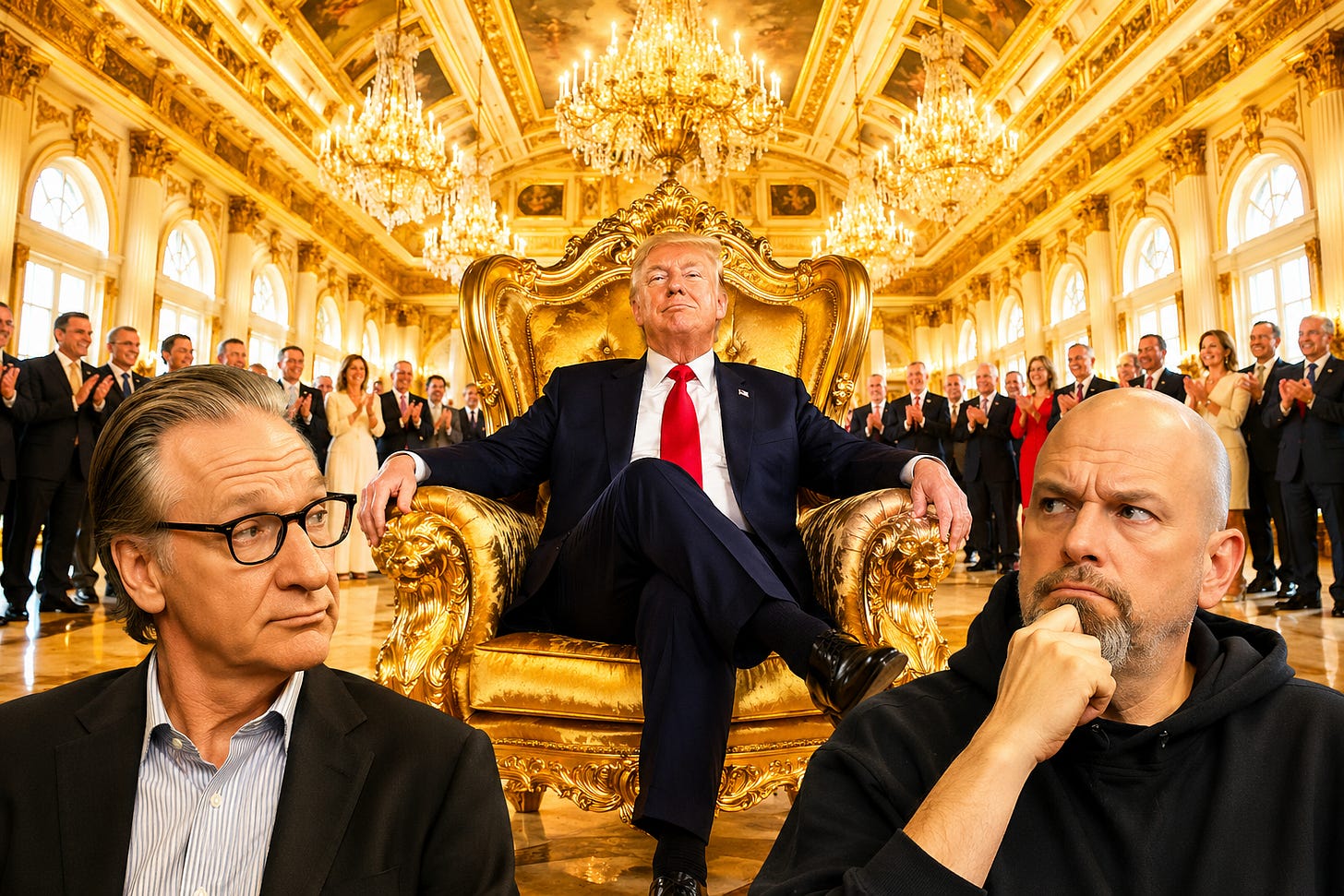
By mid-2026, the stark contrast between lavish spending on Trump’s $330 million gilded White House ballroom and the economic hardships faced by millions of Americans has become a glaring symbol of elite detachment. While ordinary families struggle to afford essentials like rent, healthcare, and groceries, the president’s obsession with personal glorification projects underscores a profound disconnect that fuels public disillusionment and erodes democratic legitimacy. This opulence is not merely aesthetic but a deliberate transformation of democratic governance into a personal branding exercise for a billionaire strongman, as critics argue the golden ballroom is "a statement about power" rather than public service.
The dismissive reactions from elite figures such as Bill Maher and Senator John Fetterman, who trivialized public outrage over the extravagant spending as mere "couch money," reveal a smug and self-satisfied elite that deepens the divide between political/media elites and everyday citizens. This elite detachment is compounded by budget priorities that slash funding for vital programs supporting tribes, public lands, and wildlife, while simultaneously increasing allocations for Washington D.C. beautification and Trump’s vanity projects. Such prioritization exemplifies political corruption, as Representative Jared Huffman bluntly states, marking this administration as "the most nakedly corrupt in American history," thereby intensifying public cynicism toward democratic leadership.
Underlying the critique of ostentatious wealth is not envy but a principled opposition to concentrated power masquerading as virtue. Progressives emphasize the societal value of everyday workers—like teachers—over billionaire excess, highlighting how Trump’s branding efforts reduce governance to a luxury commodity. This framing challenges the legitimacy of a system where political authority is wielded as a personal brand, undermining the foundational democratic ideal that public service should prioritize collective welfare over individual aggrandizement.

Morality Lost to Partisanship
Shared ethical standards have collapsed, with political loyalty now justifying corruption and turning accountability into a partisan weapon.
By mid-2026, the political landscape reveals a stark erosion of shared moral standards, where corruption is no longer universally condemned but rather rationalized based on partisan allegiance. As Tom Bilyeu observes, behaviors once deemed unequivocally wrong, such as insider trading by CEOs, are now being normalized for politicians, reflecting a 'slippery slope' that undermines societal ethics. This moral ambiguity is compounded by the absence of concrete societal mechanisms to define and enforce common principles, leaving citizens unable to hold their leaders accountable to consistent standards.
Partisan loyalty has supplanted principle, transforming political accountability into a selective weapon rather than a universal standard. Both sides of the aisle wield accusations of corruption as tactical tools, as one analysis notes, turning accountability into a 'sword' used opportunistically when in power. This dynamic is further intensified by populism’s framing of politics as a zero-sum 'team sport,' which discourages mutual understanding and entrenches divisions, making constructive political dialogue increasingly elusive.
The breakdown of shared values and the rise of partisan tribalism have corroded transparency and trust in political institutions. Without a societal consensus on core beliefs, politicians evade clear articulation of principles, leaving the public with diminished expectations and fractured dialogue. As highlighted in multiple analyses, this lack of concretized, publicly affirmed standards means that when leaders betray principles, there is no unified framework for calling them out, deepening cynicism and political disengagement.

Warnings and Resistance Rise
Prominent critics decry the normalization of authoritarian theatrics and urge civic vigilance as democratic norms face an existential threat.
By early 2026, voices like Heather Cox Richardson and Mary Trump have sounded urgent alarms about the erosion of democratic norms under Trump 2.0, warning of a slide toward an 'imperial presidency' fueled by an open assault on truth. Mary Trump condemns the exploitation of religion to elevate Donald Trump into a superhuman figure, calling out the spectacle of MAGA pastors unveiling a massive golden statue as a dangerous performative distraction that undermines institutional integrity and demands vigilant resistance.
Alongside these warnings, public nostalgia for 2016’s perceived stability reveals a widespread yearning for normalcy amid democratic backsliding, underscoring the critical need for informed civic engagement and robust public discourse. Wajahat Ali and Mary Trump emphasize that combating the normalization of incompetence and the manipulation of religious and political symbols requires sustained political resistance and a refusal to accept authoritarian theatrics, as exemplified by the defensive rationalizations of religious leaders around the golden statue.