Google’s gemma 4 redefines local AI: lightning-fast multimodal power, open for all
The gist
Google’s Gemma 4 smashes local AI barriers with lightning-fast, multimodal models that run anywhere—phones, GPUs, and everything in between—completely offline and fully open-source.
What to know
- Gemma 4’s hybrid dense-MoE architecture delivers 70B-model reasoning with just 26B parameters, activating only 6.25% per token for massive efficiency gains.
- Edge variants (E2B/E4B) support images, video, and audio natively, run with near-zero latency even on Raspberry Pi, and enable OCR, speech, and real-time video analysis—no cloud needed.
- Released under Apache 2.0, Gemma 4 is open to all for download, fine-tuning, and commercial use, driving a vibrant ecosystem across HuggingFace, Nvidia Nims, and beyond.
Deployment-Aware AI Engineering
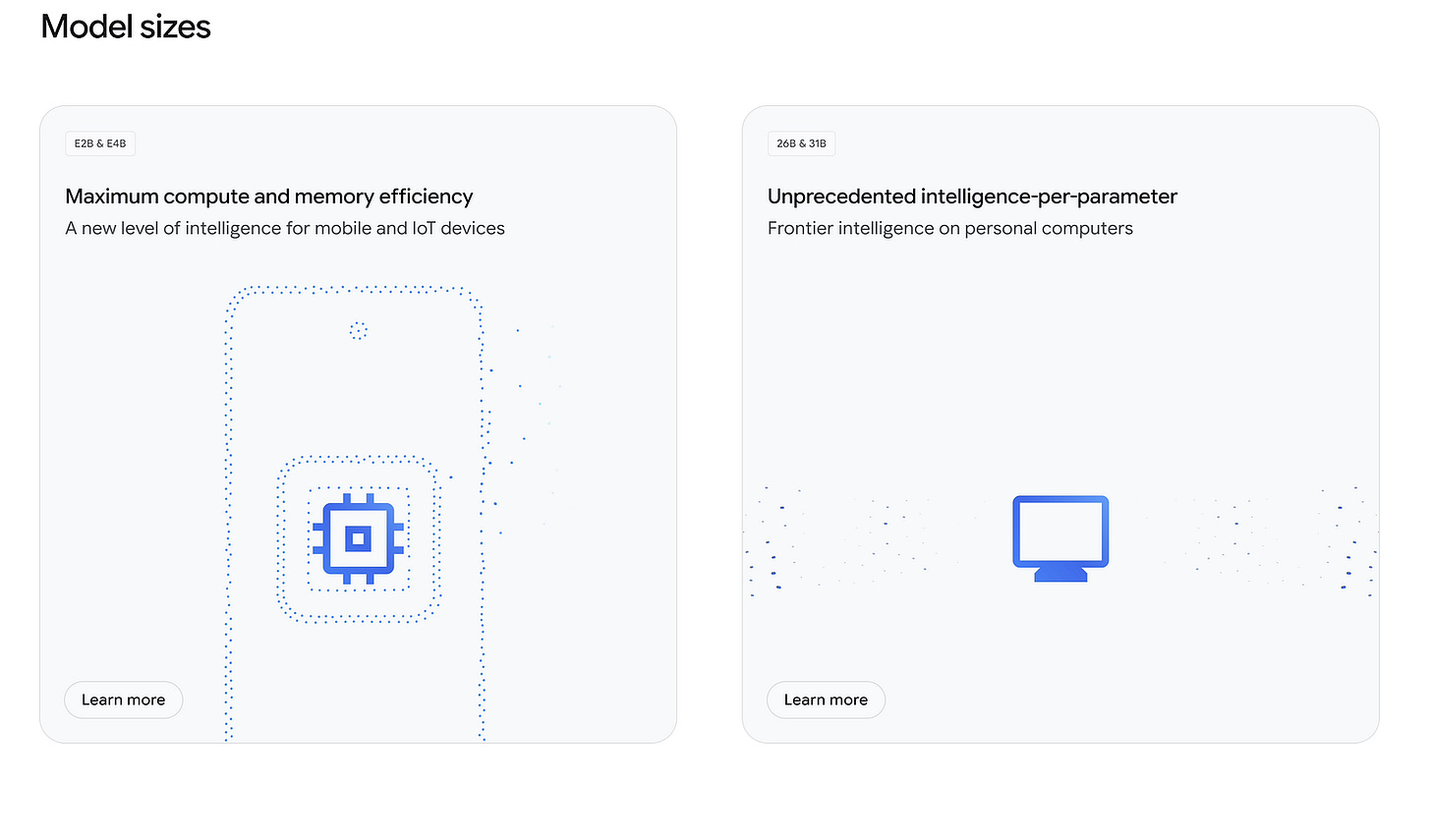
Gemma 4 splits its DNA between edge and server models, each engineered with unique memory and compute trade-offs that maximize efficiency and performance on vastly different hardware.
Gemma 4's architecture is a masterclass in tailoring AI models to diverse hardware constraints, splitting its design into two divergent DNA strands: the edge-focused E2B and E4B models optimized for phones and low-memory devices, and the server-oriented 26B and 31B models built for high-performance local GPUs. This bifurcation reflects a fundamental trade-off between memory, storage, and compute—edge devices leverage abundant flash storage to compress memory at the cost of increased computation, while servers exploit plentiful DRAM to save on compute cycles. Such deployment-aware divergence is exemplified by innovations like per-layer embeddings heavily utilized in edge models for parameter efficiency, interleaved local-global attention mechanisms that selectively pay the O(n²) compute tax, and divergent grouped query attention (GQA) strategies that optimize key-value cache compression differently across platforms.
At the heart of Gemma 4’s efficiency lies a sophisticated hybrid architecture that blends dense and Mixture-of-Experts (MoE) models, notably in the 26B variant which activates only 6.25% of its 25.2 billion parameters per token. This design combines an always-on dense feed-forward network with 128 sparse experts, routing tokens to eight experts each forward pass, thereby achieving reasoning quality comparable to a 70B model but at the inference cost of an 8B. Google's novel 'Oure' MoE architecture, featuring a shared router expert alongside 128 total experts, ensures both robustness and specialization, mitigating common routing errors in high-sparsity MoE systems and enhancing model capacity without bloating compute demands.
Gemma 4 pushes the envelope on attention mechanisms by interleaving local and global attention layers in a 5:1 ratio, allowing efficient processing of sliding windows spanning 512 tokens on smaller models and up to 1,024 on larger ones, while the final layer attends globally to all preceding tokens. This hybrid attention strategy, combining sliding window local attention with global attention, captures both fine-grained and contextual information effectively, a key factor behind its frontier-level performance on constrained compute budgets. Complementing this, grouped query attention (GQA) innovatively shares key and value heads among eight queries in global layers, doubling key-value head length to 512 and significantly reducing memory and inference costs without sacrificing accuracy.
Beyond architectural topology, Gemma 4’s dense models outperform larger peers by integrating curated training data, improved image understanding, and efficient memory reuse through a shared KV-cache. Unlike prior models that distorted images into squares, Gemma 4 processes images in their original aspect ratio, boosting benchmark performance. The shared KV-cache innovation reduces redundant computations by allowing layers to borrow previously computed memory rather than recalculating from scratch, enhancing efficiency without compromising output quality. These refinements underscore Google’s commitment to maximizing intelligence per parameter and compute unit, cementing Gemma 4’s status as a state-of-the-art model despite its relatively modest parameter count.




Per-Layer Embeddings Power
By assigning unique embeddings to every decoder layer and storing them in flash, Gemma 4 achieves Quen 3.5-level reasoning with a fraction of the memory footprint.
By early 2026, Google’s Gemma 4 model revolutionized local and edge AI through its exceptional intelligence per parameter, delivering performance comparable to much larger models like Quen 3.5 despite having only 31 billion parameters. This breakthrough was achieved by leveraging per-layer embeddings (PLE), which assign each of the 35 decoder layers its own 256-dimensional embedding table, enabling fresh, context-aware token representations at every layer. Rather than increasing model size, this approach maximizes parameter efficiency and allows large embedding tables to be stored in flash memory instead of DRAM, exploiting the abundant flash storage on consumer devices to dramatically reduce VRAM usage and memory bottlenecks during inference.
Gemma 4’s architecture smartly balances compute and memory constraints across hardware targets by adopting distinct strategies for edge and server environments. On edge devices like phones and Raspberry Pi, models such as E2B and E4B run with near-zero latency and low memory usage by loading only a subset of parameters into GPU memory while offloading large static embedding tables to flash storage. This memory compression comes at a modest compute cost but enables efficient multitasking and battery-friendly operation, with inference typically activating just 2 to 4 billion parameters and requiring as little as 6 to 8 GB of VRAM. Conversely, server models prioritize memory to save compute, fitting larger variants within a single 80GB H100 GPU and supporting quantized versions that further reduce compute costs for local AI servers.
The hybrid Mixture-of-Experts (MoE) design in Gemma 4’s 26 billion parameter model exemplifies efficiency by activating only a fraction of the network per token—about 6.25%—while maintaining reasoning quality comparable to models nearly three times larger. This is achieved through a dense feed-forward network combined with sparse expert routing, where an always-on dense path guarantees output quality even if routing errors occur, making high sparsity both practical and reliable. Complementing this, innovations like cross-layer KV-cache sharing reduce memory cache requirements by 83%, further optimizing local inference without sacrificing performance.
True Multimodal Edge AI
Gemma 4’s E2B and E4B models deliver real-time image, video, and audio processing on phones and embedded devices—fully offline and with battery-friendly efficiency.
By early 2026, Google DeepMind’s Gemma 4 edge models, notably the E2B and E4B, have set a new benchmark for on-device multimodal AI by natively supporting inputs across images, video, and audio. These models excel at complex visual tasks such as OCR and chart understanding, while also enabling robust speech recognition, all running fully offline with near-zero latency on a wide range of devices including phones, Raspberry Pi, Nvidia Jetson, and embedded systems. This seamless multimodal capability is complemented by lightweight architectures—using only 2 to 4 billion parameters during inference—to optimize RAM and battery usage, making high-quality AI accessible on mobile and embedded hardware without cloud dependency.
Gemma 4’s open-source nature under the Apache 2.0 license and broad platform availability—from HuggingFace to Nvidia Nims—empowers developers to download, fine-tune, and deploy these models locally, fostering a vibrant ecosystem of user-customizable AI skills. The models’ deployment-aware design, tailored for distinct hardware targets and inference budgets, ensures practical on-device applications such as speech recognition, video analysis, and agentic workflows with native function calling and structured JSON outputs. This flexibility not only supports offline operation on billions of Android devices and laptops but also hints at powering future AI assistants like Apple’s new Siri, underscoring Gemma 4’s role as a general-purpose reasoning engine with multimodal prowess.
Beyond foundational capabilities, Gemma 4 enables powerful, personalized on-device AI experiences that users can create and customize without leaving their apps or requiring internet connectivity. Leveraging Google’s Light RT framework built on TensorFlow Lite, these AI skills run efficiently across platforms including Android, iOS, Mac OS, Linux, Windows, web, and IoT devices. Practical applications range from sleep tracking and mood analysis to music generation and grounded visual reasoning for real-time video analysis—such as fire detection or dash cam footage review—entirely offline. The open-source sample apps and active GitHub community further facilitate skill sharing and collaborative innovation, making Gemma 4 a scalable, versatile solution for next-generation edge AI.



Multi-Token Prediction Breakthrough
A lightweight drafter model speculatively generates multiple tokens in parallel, tripling Gemma 4’s inference speed while preserving output quality and accuracy.
Gemma 4’s Multi-Token Prediction (MTP) technology revolutionizes inference speed by employing a smaller, architecturally lightweight drafter model—such as the 78M-parameter E2B assistant with just four transformer layers—that speculatively drafts multiple tokens in parallel. The main, larger target model then verifies these tokens simultaneously, enabling up to 3x faster inference without any loss in output quality or reasoning capabilities. This approach not only doubles decoding throughput on GPUs like Nvidia RTX Pro 6000 and Apple Silicon but also achieves up to 5x speedups in simpler tasks, demonstrating remarkable efficiency gains across diverse hardware and workloads.
Integration and community engagement have been pivotal in MTP’s rapid adoption and optimization. The MTP drafters are openly licensed under Apache 2.0 and seamlessly integrate with popular inference engines such as vLLM, MLX, and SGLang, which support configurable speculative decoding parameters tailored to different Gemma 4 model sizes. This open ecosystem has spurred detailed technical resources, including visual guides and comparative analyses against other speculative decoding methods like EAGLE-3 and DFlash, fostering a collaborative environment that continuously refines draft model architectures, context caching strategies, and performance trade-offs.
Beyond raw speed, Gemma 4’s MTP addresses the traditional memory bandwidth bottlenecks of token-by-token generation by enabling parallel token prediction and verification, effectively leveraging modern GPU architectures more efficiently. Innovations such as KV cache sharing and reuse of internal activations between the drafter and target models minimize VRAM overhead, ensuring that the acceleration does not come at the cost of excessive resource consumption. While MTP slightly increases memory usage and may see diminishing returns at very high concurrency levels, it maintains identical output accuracy, making it a practical and robust solution for accelerating local AI inference without hardware upgrades.




Open Ecosystem, Limitless Customization
Gemma 4’s Apache 2.0 licensing and active GitHub community empower developers to build, share, and commercialize local AI skills across every major platform.
By releasing Gemma 4 under the commercially permissive Apache 2.0 license, Google DeepMind has significantly lowered barriers for developers to freely download, modify, and commercially deploy these models, fostering a truly open ecosystem. This licensing shift from earlier, more restrictive terms marks a strategic move akin to Google's Android playbook, encouraging broad experimentation and customization while addressing privacy and sandboxing concerns that previously limited adoption. As a result, Gemma 4 stands out in 2026 as a flagship open-source AI model family that invites contributions and innovation across a diverse developer base.
Gemma 4’s availability across a wide range of platforms and frameworks—including HuggingFace, Llama CPP, Nvidia Nims, and LM Studio—combined with its native multimodal capabilities for video, images, and audio, empowers developers to deploy efficient AI locally on edge devices such as phones, Raspberry Pi, and Nvidia Jetson. This cross-platform support, bolstered by frameworks like TensorFlow Lite and Light RT, ensures compatibility from Android and iOS to web browsers via WebGPU, enabling near-zero latency offline AI experiences and fueling a vibrant ecosystem focused on local, resource-efficient AI applications.
The open-source nature of Gemma 4 extends beyond licensing to include an active developer community facilitated by an open GitHub repository and sample app where users can create, share, and customize AI skills directly. This integrated environment, complete with in-app skill creation and accessible instructions via QR codes, lowers the barrier to entry and accelerates collaborative innovation, nurturing a grassroots local AI developer ecosystem that thrives on experimentation and rapid iteration.
Google’s introduction of multi-token prediction (MTP) drafters under the Apache 2.0 license exemplifies how openness drives technical innovation and ecosystem growth. By enabling multiple tokens to be predicted in parallel and verified in a single pass, MTP triples local AI inference speed without hardware upgrades, making advanced AI capabilities more accessible on consumer devices. The availability of these drafters across platforms like Hugging Face and integration with serving stacks such as vLLM and MLX further encourages developers to experiment and optimize efficient local AI deployments, reducing reliance on cloud infrastructure.