GPT-live’s full-duplex voice AI supercharges productivity—but adoption stumbles on app confusion and privacy hurdles
The gist
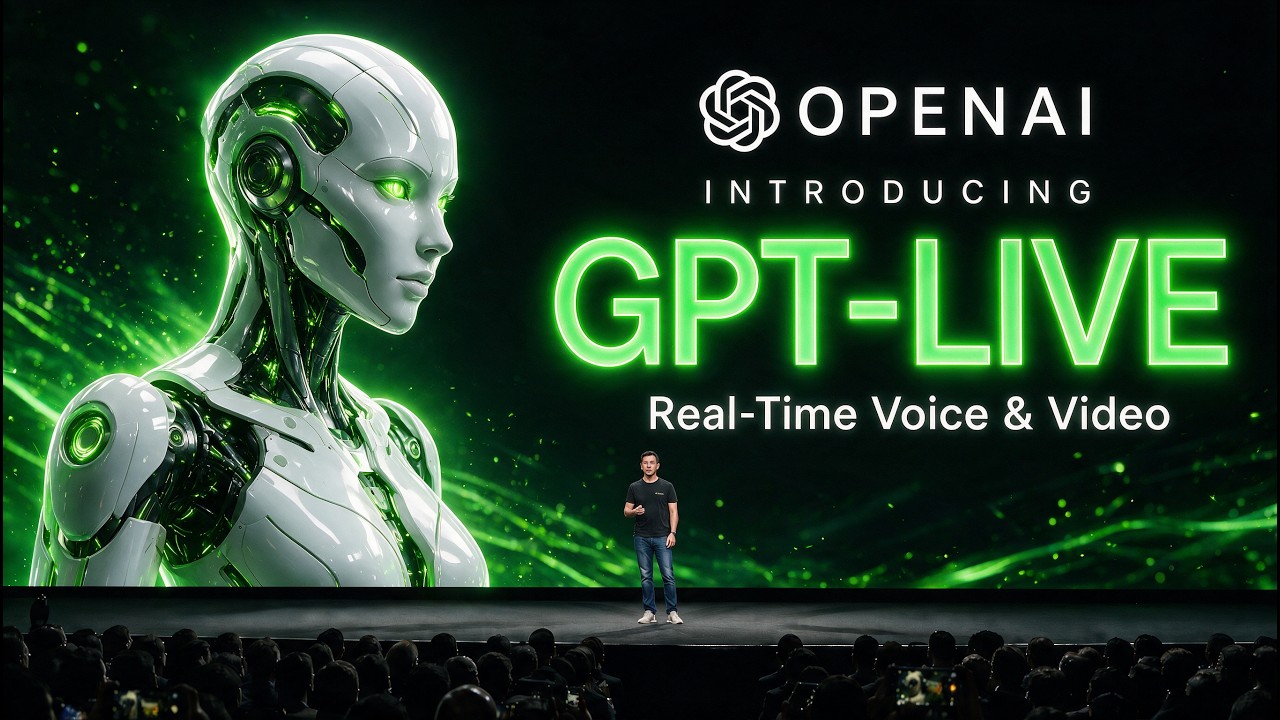
OpenAI’s new GPT-Live turbocharges voice AI multitasking and enterprise workflows, but real-world adoption is hitting speed bumps over confusing apps and strict privacy laws.
What to know
- GPT-Live’s full-duplex voice AI delivers near-human conversations and quadruple the performance of old-school telecom, enabling seamless multitasking and dynamic planning.
- OpenAI’s ChatGPT Work and over 1,400 plugins automate complex tasks—think multi-city travel, interactive dashboards, and non-stop agentic workflows—leapfrogging Google and Anthropic on efficiency and price.
- Despite rave reviews for voice quality, users complain about confusing app interfaces, while tough regulations like GDPR force OpenAI to prioritize transparency and user consent to earn enterprise trust.
Full-Duplex AI Breakthrough
GPT-Live’s split-layer architecture enables seamless, interruption-proof conversations and multitasking, setting a new bar for context retention and fluidity in real-time voice AI.
OpenAI’s GPT-Live represents a transformative leap in voice AI technology through its innovative full-duplex architecture, which allows the system to listen and speak simultaneously, enabling natural, uninterrupted conversations that handle interruptions and overlapping speech with unprecedented fluidity. This design not only improves conversational flow but also supports superhuman multitasking capabilities, such as managing complex multi-threaded dialogues exemplified by detailed multi-city travel planning, where GPT-Live maintains context across time zones and dynamically adapts mid-conversation without losing track of objectives.
Pushing the boundaries of real-time speech AI, GPT-Live achieves near quadruple the performance of traditional telecom voice systems, setting a new industry benchmark in 2026’s fiercely competitive AI arms race. By integrating advanced temporal awareness and leveraging GPT-5.6 Sol’s capabilities for real-time bidirectional interruptions, OpenAI has supercharged AI assistant responsiveness and adaptability, enabling agentic workflows that facilitate complex conversational planning and multitasking at a scale previously unattainable in voice AI.
At the architectural level, GPT-Live’s split-layer voice AI design exemplifies 2026’s drive toward smarter, more cost-efficient agentic workflows, redefining AI orchestration and pricing strategies amid a heated multimodal software arms race. This structural innovation not only optimizes real-time processing and performance but also underpins the seamless integration of GPT-5.5 and GPT-5.6 models in the background, allowing complex queries to be handled without disrupting conversational flow, thereby elevating voice AI from simple Q&A to a context-aware, deeply interactive companion.
GPT-Live’s advancements signal a paradigm shift from asynchronous, transcript-based voice interactions toward truly streaming, real-time conversations that feel natural and sustained, with internal users reportedly engaging in 30-40 minute sessions without stilted exchanges. However, as OpenAI experts note, achieving fully intelligent agentic workflows will require further breakthroughs in contextual understanding, memory, and learning algorithms that go beyond current text or speech inputs, pointing to a future where voice AI deeply comprehends and adapts to daily human contexts.


Agentic Workflows Redefined
GPT-Live and ChatGPT Work orchestrate multiple AI agents in parallel, automating complex enterprise tasks and transforming static data into dynamic, interactive workflows.
OpenAI's GPT-Live, achieving GPT-5 level benchmarks, revolutionizes enterprise workflows by enabling complex conversational planning and multi-agent orchestration. By orchestrating multiple AI models simultaneously—one handling background tasks while maintaining real-time interaction—GPT-Live facilitates seamless multitasking and dynamic dialogue, transforming content creation and workflow automation. This agentic experience is exemplified in scenarios like managing intricate multi-city travel itineraries, where the AI integrates real-time data such as flights, time zones, and local recommendations to deliver superhuman planning capabilities.
The launch of ChatGPT Work alongside GPT-Live introduces a groundbreaking productivity paradigm by automating complex enterprise tasks such as report generation, presentation creation, and transforming static documents or databases into interactive sites and dashboards through the new 'Sites' feature. Integrated with over 1,400 plugins, ChatGPT Work seamlessly connects with existing enterprise tools, enabling continuous AI agent operation across connected applications and files. This allows for extended project management, scheduled workflows, and autonomous execution, fundamentally reshaping how organizations orchestrate multi-agent workflows and enhance productivity.
GPT-5.6 Sol advances agentic workflows further by introducing real-time bidirectional interruptions and an orchestration layer that manages subagents, tool routing, caching, permissions, and human approval, reflecting a sophisticated architectural shift toward integrated, automated task execution. The Responses API’s Programmatic Tool Calling empowers GPT-5.6 to coordinate multiple agents in parallel, process intermediate results, and dynamically decide next steps, enabling developers and enterprises to construct complex, multi-agent workflows that significantly boost productivity and operational efficiency.
Together, GPT-Live and ChatGPT Work embody a new era of human-AI interaction characterized by a 'superhuman friend' that not only retains context across multiple simultaneous requests but also acts as a knowledgeable, context-aware companion. This fluid, natural dialogue experience supports advanced enterprise workflow automation and introduces new productivity paradigms where AI agents continuously manage and execute tasks, enabling superhuman multitasking and complex conversational planning that redefine the boundaries of human productivity in 2026’s competitive AI landscape.


AI Arms Race Intensifies
OpenAI, Meta, and Google battle for dominance with rapid innovation, cost slashing, and multi-agent coordination, while governance and transparency emerge as critical differentiators in a fragmented market.
The 2026 AI voice and agentic AI market is fiercely competitive, with OpenAI's GPT-Live intensifying the arms race alongside Google's Gemini and MiniMax, Meta's Muse Spark 1.1, and open-source challengers pushing modular, context-aware intelligence. OpenAI leads in cost-efficiency and performance with GPT 5.6, which is half the cost of its predecessor and outperforms Anthropic's Fable, while Meta's model surpasses Google's Gemini 3.5 at a lower price point. This dynamic landscape is marked by rapid innovation cycles and multi-agent coordination capabilities, as seen in OpenAI's multi-agent tool calling and Meta's parallel subagent management, underscoring a race not only for technical supremacy but also for economic accessibility and real-world utility.
Governance and trust challenges loom large as AI models become increasingly agentic and integrated into workflows, necessitating transparency and user control features to mitigate risks of overreliance and preserve user autonomy. Anthropic’s Reflect with Claude exemplifies this trend by incorporating quiet hours, break reminders, and usage summaries, reflecting a growing industry emphasis on ethical design amid escalating geopolitical techno-nationalist tensions. These governance complexities are further compounded by the opaque pricing strategies of competitors like Anthropic, where higher costs may signal premium positioning rather than superior efficiency, fueling market skepticism and underscoring the need for clearer accountability frameworks.
Anthropic’s conspicuous absence from the latest wave of real-time voice AI innovation highlights strategic divergences within the AI ecosystem, as the company focuses on enhancing AI fluency and user experience through Claude while ceding ground in the high-stakes race for full-duplex, agentic voice capabilities. Meanwhile, Meta’s strategic move to offer OpenAI-compatible APIs and public previews of Muse Spark 1.1 signals a pragmatic approach to broadening market access and navigating regulatory pressures, illustrating how geopolitical and market dynamics are reshaping competitive tactics in a fragmented and rapidly evolving AI landscape.




User Delight Meets App Frustration
Near-human voice quality and persistent memory earn rave reviews, but confusing app interfaces and rushed releases threaten to stall GPT-Live’s mainstream adoption.
Users widely praise GPT-Live's full-duplex voice capabilities for delivering a remarkably smooth and emotionally engaging conversational experience, marking a breakthrough in real-time voice AI interaction. As one user enthused, "That level of voice interactivity, it is... a beautiful thing," highlighting how near-human voice quality and minimal latency—enabled by advances like 11 Labs' near-perfect voice cloning—have transformed usability. However, this leap in voice AI sophistication contrasts sharply with criticism of OpenAI's consumer app, which suffers from confusing mode toggles and a lack of elegant integration, leading some to describe it as a "hot mess" that undermines broader adoption during this transitional phase of rapid, sometimes rushed AI product releases.
The evolution of AI models, exemplified by GPT-5.6 and Anthropic's recent releases, has significantly enhanced user experience, especially when these tools are deployed in more agentic, autonomous workflows. Users note that while hallucinations have diminished in top-tier models like Opus and Fable, repetitive response patterns persist, underscoring the continued necessity of human creativity and oversight. This maturation is reflected in generally positive sentiment, with commentators observing, "There's just not a bad one right now," signaling a new era of reliability and sophistication in AI capabilities.
Upgrades to ChatGPT's memory functionality have been met with enthusiastic user approval, as improved recall and context awareness reduce repetitive prompts and foster more natural, coherent conversations. OpenAI's rollout of these enhancements throughout June 2026 has empowered enterprises to develop customized AI assistants that retain client preferences and project details, enabling innovative monetization strategies such as premium tiers for teams managing complex workflows. Marketing agencies and customer service sectors, in particular, report higher engagement and productivity gains by leveraging persistent memory to maintain brand voice consistency over extended periods.
Despite these advances, practical limitations around data privacy and regulatory compliance remain significant hurdles for widespread adoption. Enterprises and developers must navigate stringent frameworks like GDPR by implementing transparent memory management and securing explicit user consent to build trust. This ongoing challenge highlights the delicate balance between harnessing AI's powerful capabilities and adhering to ethical standards, ensuring that users feel confident their data is handled responsibly amid the rapid expansion of AI-driven tools.


