Holy war at the Pentagon? hegseth’s ‘crusader’ worship services ignite church-state firestorm
The gist
Pentagon worship services led by Pete Hegseth have triggered a fierce constitutional battle by turning military prayer into a crusader’s call for holy war against Iran.
What to know
- Hegseth’s Pentagon prayers fuse violent Old Testament scripture with pop culture, framing the Iran war as a divinely sanctioned crusade.
- Critics warn this religious-military blend undermines America’s secular democracy, reviving fears of theocratic rule and church-state meltdown.
- Public backlash is mounting as militant Christian rhetoric distorts both U.S. foreign policy and foundational Christian teachings on peace.
Sanctifying War at the Altar
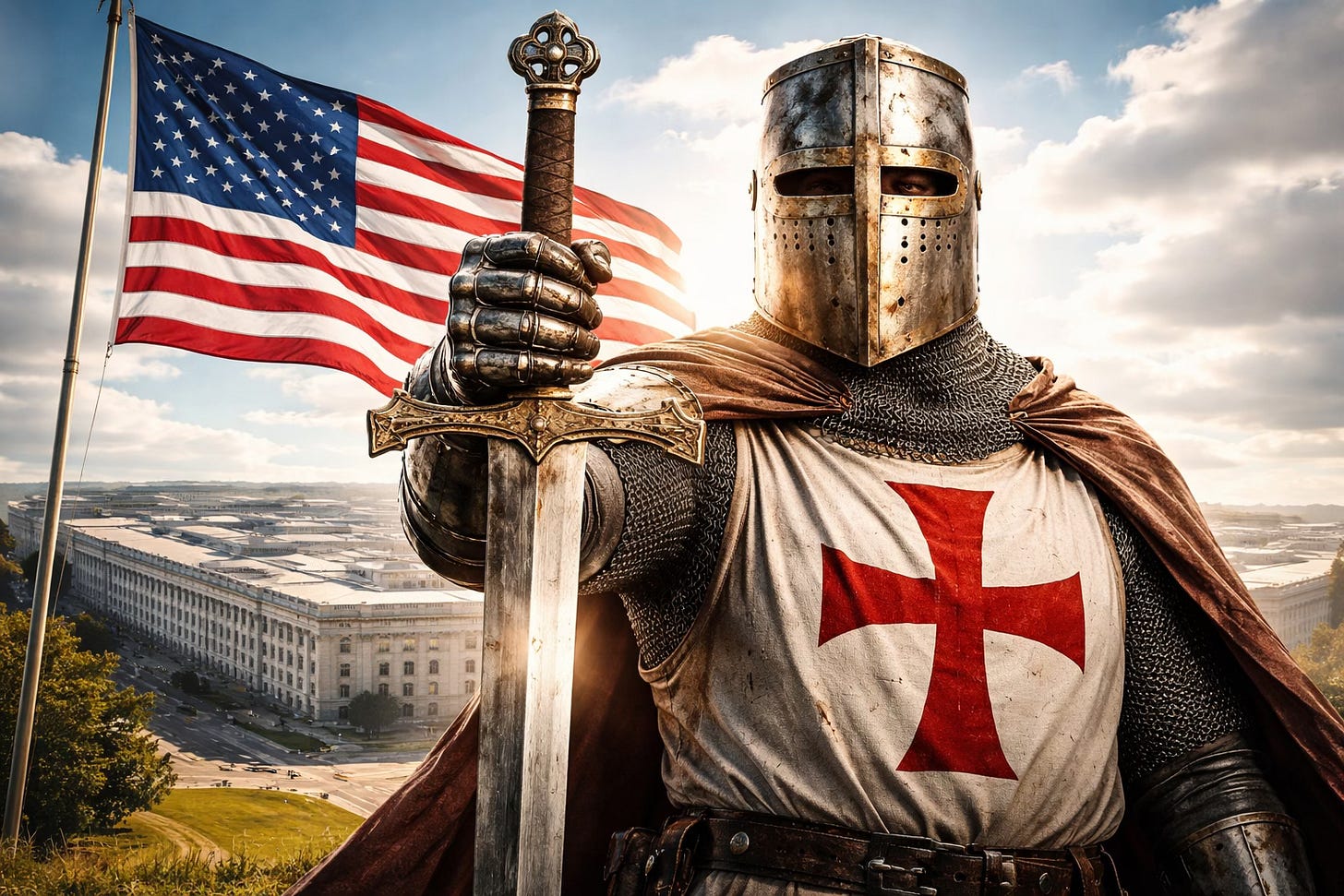
Hegseth’s Pentagon prayers weaponize scripture and pop culture, fusing Crusader symbols and Hollywood violence to frame the Iran conflict as a sacred, divinely mandated crusade.
Pete Hegseth’s worship services at the Pentagon explicitly frame the military conflict against Iran as a holy war, employing violent biblical language to sanctify lethal military action. His prayers invoke scripture such as Psalm 18:37-42 and prominently feature symbols like the Jerusalem Cross and the phrase 'Deus Vult' on his Bible, alongside his Crusader tattoos, reinforcing a militant Christian identity that echoes historical crusades. This theological framing not only justifies but glorifies swift and merciless justice against perceived enemies, casting the Iran war as divinely sanctioned and righteous.
Hegseth’s prayers represent a deliberate theological militarization, blending scriptural violence with aggressive military objectives by reconfiguring biblical texts into calls for future violent action. His 'Mad Libs mashup' approach distorts original scripture—altering tenses, pluralizing singular references, and mixing translations—to weaponize the Bible for political ends, as seen in his use of Proverbs 28:1 and other Old Testament verses popular in Christian Nationalist rhetoric. This manipulation undermines authentic theological interpretation, instead framing warfare as a sacred crusade that demands overwhelming violence against 'wicked' enemies.
In a striking and controversial fusion of pop culture and scripture, Hegseth incorporates a violent prayer inspired by the 'Pulp Fiction' monologue—specifically the 'CSAR 2517' prayer echoing Ezekiel 25:17 and Samuel L. Jackson’s character Jules Winnfield—to sanctify U.S. military action against Iran. This blending of Hollywood violence with biblical rhetoric not only sanctifies warfare as divine vengeance but also signals a dangerous theological militarization that risks dehumanizing enemies and framing modern conflict as a righteous crusade, raising profound concerns about the erosion of church-state separation and the ethical use of religious language in military contexts.
Hegseth’s pattern of invoking violent prayers previously used in other military contexts, such as the chaplain-led Maduro raid in Venezuela, illustrates a recurring strategy of legitimizing U.S. military interventions through scriptural violence. By linking contemporary conflicts to a tradition of divinely sanctioned warfare, his prayers blur the lines between worship and policy, suggesting that religious fervor should directly inform military conduct and decision-making, thereby intensifying the theological framing of war as a holy and just endeavor.

Church-State Boundaries Shattered
Hegseth’s worship services resurrect the specter of religious tyranny by collapsing constitutional safeguards and entwining militant Christianity with U.S. military power.
Pete Hegseth’s leadership of Pentagon worship services has ignited fierce constitutional debates, as critics argue his actions dangerously blur the line between church and state, contravening the secular democracy the Founders painstakingly established. By intertwining a fundamentalist, apocalyptic Christian narrative with military functions, Hegseth and his GOP allies are accused of undermining the very principles that safeguard America from the historical perils of religious tyranny—perils vividly illustrated by early colonial punishments such as Quakers being banned or executed and Virginians imprisoned for dissenting beliefs. This revival of religious influence in state affairs threatens to unravel the constitutional fabric designed to prevent the fusion of religious zealotry with political and military power.
The Founders and Framers of the Constitution deliberately crafted a secular government framework to avoid the oppressive consequences witnessed when religious authority commandeered political and military power, believing that secular democracy offered a more unifying and peaceful societal foundation than any faith could provide. This historical wisdom is starkly contradicted by Hegseth’s recent Pentagon prayer invoking 'overwhelming violence' against Iranians, a militarized religious rhetoric condemned not only for its moral repugnance but also for its constitutional impropriety. Such prayers, led by a figure described as an 'alcoholic, serial adulterer, wife-abusing Secretary of War,' exemplify the dangerous fusion of violent religious fervor with state military action, raising profound questions about the erosion of church-state separation in America’s highest defense institution.

Christian Nationalism Drives Policy
Christian nationalist ideology under Hegseth has purged dissenters from military leadership and recast U.S. Iran policy as a theocratic crusade, sidelining legal and diplomatic norms.
Pete Hegseth’s overt embrace of Christian nationalist ideology, exemplified by his 'Deus vult' tattoos and his book American Crusade, has profoundly shaped U.S. Iran war policy and military leadership narratives. This religious certainty, shared by senior officials including former President Trump, reframes international legal constraints as mere political annoyances, marginalizing dissenters as disloyal and enabling a strategic approach that prioritizes theological imperatives over diplomatic norms.
Evangelical and Christian Zionist apocalyptic frameworks have deeply influenced the administration’s Middle East strategy, treating Israel’s territorial disputes and confrontation with Iran as prophetic milestones. Research from the Misgav Institute and the Washington Institute reveals how this theological lens, rooted in Christian Zionism, has driven Trump-era policies that conflate religious destiny with geopolitical objectives, effectively sacralizing the conflict and justifying aggressive military postures.
Under Hegseth’s direction, Christian nationalist ideology has catalyzed a sweeping purge of military leadership, including the firing of Army Chief of Staff General Randy George and Chief of Chaplains Major General William Green, to install loyalists aligned with a theocratic and authoritarian agenda. This shift not only enforces doctrinal conformity—such as lifting bans on troops carrying firearms on bases under the guise of 'God-given rights'—but also signals a move toward governance modeled on Doug Wilson’s extremist theonomy, which advocates for divine Christian law supplanting secular democracy.
Religious symbolism and rhetoric have been weaponized to frame the Iran war as an existential holy war, with figures like Trump and Hegseth reinterpreting Islamic phrases through a militant Christian nationalist lens. For instance, Trump’s use of 'Subhanallah' and Hegseth’s adoption of an Arabic 'infidel' tattoo invert Islamic meanings to bolster a narrative of civilizational conflict, reinforcing a militant identity that fuses religious zealotry with U.S. military policy.

Theology Twisted for Warfare
Militant prayers and biblical violence distort Christian teachings on peace, fueling public backlash and polarizing U.S. foreign policy debates over the Iran conflict.
Pete Hegseth’s invocation of violent Old Testament prayers, such as calling to 'pour out your wrath' and 'break the teeth of the ungodly,' starkly contrasts with foundational Christian teachings that emphasize peace and the rejection of war, as underscored by Pope Leo’s declaration that Jesus is the 'king of peace, who rejects war' and 'does not listen to the prayers of those who wage war.' This blending of militant religious rhetoric with political agendas has contributed to a polarized public discourse surrounding the Iran conflict, evidenced by a Gallup poll revealing that by early 2026, 41% of Americans sympathize more with Palestinians while 36% side with Israelis, illustrating how religious-nationalist framing complicates U.S. foreign policy debates.
The strategic use of ancient biblical violence to sanctify contemporary military actions risks distorting Christian theology and 'giving God a bad name,' as critics argue that framing the Iran-US/Israeli war in such terms effectively portrays the divine as endorsing war crimes. This theological misappropriation has fueled significant public backlash and controversy, highlighting the dangers of conflating sacred teachings with violent political objectives and raising profound questions about the ethical implications of religious rhetoric in legitimizing conflict.