Home depot doubles down on pros, sidesteps economic gloom
The gist
Home Depot is doubling down on its Pro segment and operational discipline, sidestepping economic hand-wringing to drive growth even as DIY sales lag and margins face pressure.
What to know
- Pro customer sales surged with five straight quarters of 10%+ online growth, powered by innovations like the Magic Apron AI assistant and same-day Express Delivery.
- Margin headwinds stem from the lower-margin GMS acquisition and rising operating expenses—partially offset in Q2 by a one-time $730 million tariff refund that boosted gross margin 145 basis points.
- CEO Ted Decker is steering clear of economic forecasts, focusing on controllable levers like inventory and service, while maintaining full-year guidance and expanding Pro offerings through strategic acquisitions.
Steering Clear of Forecasts
Home Depot’s leadership sidesteps economic speculation, spotlighting operational discipline and service innovations to inspire investor confidence amid uncertainty.
Home Depot's leadership, led by CEO Ted Decker, adopts a disciplined communication strategy that deliberately sidesteps macroeconomic forecasting, instead focusing investor attention on operational factors within their control such as inventory availability and customer service enhancements. Decker’s remark that 'we are probably all spending too much time in economics in the home improvement industry these days' encapsulates this approach, underscoring a preference for managing tangible levers like separating the ME teams and rolling out 30-day trade credit for pros rather than speculating on uncertain economic variables.
In addressing external cost pressures, Home Depot’s leadership downplays the impact of tariffs and tax refund fluctuations, reinforcing a cautious yet confident outlook. Executive Billy Bastek highlighted that over half of Home Depot’s products are domestically sourced, limiting tariff effects to roughly 3% of cost of goods, while Decker tempered expectations around tax refunds by noting the company historically captures only about 60 basis points of personal consumption expenditures from such boosts. This measured stance helps maintain investor confidence amid broader economic uncertainties.
Despite macroeconomic headwinds, Home Depot’s leadership reaffirms full-year guidance, signaling resilience in consumer spending while acknowledging ongoing caution in discretionary purchases amid geopolitical and interest rate uncertainties. They emphasize that consumers remain fundamentally strong but are prudent in their spending decisions, with the biggest concern being the prospect of sustained higher interest rates and geopolitical volatility, reflecting a balanced outlook that blends confidence with vigilance.
Management consistently deflects analyst attempts to quantify exposure to discretionary big-ticket projects, reflecting a strategic choice to avoid committing to metrics they do not track or control. Ted Decker’s refusal to disclose exact sales figures related to discretionary spending underscores a disciplined messaging approach designed to prevent speculation and maintain focus on operational execution rather than uncertain macroeconomic variables.


Pros Power Performance
Professional contractors are driving Home Depot’s growth as digital tools, rapid delivery, and tailored services set a new standard for the Pro customer experience.
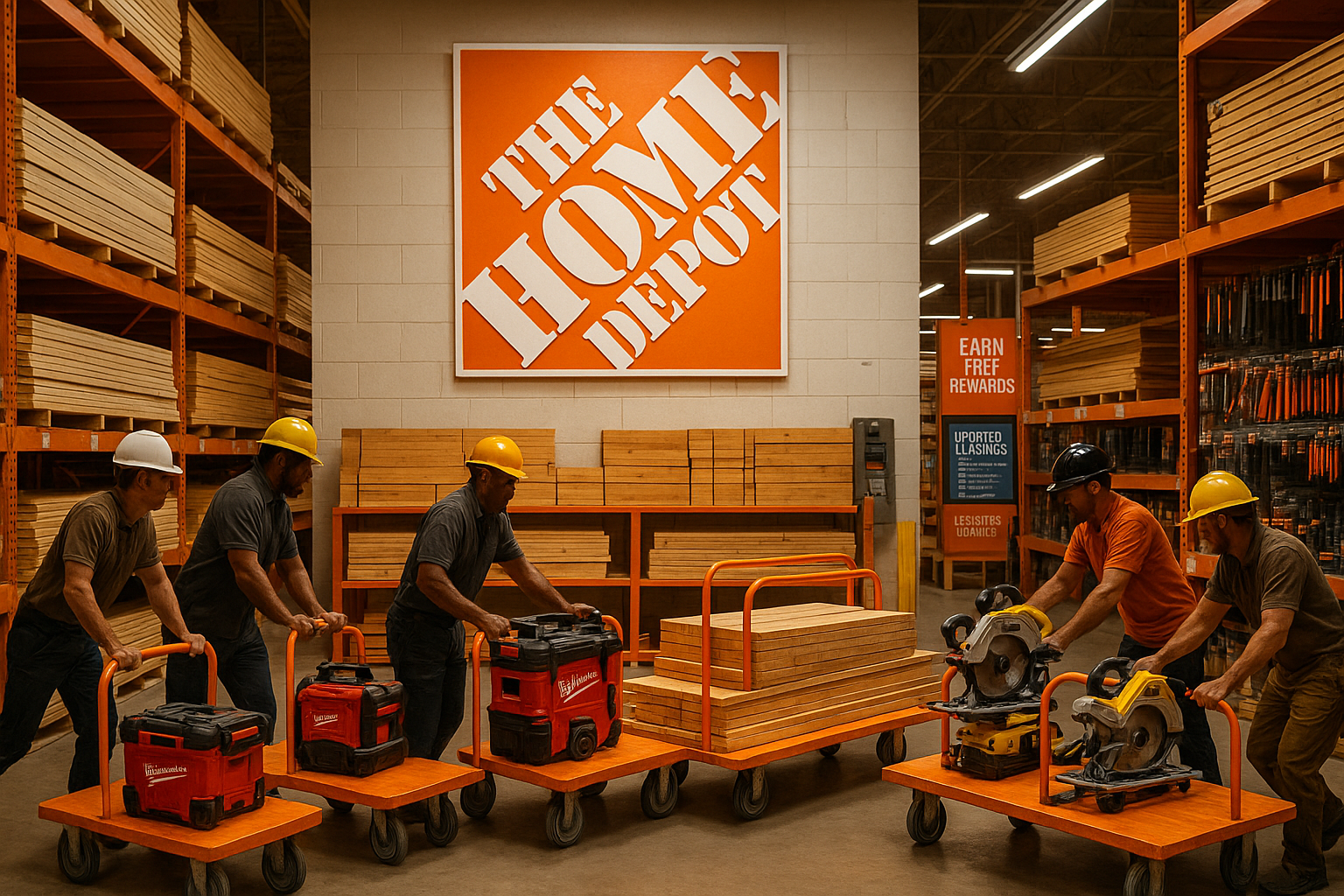
Home Depot's Pro customer segment continues to demonstrate resilience and growth despite a sluggish housing market, with positive comparable sales outpacing the DIY segment. This strength is reflected across nine of sixteen merchandising departments, including power tools and plumbing, underscoring the company's strategic focus on professional contractors as the key revenue driver in challenging times.
The company’s digital transformation plays a pivotal role in enhancing the Pro customer experience, with online sales growing over 10% for five consecutive quarters and innovations like the Magic Apron AI shopping assistant driving engagement. By localizing inventory knowledge and facilitating millions of monthly queries, Magic Apron empowers both online and in-store associates to meet Pro customers’ complex needs efficiently, reinforcing Home Depot’s interconnected omnichannel approach.
Operational and service innovations, including the nationwide launch of Express Delivery with a flat fee and sub-three-hour delivery times—often under one hour—significantly elevate Home Depot’s value proposition for Pro customers facing urgent job site demands. Complemented by improved delivery lead times, with 65% of in-stock parcels arriving same or next day and 55% of bulky items delivered within two days, these enhancements reflect a deliberate shift to prioritize speed and reliability in professional fulfillment.
Strategic acquisitions such as the $18 billion purchase of SRS Distribution and GMS have expanded Home Depot’s Pro footprint, enabling deeper integration and cross-selling opportunities within its ecosystem. With 90% of stores closing sales through SRS’s Quote Center Marketplace and plans to open 40 to 50 new Specialized Rental Services locations, Home Depot is leveraging these assets to deliver mid-single-digit organic growth and double cross-sell revenues, providing contractors a comprehensive one-stop solution from lumber to HVAC equipment.



Margins Masked by Refunds
A one-time tariff refund temporarily boosted Home Depot’s margins, but underlying cost pressures and a lower-margin acquisition signal tougher profitability ahead.
Home Depot's margin pressures in recent quarters are largely attributable to the acquisition of GMS, a wallboard and ceilings company with a naturally lower-margin product mix, rather than any loss of pricing power. This strategic shift in product composition, combined with increased operating expenses, contributed to a decline in operating margin from 11.3% to 10.1%, illustrating the challenge of integrating new business lines while maintaining profitability.
The company benefited significantly from a one-time $730 million tariff refund under the International Emergency Economic Powers Act (IEPA), which directly reduced cost of goods sold by $685 million and boosted gross margin by approximately 145 basis points in Q2. However, this windfall masked underlying cost pressures from rising fuel, energy, and commodity expenses, which together exerted about 60 basis points of margin headwinds, alongside an additional 60 basis points of dilution from the GMS acquisition mix effect.
Despite the temporary tariff refund cushioning, Home Depot’s management, led by CFO Richard McPhail, emphasized that the company would have exceeded earnings expectations even without this government support, underscoring disciplined operational execution. McPhail noted that the refunds allowed the company to offset increased costs and maintain market value, but also cautioned that these benefits are transient, with the tariff-related margin uplift expected to largely disappear by Q4 2026, leading to flat gross margins and renewed margin pressures from ongoing cost inflation.