Hong kong extends hedge fund tax breaks as global wealth chases safe havens
The gist
Hong Kong is doubling down on its status as a global wealth magnet by extending hedge fund tax breaks through 2026, as the world’s elite scramble for safe havens and diversified portfolios.
What to know
- Hong Kong’s carried interest tax relief for hedge fund managers now runs through mid-2026, sharpening its edge in the global contest for top investment talent.
- Singapore, the UAE, and Hong Kong are set to capture nearly two-thirds of new ultra-high-net-worth inflows by 2029, as wealthy individuals spread assets and citizenships across multiple hubs.
- The UAE is surging as a talent and wealth hotspot, attracting 194,000 skilled workers in 2025 and doubling its millionaire count over the past decade thanks to zero income tax and aggressive government incentives.
Hong Kong's Hedge Fund Power Play
By extending carried interest tax breaks, Hong Kong is doubling down on its bid to outshine global rivals and attract elite fund managers, fueling a hedge fund boom amid fierce competition for investment talent.
By mid-2026, Hong Kong has strategically extended its carried interest tax relief specifically for hedge fund managers, signaling a robust push to cement its status as a premier financial hub. This targeted incentive is designed to lure top-tier investment talent amid fierce global competition, leveraging the city’s strong investor confidence in hedge funds to create a more attractive environment for fund management. Industry insiders view this move as a calculated effort to balance competitive tax policies with sustained growth in hedge fund activity, positioning Hong Kong as a magnet for elite asset managers.
The Rise of Global Sovereign Portfolios
Wealthy individuals are strategically building multi-jurisdictional portfolios and snapping up global residencies, turning cities like Hong Kong, Singapore, and Dubai into magnets for diversified, mobile capital.
Wealthy individuals and families are increasingly constructing 'sovereign portfolios' that span multiple jurisdictions, combining residence rights, citizenships, investments, and business interests to hedge against geopolitical tensions and tax uncertainties. This strategic diversification moves beyond traditional relocation, reflecting a sophisticated approach to global wealth management that prioritizes flexibility and risk mitigation amid rising geopolitical instability. Juerg Steffen, CEO of Henley & Partners, emphasizes this shift, noting that the assumption of wealthy residents' stability is 'increasingly outdated' as they seek multi-jurisdictional options to preserve and grow their assets.
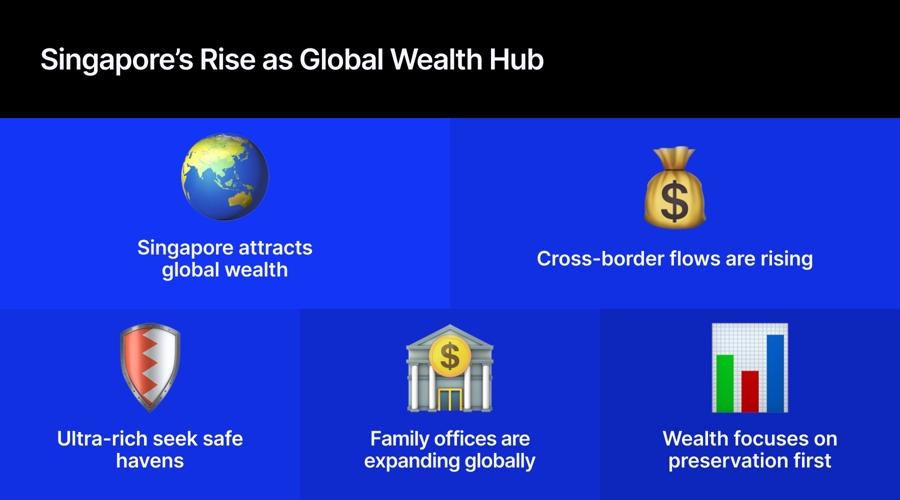
Hong Kong, Singapore, and the UAE have emerged as premier destinations for internationally mobile wealth, driven by their favorable tax regimes, geopolitical stability, and high quality of life. The UAE, in particular, has led millionaire migration over the past two years despite ongoing Gulf conflicts prompting contingency planning among residents. Singapore’s private banking sector, managing nearly $200 billion in global assets with two-thirds from abroad, attracts entrepreneurs focused on legacy planning, while Hong Kong remains the primary gateway for offshore wealth booking before clients expand their portfolios regionally. These hubs are projected to capture nearly two-thirds of new ultra-high-net-worth inflows through 2029, underscoring their central role in global wealth diversification.
Affluent Americans are driving record demand for residence and citizenship programs worldwide as they seek to diversify internationally without fully expatriating, reflecting concerns over domestic policy risks rather than outright abandonment of their home country. Darlene Patterson, Global Head of Client Solutions at Citi Wealth, highlights this unprecedented trend of U.S. clients booking assets outside the country and obtaining residencies or golden visas in jurisdictions such as Italy, Portugal, Jersey, Australia, and New Zealand. This pursuit of 'optionality' aligns with a broader global pattern where wealthy individuals balance asset security, lifestyle preferences, and tax considerations across multiple financial hubs including Hong Kong, Singapore, and the UAE.
The growing international mobility of high-net-worth individuals is evident in investment migration program applications, with Henley & Partners receiving submissions from 86 nationalities across 47 programs in early 2026, and over 28% of applicants residing outside their country of nationality. This trend highlights the increasing importance of multi-jurisdictional asset diversification and residence strategies as wealthy clients navigate a complex landscape shaped by shifting tax policies, geopolitical risks, and evolving lifestyle demands. The newly developed Global Wealth Mobility Framework further underscores this complexity by evaluating jurisdictions on taxation, migration pathways, quality of life, and geopolitical stability, reflecting the multi-dimensional decision-making process of global wealth holders.

Talent Wars and Wealth Migration
As cross-border moves by top professionals shrink and China clamps down on capital outflows, the UAE and other emerging hubs are seizing the moment—luring talent and wealth with bold incentives and flexible hiring strategies.
Global mobility of highly skilled professionals, particularly in AI and STEM fields, contracted nearly 12% in 2025, dropping from 3.7 million to 3.3 million cross-border relocations. This decline underscores the intensifying competition for top talent, where countries leading in technology-specific expertise are 17 times more likely to dominate that sector, and companies that successfully attract global leaders see shareholder value increase by 1 percentage point annually. As Christian Schwaerzler of BCG emphasizes, talent strategy transcends HR concerns, becoming a core competitiveness issue that demands integrated approaches combining domestic upskilling, technology adoption, and immigration reform to sustain national and corporate leadership.
Emerging hubs like the UAE are rapidly reshaping the global talent landscape by capitalizing on strategic government investments and favorable trade agreements, such as the Dh2.5 billion economic stimulus and the UK-UAE trade pact. The UAE attracted nearly 194,000 highly skilled workers in 2025, gaining market share and challenging traditional Western centers like the UK and Canada, which slipped from the top three to seventh place. Companies in sectors like financial services, technology, and real estate are aggressively hiring scarce talent—including cloud architects and deep tech specialists—often onboarding employees remotely with plans for future relocation, reflecting a nimble and resilient hiring strategy amid global uncertainties.
Beijing’s intensified capital outflow controls, triggered by a record USD 807 billion moving offshore in 2025, represent a strategic clampdown to regain oversight of Chinese wealth, including hefty penalties on brokerages and tighter bank regulations. While Hong Kong remains a primary offshore wealth hub—its family-office count surged 25% to 3,400 last year—these measures are prompting wealthy Chinese investors to diversify their assets across multiple jurisdictions rather than abandon offshore holdings altogether. Dubai, with its zero personal income tax, common-law courts, and political neutrality amid US-China tensions, has emerged as a compelling alternative, evidenced by a 102% increase in its millionaire population over the past decade, positioning the UAE as a formidable competitor in global wealth migration.