HSBC, standard chartered make first live SWIFT token transfer
The gist
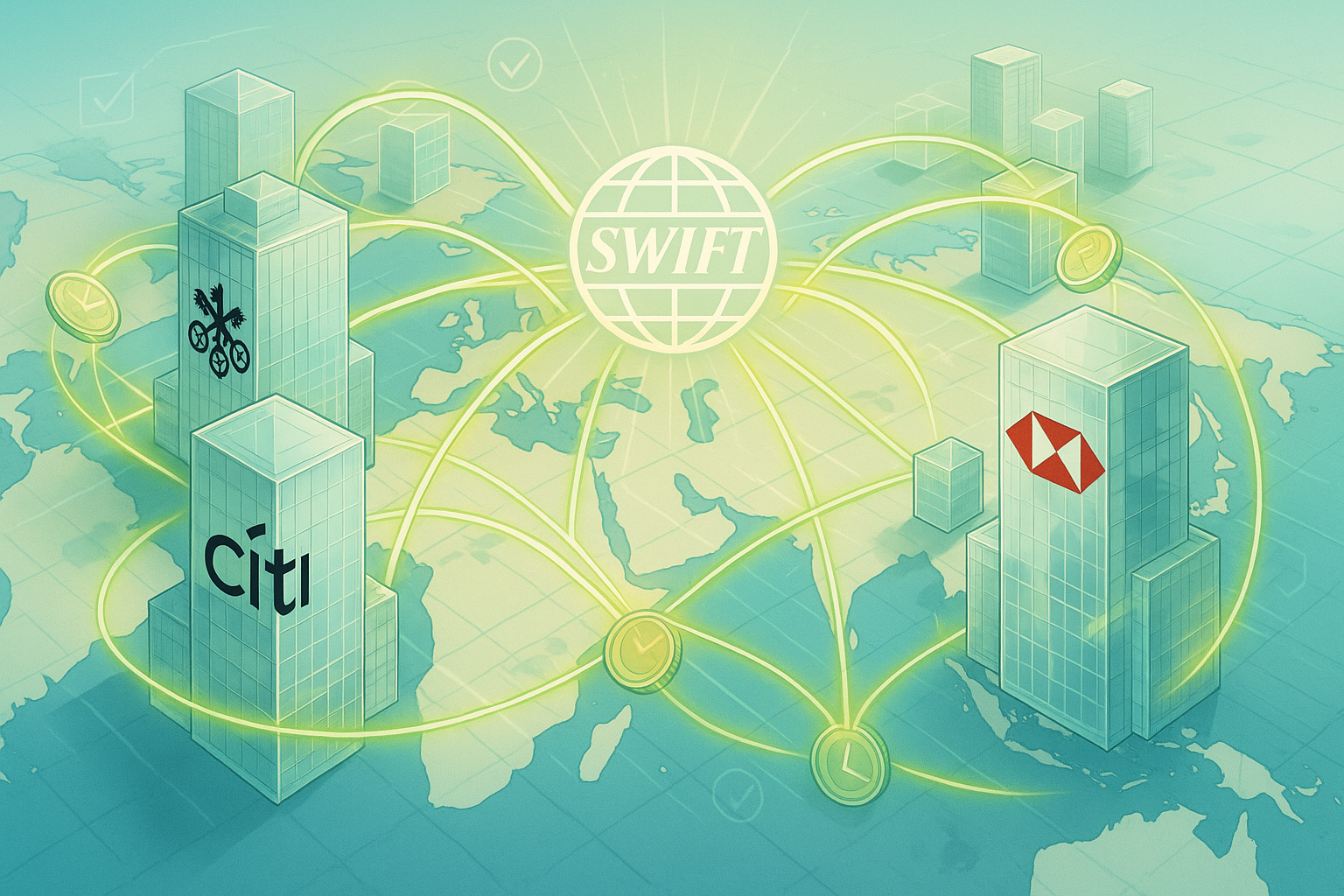
HSBC and Standard Chartered have just pulled off the world’s first live interbank tokenized deposit on SWIFT’s blockchain, signaling that big banks are getting serious about programmable money.
What to know
- Seventeen global banks—including HSBC and Standard Chartered—completed the first tokenized deposit transfer using SWIFT’s new blockchain-based Shared Ledger.
- SWIFT’s hybrid model matches and nets payment obligations on-chain while keeping final settlement off-chain, preserving regulatory controls and operational safety.
- Taurus integrated its tokenization and custody platforms with SWIFT, letting institutional clients rapidly onboard and execute tokenized deposit payments across global platforms.
Banks Pioneer Token Transfers
HSBC and Standard Chartered’s live blockchain transaction marks a turning point for regulated digital money, proving cross-border interoperability while preserving regulatory safeguards.
HSBC and Standard Chartered have achieved a landmark milestone by completing the first live interbank deposit token transaction on SWIFT’s blockchain-based Shared Ledger, signaling a pivotal step in the modernization of cross-border payments. This pilot, which involves a consortium of 17 global banks, demonstrates the practical movement of regulated tokenised deposits across jurisdictions, showcasing how digital money issued by banks can operate interoperably while maintaining existing regulatory protections. Lewis Sun, HSBC’s head of digital currencies, described the event as a “landmark moment” that underscores the growing adoption of blockchain-style rails within mainstream banking infrastructure.
The transaction exemplifies SWIFT’s evolution from a traditional messaging network to a secure orchestration layer that enables interoperability between distinct tokenised deposit platforms without replacing established settlement systems. By matching and netting payment obligations on the Shared Ledger, SWIFT facilitates a hybrid on-chain/off-chain settlement model where each bank retains control over its own deposit records, assets, and final settlement processes. This approach addresses a core challenge in tokenised commercial bank money by preventing isolated liquidity pools and potentially extending the interoperability model of conventional cross-border payments into the realm of digital money.
While this live deployment marks a significant operational milestone demonstrating readiness for real-world application, key transactional details such as value, currency pairs, and settlement speed remain undisclosed, indicating that the model is still in an early phase and not yet proven for high-volume commercial use. Nevertheless, the successful execution of a 24/7 transfer without intermediaries between HSBC and Standard Chartered highlights the potential for streamlined, programmable, and automated settlement workflows that could revolutionize cross-border payment rails in the near future.
Hybrid Settlement, Real Impact
SWIFT’s on-chain orchestration and off-chain settlement keep banks in control and cut operational friction, bridging digital and traditional finance without compromising compliance.
SWIFT’s blockchain-based shared ledger serves as a secure orchestration layer that enables tokenized deposit obligations to be matched, netted, and validated on-chain, while final settlement remains off-chain within existing banking infrastructure. This hybrid model allows banks like HSBC and Standard Chartered to retain control over their own deposit records and settlement processes, coordinating separate tokenization platforms without requiring a unified deposit issuance system. By offsetting payment obligations in opposite directions and providing both banks with a synchronized view of transaction status, the on-chain netting and shared validation significantly reduce operational costs and reconciliation efforts.
The deliberate choice to keep final settlement off-chain leverages regulated deposit money, existing compliance controls, and established settlement arrangements, while adding an always-available coordination layer that enhances interoperability. This approach addresses the critical challenge of connecting tokenized commercial bank money issued by different institutions, preventing isolated liquidity pools by linking bank-operated tokenization platforms. As Lewis Sun, HSBC’s head of digital currencies, noted, this hybrid model marks a landmark moment by demonstrating that digital money issued by banks can operate seamlessly across institutions without disrupting the regulatory protections and infrastructure of the traditional financial system.
Taurus Fast-Tracks Integration
Taurus’s seamless link with SWIFT’s ledger accelerates institutional onboarding, paving the way for tokenized bank deposits to enter mainstream cross-border payments within weeks.
Taurus has strategically integrated its tokenization and custody platforms with SWIFT's blockchain-based Shared Ledger, creating a seamless bridge for clients to connect their existing digital asset infrastructures and execute payments using bank-issued tokenized deposits. This collaboration not only broadens banks' access to innovative tokenized deposit payment methods but also streamlines the onboarding process for institutional clients, accelerating their participation in SWIFT's evolving ecosystem.
With the integration now live, Taurus anticipates that the first institutional clients will connect to its platforms within days, setting the stage for initial distributed ledger technology transactions to occur within weeks. This rapid deployment underscores the practical viability of combining Taurus's tokenization and custody capabilities with SWIFT's ledger, marking a significant step toward mainstream adoption of tokenized bank deposits in cross-border payments.
Global Banks Embrace Blockchain
Seventeen leading banks are piloting SWIFT’s shared ledger to enable round-the-clock, real-time settlement—streamlining liquidity transfers while upholding strict regulatory standards.
Seventeen major global banks spanning six continents have joined SWIFT's ambitious pilot to operationalize a blockchain-based Shared Ledger for tokenized bank deposits, aiming to enable reliable, 24/7 real-time cross-border payments. This consortium reflects a significant industry shift as traditional banks like HSBC and Standard Chartered actively test live transactions, signaling growing confidence in blockchain's ability to modernize and streamline liquidity transfers across borders.
The pilot is carefully designed to integrate with existing compliance and risk management frameworks, ensuring that the adoption of distributed ledger technology complements rather than disrupts regulatory standards. By focusing on regulatory alignment and operational safety, SWIFT and its banking partners are exploring how tokenization can enhance continuous settlement capabilities without compromising the rigorous controls that underpin global banking.
SWIFT's Shared Ledger connects deposit token platforms across participating banks to facilitate real-time, round-the-clock settlement, significantly reducing reliance on traditional correspondent banking networks and their associated delays. This hybrid on-chain/off-chain model not only accelerates cross-border payments but also exemplifies how blockchain can be pragmatically integrated into core banking functions, moving beyond experimental phases toward scalable, industry-wide adoption.