Juneteenth’s rising legacy: america’s 250th birthday forces a reckoning with freedom’s contradictions
The gist
As America nears its 250th birthday, Juneteenth’s rise as a federal holiday forces the nation to confront the glaring contradictions between its founding ideals and its unfinished fight for freedom.
What to know
- Juneteenth marks the belated emancipation of over 250,000 enslaved Black Americans in Texas on June 19, 1865, and only became a federal holiday in 2021 after decades of activism led by figures like Opal Lee.
- America’s 250th anniversary in 2026 is more a battleground for contested narratives than a unified celebration, with partisan divisions exposing cracks in the country’s self-image as a land of liberty.
- Justice Stephen Breyer urges Americans to unite around founding documents—not ethnicity—while Juneteenth’s recognition has become a flashpoint for demands on racial justice, voter rights, and honest history.
Juneteenth’s Delayed Freedom
Juneteenth marks not just emancipation’s arrival in Texas but the enduring struggle against broken promises, racial violence, and the unfinished business of Black liberation.
Juneteenth originated on June 19, 1865, when approximately 2,000 Union soldiers, led by Major General Gordon Granger, arrived in Galveston, Texas, to announce the emancipation of over 250,000 enslaved Black people—effectively enforcing the Emancipation Proclamation two and a half years after it was issued. This delayed liberation highlights the uneven and protracted nature of freedom in the United States, underscoring Juneteenth as a pivotal moment marking the actual end of slavery in one of the last holdout states.
While Juneteenth has been celebrated within African American communities for generations as a symbol of freedom, resilience, and the ongoing struggle for equality, its broader recognition was slow to materialize. It became the first emancipation celebration to gain official state holiday status in Texas in 1980, thanks to the efforts of African-American legislator Al Edwards, and was only federally recognized in 2021 when President Joe Biden signed the Juneteenth National Independence Day Act into law. This shift from a regional observance to a nationwide commemoration reflects both the enduring cultural significance of Juneteenth and the impact of activism, notably by Opal Lee, the so-called grandmother of Juneteenth, who tirelessly campaigned for its recognition.
The legacy of Juneteenth is deeply intertwined with the harsh realities of systemic oppression and racial violence that persisted long after emancipation. Despite the formal end of slavery, formerly enslaved Black Americans were denied reparations or property and were often forced to continue laboring under exploitative conditions, highlighting the incomplete nature of their freedom. The 1939 white mob attack on Opal Lee’s family home in Fort Worth, Texas, exemplifies the violent resistance to Black equality that Juneteenth also memorializes, reminding us that the celebration is as much about resilience in the face of ongoing injustice as it is about liberation.



Founding Ideals, Deep Contradictions
America’s revolutionary vision of equality was forged by men who owned slaves and exterminated Native peoples, making dissent and debate as central to the nation as its founding documents.
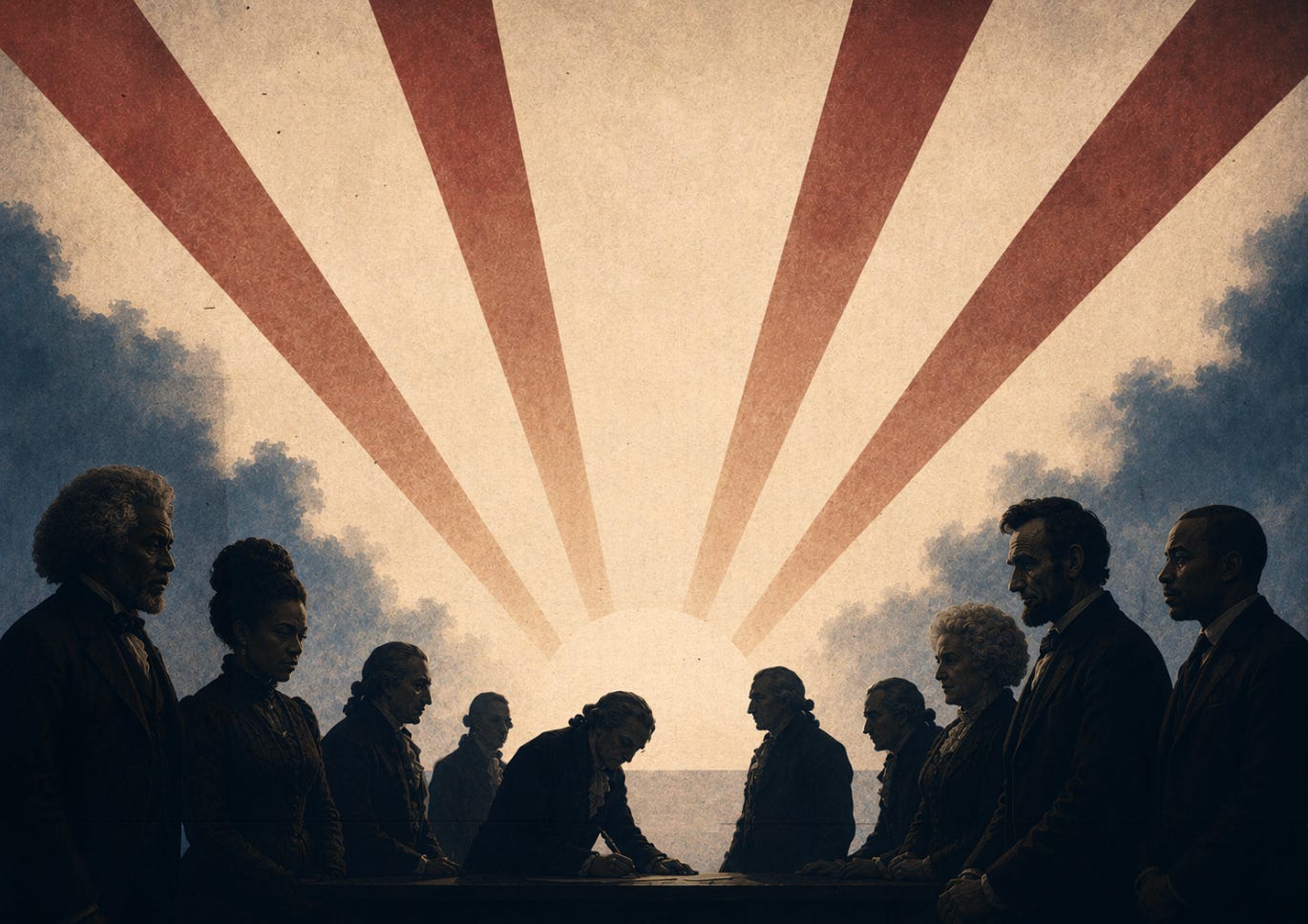
The Declaration of Independence, signed in 1776 by 56 diverse individuals—including plantation owners and abolitionists, 41 of whom owned slaves—embodied a radical and uncertain commitment to the revolutionary ideal that 'we are all created equal' and capable of self-government. This foundational vision asserted that 'people matter more than the state,' yet it was born amid profound contradictions, as the nation simultaneously upheld slavery and the extermination of Native peoples. The founding generation’s ongoing struggle to reconcile these tensions has made dissent, debate, and free speech essential disciplines for the survival and evolution of the American republic.
Abraham Lincoln, confronting the nation’s greatest crisis, repeatedly urged a return to the founding principles of the Declaration of Independence as a means to preserve the Union. In his 1854 Peoria Speech, he called for re-adoption of the Declaration’s spirit and policies to ensure that 'millions of free happy people' would bless the nation for generations. By December 1862, Lincoln framed the Civil War as a pivotal moment demanding that Americans 'disenthrall ourselves' from outdated dogmas to 'nobly save, or meanly lose, the last best hope of earth,' underscoring the evolving interpretation of the founding ideals amid national upheaval.
The glaring contradiction between America’s self-image as a beacon of freedom and the reality of slavery was powerfully exposed by Frederick Douglass in his 1852 speech 'What to the American Slave is the 4th of July?' Speaking as a fugitive slave, Douglass condemned the national celebration as a sham, describing slavery as a 'serpent coiled up in the bosom of the nation.' This critique highlights the divided soul Eddie Glaude describes—a nation imagining itself both as a white republic and a land of liberty—while African American history marks July 5th as a significant day of emancipation, paralleling commemorations like Juneteenth.



America 250: A Fractured Milestone
The 250th anniversary reveals a nation at odds with its own history, as partisan battles and leadership turmoil threaten to overshadow honest reckoning and unity.
The 250th anniversary of America’s founding in 2026 has emerged less as a jubilant celebration and more as a sobering moment of reflection amid deep political crisis and polarization. With figures like House Speaker Mike Johnson openly discussing power protection to avoid scrutiny and Donald Trump misunderstanding foundational texts—claiming the Declaration of Independence is simply “a declaration of unity and love”—the anniversary underscores a disconnect between current leadership and the nation’s founding ideals. This fraught political landscape, marked by Trump’s partisan rebranding of the milestone and efforts to reshape historical narratives, reveals an America grappling with the fragility of its democratic project at a critical crossroads.
America’s identity at 250 years is defined not by unblemished achievement but by an ongoing, often painful, struggle to reconcile its founding ideals with historical and contemporary injustices. As noted by Eddie Glaude, the nation was born of contradiction—imagining itself as a beacon of freedom while simultaneously upholding slavery and indigenous extermination—echoing Frederick Douglass’s 1852 speech that called the Fourth of July a “sham” for enslaved people. This anniversary spotlights the enduring racial injustice and exclusion that complicate celebrations of independence, reinforcing that the Declaration of Independence was never a document of fulfillment but a call to continuous striving.
The America250 commission initially envisioned the 250th anniversary as the most inclusive commemoration in U.S. history, with 100,000 events nationwide emphasizing public participation and honest reckoning with the nation’s past. However, this vision has been undermined by political polarization and leadership changes, including executive director Ari Abergel’s controversial moves to reshape programming and pressure commissioners to resign. This shift from a community-driven initiative to a politically charged campaign reflects broader societal divisions and challenges the nation’s ability to unify around its founding principles during this milestone.
Looking forward, despite the anniversary’s contradictions and challenges, there remains cautious hope that America’s defining characteristic is its capacity for self-correction and progress. Drawing on Tocqueville’s 1830s observation that Americans’ great privilege lies in their ability to repair faults, commentators express optimism that the nation will adapt to contemporary disruptions like AI and strive for more equitable economic outcomes. This enduring aspiration to live up to the ideals of democracy, justice, and inclusion continues to shape the evolving meaning of American independence in the 21st century.




Juneteenth: From Memory to Movement
The federal recognition of Juneteenth, driven by the resilience of activists like Opal Lee, has transformed the holiday into a rallying point for racial justice and historical truth amid ongoing backlash.
Juneteenth’s elevation to a federal holiday in 2021, championed by 94-year-old activist Opal Lee—who survived racial violence as a child when white rioters burned her family’s home—symbolizes a long-overdue national reckoning with America’s history of slavery and systemic racial oppression. This recognition not only honors Black resilience but also fuels contemporary grassroots movements that highlight the persistent economic disenfranchisement and violent backlash Black communities have faced despite their efforts to build wealth and claim justice.
Juneteenth has evolved beyond a historic celebration into a potent platform demanding racial justice, voter rights protection, and truthful education about America’s past. Advocates call for collective action and concrete policies to combat voter suppression and systemic inequality, urging leaders to invest in communities harmed by discrimination and to enforce honest historical narratives that align with the nation’s founding promises of liberty and justice for all.
The politicization of America’s founding anniversaries, exemplified by Trump-sponsored Freedom 250 events overshadowing the bipartisan America 250 celebrations, reflects ongoing tensions in how the nation’s ideals are commemorated. This discord underscores the enduring contradiction at America’s core: the simultaneous self-image as a beacon of freedom and a white republic, a duality that Frederick Douglass famously critiqued in his 1852 speech as a 'sham' masking deep racial injustice—a contradiction that continues to fuel contemporary debates and demands for honest historical reckoning.
Unity Through Founding Documents
Justice Breyer insists that America’s true cohesion lies in shared devotion to its founding texts—not ethnicity—urging active civic engagement as the antidote to division and disillusionment.
By mid-2026, Justice Stephen Breyer underscored a distinctive foundation for American unity, one rooted not in ethnic or tribal identity but in shared reverence for seminal documents like the Declaration of Independence, the Constitution, and the Gettysburg Address. He argued that these texts uniquely bind the nation’s diverse populace, offering a common framework amid growing societal divisions. Furthermore, Breyer advocated for active civic engagement and respectful discourse as vital tools for addressing governmental dissatisfaction, urging citizens to channel their frustrations into supporting alternative political groups rather than succumbing to feelings of powerlessness.