MCP becomes AI’s universal connector—but security woes mount
The gist
MCP has become the universal plug for AI agent integration, but its meteoric rise is exposing the industry to new—and serious—security headaches.
What to know
- Since its open-source debut in November 2024, MCP has racked up over 97 million SDK downloads and is now the go-to integration standard for OpenAI, Google DeepMind, Microsoft, and more.
- Rapid adoption has revealed critical vulnerabilities like prompt injection and tool poisoning, with over half of public MCP servers relying on insecure secrets and a 72.8% tool poisoning attack success rate.
- The Agentic AI Foundation (under the Linux Foundation) is scrambling to shore up governance and security, as enterprises like Microsoft Dynamics 365 and Zapier bet big on MCP to automate complex, auditable workflows.
Origins of MCP: Security by Design
MCP was born from the urgent need to tightly couple agent permissions with runtime actions, a challenge first tackled in early AI SRE projects and solved through deep collaboration between Arcade and Anthropic.
The Model Context Protocol (MCP) emerged from a pressing need to securely authorize AI agents to act on users' behalf, a challenge vividly illustrated by early attempts to build an autonomous SRE agent capable of fixing bugs. Sam Partee of Arcade highlighted the complexity of connecting AI tools like Datadog without compromising user credentials, underscoring the inseparability of runtime authorization from agent actions—a novel problem distinct from traditional business logic authorization. This foundational insight drove the initial focus on creating a minimum viable product that could safely manage agent permissions while enabling practical AI tool integration.
Arcade, initially conceived as middleware, evolved into a comprehensive platform providing both execution and authorization environments for AI agents, predating the formal definition of MCP. Sam Partee described Arcade as an MCP platform that enables agents to securely access resources and services on behalf of users, reflecting an early recognition that safe agent operation required tightly coupled runtime and authorization contexts. This evolution from middleware to platform laid critical groundwork for the subsequent establishment of MCP as an open standard.
Collaboration with Anthropic proved pivotal in formalizing the authorization protocols that underpin MCP, with Sam Partee noting ongoing joint efforts to integrate sophisticated auth mechanisms. This partnership helped solidify MCP's approach to AI agent tool calling, transitioning it from a proprietary solution into a broadly accepted protocol. By early 2026, MCP had gained rapid traction within the AI developer community, reflecting its timely response to the growing interoperability and security demands of AI tooling.
The conceptual roots of MCP trace back to early 2023 when David Soriapara and co-creator Justin Spur Summers recognized the inefficiency of copying code snippets and documents into AI applications, inspiring the creation of a middleware application called 'Cloud Connect.' This initial solution aimed to bridge multiple clients and data sources but soon evolved into a deliberate protocol designed to solve the N times M connectivity problem. By consciously framing MCP as a protocol rather than a single application, the founders addressed the critical interoperability challenges in AI tooling, enabling scalable and standardized integration across diverse systems.


How MCP Became AI’s USB-C
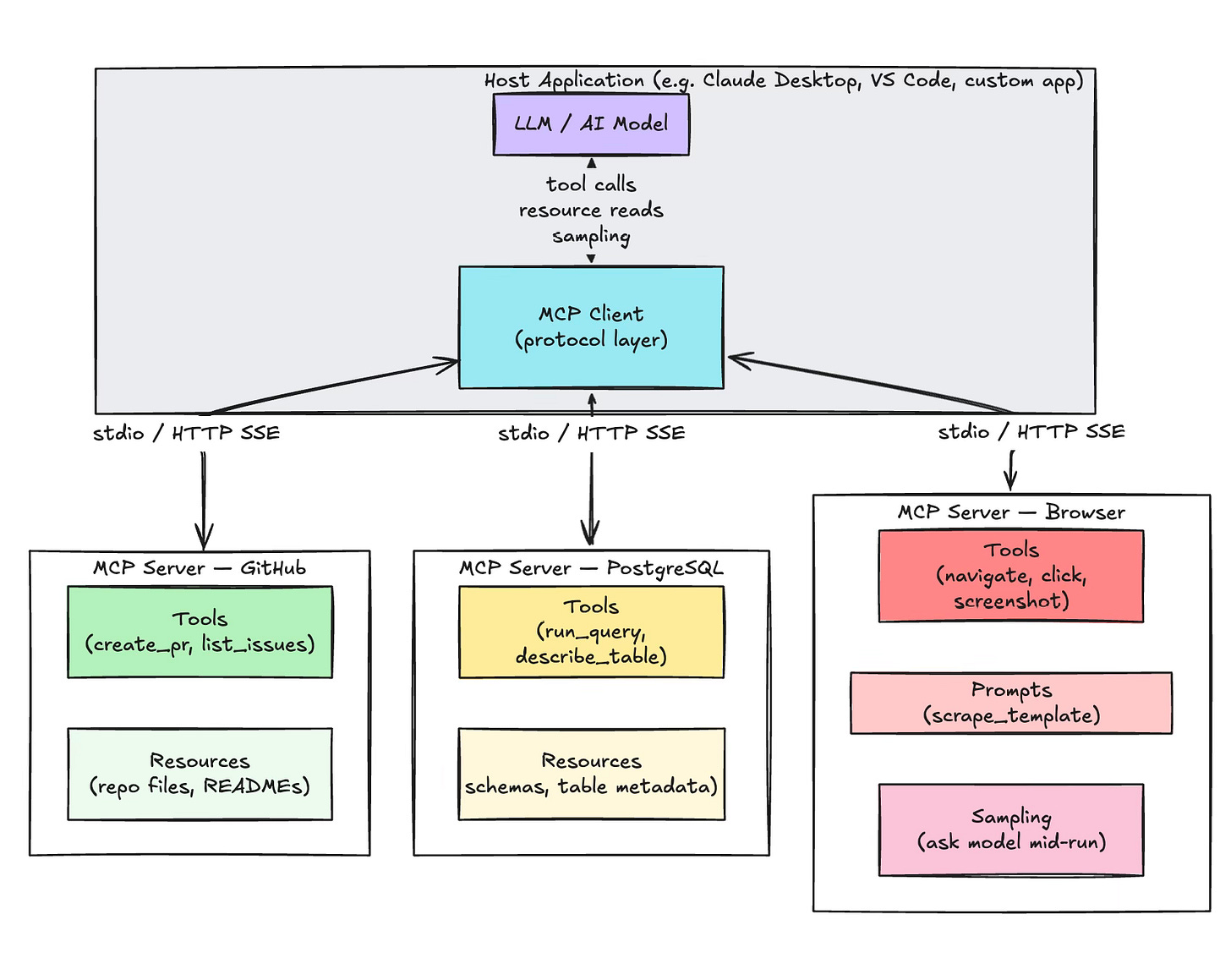
By standardizing prompts, tools, and resources in a universal client-server model, MCP slashed integration complexity for AI tools, making secure, reusable connections to external APIs as simple as plugging in a cable.
The Model Context Protocol (MCP) employs a strict client-server architecture that standardizes AI integration with external tools through three core primitives: Prompts, Tools, and Resources. MCP clients embedded within AI applications use JSON-RPC 2.0 to discover and invoke these capabilities exposed by MCP servers, which translate standardized requests into proprietary API calls for services like GitHub, Slack, and Postgres. This architecture effectively decouples large language models from target APIs, enabling write-once, use-anywhere tool creation that simplifies integration complexity from an M×N problem to M+N, akin to a universal USB-C connector for AI workflows.
While MCP’s architecture brings robust standardization and security—supporting OAuth 2.1 roles and rigorous translation testing—it introduces operational complexity, especially in remote, multi-tenant, and authenticated deployments. This makes MCP particularly well-suited for connecting LLMs to complex, stateful external systems where security and reusability are paramount, as exemplified by early adopters like Replit, GitHub’s VS Code integration, and Stripe’s payment operations. Conversely, lighter alternatives such as SKILLs are preferred for simpler, self-contained tasks, highlighting MCP’s niche in enterprise-grade AI-to-tool integration.
MCP complements the Agent-to-Agent (A2A) protocol, with MCP focusing on vertical AI-to-tool communication and A2A enabling horizontal AI agent collaboration. This synergy is demonstrated in practical workflows where, for instance, an inventory agent uses MCP to manage databases while communicating with order and supplier agents via A2A. Together, these protocols mark a pivotal industry standardization moment, replacing fragmented bespoke integrations with interoperable, reusable frameworks that collectively empower AI systems to operate complex software ecosystems seamlessly.
Beyond mere API calls, MCP is designed as a protocol that gives large language models 'fingers' to dynamically access and manipulate external information, enhancing their problem-solving capabilities beyond conversational input-output. Running MCP servers locally leverages user credentials for secure, efficient tool access, while the protocol’s standardized discovery and execution patterns allow AI applications like Claude to interact with diverse tools through AI harnesses. This evolution builds on earlier innovations such as LangChain’s 2023 browser retrieval feature, formalizing a universal, transport-agnostic interface that transforms how AI models extend their reach into real-world workflows.





From Lab Rivalry to Open Stewardship
Anthropic’s donation of MCP to the Linux Foundation and Google’s parallel A2A protocol triggered an unprecedented cross-industry alliance, turning protocol governance into the new battleground for AI infrastructure dominance.
Since its open-source release by Anthropic in November 2024, the Model Context Protocol (MCP) has rapidly become the de facto standard for AI agent interoperability, with every major AI lab—including OpenAI, Google DeepMind, Gemini, and Microsoft—adopting it by the end of 2025. This swift uptake, marked by over 97 million monthly SDK downloads and more than 10,000 active servers by early 2026, transformed the AI ecosystem by enabling tools and skills to work seamlessly across platforms, effectively dismantling vendor lock-in and fostering a composable agent landscape reminiscent of the web's evolution in the late 1990s.
Anthropic’s strategic donation of MCP to the Linux Foundation in December 2025 catalyzed the formation of the Agentic AI Foundation, a governance body backed by industry heavyweights such as OpenAI, AWS, Google, Microsoft, and Bloomberg. This move institutionalized protocol stewardship, ensuring neutral oversight critical for preventing fragmentation and maintaining backward compatibility as adoption scales, while also fostering a collaborative ecosystem where startups and enterprises alike benefit from reduced integration complexity and enhanced flexibility to swap models or tools without costly rewrites.
Complementing MCP’s role in agent-to-tool communication, Google’s Agent-to-Agent Protocol (A2A), launched in April 2025 and adopted by over 150 organizations including Atlassian and Salesforce, expanded the ecosystem by enabling seamless agent collaboration. Rather than competing, MCP and A2A protocols coexist to address distinct connectivity challenges, collectively mirroring historic technology adoption patterns where foundational standards like TCP/IP and HTML commoditized infrastructure, allowing value to migrate upward to models and orchestration layers—an ecosystem dynamic carefully shaped by Anthropic and Google to secure their central positions through protocol leadership.
The widespread integration of MCP into major developer tools and enterprise platforms—such as Replit, GitHub’s VS Code registry, Stripe’s payment operations, and Microsoft’s Azure AI services—has significantly reduced the fragmentation that once plagued AI-tool connectivity. By standardizing user consent for tool calls and enabling agents to combine internal business intelligence with external market data, MCP not only enhances security and trust but also unlocks improved analytics capabilities, driving more accurate forecasts and automated reporting that accelerate innovation across diverse industries.




Security Gaps Exposed at Scale
Widespread MCP adoption has revealed a fragile security landscape, where hardcoded secrets and immature governance leave thousands of servers vulnerable to mass exploitation and simultaneous compromise.
The donation of the Model Context Protocol (MCP) to a neutral governing body initially fostered collaborative security improvements by alleviating competitive concerns among companies, enabling shared enhancements in authentication and operational infrastructure. MCP’s design introduced a centralized connectivity layer that decouples execution environments from authentication management, simplifying integration complexities and reducing operational burdens through features like automatic discovery and connection pooling, as exemplified by Anthropic’s comprehensive internal use of an MCP gateway.
By early 2026, the rapid and widespread adoption of MCP exposed significant security vulnerabilities, including prompt injection, permission escalation, and tool poisoning attacks, compounded by immature governance frameworks dominated by commercial interests prioritizing speed over security. Studies revealed that over half of public MCP servers relied on insecure hardcoded secrets, with only a fraction implementing OAuth, leading to a 72.8% success rate in tool poisoning benchmarks. This universal attack surface risked simultaneous compromise across thousands of servers, underscoring the urgent need for inventorying MCP usage, network segmentation, and vigilant monitoring.
Authentication and governance challenges intensified as MCP evolved from local-only applications to support remote Internet services, revealing OAuth’s limitations in dynamic, plug-and-play environments. This prompted extensions to OAuth specifications and the emergence of MCP gateways that centralize authentication tasks, easing implementation complexity. Open community engagement proved vital in identifying new protocol primitives like 'elicitations' to enforce user interactions and strengthen security. However, operational burdens remain high due to manual capability-scoped server provisioning and fragmented governance models, with enterprises struggling to maintain visibility and enforce least privilege principles at scale.
Recent enterprise deployments, such as Snap’s Ads MCP server, demonstrate advanced security architectures assigning unique OAuth client IDs per AI agent and enforcing two-step authorization processes that separate organizational enabling from individual user consent, thereby enhancing auditability and control. Yet, as MCP moves from read-only to write capabilities—seen in platforms like X Ads—governance complexities escalate, requiring human-in-the-loop approval gates and structural safeguards to prevent unauthorized actions. Meanwhile, operational improvements like upcoming MCP standard updates aim to reduce server maintenance burdens and costs, but the protocol’s instability and overlapping competing standards continue to challenge unified governance and secure large-scale adoption.


Enterprise Workflows, Real ROI
MCP is quietly revolutionizing business operations, powering everything from financial platforms to ad campaign management with AI agents that deliver measurable productivity gains and granular auditability.
The Model Context Protocol (MCP) has fundamentally transformed AI integration in business workflows by providing AI agents with reliable, permission-aware access to curated data and bounded actions, which enhances accuracy and trustworthiness. This standardized context enables AI to operate dependably within complex systems, as seen in Microsoft’s Dynamics 365 where users can automate up to 650,000 actions, and in platforms like 1inch and Hanover Park that streamline real-time financial and decentralized finance operations. By addressing systemic challenges such as permissions, auditability, and workflow norms, MCP bridges the gap between impressive AI demos and robust, enterprise-grade tools.
Leading enterprises across sectors are leveraging MCP-enabled AI agents to automate and optimize workflows with measurable ROI. Cloudinary’s AI agents, for example, have boosted visual media management productivity and delivered returns up to 203% by automating taxonomy, search, and moderation tasks without disrupting existing tech stacks. Similarly, Duco’s autonomous post-trade platform uses MCP to constrain AI actions within auditable frameworks, reducing reconciliation build times from days to hours and gaining adoption among top financial firms. These real-world deployments highlight MCP’s role in enhancing operational efficiency while maintaining compliance and human oversight.
The advertising industry has seen a rapid and widespread adoption of MCP as a unifying interface layer that enables AI agents to manage campaigns across multiple platforms with granular governance. Companies like Snap, X, PropellerAds, and others have launched MCP servers that allow AI tools such as ChatGPT, Claude, and Grok to perform complex campaign operations—from creation to optimization—through natural language commands. X’s MCP implementation notably balances write access with safety by requiring campaigns to remain paused until explicitly activated, reflecting a cautious but enabling approach that contrasts with Google’s read-only and Meta’s full-write models. This shift moves campaign management from native dashboards into AI-driven workflows, improving efficiency and reducing manual workload.
Beyond advertising and finance, MCP is accelerating AI-driven automation across diverse business functions by enabling seamless, secure integration of multiple tools and data sources. For instance, Zapier’s MCP and SDK empower AI agents to reliably execute tasks across over 9,000 apps with fine-grained permissions, preventing unauthorized actions while expanding automation possibilities. Market analysts and developers benefit from MCP’s ability to provide up-to-date, structured context from sources like GitHub, Slack, and financial APIs, reducing hallucinations and boosting productivity. This broad ecosystem growth, fueled by open-source contributions and major cloud providers’ adoption, underscores MCP’s pivotal role in standardizing AI workflows and enhancing data-driven decision-making.




MCP’s Next Phase: Usability vs. Risk
As MCP matures into the backbone of enterprise AI, its shift toward streamlined integration and pre-built connectors is lowering adoption barriers—but also heightening the stakes of security missteps.
Since its open-sourcing by Anthropic in late 2024, the Model Context Protocol (MCP) has rapidly evolved from a local-only specification to a foundational AI integration standard, boasting over 110 million monthly downloads by early 2026 and deep adoption across major platforms including OpenAI’s Agents SDK, Google’s ADK, and Microsoft SQL Server 2025. This growth reflects MCP’s transition from enabling basic agent coding in 2025 to supporting production-ready general agents capable of complex knowledge work, signaling a maturation phase where the protocol focuses on refining infrastructure—such as session ID handling to reduce operational burdens—over adding new features, thereby enhancing efficiency and lowering costs for large-scale deployments.
MCP’s strategic donation to the Agentic AI Foundation under the Linux Foundation in December 2025, backed by industry giants like AWS, Google, Microsoft, and Bloomberg, underscores its positioning as the unifying open standard amid competing proprietary protocols. This coalition has propelled MCP to become the ‘USB-C of AI,’ enabling seamless interoperability where composable autonomous agents orchestrate specialized tasks—ranging from research to execution—across ecosystems, fundamentally shifting AI usage from reactive chatbots to goal-driven autonomous systems that independently manage workflows and error correction.
Recent and upcoming usability improvements to MCP aim to dramatically lower technical barriers for enterprise adoption by simplifying authentication, providing pre-built connectors, and streamlining integration with external data sources. These enhancements arrive at a critical juncture as enterprises confront an integration wall, needing AI assistants that perform real tasks securely without exposing broad API access or incurring costly custom builds. While these advances bolster MCP’s competitive edge against proprietary alternatives by emphasizing security, control, and vendor independence, they also raise concerns about potential misconfigurations if developers prioritize speed over rigorous security reviews.
MCP’s explosive adoption trajectory—reflected in a 4,750 percent growth rate and over 10,000 active public servers by mid-2026—has cemented its role as foundational infrastructure across diverse enterprise AI engineering workflows. Its integration into flagship products like Microsoft SQL Server 2025, which natively supports MCP servers to enable semantic access to decades of business data without migration, exemplifies how MCP is becoming the structural assumption for AI interoperability. Supported by major players such as Microsoft, OpenAI, and Google DeepMind, MCP is poised to dominate as the de facto standard that eliminates bespoke glue code and streamlines AI agent connectivity across the industry.