Measles surge fuels backlash against trump-kennedy vaccine rollbacks
The gist
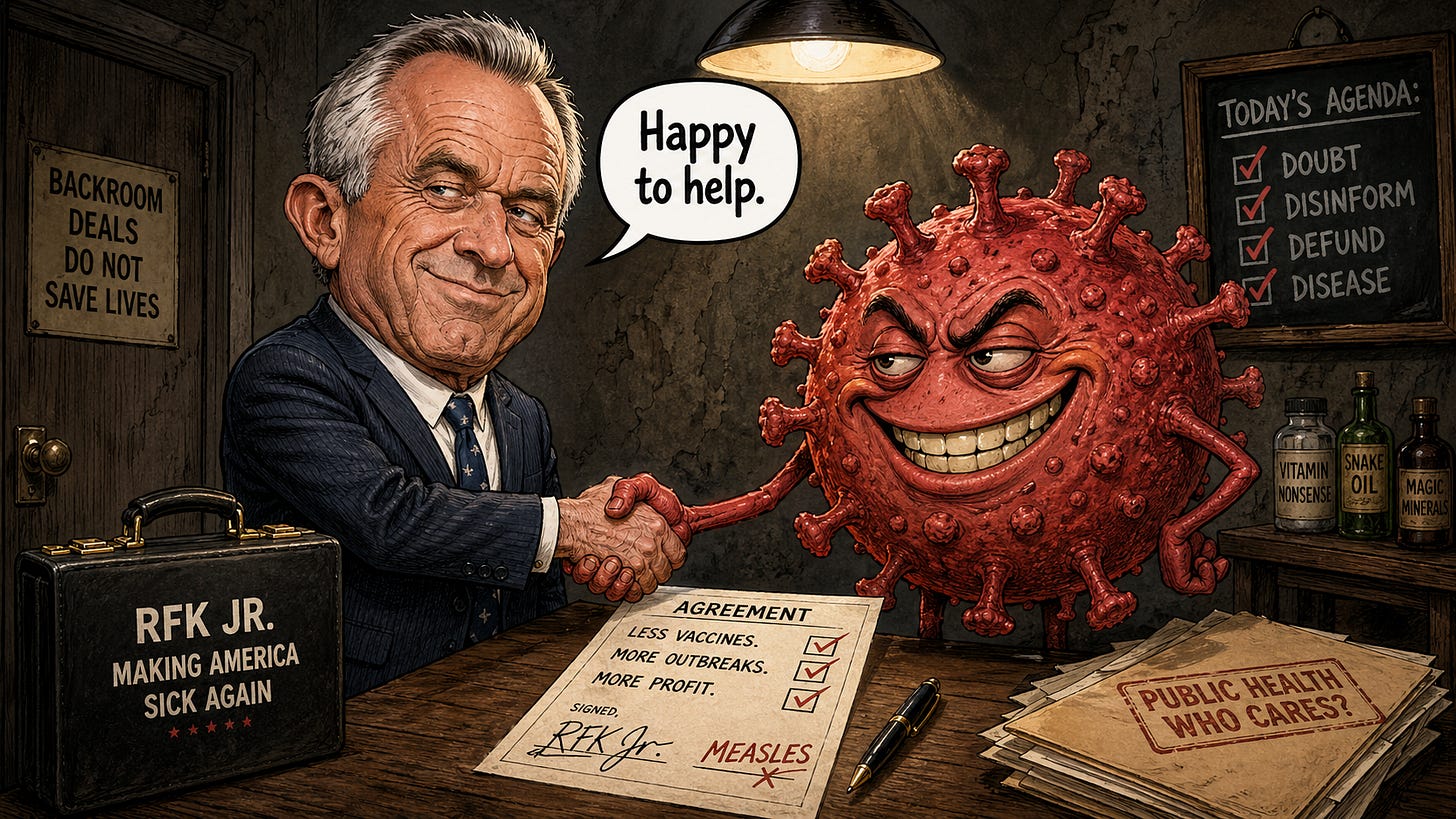
A surge in measles cases is fueling fierce backlash as controversial Trump-Kennedy vaccine rollbacks upend U.S. immunization policy and public trust.
What to know
- The CDC’s vaccine advisory committee was overhauled in 2026 to include vaccine skeptics, sparking legal chaos and eroding expert oversight.
- Trump’s executive order slashed childhood vaccines from 17-18 to 11 and split the MMR shot into three, despite unanimous medical opposition and no scientific backing.
- MMR vaccination rates have dropped below herd immunity, leading to over 2,300 measles cases and three deaths in 2026, as courts and manufacturers scramble to respond.
CDC Expertise Gutted
Sweeping leadership purges and a reimagined vaccine committee stacked with skeptics left the CDC rudderless and public trust in immunization policy shattered.
Under the leadership of HHS Secretary Robert F. Kennedy Jr., the CDC underwent a profound leadership upheaval marked by the dismissal of key personnel and a sweeping restructuring of the Advisory Committee on Immunization Practices (ACIP). This overhaul replaced seasoned experts with members lacking relevant qualifications, creating a leadership vacuum that jeopardized the integrity of national immunization efforts and eroded public trust in disease prevention strategies.
By mid-2026, the ACIP charter was fundamentally revised to broaden membership criteria and pivot the committee’s mission from endorsing new vaccines to evaluating alternative disease prevention methods. This strategic shift facilitated the appointment of vaccine skeptics aligned with Kennedy’s controversial agenda, prompting sharp criticism from experts who argued that loosening expertise requirements and altering the committee’s focus undermined scientific rigor and compromised public health policy.
The leadership turmoil and contentious restructuring sparked legal challenges that effectively paralyzed the ACIP throughout 2026, with no meetings convened and ongoing disputes over the confidentiality of case materials. These legal battles not only stalled vaccine advisory processes but also deepened uncertainty around the committee’s legitimacy, further complicating the nation’s ability to maintain coherent and trusted immunization guidance.


Trump’s Vaccine Overhaul
Trump’s anti-vaccine rhetoric and executive orders, fueled by conspiracy theories, dismantled expert panels and slashed vaccine recommendations despite unanimous medical opposition.
Former President Donald Trump’s longstanding endorsement of debunked anti-vaccine claims, such as the false link between vaccines and autism, laid the groundwork for significant shifts in U.S. vaccine policy during his administration. This rhetoric influenced key appointments, notably Robert F. Kennedy Jr. as Secretary of Health and Human Services, who swiftly dismantled established vaccine advisory structures and overhauled childhood vaccine recommendations, including disbanding the CDC’s expert advisory board. Concurrently, the FDA under Trump adopted misguided guidance, such as advising pregnant women against Tylenol based on unfounded autism concerns, while slashing funding for critical mRNA vaccine research, signaling a broader departure from evidence-based public health practices.
Trump’s direct involvement intensified in 2026 when he pressured HHS Secretary Kennedy to further reduce the childhood vaccine schedule, despite overwhelming scientific consensus disproving any vaccine-autism link. In May, Trump formalized this agenda by signing an executive order aimed at cutting recommended vaccines and controversially advocating splitting the combined MMR vaccine into separate measles, mumps, and rubella shots—a move experts warned would disrupt vaccination efforts and public health outcomes. This executive order bypassed the CDC’s traditional evidence-based process, relying instead on presidential advisers and international comparisons without new scientific data, while also challenging state exemption laws and prompting the creation of a federal task force to enforce these contentious changes.
The August 2026 executive order, dubbed the “Gold Standard Childhood Vaccine Recommendations,” slashed the number of universally recommended childhood vaccines from 17-18 to 11 and mandated splitting the MMR vaccine into three separate shots, despite lacking scientific support and facing unanimous opposition from major medical organizations like the American Academy of Pediatrics and the American Medical Association. Experts highlighted that splitting the MMR vaccine would create logistical challenges, increase missed or delayed vaccinations, and risk exacerbating measles outbreaks, with the policy’s origins tracing back to discredited research by Andrew Wakefield. Vaccine manufacturers Merck and GSK expressed no interest in developing separate MMR shots due to prohibitive costs and regulatory hurdles, making the policy’s practical implementation highly unlikely.
Trump’s vaccine policy shifts have sparked significant legal and public trust challenges, as courts blocked Kennedy’s narrowed vaccine recommendations due to procedural violations and unlawful advisory panel appointments, with ongoing appeals complicating the landscape. The executive order’s attempt to override established CDC authority—granted by Congress to the Advisory Committee for Immunization Practices—has raised constitutional questions about presidential versus legislative and scientific oversight in vaccine policymaking. Moreover, by revising established schedules without new evidence and emphasizing trust and education over mandates, the administration’s approach paradoxically undermined public confidence, especially among hesitant parents influenced by misinformation, thereby threatening to reverse decades of progress in childhood immunization coverage.


Measles Outbreaks Surge
MMR vaccination rates plummeted below herd immunity, triggering the worst U.S. measles outbreaks in decades, mounting deaths, and billions in projected losses.
By early 2026, the United States faced a dramatic resurgence of measles, with over 4,850 infections and three deaths reported since the start of 2025, marking the highest case numbers since 1991. This alarming increase, including more than 2,300 cases in 2026 alone, was directly tied to declining MMR vaccination rates that fell below the herd immunity threshold, fueled in part by vaccine misinformation propagated by figures like Robert F. Kennedy Jr., who, as the nation's top health official, has been criticized for undermining public trust and failing to promote vaccination urgency.
The public health consequences extend beyond individual illness to substantial economic and societal burdens, with a 2026 Yale-linked study estimating measles outbreaks cost the U.S. $244.2 million in 2025 alone. If vaccination coverage continues to decline by just one percentage point annually, projections warn of over 17,000 cases, 4,000 hospitalizations, and 36 preventable deaths each year by 2030, alongside nearly $7.8 billion in cumulative losses, as health departments, schools, and hospitals scramble to manage outbreaks caused by preventable diseases.
Localized vulnerabilities have intensified the crisis, with states like South Carolina, Utah, Virginia, Florida, and Pennsylvania experiencing significant year-over-year increases in measles cases, many linked to unvaccinated individuals or those with unknown vaccination status. Compounding this, MMR coverage among kindergartners dropped from 95.2% in 2019-20 to 92.5% in 2024-25, leaving approximately 286,000 children unvaccinated, while exemptions for medical, religious, or personal beliefs in most states complicate efforts to maintain herd immunity amid widespread outbreaks.
The resurgence of measles also highlights deeper systemic weaknesses in U.S. public health infrastructure, exacerbated by policy shifts under the Trump administration and Kennedy’s leadership. The CDC lost nearly a quarter of its workforce since January 2025, and the number of universally recommended childhood vaccines was cut from 17 to 11, impairing outbreak response capabilities. Additionally, budget cuts delayed critical FDA food traceability rules and led to disbanding key advisory committees, contributing to broader outbreaks of rare diseases and signaling a troubling erosion of the nation’s ability to prevent and control vaccine-preventable illnesses.



Legal Chaos Paralyzes ACIP
Courtroom battles over Kennedy’s handpicked advisory board froze all vaccine committee activity, sowing confusion and undermining the legitimacy of federal vaccine governance.
By mid-2026, the Advisory Committee on Immunization Practices (ACIP) underwent a controversial charter revision that broadened member eligibility and shifted its mission from recommending new vaccines to evaluating alternatives, a move orchestrated under Health Secretary Robert F. Kennedy Jr. to accommodate vaccine skeptics. Experts widely criticized this change as a deliberate attempt to undermine scientific rigor and advance an anti-vaccine agenda by diluting expertise requirements and altering the committee’s foundational purpose, thereby eroding trust in the institution’s integrity.
The legitimacy of the ACIP became a focal point of legal battles, resulting in a complete halt of its meetings throughout 2026 and casting a shadow of institutional uncertainty over vaccine governance. Federal courts blocked key vaccine schedule revisions proposed by Kennedy, citing procedural irregularities and the unlawful seating of advisory panel members, which underscored the contentious disputes surrounding the committee’s authority and composition.
The executive order signed on August 10, 2026, by President Trump and Secretary Kennedy dramatically bypassed the traditional CDC-led, evidence-based vaccine recommendation process, instead relying on presidential advisers and international comparisons without presenting new scientific data. This order not only mandated a federal task force to implement sweeping changes—including slashing the childhood vaccine schedule to 11 and splitting the MMR vaccine—but also challenged state exemption laws, thereby igniting significant legal uncertainties and potential conflicts over federal versus state vaccine governance.
Amid ongoing litigation challenging both the ACIP’s reconstitution and the revised vaccine schedules, multiple lawsuits filed by medical groups and states accused the administration of violating the Administrative Procedure Act and the Federal Advisory Committee Act by improperly appointing members and circumventing established procedures. The August executive order layered additional complexity onto these disputes, with legal experts anticipating either its incorporation into existing lawsuits or the emergence of new challenges, highlighting the fraught and unsettled nature of vaccine policy reform in this period.
Skepticism Fuels School Risk
Political maneuvering and rising anti-vaccine sentiment have driven down school immunization rates, leaving hundreds of thousands of children unprotected and deepening America’s public health divide.
By early 2026, vaccine skepticism in the U.S. had been significantly deepened by political and ideological influences, notably from figures like Robert F. Kennedy Jr., who skillfully blurred settled science into a 'haze of insinuation' that eroded public trust and painted expertise as sinister. This manufactured doubt has tangible consequences: declining MMR vaccination rates have slipped below herd immunity thresholds, triggering increased hospitalizations, school disruptions, and economic burdens as communities grapple with outbreaks fueled by a vocal minority rejecting infectious disease laws.
The Trump administration’s public health policy shifts further exacerbated vaccine skepticism and weakened the nation’s disease control infrastructure. By cutting the CDC’s recommended childhood vaccines from 17 to 11 and slashing nearly a quarter of its workforce, the administration undermined disease tracking and response just before historic outbreaks, while simultaneously sowing distrust through executive orders that reduced vaccination schedules and confused parents—actions that complicated school vaccination efforts and community protection.
Political and religious exemptions in most states have become flashpoints in the vaccination debate, with MMR coverage among kindergartners dropping from 95.2% in 2019-20 to 92.5% in 2024-25, leaving roughly 286,000 children unvaccinated. This decline reflects a growing divide where red states, pressured by anti-vaccine groups and executive orders, tend to loosen school vaccination mandates, while blue states maintain stricter requirements, illustrating how politicization complicates efforts to sustain herd immunity and protect vulnerable populations.
While political identity plays a significant role in vaccine hesitancy, deeply rooted religious beliefs independently drive resistance in specific communities, such as the Amish in Texas and Slavic groups in South Carolina, who reject vaccines based on century-old convictions. This complexity is often oversimplified in media narratives that attribute outbreaks solely to politics, ignoring how religious exemptions contribute to localized measles surges like Utah’s prolonged outbreak, thereby complicating public health responses and requiring nuanced engagement strategies.

MMR Split Sparks Backlash
Forcing separate measles, mumps, and rubella shots has triggered logistical nightmares, industry resistance, and condemnation from medical groups as outbreaks expose cracks in the vaccine system.
The August 10, 2026 executive order mandating the splitting of the combined MMR vaccine into three separate shots has sparked widespread expert concern over the logistical and practical fallout. Public health authorities like Neil Maniar of Northeastern University warn that increasing the number of injections from two to six in early childhood could lead to more delayed or missed vaccinations, undermining compliance and public health outcomes. Merck and other manufacturers face daunting challenges, including costly and unprecedented regulatory hurdles to develop and license monovalent vaccines, with experts like William Moss of Johns Hopkins University doubting any near-term feasibility given the extensive time and resources required.
Beyond manufacturing hurdles, healthcare providers and parents are bracing for increased complexity and burden as the vaccine schedule narrows from 17-18 to 11 recommended shots and doses are spaced over more pediatric visits. This fragmentation not only complicates logistics but also raises costs and inconvenience, risking lower vaccination rates amid conflicting guidelines. The American Academy of Pediatrics and other medical organizations have condemned the policy shift as “disheartening” and “dangerous,” emphasizing that bypassing the CDC’s evidence-based process threatens to erode public trust and disrupt well-established vaccination practices.
The policy upheaval coincides with a troubling resurgence of measles, which has already surpassed the highest annual U.S. case count since 1991 within just seven months of 2026. Experts liken this outbreak to a diagnostic dye revealing cracks in the nation’s vaccination system, warning that ongoing shifts under Robert F. Kennedy Jr. and President Trump—from vaccine promotion to fostering doubt—may drive manufacturers out of the market and leave communities vulnerable to preventable diseases. This erosion of bipartisan vaccination progress underscores the high stakes of the logistical and practical disruptions triggered by the new vaccine policies.