Megawatt truck charging surges as smart networks lead shift
The gist
Siemens and tech giants are electrifying the freight world, unleashing megawatt-class chargers and smart networks that supercharge heavy-duty EV trucking at record speed.
What to know
- The megawatt charging connector market is projected to hit $3.1 billion by 2036 as heavy-duty EV truck adoption accelerates and megacharger networks expand.
- Siemens’ SICHARGE FLEX (1.68 MW), Tesla’s Megacharger (1.2 MW), and Huawei’s modular FusionCharge (up to 720 kW) are setting the pace with scalable, high-efficiency charging solutions.
- Bidirectional charging, dynamic energy management, and distributed charging architectures are now key to slashing grid strain and boosting site utilization by up to 83%.
Megacharger Rollout Goes Global
Tesla, Siemens, and OMV are racing to deploy megawatt-class chargers along critical freight corridors, signaling a global shift as heavy-duty EV infrastructure matures beyond pilot projects.
The megawatt charging connector systems market is poised for robust expansion, with projections estimating a valuation of USD 3.1 billion by 2036, fueled by the accelerating adoption of heavy electric trucks across global logistics networks. This surge reflects a broader industry commitment to electrifying freight transport, underscoring the critical role of ultra-high-power charging infrastructure in enabling long-haul and regional operations.
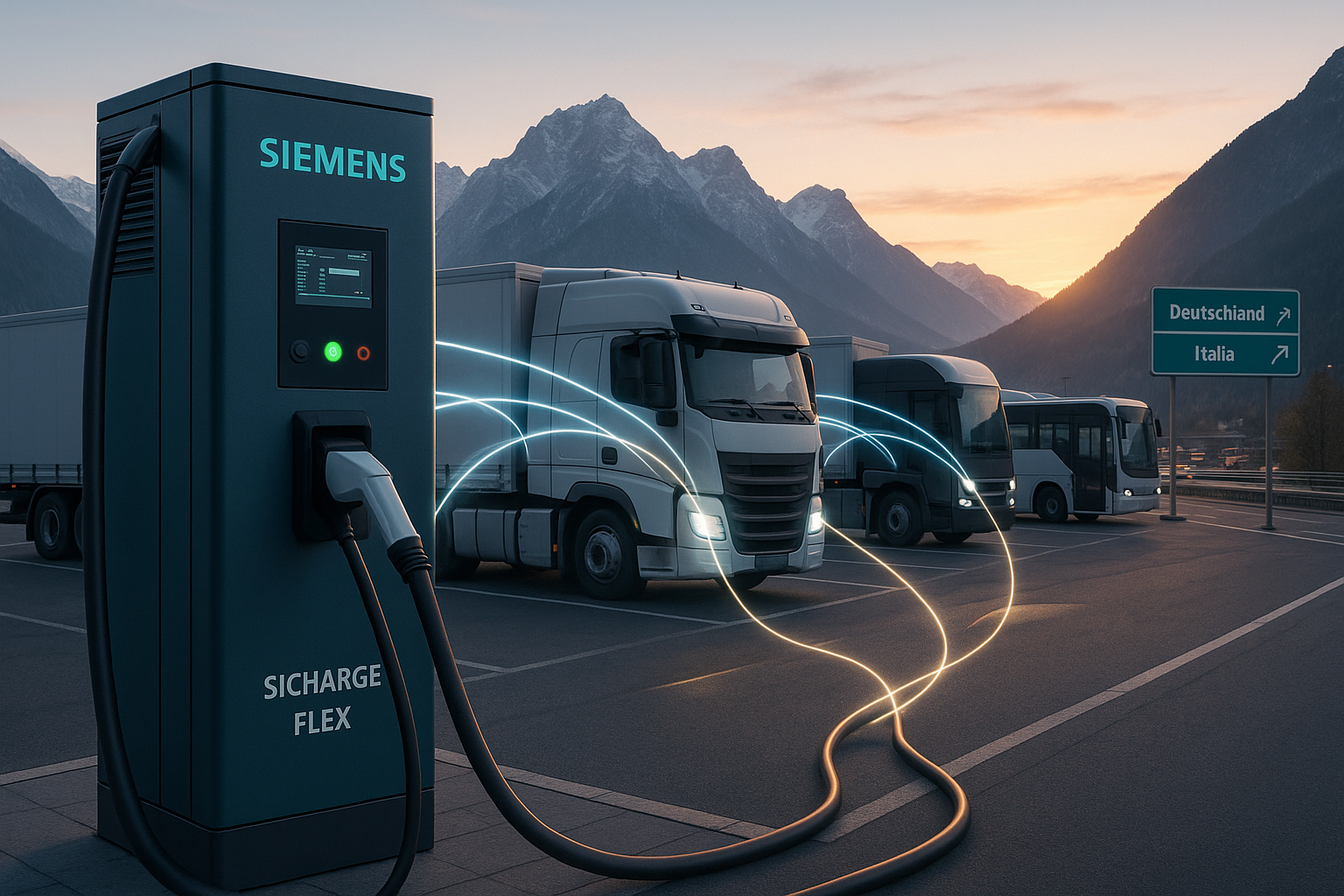
Siemens and OMV Austria exemplify the commercial deployment momentum in Europe, with Siemens unveiling the 1.68 MW SICHARGE FLEX charger and OMV piloting megachargers along the strategic Germany–Italy A12 corridor. These initiatives highlight a concerted effort to embed ultra-high-power charging stations along vital transport arteries, facilitating seamless cross-border heavy-duty electric truck operations and signaling a maturation of the European megawatt charging ecosystem.
Tesla is aggressively expanding its Megacharger network in the United States, focusing initial deployments in Southern California’s dense industrial zones such as Vernon, where six stalls deliver up to 1.2 MW each to support last-mile and regional haul fleets. With plans for approximately 64 additional stations nationwide—including 17 in California and partnerships with Pilot Travel Centers across multiple states—Tesla’s strategy reflects a market-driven approach to scaling infrastructure where demand is concentrated, while leveraging the Megawatt Charging System’s 3.75 MW protocol ceiling to future-proof their network.
Modular Tech Powers Next-Gen Charging
Innovators like Siemens, Huawei, and Fraunhofer ISE are redefining megawatt charging with modular, battery-integrated systems that slash grid demands and boost efficiency, paving the way for scalable, ultra-fast truck charging.
Siemens’ launch of the SICHARGE FLEX system marks a leap forward in megawatt-class charging, delivering up to 1.68 MW through a modular architecture designed for heavy-duty electric trucks. This innovation is strategically deployed along critical European corridors like the Germany–Italy A12, where OMV Austria pilots the megacharger, underscoring a coordinated effort to support long-haul electrification with ultra-high-power infrastructure.
Huawei’s FusionCharge platform revolutionizes charging efficiency by combining a liquid-cooled, DC-coupled battery system with a fully modular design that supports scalable upgrades from fast to ultra-fast charging without hardware replacement. Operating at up to 720 kW across 12 connectors while drawing only about 50 kW from the grid, it dramatically reduces infrastructure demands and permit delays, all while maintaining a quiet operation below 55 dB and a battery storage round-trip efficiency of approximately 92.1%.
Fraunhofer ISE’s modular DC/DC converter system exemplifies cutting-edge grid optimization by enabling megawatt-class charging above 1 MW from a limited 500 kW grid connection through integrated second-life battery storage. Achieving a peak efficiency of 99.26% and a power density of 9 kW per liter, this compact, scalable solution features a common DC bus architecture that flexibly balances power flows and integrates on-site PV generation, while supporting up to four 250 kW units in parallel compatible with both CCS and MCS standards.
Huawei’s ongoing development of a 1,500 kW megawatt-class variant signals a push toward even higher power modular charging systems tailored for logistics hubs and heavy trucks, reflecting a broader industry trend of scaling liquid-cooled, battery-integrated platforms to meet the demanding needs of heavy-duty electric vehicle fleets.
Bidirectional Charging Breaks Barriers
Emerging AC and megawatt-class bidirectional charging solutions are turning electric trucks into mobile energy assets, but fragmented standards and regulatory hurdles still challenge widespread adoption.
Bidirectional charging technology is gaining traction as a practical solution for heavy-duty electric vehicles, with a strong emphasis on bidirectional AC charging due to its cost-effectiveness and scalability compared to DC systems. Companies like Valeo are pioneering bidirectional AC wallboxes, initially launching with Nissan in the UK, leveraging onboard vehicle inverters to simplify infrastructure and reduce costs. This approach aligns with the vision of electric vehicles serving as distributed energy resources, enabling vehicle-to-grid and vehicle-to-home applications that enhance grid flexibility and provide new value streams for fleet operators.
General Motors exemplifies the integration of bidirectional charging with mobile battery storage systems, developing vehicle-to-home solutions and exploring sodium battery technologies for energy storage. This synergy between EVs and mobile energy storage not only supports rapid, high-power charging but also enables fleets to operate independently of fixed grid upgrades, effectively moving charging infrastructure to where demand exists. As Greg Laudermilch of CSI highlights, adding bidirectional Megawatt Charging System capability to mobile battery energy storage elevates this concept to new power levels, facilitating both charging and grid services such as peak shaving and energy shifting.
The commercialization of bidirectional megawatt charging systems is underpinned by emerging standardized protocols like IEC TS 63379 and SAE J3271, which define connectors, communications, and interoperability requirements essential for heavy-duty transport applications. However, despite technical readiness, widespread adoption faces hurdles from fragmented standards, regulatory uncertainties, and unresolved grid fee structures, particularly in regions like Germany. Corporate fleets with predictable downtime stand out as ideal early adopters, capable of leveraging bidirectional charging to provide grid flexibility and monetize energy market participation while navigating these evolving frameworks.

Smart Networks Tackle Grid Strain
Dynamic load management and integrated energy platforms are transforming charging sites into resilient, multi-layered hubs, optimizing power flows and economics as operators race to keep pace with surging demand.
Ultra-fast charging for heavy-duty electric trucks introduces sharp, high-intensity power peaks that strain existing grid and site infrastructure, pushing operators toward megawatt-level connections and more complex electrical designs. To address these challenges, dynamic energy and load management systems have become essential, enabling real-time optimization that balances demand across multiple chargers and power sources. This digital orchestration not only maximizes energy efficiency but also reduces infrastructure footprint and operational inefficiencies, creating a viable pathway to scale ultra-fast charging without costly and slow grid upgrades.
Beyond raw capacity, charging sites are evolving into integrated energy platforms that incorporate storage, distributed energy resources, and microgrids to enhance flexibility and resilience. Operators like Ausgrid exemplify this approach by prioritizing hierarchical charging strategies—favoring depot charging, supplemented by substations and employee home charging—to optimize control and energy supply for fleet electrification. Additionally, innovations such as vehicle-to-vehicle charging are being explored to bolster operational continuity, reflecting a broader trend toward intelligent, multi-layered infrastructure design that supports scalable expansion without major reinvestment.
Economic viability remains a critical hurdle, as DC fast charging ports typically require 15 to 25% utilization to break even, yet industry-wide utilization hovers around 15%. Companies are responding by deploying dynamic load management and strategic network build-outs that leverage network effects—where high-performing sites compensate for lower-utilization locations—to deliver reliable, everyday and travel charging options. While early deployments prioritize driver experience over incorporating battery storage or solar for demand charge mitigation, future plans anticipate integrating these technologies to further improve cost efficiency and grid interaction.
Increasing the number of charging plugs and adopting distributed charging architectures that dynamically share power among multiple points have proven more effective at boosting site utilization than simply adding installed charging power. Kempower’s ChargEye data reveals that sites with distributed charging achieve up to 83% higher utilization compared to fixed-power setups, underscoring that public charging is increasingly an infrastructure utilization challenge rather than a pure power deployment issue. As Jed Routh of Kempower emphasizes, intelligent load management solutions are now paramount to unlocking the full potential of ultra-fast charging networks.