Meta’s AI watermark flounders as google’s SynthID shines
The gist
Meta’s much-hyped AI image watermark collapses under basic edits, while Google’s open-source SynthID stays strong—spotlighting a widening rift in how the industry labels AI creations.
What to know
- Meta’s Content Seal misses over 55% of AI-generated images after simple cropping, while Google’s SynthID keeps detection rates near 98%.
- Content Seal is locked to Meta’s Muse AI and a closed web tool, but SynthID is open source, industry-backed, and compatible with standards like C2PA.
- With regulators like the EU pushing for robust, multi-layered transparency, the clash between closed and open watermarking is fueling calls for unified, durable solutions.
Meta’s Watermark Weakness Exposed
Meta’s Content Seal fails under basic edits like cropping, revealing a major flaw in its ability to reliably flag AI-generated images in the wild.
Meta's Content Seal watermarking system exhibits a critical vulnerability in its detection capabilities, failing to identify over 55% of AI-generated images once they are cropped—a common editing practice on social media. Independent testing by Reuters and other analysts revealed that while the system reliably flagged original, unmodified images created with Meta's Muse AI tool, cropping images to about one third to one half of their original size caused the watermark signal to degrade or disappear, severely undermining detection accuracy. This discrepancy exposes a significant gap between Meta's claims of robustness and the practical realities of image sharing online, where cropping, resizing, and compression are routine.
The technical limitations of Content Seal highlight broader challenges faced by watermark-based AI detection methods, as subtle digital markers embedded within images are easily disrupted by common modifications like cropping and resizing. Experts such as Siwei Lyu emphasize that these alterations can remove or distort the embedded signals that detection models rely on, causing them to lose critical identifying information. Meta itself acknowledges that heavy cropping can cause the watermark to be lost, underscoring the inherent fragility of current watermarking approaches in real-world scenarios where images undergo frequent edits before circulation.
Beyond performance issues, Content Seal's technical design suffers from limited interoperability and accessibility, operating as a proprietary system incompatible with open standards like Google's SynthID and the C2PA Content Credentials framework. This siloed approach not only restricts the tool's ability to detect AI-generated images from older Meta AI models but also confines users to a standalone web interface with daily usage limits, complicating widespread adoption and consistent verification. Such fragmentation in AI watermarking ecosystems raises concerns about the feasibility of establishing reliable, standardized detection methods across platforms and providers.

Closed vs. Open: A Strategic Divide
Meta’s proprietary, siloed watermarking approach isolates it from broader industry collaboration, while Google’s open-source SynthID gains trust through transparency and cross-platform support.
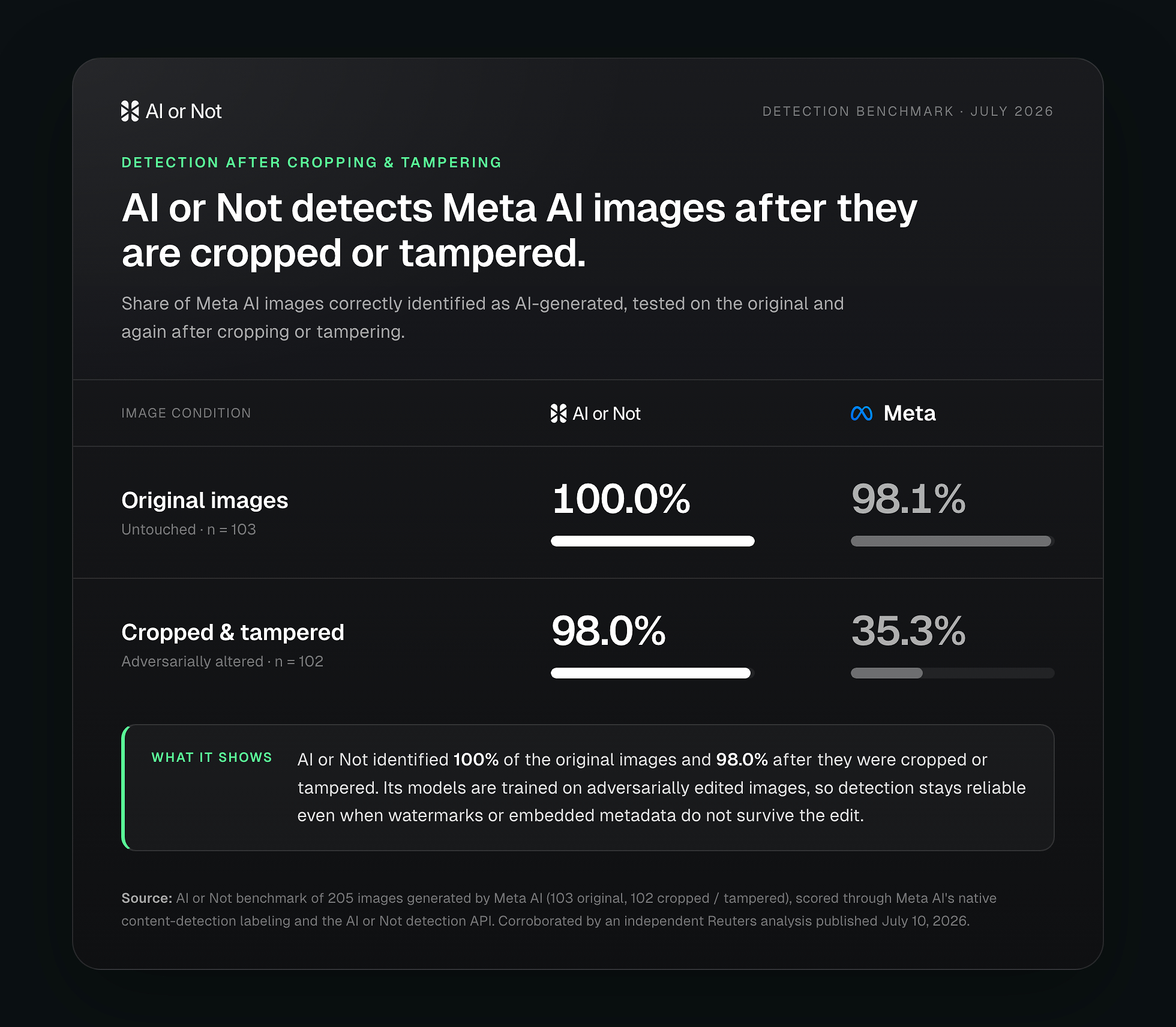
Meta's Content Seal watermarking system, designed exclusively for its Muse AI-generated images, demonstrates significant vulnerabilities in practical detection scenarios. While Meta claims high native labeling accuracy (98.1%), independent analysis reveals that after common image edits like cropping or tampering, detection rates plummet to just 35.3%, missing over half of AI-generated images. In contrast, Google's open-source SynthID maintains robust detection accuracy near 98% even after such modifications, underscoring a critical reliability gap between the two approaches.
A fundamental divergence between Meta's Content Seal and Google's SynthID lies in their approach to interoperability and transparency. Meta's proprietary system operates in isolation, detectable only via a dedicated web tool and limited to its own AI models, reflecting a guarded stance that curtails broader adoption and integration. Conversely, Google's SynthID embraces open-source principles and industry standards like C2PA, fostering cross-platform compatibility and gaining endorsements from major players such as OpenAI and integration into Google's Gemini AI chatbot, which enhances trust and usability across the AI ecosystem.
Meta's muted rollout and limited promotion of Content Seal suggest a reluctance to fully engage with the collaborative ethos increasingly favored in AI content detection. Unlike Google's SynthID, which is openly championed and integrated across multiple platforms, Content Seal was introduced with minimal fanfare, resembling a minor software update rather than a strategic initiative. This guarded approach, coupled with Meta's insistence on proprietary control, contributes to fragmentation in watermarking standards, creating inefficiencies and detection blind spots that undermine collective efforts to reliably identify AI-generated content and combat misinformation.


Regulators Demand Layered Solutions
With no single watermarking method proving foolproof, regulators like the EU are pushing for multi-layered, interoperable standards to ensure durable AI content transparency—despite lingering technical hurdles.
The AI industry currently faces a fragmented landscape where no single watermarking or detection technology sufficiently balances effectiveness, interoperability, privacy, and cost, underscoring the urgent need for standardized, multi-layered approaches. Studies recommend combining cryptographic provenance metadata, invisible watermarking, and passive detection tools to offset individual weaknesses, reflecting a consensus that a layered strategy is essential for robust AI content verification.
Regulatory momentum, particularly from the EU AI Act, is driving the adoption of enforceable transparency standards that mandate machine-readable and detectable markings on AI-generated content. Rather than prescribing a single technology, the Act emphasizes functional goals such as reliability, durability, and interoperability across systems, encouraging multi-layered watermarking solutions that integrate cryptographic metadata standards like C2PA with pixel or text watermarks and server-side audit trails to maintain integrity even when embedded signals are compromised.
Despite these regulatory frameworks, significant technical and enforcement challenges persist, including metadata stripping during file re-saving or platform uploads, adversarial attacks degrading pixel watermarks, and the inability of the EU AI Act to govern locally run AI models or offline uses. Enforcement relies on national authorities assessing whether providers have made good-faith, best-available implementations across multiple watermarking layers rather than demanding perfect, tamper-proof marks, highlighting the practical complexities in achieving durable AI content marking.
The lack of interoperability between proprietary systems like Meta's Content Seal and open standards such as Google's SynthID and C2PA exacerbates fragmentation, complicating detection efforts for platforms and fact-checkers. This fragmentation fuels interest in decentralized, blockchain-based provenance registries that could offer immutable, trustless verification of AI-generated content, suggesting that future industry-wide solutions may hinge on embracing open, standardized, and decentralized technologies to overcome current limitations.