Open-source AI shakes up autonomous cars: industry swerves toward reasoning, transparency, and collaboration
The gist
Open-source, reasoning-based AI is reshaping the autonomous vehicle race, bringing explainability, collaboration, and a surge of innovation as Level 4 self-driving edges toward reality.
What to know
- NVIDIA's Alpamayo and Rivian's Large Driving Model mark a shift from rigid, rules-based systems to transparent, human-like reasoning in AVs.
- Open platforms like Alpamayo and Autoware are letting automakers—including Mercedes-Benz, Lucid, and Uber—build advanced autonomy stacks without proprietary lock-in.
- The industry is racing to tackle rare 'long-tail' driving scenarios, with nearly 70% of new vehicles in some markets set to support advanced autonomy by early 2025.
AI Shifts to Human Reasoning
Automakers are abandoning brittle, hand-coded rules in favor of neural models that reason through complex driving scenarios, making decisions transparent and adaptable as hardware and environments evolve.
The autonomous vehicle industry is undergoing a fundamental shift from perception-driven, rules-based systems to reasoning-based AI architectures, a transition exemplified by both Rivian and NVIDIA. Rivian’s journey, catalyzed by a 2021 team reboot, saw the company abandon deterministic, hand-coded control strategies in favor of an end-to-end Large Driving Model (LDM) inspired by transformer-based AI, enabling vehicles to handle complex scenarios—like stoplights and switchbacks—without explicit rules. NVIDIA’s Alpamayo 1, a 10-billion-parameter open-source Vision-Language-Action (VLA) model, further cements this new paradigm by integrating multimodal sensor data, language, and action planning to produce explainable, step-by-step reasoning traces for each driving decision, a leap that not only improves transparency and safety but also reduces reliance on bulky sensor suites like LiDAR.
Technical motivations for this shift are rooted in the limitations of legacy perception and rules-based systems, which struggle with the 'long tail' of rare, unpredictable driving scenarios and require constant manual tuning as environments or hardware change. Reasoning-based AI models, particularly those built on neural nets, offer superior adaptability and generalization—Rivian’s RJ Scaringe notes these models 'continue to work and all the work that you put into the model continues to work as you change or enhance the perception platform or the compute platform.' This adaptability is further enhanced by advancements in sensor fusion, targetless calibration, and scalable data infrastructure, as demonstrated by Deepen AI’s VLA framework and Safety Pool™ database, which support rigorous testing and rapid OTA updates to keep models current and robust.
The open-sourcing of reasoning-based models and simulation tools—spearheaded by NVIDIA’s Alpamayo family—marks a pivotal industry-wide commitment to collaboration, transparency, and safety validation. By pairing open-source reasoning models with extensive real-world datasets and simulation frameworks like AlpaSim, NVIDIA enables automakers such as Mercedes-Benz, JLR, Lucid, and Uber to build compatible, safety-validated autonomy stacks without relying on proprietary black boxes. This collaborative approach stands in contrast to Tesla’s end-to-end learning strategy and is seen as essential for tackling the 'last one percent' of edge-case scenarios that have long eluded traditional AV systems.
Market forces are accelerating this transition, as consumer demand for higher-level intelligent driving functions (L2.5 and L2.9) has reshaped the competitive landscape—by early 2025, nearly 70% of new vehicles in some markets were equipped with these features, while traditional L1-L2+ systems declined. OEMs are responding with pre-embedded hardware strategies, integrating high-compute chips and advanced sensors to enable rapid activation of L3 and beyond, positioning themselves for regulatory shifts and the widespread deployment of reasoning-based, vision-language-action models that promise safer, more reliable autonomy.






Open-Source Sparks Industry Race
Platforms like Nvidia’s Alpamayo and TIER IV’s Autoware are breaking down competitive silos, enabling global collaboration and rapid progress on the toughest edge cases through shared data and explainable models.
The autonomous vehicle industry is undergoing a fundamental transformation as open-source platforms like TIER IV’s Autoware and Nvidia’s Alpamayo gain traction, enabling unprecedented collaboration and transparency. TIER IV’s showcase at CES 2026, in partnership with the Autoware Foundation and leveraging SOAFEE-enabled cloud-native architectures, exemplifies how open-source initiatives are breaking down silos and fostering global partnerships. By making models, data, and simulation tools openly available, these platforms invite a broader range of participants to tackle the industry’s most complex challenges—particularly the elusive 'long-tail' of rare and ambiguous driving scenarios—accelerating both innovation and safety.
Nvidia’s Alpamayo family, unveiled in early 2026, has rapidly become a linchpin for industry-wide collaboration by providing a comprehensive suite of open-source reasoning-based AI models, simulation frameworks like AlpaSim, and vast real-world datasets. With support from major automakers such as Mercedes-Benz, JLR, Lucid, and Uber, and with resources openly available on GitHub and Hugging Face, Alpamayo enables manufacturers to build, fine-tune, and validate advanced Level 4 autonomous systems without being locked into proprietary solutions. This approach not only democratizes access to cutting-edge AI but also mirrors the disruptive impact of Android in the smartphone market, promising to accelerate adoption and innovation across the sector.
A defining feature of this open-source movement is the emphasis on transparency and explainability, as seen in Alpamayo 1’s 10-billion-parameter vision-language-action model, which uses chain-of-thought reasoning to generate human-readable explanations for driving decisions. This leap beyond traditional black-box systems not only enhances safety and trust but also empowers developers to rigorously test and refine models using diverse, edge-case-rich datasets from over 25 countries. By lowering technical and financial barriers, Nvidia’s strategy—akin to launching an 'Android for autonomy'—is fueling an arms race among OEMs and ODMs, with the ultimate goal of accelerating the industry’s march toward safe, widely deployed self-driving vehicles.



Open vs. Proprietary Showdown
Nvidia’s open AI stack is challenging Tesla and Waymo’s closed dominance, letting dozens of manufacturers leapfrog into advanced autonomy and forcing incumbents to accelerate or risk losing ground.
The competitive landscape in autonomous vehicles is rapidly evolving into a high-stakes contest between open-source and proprietary ecosystems, with Nvidia’s open AI stack emerging as a formidable 'Android-like' alternative to Tesla and Waymo’s closed systems. By launching the Alpamayo family of open-source AI models and simulation tools, Nvidia is not only accelerating the pace of innovation but also democratizing access to advanced self-driving technology for OEMs and ODMs worldwide. This strategy, supported by partnerships with Mercedes-Benz, JLR, Lucid, and Uber, is expected to capture a majority market share—potentially 60-70%—by enabling a broad array of manufacturers to deploy autonomous features, intensifying pressure on proprietary players to speed up their own deployments and adapt to a more open, collaborative industry model.
Contrasting sharply with Nvidia’s open-source push, Tesla and Waymo continue to champion proprietary, vertically integrated approaches, each with distinct technical philosophies and deployment strategies. Waymo’s meticulous, sensor-rich, and highly mapped deployments have enabled it to offer fully driverless rides in multiple U.S. cities, outpacing Tesla’s vision-only system, which still requires human safety drivers and faces regulatory hurdles such as the inability to legally sell the Cybercab. While Tesla leverages its vast fleet for a bottom-up rollout, Waymo’s methodical expansion and operational partnerships—such as with Terawatt and international collaborations like Bolt with Pony.ai—have solidified its early lead, though the market remains in its infancy with less than 1% U.S. adoption, leaving room for rivals to catch up.
Emerging challengers like Rivian are blurring the lines between open and closed ecosystems by adopting AI-centric, reasoning-based models and signaling a willingness to license their technology. Rivian’s custom AI chip, developed with Arm and TSMC, and its 'Universal Hands-Free' system—targeting SAE Level 4 autonomy and broad deployment for a $2,500 fee—position the company as a technology leader aiming to disrupt the dominance of Tesla and Waymo. By leveraging lidar, radar, and large-scale fleet data to train its Large Driving Model, Rivian is betting that an open, data-driven approach can accelerate both innovation and mass-market adoption, especially as it eyes a 2026 robotaxi launch.
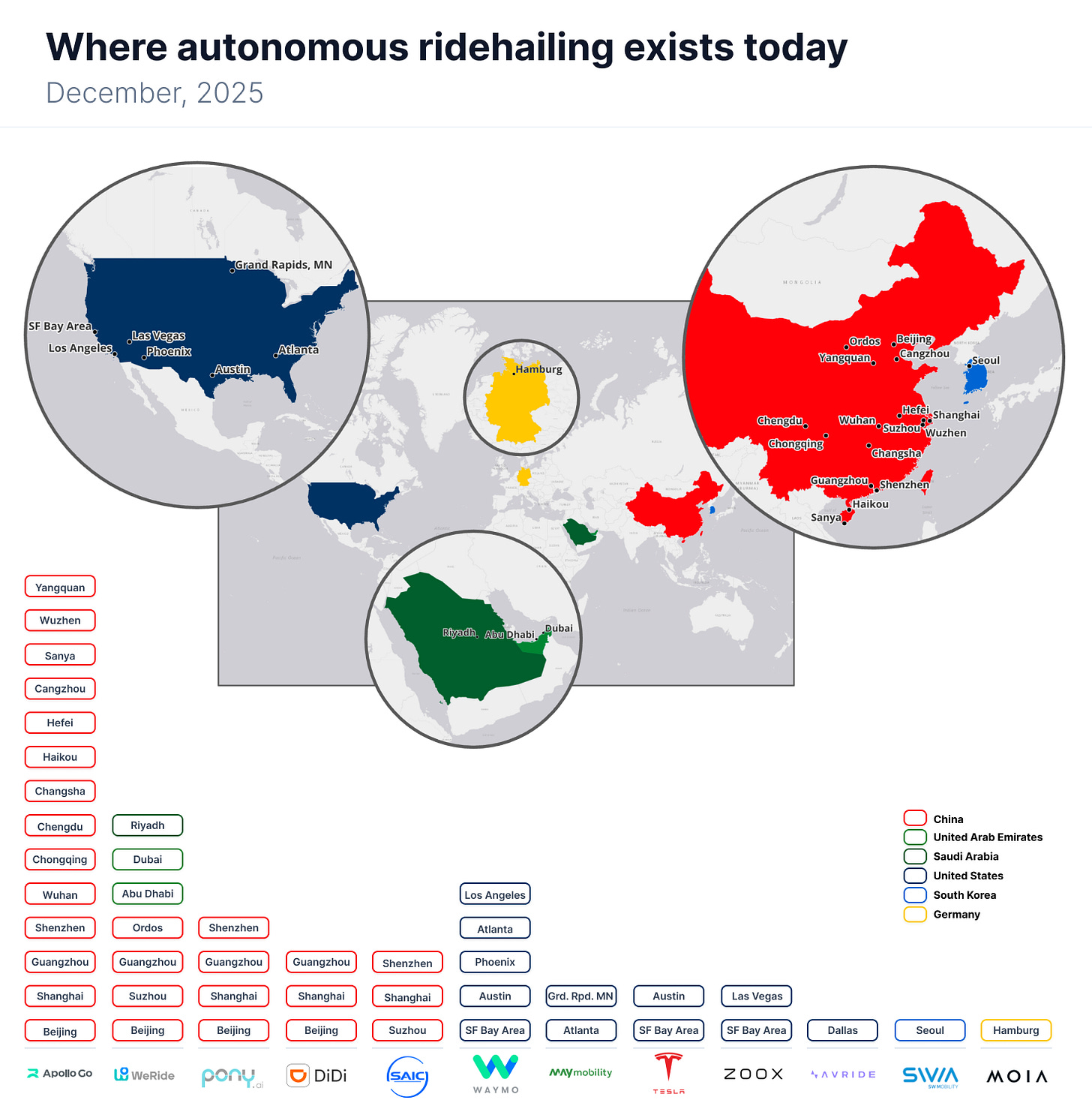
Regional dynamics further underscore the impact of ecosystem openness on market competition and consumer benefits. In China, an open competition model with multiple robotaxi providers—such as Apollo Go, WeRide, Pony.ai, DiDi, and SAIC—operating in the same cities has led to rapid service improvements and price reductions, directly benefiting riders who choose among competing apps. In contrast, Western markets remain more closed, with platform-mediated competition (e.g., Uber) limiting direct consumer choice and slowing the pace of innovation, as only Waymo currently operates a true commercial service. This divergence suggests that openness, both in technology and market structure, is a key driver of accelerated deployment and consumer adoption in autonomous mobility.



Transparency Drives Safety Leap
Reasoning-based models and open datasets are making AV decision-making auditable and understandable, addressing regulatory scrutiny and public trust by enabling vehicles to explain their actions in real time.
By early 2026, the autonomous vehicle industry is making significant strides in safety and explainability through the adoption of reasoning-based AI and robust data infrastructure. Deepen AI’s Safety Pool™ database, now integrated with World Foundation Models, enables rigorous, auditable testing and validation at scale—crucial as AVs transition from pilot projects to regulated, real-world deployments. Meanwhile, NVIDIA’s Alpamayo 1, a 10-billion-parameter open Vision-Language-Action (VLA) model, leverages advanced reasoning to handle rare and complex driving scenarios, setting new benchmarks for safety and transparency as the industry targets Level 4 autonomy.
A defining feature of this new wave is the move toward open, collaborative platforms that foster transparency and collective progress against the long-tail challenge. NVIDIA’s decision to open-source Alpamayo 1 and its extensive datasets on Hugging Face—backed by industry players like JLR, Lucid, Uber, and Berkeley DeepDrive—signals a shift from proprietary, black-box systems to shared ecosystems where safety and explainability are industry-wide priorities. This collaborative approach not only accelerates the identification and handling of rare edge cases but also builds public trust by making the decision-making logic of autonomous vehicles accessible and auditable.
The technical heart of these advances lies in reasoning-based frameworks like the Vision-Language-Action (VLA) model and chain-of-thought reasoning, which allow AVs to process multi-sensor data, anticipate uncertainty, and generate human-readable explanations for their actions. Unlike traditional pattern-recognition systems that falter in unfamiliar situations, models such as Alpamayo can explain, for instance, why a vehicle nudges left to avoid construction cones or slows down when a ball rolls into the street—mirroring human judgment and erring on the side of caution. This leap in explainability not only addresses regulatory and public concerns but also directly tackles the long-tail problem by enabling AVs to reason through rare, unpredictable scenarios step by step.
Supporting these reasoning-based models is a growing ecosystem of open-source simulation tools and diverse, real-world datasets, such as NVIDIA’s AlpaSim and over 1,700 hours of driving data from 25+ countries. These resources enable closed-loop testing and continuous learning, allowing AVs to be evaluated and improved in a wide array of edge cases before real-world deployment. By integrating these capabilities with production platforms like NVIDIA DRIVE and securing partnerships with automakers such as Mercedes-Benz, the industry is bridging the gap between research and road-ready, explainable autonomy—laying the groundwork for safer, more trustworthy self-driving cars.


Global Rollout Faces Local Hurdles
Despite surging commercial deployments, regional regulations, public trust, and cost constraints are creating a fragmented path to mass adoption, with Europe, China, and the US each shaping the future of autonomy on their own terms.
The global autonomous vehicle market is rapidly maturing, with multiple companies such as Waymo and Baidu’s Apollo Go each reporting 250,000 paid rides per week by late 2025, signaling a shift from early experimentation to commercial scale. However, the presence of strong regional players and AI hubs across China, the US, and Europe means that regulatory pathways and consumer trust are evolving differently in each market, leading to varied paces of innovation and commercial rollout. As noted in industry commentary, ensuring the health of European AI capabilities is strategically important, highlighting how regional strengths and regulatory nuances will shape the future of mobility.
Waymo’s methodical approach—deploying fully driverless rides in major US cities like San Francisco, Los Angeles, and Phoenix, and leveraging comprehensive sensor suites and high-precision mapping—has been instrumental in building both consumer trust and regulatory acceptance, accelerating its rollout ahead of competitors such as Tesla. Yet, despite these advances, the market remains in the early adopter phase, with less than 1% of the US population having experienced a driverless taxi ride, underscoring that regulatory frameworks and public confidence are still works in progress and leaving room for rivals to catch up before mass adoption takes hold.
Cost and scalability remain critical factors influencing both regulatory acceptance and the pace of commercial deployment. Waymo’s vehicles, with their sophisticated sensor arrays, have historically cost around $250,000 each, while Tesla’s vision-only approach could enable rapid scaling by updating its vast existing fleet—potentially shifting competitive dynamics if regulatory bodies deem the technology sufficiently safe. This tension between technological sophistication and affordability is mirrored in regulatory decisions, such as Waymo’s operational pause in Santa Monica due to community concerns, illustrating how local governance and economics are tightly intertwined in the rollout of autonomous mobility.
The introduction of Nvidia’s open-source end-to-end AI platform for autonomous vehicles in early 2026 is poised to be a game-changer, democratizing access to advanced self-driving capabilities much like Android did for smartphones. By enabling any automaker or fleet operator—from Lyft to DoorDash—to integrate robust autonomy, Nvidia’s platform is expected to accelerate adoption, intensify competition, and diversify the global mobility ecosystem. However, as consumer trust in these systems grows, industry observers caution against premature deployment, emphasizing the ongoing need for safety oversight even as the technology matures.
Regional differences in competitive models are shaping both regulatory outcomes and consumer experiences: China’s robotaxi market, with four competing providers in cities like Beijing and Shanghai, is driving rapid service improvements and price reductions, while Western markets remain more platform-dependent, with companies like Waymo operating largely unchallenged and others such as Zoox and Tesla still reliant on safety drivers. This divergence means that while Chinese consumers benefit from direct competition and faster innovation, Western adoption may hinge on familiar platforms like Uber, potentially increasing ridership but slowing the pace of direct competitive gains and regulatory adaptation.
Consumer demand for higher-level autonomous features is reshaping the market structure, particularly in China, where leading OEMs like NIO, XPeng, and Geely are racing to mass-produce L3-capable vehicles by 2026. With 33% of consumers seeking upgrades to L3/L4 functions and nearly 35% of new cars already equipped with advanced L2.5 or L2.9 systems in early 2025, regulatory compliance and sensor fusion reliability have become key battlegrounds. OEMs that successfully navigate these challenges are poised to establish themselves as technological leaders, accelerating both adoption and the broader transformation of the mobility landscape.