Retail media booms, but incrementality tightens
The gist
Retail media is exploding beyond the shelf, but ad overload and measurement hurdles are forcing brands to rethink how—and where—they spend.
What to know
- Walmart Connect’s ad business jumped 43% in Q2 2026, but Amazon still dominates with 78% of US retail media spend in 2025.
- New tools like the Shopper Purchase Rate (SPR) are helping brands link ad spend directly to sales and shopper engagement, bridging the gap between digital and in-store impact.
- Despite flashy growth, digital-only retail media campaigns reach less than 4% of households—traditional TV is still essential for mass brand penetration.
Retail Media's Expanding Battlefield
Retail media has exploded into a complex, omnichannel ecosystem—spanning CTV, in-store, and fintech integrations—as agencies and retailers race to outmaneuver Amazon’s dominance and claim a share of a $200 billion global market.
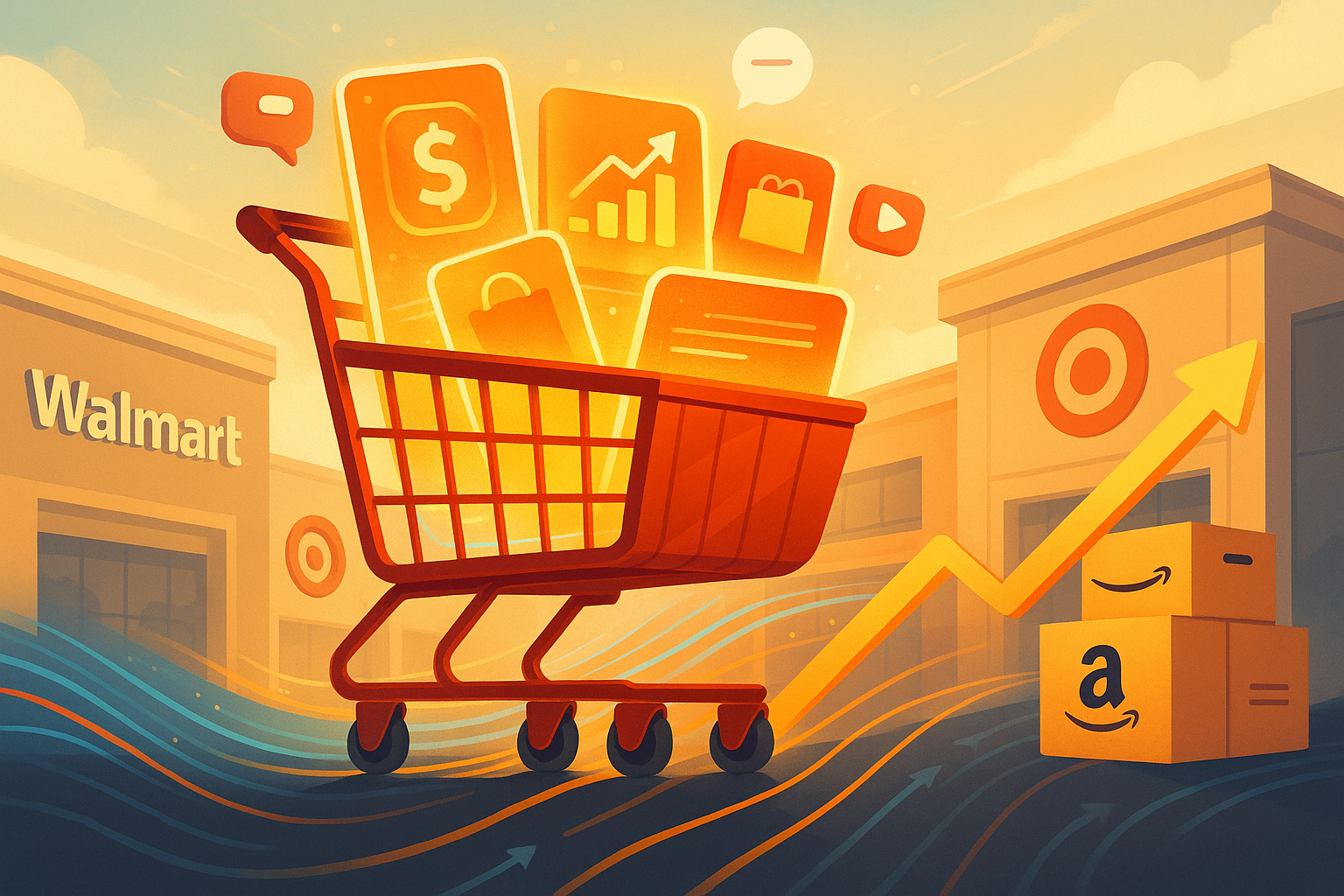
Retail media advertising has evolved far beyond its traditional roots in product ads, blossoming into a multifaceted commerce platform that spans in-store, ecommerce, marketplaces, offsite media, and connected TV (CTV). Walmart Connect exemplifies this trend, posting a 43% year-over-year growth in Q2 2026 while expanding into CTV through acquisitions like Vibe.co. Meanwhile, innovations like Citi’s integration of commerce media with financial services and Target’s AI-driven platform traffic growth underscore the sector’s rapid diversification and technological sophistication.
Major retailers are increasingly leveraging retail media as a critical revenue engine and a strategic weapon against Amazon’s dominance. Walmart’s global ad revenue surged 38% year-over-year in Q2 2026, prompting an upward revision of its full-year earnings guidance, while Target’s advertising business grew nearly 29%, generating $279 million. Despite this, Amazon remains the market titan, capturing 78% of US retail media spend in 2025 and commanding over two-thirds of investment across key European markets, with its advertising reach extending beyond retail into platforms like Prime Video and Twitch—projected to generate $6.7 billion in 2027.
The retail media landscape is not only expanding in scale but also in complexity, as agencies bolster their capabilities to navigate dominant platforms like Amazon and TikTok Shop through strategic acquisitions such as Chief Media’s purchase of AMZ Advisers and Reach Social. This consolidation reflects the growing strategic importance of retail media expertise amid a market expected to exceed $200 billion in global investment by 2026 and capture over 15% of worldwide ad spend, signaling a fiercely competitive environment where every pixel is indeed for sale.
Despite explosive growth, retail media’s advertiser base remains highly concentrated, with nearly 74% of UK brands engaging with three or fewer retail media networks. This concentration means that most networks rely heavily on a small cadre of large advertisers for the bulk of their revenue, highlighting a market dynamic where scale and deep relationships with key advertisers are paramount to sustaining growth and influence.

Rethinking Retail Media Metrics
Brands are abandoning legacy digital metrics in favor of holistic, omnichannel measurement frameworks that directly link ad spend to actual sales and shopper behavior, driving cross-functional accountability and smarter investment.
Traditional measurement frameworks, often adapted from digital media, fall short in capturing the true impact of retail media, especially in-store activations, creating friction that stalls budget growth and limits scalability. Industry leaders like Paul Brenner of ISM emphasize the necessity of grounding measurement in actual product movement rather than conventional digital metrics to transition retail media from experimental to repeatable investments.
The Shopper Purchase Rate (SPR) framework emerges as a pivotal innovation, not introducing a new KPI but rather unifying multiple existing metrics—such as dollars spent, units moved, and shopper behavior—into a comprehensive narrative that aligns brands, retailers, and agencies. This approach fosters organizational integration by presenting different scorecards side by side, creating a 'throughline' that links media spend directly to sales outcomes and shopper engagement, thereby facilitating more productive cross-functional conversations.
As retail media matures, measurement is evolving from channel-specific attribution models like ROAS to holistic, omnichannel frameworks that better reflect the shopper journey and media’s total impact. Executives such as Marc Pritchard highlight the persistent challenge of establishing a direct sales signal to attribute media spend accurately, noting that markets like China—where over 60% of business is digital commerce—are leading the way in connecting brand communication to commerce, which promises to exponentially enhance media investment decisions and brand building.
Innovators like Instacart and Freeosk are pushing measurement beyond traditional last-touch attribution by incorporating portfolio-level views, multi-touch attribution, causal modeling, and AI-driven analytics. Instacart’s Laura Jones underscores the value of balancing upper and lower funnel metrics to capture retail media’s full impact, supported by a growing library of case studies demonstrating increased efficiency when integrating upper funnel efforts. Meanwhile, Freeosk’s Retail Media 3.0 approach bridges physical store experiences with digital identity and closed-loop measurement, addressing long-standing gaps that have historically limited brand investment in the physical retail channel.


Brand Building Beyond the Shelf
Retail media is evolving from a pure sales-activation tool into a high-ROI brand-building channel, outperforming traditional advertising in driving purchase intent and brand favorability when integrated into broader marketing strategies.
Retail media occupies a unique position at the intersection of immediate sales activation and brand engagement by targeting consumers both in the moment of purchase and during pre-shopping planning. As highlighted in Walmart and Target shopper behaviors, retail media aims to infiltrate decision-making moments—whether on-shelf or beforehand—to influence brand choice effectively. However, critics like Mark Ritson argue that retail media primarily serves as a bottom-of-the-funnel, defensive tactic focused on locking in distribution and driving immediate sales rather than fostering long-term brand equity, a view reinforced by ANA findings that much retail media funding is reallocated from traditional brand-building budgets rather than being truly incremental.
Contrary to the skepticism, emerging evidence demonstrates retail media’s capacity to contribute meaningfully to brand building when integrated thoughtfully. Retail media channels outperform average advertising in increasing purchase intent by 10%, brand favorability by 9%, and online ad awareness by 16%, with platforms like Amazon and Twitch delivering ad experiences that consumers find relevant and welcome. Campaigns such as L’Oreal’s TikTok Shop exemplify how combining ecommerce and social commerce within retail media strategies can simultaneously boost brand equity and drive sales across both online and offline channels, underscoring retail media’s potential as a complement to traditional brand marketing rather than merely a performance channel.
The growing recognition of retail media’s brand-building potential is further supported by marketing effectiveness research and causal modeling, which reveal that retail media networks consistently deliver some of the highest ROI among advertising channels. Despite this, there remains a significant budget misalignment, with over 70% of U.S. ad spend funneled into performance media even though CMOs express a preference for allocating 55-60% toward brand building. Retail media’s proximity to commerce uniquely enhances both physical and mental availability, offering fast reach and cultural relevance that can substitute for the declining attentiveness of linear TV, positioning it as a mass-reach vehicle ideal for national brands seeking to build lasting brand equity.

TV Still Reigns for Reach
Despite retail media’s digital surge, digital-only ad campaigns barely move the needle on household reach, with traditional TV remaining essential for mass penetration and effective brand engagement.
While retail media advertising has surged as a vital channel for brands, sustaining consumer engagement faces significant hurdles due to ad saturation and the limited incremental reach of digital-only campaigns. A 2026 study on FMCG brands revealed that digital-only exposure accounted for less than 1 to 4 percent of households, underscoring that digital retail media struggles to expand audience reach beyond what traditional TV already achieves. Combining television with digital efforts, however, boosted brand penetration to nearly 75 percent, highlighting that digital ads alone cannot replace the broad reach and engagement power of traditional TV in a saturated advertising landscape.