Riot’s AI pivot sparks Wall Street buzz—but risks loom
The gist
Riot Platforms is ditching its bitcoin roots, betting $9.1 billion and 20 years on becoming an AI data center heavyweight—Wall Street loves the pivot, but execution risks could bring the whole plan down.
What to know
- Riot inked a $9.1B, 20-year AI data center lease with Anthropic at Rockdale, cementing its shift from crypto mining to AI infrastructure landlord.
- A $573M Morgan Stanley-led loan will fund a 191 MW expansion, while the Corsicana site aims for 756 MW and $1.5B annual contract value by 2028.
- Analysts have hiked price targets to $25–$40 per share on AI optimism, but warn Riot must deliver on ambitious growth or risk falling flat.
From Crypto to AI Titan
Riot’s $9.1B Anthropic deal transforms it from a bitcoin miner into a power-rich AI landlord, signaling a new era where control over electricity grids trumps mining hardware.
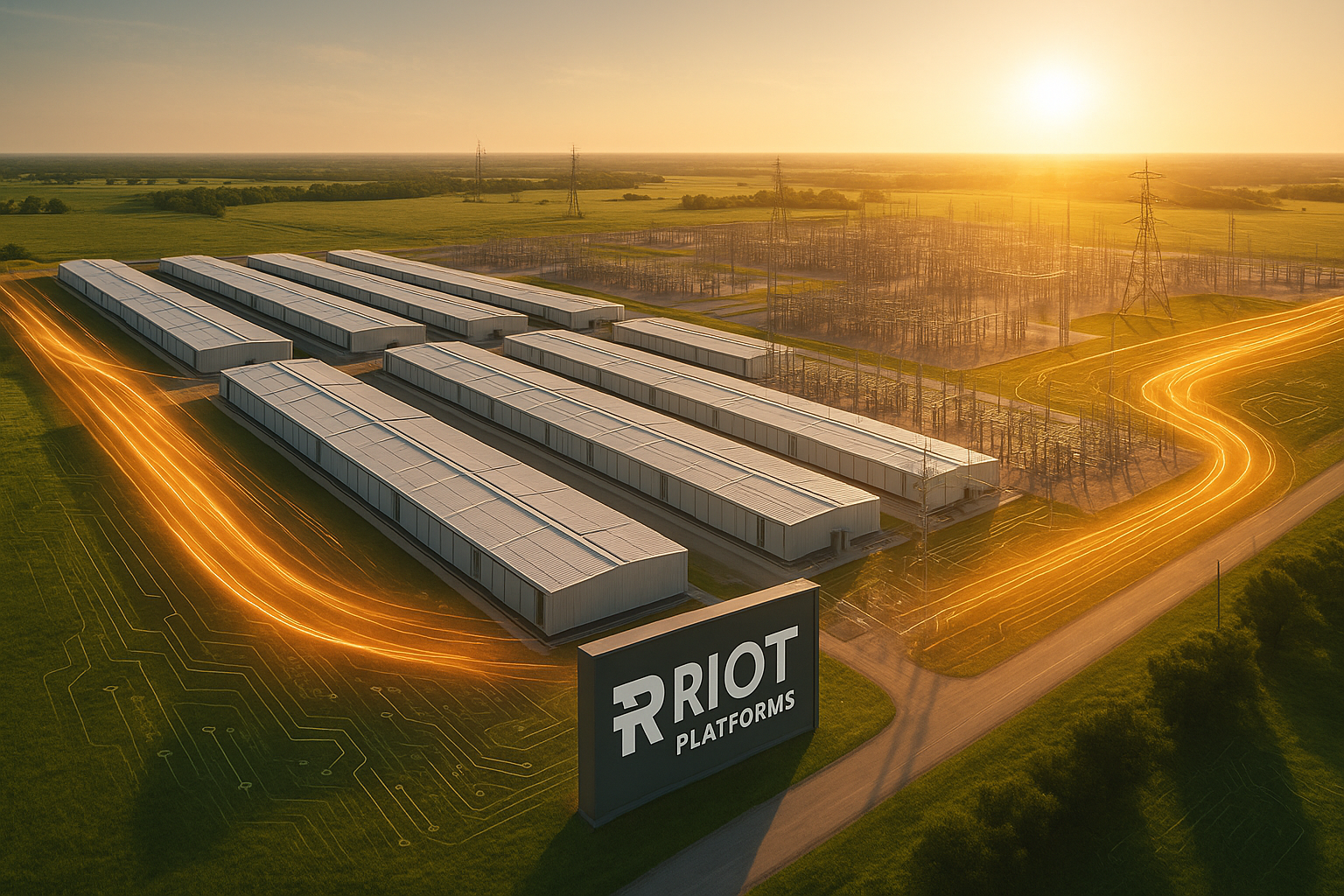
Riot Platforms’ landmark $9.1 billion, 20-year lease agreement with Anthropic marks a definitive strategic pivot from Bitcoin mining to becoming a leading AI data center landlord. Centered at Riot’s Rockdale, Texas campus, the deal secures 191 megawatts of critical IT capacity dedicated to Anthropic’s frontier AI workloads, underscoring Riot’s evolution into a major player in AI infrastructure. CEO Jason Les hailed this as “a defining moment” in Riot’s transformation, signaling a broader industry trend where crypto mining companies leverage their power and cooling assets to serve the booming AI compute market.
The Anthropic lease significantly expands Riot’s AI data center capacity to 241 megawatts when combined with its earlier 50 MW contract with AMD, collectively representing nearly $9.8 billion in long-term contracted revenue. This scale of infrastructure—enough power to charge over a million iPhones for a year—reflects Riot’s commitment to industrial-scale AI operations and cements its role as a utility-like provider of computational power in the emerging AI era. The deal’s two-phase delivery by mid-2028 and its unusually long 20-year term with extension options potentially raising the value to $16.1 billion highlight Anthropic’s strategic commitment amid fierce competition for grid-connected AI capacity.
Riot’s transformation from volatile Bitcoin mining margins to stable, predictable AI infrastructure revenue is emblematic of shifting tech dynamics where demand for high-performance computing, driven by generative AI models like Anthropic’s Claude, is soaring. The company’s most valuable asset is no longer mining machines or Bitcoin itself, but its control over large-scale electricity and infrastructure—power grids repurposed for AI workloads. This landmark deal not only boosts Riot’s revenue potential and financial resilience amid macroeconomic challenges but also sets a precedent for traditional data center providers to pivot toward AI services, reflecting a broader crypto-to-AI infrastructure convergence.


Building an AI Powerhouse
Riot is turbocharging its data center empire with $573M in fresh financing and a nuclear energy push—betting on modular reactors to break grid bottlenecks and fuel hyperscale AI growth.
Riot Platforms has strategically secured a $573 million senior secured delayed-draw term loan, primarily led by Morgan Stanley, to finance a 191 MW expansion at its Rockdale AI data center, exemplifying a hybrid financing approach that recycles revenues from existing contracts like AMD while avoiding convertible debt. This financing milestone underpins Riot's aggressive infrastructure growth plans, which include a capital expenditure of $2.1 to $2.3 billion for the Anthropic project at Rockdale, with an industry-standard capex of approximately $12 million per megawatt, positioning the company to recoup infrastructure costs within five years and capitalize on 15 to 25 years of largely depreciation-free profits.
Beyond Rockdale, Riot is ambitiously expanding its data center footprint with the Corsicana site, recently redesigned to boost compute capacity by about 70 MW to a total of 756 MW, making it a premier hyperscale AI data center location between Dallas and Austin. Scheduled for full deployment by June 2028, Corsicana is projected to generate approximately $1.5 billion in annual contract value, supported by flexible, efficient designs with competitive PUE around 1.3, and enhanced by Riot’s internal manufacturing capabilities through ESS Metron, which mitigates industry-wide supply chain constraints and accelerates project delivery.
In a forward-thinking move to sustainably meet the soaring energy demands of AI workloads, Riot is pioneering a modular nuclear power strategy by partnering with Terrestrial Energy to deploy integral molten salt reactors (IMSRs) co-located at its Texas and Kentucky data center sites. This initiative aims to add up to 4 gigawatts of low-cost, clean nuclear capacity—significantly alleviating grid bottlenecks and enabling rapid capacity expansion beyond the current 1.9 GW pipeline at Rockdale, Corsicana, and Kentucky—thereby enhancing scalability, reducing operational costs, and reinforcing Riot’s position as a leader in AI infrastructure innovation.
While Riot’s financing and expansion efforts position it for substantial revenue growth—projecting $1.2 billion in revenue and $148.2 million in earnings by 2029—the company faces inherent risks from increased leverage and capital intensity amid ongoing negative earnings. Nevertheless, Riot’s strategic use of its extensive power capacity in high-demand regions, combined with client-managed maintenance that limits ongoing costs, underscores a robust long-term profitability outlook contingent on successful execution of its ambitious AI data center projects.

AMD Alliance Drives Growth
Riot’s deepening partnership with AMD locks in long-term, high-margin revenue streams and showcases disciplined execution, as the company slashes capex and delivers ahead of schedule.
Riot Platforms has significantly deepened its partnership with AMD, initially securing 50 megawatts of compute power at the Rockdale facility with an option to scale up to 200 megawatts. This expansion reflects AMD's strong confidence in Riot's data center strategy, as evidenced by the early exercise of expansion options and the conversion of the original right of first refusal into a simpler option clause to streamline future growth discussions. The partnership now underpins a substantial revenue stream, with Riot projecting run rate revenue from AMD leases to grow from approximately $38 million by the end of 2026 to about $56 million by the end of 2027, demonstrating robust operational execution and capacity delivery on aggressive timelines.
CEO Jason Les emphasizes a disciplined leasing strategy that prioritizes securing high-quality tenants quickly without overcomplicating deals, aiming to drive valuation through steady cash flow multiples. This pragmatic approach is complemented by Riot's operational rigor, including on-schedule delivery of data center capacity—such as the timely completion of the first AMD tranche in January and the final tranche by May 2026—and a flexible, customer-centric data center design that accommodates diverse tenant requirements. Such operational discipline supports strong net operating income margins targeted around 80-85%, tenant satisfaction, and a seamless transition from Riot’s bitcoin mining roots to a credible digital infrastructure landlord.
Riot’s operational excellence extends beyond construction timelines to encompass supply chain management, financing discipline, and integrated critical operations teams that directly influence leasing processes. CEO Les highlights that these factors—delivery speed, supply chain control, and disciplined financing—are pivotal catalysts for valuation re-rating, while robust operational structures help avoid penalties from service level agreement breaches. Cost efficiencies are evident as capital expenditure per megawatt decreased from $3.6 million to $3.3 million due to repeated work, and the expanded AMD contracts include inflation escalators, further enhancing revenue predictability and margin stability.

Wall Street's High-Stakes Bet
Analysts are bullish on Riot’s AI pivot, but a sharp split between glowing brokerage targets and skeptical quant models highlights the razor-thin margin for error in its transformation.
Wall Street has responded to Riot Platforms' strategic pivot with broad enthusiasm, as evidenced by a flurry of price target upgrades ranging from $25 to $40 per share from firms like Cantor Fitzgerald, HC Wainwrightson, and BTIG. Cantor Fitzgerald notably assigned an overweight rating with a $30 target, highlighting the $9.1 billion Anthropic lease as a valuation cornerstone and projecting an additional $41 per share upside contingent on the Corsicana lease signing. Despite this optimism, Riot’s stock price has exhibited only modest gains post-earnings, reflecting investor caution amid the complex transition from bitcoin mining to AI data center landlord, where the market appears to be pricing in much of the anticipated growth already.
The valuation uplift potential for Riot is substantial but hinges critically on execution risks tied to contract finalizations and expansion decisions. The Corsicana facility alone could generate approximately $1.5 billion in annual revenues, with analysts modeling a 20x EBITDAR multiple that might double Riot’s share price, contingent on signing the lease and AMD’s expansion options at Rockdale. However, these optimistic scenarios rest on assumptions of high EBITDA margins around 80% and disciplined capital expenditure, underscoring the delicate balance Riot must maintain between aggressive growth and prudent financial management to avoid replacing bitcoin mining’s volatility with new operational risks.
Investor sentiment toward Riot’s evolving revenue mix is mixed, reflecting a tension between bullish brokerage recommendations and more cautious quantitative models. While 16 out of 21 brokerage firms rate Riot as a Strong Buy, the Zacks Rank currently signals a Sell due to a 21.5% downward revision in earnings estimates, highlighting skepticism about near-term profitability amid the transition. This divergence illustrates the market’s struggle to reconcile Riot’s ongoing bitcoin mining cash flows—still profitable at current bitcoin prices—with the nascent but potentially transformative AI data center revenues, which promise steadier, longer-duration contracts but require successful execution and capital discipline.
Riot’s shift toward AI infrastructure commands significantly higher valuation multiples—around 20x EBITDA compared to 2-3x for bitcoin mining—reflecting Wall Street’s growing confidence in the predictability and profitability of long-term AI data center leases like Anthropic’s 20-year deal. Yet, this premium valuation also brings challenges, as Riot’s price-to-sales ratio at 10.6x far exceeds industry averages, suggesting much of the AI growth story is already priced in. Market participants are thus closely monitoring Riot’s ability to deliver on buildout timelines, power reliability, and tenant acquisition, with management emphasizing pragmatic leasing strategies focused on securing quality tenants at fair market rates to support sustainable valuation gains.

