Rise of the robo-naturals: bio-inspired bots blur the line between machine and animal
The gist
Bio-inspired robots are smashing the boundary between machine and animal, bringing soft, adaptive, and eerily intuitive bots out of the lab and into the real world.
What to know
- From octopus-inspired limbs to grasshopper-style wings, today's robots mimic nature's best tricks for touch, motion, and resilience.
- New breakthroughs like Gaussian process regression and stretchable Kuryami sensors are giving bots human-like dexterity and transparent, wearable interfaces.
- X-Humanoid’s Embodied Tien Kung 2.0 and Ultra robots are already tackling tough tasks in factories and power grids, signaling a leap toward fully autonomous, bio-mimetic machines.
Touch Gets a Brain Upgrade
Distributed intelligence inspired by octopus limbs is giving robots adaptive, context-aware touch rivaling human sensation.
Replicating the human sense of touch in robots has long been a formidable challenge, given the intricate interplay of mechanoreceptors in our skin and the active, exploratory nature of human touch. Unlike traditional robotic systems that rely on centralized processing, recent advances draw inspiration from biological models—such as the octopus, which distributes neural processing throughout its limbs—to develop distributed, embodied intelligence. This paradigm shift enables robots to generate adaptive, context-sensitive behaviors by leveraging the dynamic interaction between their soft, compliant bodies and the environment, moving closer to the nuanced sensorimotor capabilities that define human touch.

Nature’s Playbook Fuels Dexterity
From grasshopper wings to human-like grasping, robots are mastering nuanced movement and resilience by fusing biological insights with cutting-edge algorithms.
The fusion of biological inspiration and advanced engineering is redefining robotic motion, dexterity, and resilience. Early 2026 saw engineers drawing lessons from the American grasshopper’s wing structure, revealing that while corrugation aids lift and foldability, smooth wings are superior for gliding efficiency—insights that are directly shaping the design of next-generation untethered gliding robots. This delicate balancing act between structural complexity and aerodynamic performance exemplifies how deep biological understanding is now a cornerstone of robotic innovation, with future research aiming to optimize both foldability and flight, bridging the gap between nature and machine.
Robotic dexterity is making a quantum leap thanks to adaptive motion systems that mimic human intuition. Researchers have harnessed Gaussian process regression (GPR) to enable robots to replicate human grasping behaviors with minimal training data, allowing them to intuitively adjust their grip for objects of unknown stiffness or weight—something previously out of reach for most machines. This GPR-based approach not only slashes position and force errors by up to 74% compared to conventional models, but also brings robots closer to the human-like adaptability needed for dynamic, real-world environments, marking a pivotal advance in robotic manipulation.
Swarm intelligence and soft robotics are converging to create machines with collective agility and resilience reminiscent of natural systems. The development of SGbots, which use soft actuators to 'bloom' and collectively control sunlight, demonstrates how swarm behaviors can endow robots with the ability to adapt and maintain function even when individual units fail. Meanwhile, soft micro-aerial robots inspired by insect flight have showcased extraordinary robustness—surviving wing cuts, actuator punctures, and still flying accurately—while also exhibiting cooperative behaviors like collective payload transport, feats that remain challenging for traditional robotic systems.
The latest generation of bio-inspired micro-aerial robots, such as those developed by Kevin Chen’s team, are powered by high-bandwidth soft artificial muscles that enable animal-like agility, rapid maneuvers, and resilience to in-flight collisions. By combining soft actuators with rigid appendages, these robots achieve a rare balance of speed, precision, and robustness, outperforming both purely rigid and purely soft predecessors. The vision for the coming years is ambitious: integrating onboard sensors and batteries to achieve high-level autonomy—such as recognizing and landing on specific flowers—while maintaining the safety, power, and adaptability that define the natural world’s most agile flyers.

Brains, Sensors, and Seamless Control
Robots now coordinate reasoning, motion, and tactile feedback through layered AI and soft sensors, achieving fine manipulation once exclusive to humans.
The integration of hierarchical AI models and advanced soft sensor technologies is redefining the boundaries of embodied intelligence in robotics. In early 2026, Sharpa’s CraftNet showcased how separating reasoning, motion planning, and fine-motor interaction into asynchronous systems—aptly named the Reasoning Brain, Motion Brain, and Interaction Brain—enables robots to achieve human-like precision in fine manipulation tasks, leveraging tactile data to tackle the notorious 'last millimeter' problem. Meanwhile, advances in multimodal, stretchable sensors—such as those using ionic liquid optics and conductive fabric—allow for transparent, wearable devices that, when paired with AI-driven learning, can decode complex motions like finger movements, further blurring the line between robotic and biological dexterity.
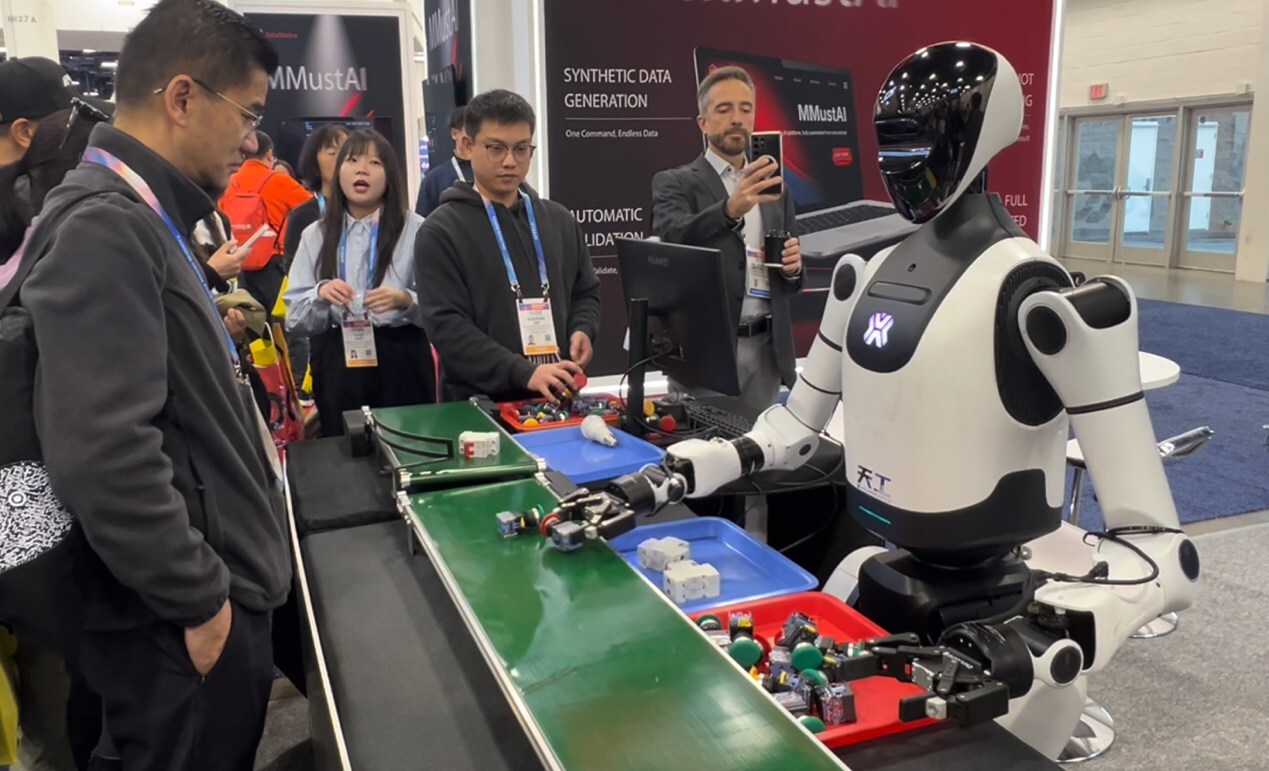
The practical deployment of embodied intelligence is rapidly scaling, as seen at CES 2026 where X-Humanoid’s Embodied Tien Kung 2.0 and Ultra robots demonstrated fully autonomous operation in real-world industrial and service settings. By integrating proprietary technologies like UVMC and Wise KaiWu, these robots achieve real-time visual-to-motion translation, bimanual coordination, and adaptive responses, underscoring how the convergence of sensing, control, and AI is making autonomous perception, planning, and action not just possible, but commercially viable.
Inspired by biological proprioception, researchers are embedding sensors directly into robotic actuators, mimicking mechanisms like the human Golgi tendon to provide real-time feedback for control. This approach, exemplified by actuators with integrated proprioceptive sensors, enhances the seamless integration of sensing and actuation in soft robotics, while innovations such as Yong’s 4x4 sensor matrix—operating through a single wire—tackle the wiring complexity that has long hampered scalable sensor deployment. The result is a new generation of soft robots capable of more natural, robust, and scalable interactions with their environments.
The philosophy of embodied intelligence is pushing robotics beyond traditional AI scaling, as articulated by Cecilia Laschi, who highlights how musculoskeletal structures, compliant materials, and morphological design allow robots to offload computation mechanically, reducing energy consumption and enhancing sensory-motor coordination. This principle of morphological computation—where perception and action emerge from the tight coupling of body, environment, and control—suggests a future where even electronics-free soft robots, programmed entirely by their physical structure, could become a reality, marking a radical shift toward energy-frugal, embodied control architectures.
In aerial robotics, the fusion of high-bandwidth soft actuators with rigid appendages is yielding micro-flyers that combine agility and resilience, as demonstrated by Kevin Chen’s robots capable of 1000-second hovering flights, rapid somersaults, and autonomous recovery from collisions. The ongoing miniaturization and onboard integration of sensors, electronics, and batteries further empower these micro-aerial robots to perceive and navigate complex environments autonomously, embodying the next frontier of robust, bio-inspired machine intelligence.
Breakthroughs in ultra-stretchable, transparent soft sensors—such as those developed by Professor Sunan Co using Kuryami material—are enabling unobtrusive, wearable sensing that conforms seamlessly to 3D surfaces. These advances not only support more natural robot-environment interactions but also pave the way for soft robotic systems that can operate with minimal interference and maximal adaptability, setting the stage for a new era of embodied intelligence in wearable robotics.

From Lab Marvel to Factory Muscle
Bio-inspired robots are escaping the lab to tackle real-world industries, with next-gen sensors and autonomy pushing them toward animal-like agility and decision-making.
By early 2026, the leap from laboratory prototypes to real-world deployment is no longer just a vision—companies like X-Humanoid are actively demonstrating how embodied intelligence can transform industries. Their Embodied Tien Kung 2.0 and Ultra robots have moved beyond controlled research settings to tackle demanding tasks in automotive manufacturing, power grid inspections, and even athletic shoe testing, showcasing the practical value of bio-inspired design. Meanwhile, the broader robotics community is pushing for even greater autonomy, with researchers envisioning robots capable of recognizing and interacting with natural objects—such as landing on a specific flower—by integrating advanced onboard sensors and batteries, signaling a future where robots blend seamlessly into complex, dynamic environments.
The journey from lab to market is fraught with challenges, particularly when it comes to scaling bio-inspired robots for diverse, unpredictable real-world settings. X-Humanoid's strategy focuses on scalable adoption through proprietary technologies like UVMC and Wise KaiWu, enabling their robots to operate with speed, accuracy, and resilience across various industries. Yet, as the field advances, the ultimate goal remains to imbue these machines with the precision, agility, power, safety, and robustness found in the animal kingdom—a tall order that underscores both the promise and the complexity of bringing bio-inspired robotics to everyday life.