Robotics leap: ABB, Nvidia, and Japan drive AI to factory floor
The gist
The robotics revolution is hitting factory floors as ABB, NVIDIA, and Japan’s industrial titans unleash near-perfect AI-powered automation at breakneck speed.
What to know
- ABB’s RobotStudio HyperReality, integrated with NVIDIA Omniverse, is slashing robot setup times by 80% and costs by 40%, boasting 99% sim-to-real accuracy in pilots at Foxconn and WORKR.
- NVIDIA’s Jetson Thor edge AI platform and Cosmos 3 Edge model enable real-time, on-device intelligence, powering safer, faster, and cloud-free robots across manufacturing.
- Japan’s top manufacturers—FANUC, Sony, Honda, and more—have joined NVIDIA’s Cosmos Coalition to lead a new era of open physical AI, while Trossen Robotics, Rabient, and Apptronic launch high-impact products and platforms.
Sim-to-Real Revolution
ABB’s RobotStudio HyperReality, leveraging NVIDIA Omniverse, is transforming robot engineering by turning simulation into a continuous, high-precision asset that slashes setup times and democratizes advanced automation for smaller manufacturers.
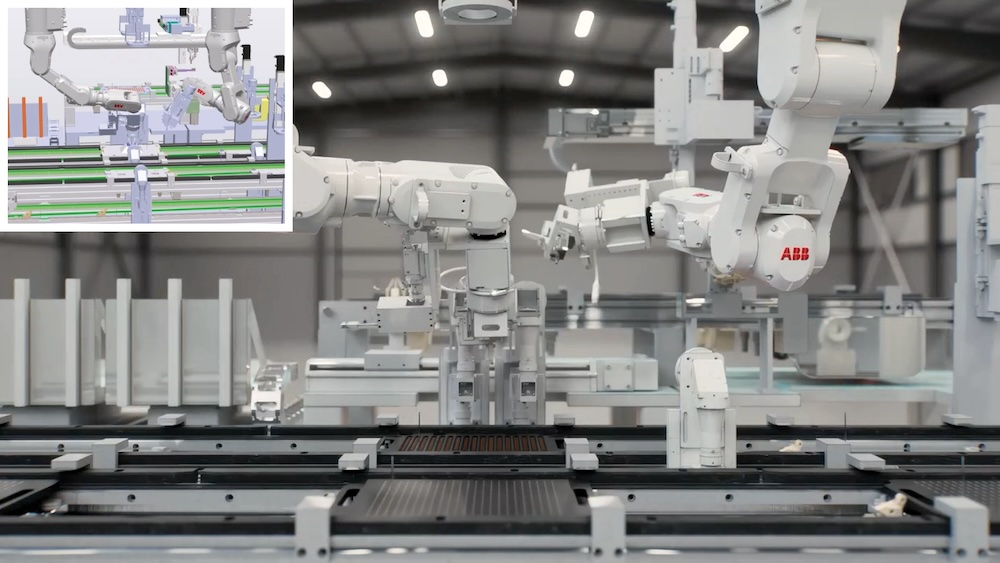
By early 2026, ABB Robotics began transforming its RobotStudio platform through deep integration with NVIDIA Omniverse libraries, culminating in the launch of RobotStudio HyperReality. This subscription-based enhancement enables physics-based simulation with unprecedented accuracy, allowing full robot cells to be exported into Omniverse environments. ABB’s virtual controller combined with Absolute Accuracy calibration reduces positioning errors to approximately 0.5 mm, significantly cutting setup time, costs, and accelerating time-to-market, particularly benefiting small and mid-sized manufacturers such as Foxconn and Workr who are already piloting these capabilities.
By mid-2026, ABB’s RobotStudio HyperReality had evolved into a high-precision simulation platform that narrows the sim-to-real gap to an impressive 99% correlation between virtual and physical robot performance. This advancement empowers manufacturers to design, test, and generate synthetic data for robotic stations well before physical deployment, slashing setup and commissioning times by up to 80% and implementation costs by up to 40%. The platform’s continuous digital twin workflows feed operational data back into simulations, enabling ongoing system optimization and process validation without interrupting production lines, thus turning simulation into a permanent engineering asset.
Foxconn’s pilot use of RobotStudio HyperReality exemplifies the platform’s impact on high-precision consumer electronics assembly, where synthetic data and virtual training reduce the need for physical adjustments and extensive engineering resources during new line startups. Meanwhile, partnerships with companies like WORKR aim to democratize AI-driven robotics for mid-sized manufacturers by combining ABB’s robots with AI to simplify task learning and deployment, requiring less programming expertise. This shift promises to broaden automation adoption beyond large enterprises, making advanced robotics accessible and practical for smaller businesses.

Edge AI Goes Mainstream
NVIDIA’s Jetson Thor and ABB’s OmniCore integration are pushing real-time, on-device AI inference into the heart of robotics, enabling agile, cloud-independent machines that thrive in latency-sensitive environments.
NVIDIA's Jetson Thor platform, built on the advanced Blackwell architecture, exemplifies a leap forward in edge AI hardware by enabling real-time, low-latency processing directly on robotics devices. This compact AI computing platform is tailored for machines that must interpret complex sensor inputs and execute AI models locally, minimizing reliance on cloud connectivity and ensuring robust operation in latency-sensitive environments such as warehouses and healthcare. By efficiently managing multiple AI workloads—including generative AI—Jetson Thor empowers robots to respond instantaneously to dynamic surroundings, enhancing safety and operational continuity even when network access is limited.
ABB Robotics’ initiative to integrate NVIDIA Jetson platforms into its OmniCore controller marks a strategic move to embed real-time AI inference capabilities at the edge, significantly boosting robot responsiveness and reducing dependence on external data centers. This integration enhances critical functions like computer vision, object detection, and adaptive movement with lower latency, which is essential for robots operating in unpredictable, fast-changing environments. By localizing AI processing, ABB aims to deliver more agile and reliable robotic systems that can maintain performance regardless of network variability.
Trossen Robotics’ adoption of the NVIDIA Jetson AGX Orin 64GB module as the standard onboard AI compute platform for both its Rivet mobile manipulation and Workbench benchtop systems underscores a commitment to unified, scalable edge AI performance across diverse robotics applications. Delivering up to 275 TOPS with 64GB LPDDR5 memory and configurable power settings, the AGX Orin supports multiple concurrent AI pipelines—from perception to learned-policy evaluation—allowing developers to keep complex robotics workflows on-device and minimize reliance on cloud infrastructure. This common architecture accelerates development cycles by enabling seamless transitions from benchtop experiments to mobile deployments, as Matt Trossen emphasizes: 'Physical AI teams should not have to rebuild the computer, power, cooling, networking and sensor stack every time they move from a benchtop experiment to a mobile robot.'
Japan’s AI Coalition Emerges
The Cosmos Coalition, backed by Japan’s manufacturing titans and NVIDIA’s open-source world models, is forging a national strategy to unify robotics, mobility, and infrastructure under a new era of physical AI leadership.
NVIDIA is aggressively expanding its physical AI ecosystem through the launch of Cosmos 3 Edge, a 4-billion-parameter world foundation model designed for real-time vision reasoning and robot policy deployment directly on edge devices like the Jetson AGX Thor. This model compresses the capabilities of the larger 65-billion-parameter Cosmos 3 platform to enable on-device inference without cloud dependency, a critical advancement for safety-critical industrial applications where latency and network reliability are non-negotiable. Complementing this, NVIDIA’s new Metropolis libraries accelerate video intelligence and agentic vision system development by at least six times, further enhancing the ecosystem’s ability to support diverse real-time AI applications across robotics and autonomous systems.
The Cosmos Coalition represents a strategic partnership uniting over 20 major Japanese industrial firms—including FANUC, Sony, Honda R&D, Fujitsu, Hitachi, and SoftBank—to collaboratively develop open physical AI world models that span manufacturing, mobility, infrastructure, and robotics sectors. This coalition not only provides members with access to open models, data curation tools, and simulation frameworks but also spearheads ambitious initiatives such as Fujitsu’s unified collaborative control platform integrating robots from FANUC, Yaskawa Electric, and Kawasaki Heavy Industries, which collectively dominate Japan’s industrial robot market. CEO Jensen Huang has framed this as a 'once-in-a-generation opportunity' for Japan to reinvent its manufacturing leadership through physical AI.
NVIDIA’s open-source approach is a cornerstone of its physical AI expansion, exemplified by the release of the Cosmos platform’s family of models and the Cosmos-Dreams closed-loop simulators that enable developers to verify and train AI policies in simulated environments before real-world deployment. This strategy extends to NVIDIA’s self-driving stack, Alpamayo, which has been open-sourced to catalyze innovation beyond autonomous vehicles into adjacent markets such as agriculture, mail delivery, and warehouse robotics. By unifying AI model development and robot deployment across industries, NVIDIA aims to accelerate the growth of what CEO Huang projects to be a $100 billion physical AI business within the next three to ten years.
The practical viability of large-scale world foundation models as real-time policy backbones for robotics is demonstrated by the post-trained Cosmos 3 Edge policy achieving a 22.9% success rate in closed-loop RoboLab tasks, running entirely on-device with low-latency action chunk generation that ensures smooth and continuous robot motion. NVIDIA supports this with an open-source, reproducible training framework and dataset (nvidia/Cosmos3-DROID) compatible with multiple robot embodiments such as the dual-arm Franka and UR robots. However, training these models demands substantial compute power, validated on NVIDIA DGX Stations equipped with Grace Blackwell Superchips, underscoring NVIDIA’s strategic investment in scalable AI infrastructure to sustain the rapid evolution of physical AI.



Stereo Vision Powers Training
Trossen Robotics and Stereolabs are setting a new standard for AI-ready data collection by embedding factory-calibrated, synchronized stereo vision into robots, streamlining the leap from simulation to real-world deployment.
The strategic partnership between Trossen Robotics and Stereolabs, an Ouster subsidiary, marks a significant leap in physical AI data collection by embedding high-fidelity stereo vision hardware directly into robotic platforms. This integration features factory-calibrated multi-camera setups with synchronized, high-resolution, motion-blur-free visual data, optimized for fine manipulation tasks and AI training workflows, thereby addressing longstanding challenges in visual data reliability and synchronization essential for imitation learning, reinforcement learning, and sim-to-real applications.
Trossen Robotics further amplifies its data collection and AI training capabilities by standardizing the NVIDIA Jetson AGX Orin 64GB module across its Rivet mobile manipulation and Workbench benchtop platforms. This onboard AI compute powerhouse delivers up to 275 TOPS, drastically reducing systems engineering overhead and enabling high-performance edge computing for multimodal data collection and real-time learned-policy evaluation, which streamlines workflows from initial data gathering to deployment in complex industrial environments.
By unifying the onboard compute architecture across both stationary and mobile platforms, Trossen Robotics facilitates seamless transitions from benchtop experimentation to mobile robotic applications, accelerating the development cycle for physical AI teams. This common architecture, supported by NVIDIA’s JetPack SDK and Isaac ROS alongside Trossen’s open SDK and simulation resources, creates a comprehensive development ecosystem that expedites robot bring-up, skill development, and real-world validation, effectively bridging the gap between simulation and physical deployment.
AI Factories Redefine Industry
NVIDIA’s pivot to AI-driven reasoning systems and the launch of Vera CPUs are transforming traditional IT into revenue-generating AI infrastructure, fueling the reindustrialization of entire economies.
NVIDIA is revolutionizing AI infrastructure by transitioning from traditional computing paradigms to AI-driven reasoning systems, where computers not only execute instructions but also understand, plan, and perform complex tasks autonomously. This evolution repositions NVIDIA’s offerings from mere IT expenses to revenue-generating 'AI factories,' with physical AI—embodied in robots, autonomous vehicles, and smart factories—emerging as the next frontier for growth beyond digital AI applications.
Marking a bold expansion, NVIDIA’s launch of Vera, a CPU tailored for AI agents requiring ultra-fast response times, challenges entrenched CPU manufacturers and signals a significant new revenue stream. This strategic move complements NVIDIA’s dominance in AI inference hardware, exemplified by the Blackwell platform, which leads the market with unmatched performance per watt, cost efficiency, and a thirtyfold increase in token throughput, underscoring NVIDIA’s command over the rapidly growing inference segment.
The demand for AI infrastructure is rapidly broadening beyond hyperscale cloud providers to include enterprises, sovereign nations, and regional AI clouds, vastly expanding NVIDIA’s total addressable market. This widespread adoption aligns with national economic revitalization efforts, as NVIDIA’s AI investments play a pivotal role in reindustrializing America through advanced chip and systems manufacturing, supporting long-term structural growth and reinforcing the strategic importance of physical AI technologies.

Robotics Ecosystem Accelerates
A surge of industry partnerships, educational initiatives, and academic investments is building a robust robotics ecosystem where rapid product launches and hands-on training are shaping the next generation of physical AI talent.
By mid-2026, the robotics landscape is evolving into a vibrant ecosystem that marries technological innovation with robust community and workforce development. Industry leaders like Foxglove and VIAM are spearheading educational initiatives such as the Actuate 2026 conference in San Francisco and the VIAM101 free robotics course in Brooklyn, empowering engineers to scale applications effectively. Simultaneously, collaborative efforts like the Dream Lab Challenge by Digikey and Arduino, alongside the retail tech hub Industry City fueled by logistics firms and startups, are catalyzing community engagement and fostering a culture of innovation through competitive incentives and shared resources.
The surge in robotics product launches and infrastructure investments underscores a practical leap in the field’s capabilities. Rabient’s Lingbot VA 2.0 Embodied Native World action model, ABB Robotics’ autonomous forklift addition to its Visual Slam AMR portfolio, and Apptronic’s Apollo 2 humanoid robot coupled with its Texas-based Robot park for data collection exemplify how companies are pushing boundaries to enable real-world applications and advanced training environments. These developments not only enhance robotic functionality but also provide critical platforms for iterative learning and deployment.
Academic institutions are playing a pivotal role in sustaining this momentum by investing in specialized facilities that nurture future talent and advance research. The University of Rhode Island’s opening of the Ocean Robotics Laboratory on its Narragansett Bay campus represents a strategic commitment to marine robotics, offering students and researchers a dedicated space to explore cutting-edge underwater technologies. This academic investment complements industry efforts, ensuring a pipeline of skilled professionals equipped to tackle emerging challenges in robotics.