Robots smash records, humans stunned at beijing games
The gist
Humanoid robots shattered athletic records and left human competitors reeling at the 2nd World Humanoid Robot Games, thanks to a fusion of bleeding-edge AI and ultra-fast 5G tech.
What to know
- Brazilian coders and Chinese engineers teamed up to create soccer robots with seamless perception, localization, and real-time decision-making on Booster Robotics’ T1 humanoid platform.
- China Unicom Beijing and Huawei’s dedicated 5G-Advanced GigaUplink network delivered sub-30ms latency and sub-decimeter BeiDou RTK positioning, giving robots lightning-fast reflexes and pinpoint navigation.
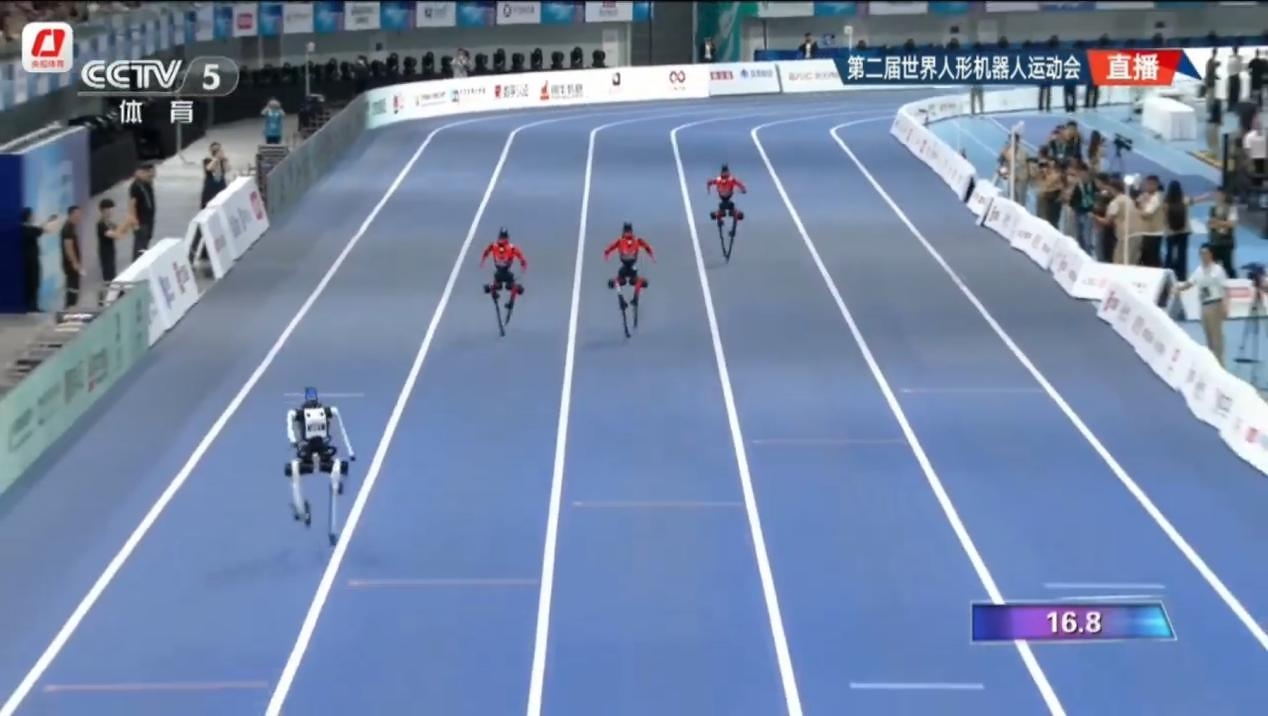
- China’s TianGong Ultra humanoid robot clocked a jaw-dropping 9.32-second 100m sprint and dominated in tennis rallies, signaling robots have officially outpaced humans on the field.
Inside the Robotic Arena
Human programmers and robot athletes are forging a new era of embodied AI, where seamless teamwork between software and hardware is tested under the pressure of real-world competition.
Human programmers and robot athletes are forging a new era of embodied AI, where seamless teamwork between software and hardware is tested under the pressure of real-world competition.
AI Soccer: Brains Meet Brawn
Brazilian coders harnessed advanced Chinese humanoid platforms to design soccer robots that merge perception, localization, and real-time tactics—proving that the future of sports is a fusion of global software talent and cutting-edge robotics.
At the 2nd World Humanoid Robot Games in Beijing, Brazilian coders are leveraging advanced Chinese humanoid platforms like Booster Robotics’ T1 to push the boundaries of embodied AI, focusing their expertise on developing sophisticated soccer algorithms rather than hardware. This collaboration enables them to craft AI systems capable of perceiving the field, localizing the ball, coordinating complex movements, and executing precise kicks, all while relying on T1’s 23 degrees of freedom and integrated sensors as a robust physical foundation. By integrating perception, localization, motion planning, balance control, and real-time decision-making into a seamless whole, the robot soccer competition serves as a rigorous proving ground for AI that must function cohesively rather than in isolated modules.

5G-A and BeiDou: The Digital Backbone
A dedicated 5G-Advanced GigaUplink network and BeiDou RTK positioning gave robots sub-30ms response times and pinpoint movement, laying the groundwork for Beijing’s smart city ambitions far beyond the games.
China Unicom Beijing and Huawei collaboratively deployed a dedicated 5G-Advanced GigaUplink network to power the 2nd World Humanoid Robot Games, leveraging a 100 MHz dedicated spectrum alongside a 300 MHz LampSite ultra-wideband indoor network. This infrastructure enabled ultra-low latency communication with end-to-end delays kept within 30 milliseconds and peak uplink speeds reaching 1 Gbps, ensuring seamless real-time telemetry, precise control signaling, and coordinated multi-robot operations essential for the event's complex autonomous competitions.
The event’s technological backbone was further enhanced by integrating the 5G-A network with BeiDou RTK positioning technology, delivering decimeter- to sub-decimeter-level accuracy. This fusion empowered humanoid robots with highly precise autonomous navigation, agile obstacle avoidance, and precision racing capabilities, showcasing a sophisticated synergy between advanced wireless communication and satellite-based positioning systems.
Beyond the games, the 5G Capital joint initiative by Beijing Unicom and Huawei aims to establish a smart city digital foundation across Beijing, extending the 5G-A GigaUplink network’s reach to support a broad spectrum of embodied AI and mobile AI applications. This strategic deployment promises ubiquitous, secure, and reliable connectivity that will fuel future cultural tourism, AI-driven events, and intelligent infrastructure, positioning Beijing at the forefront of next-generation digital ecosystems.
Humanoids Redefine Athletic Limits
Chinese robots shattered sprint records, mastered complex tennis rallies, and autonomously evolved new running gaits—demonstrating that machine learning can now outpace human athleticism and invent biomechanical strategies never seen before.
Chinese humanoid robots showcased unprecedented autonomous athletic prowess by completing over 100 consecutive tennis rallies against human opponents, leveraging the LATENT AI framework to decompose complex tennis motions into reusable primitives and adapt in real time. These robots demonstrated remarkable resilience, recovering balance mid-rally and dynamically adjusting positioning during doubles matches alongside human players, highlighting advanced perception, decision-making, and whole-body coordination in fast-paced, unpredictable environments.
The TianGong Ultra humanoid robot redefined sprinting benchmarks by shattering the human 100-meter world record multiple times within hours, ultimately clocking an astonishing 9.32 seconds and eclipsing Usain Bolt's 9.58-second mark. This rapid progression reflects X-Humanoid's relentless pursuit of superior speed and agility, further underscored by Tien Kung Ultra's dominant 400-meter win in 38.15 seconds—significantly faster than the human record and last year’s winning time—demonstrating a new era where robots surpass human athletic limits.
Beyond raw speed, humanoid robots exhibited innovative locomotion strategies emerging autonomously through reinforcement learning, such as Tien Kung Omni’s energy-efficient running gait that minimizes arm-swinging to prevent shoulder joint overheating—a novel adaptation not preprogrammed by developers. This evolution of movement efficiency signals a shift toward robots optimizing their biomechanics independently, enhancing endurance and performance in demanding athletic contexts.
Combat and ball sports robots demonstrated enhanced dynamic balance and real-time decision-making, with Unitree’s G1 and H2 models executing complex punch and dodge combinations and sparring live against professional human boxers. Simultaneously, robots engaged in high-speed ball sports, trading shots with Olympic and Grand Slam champions and kicking balls at over 100 km/h with drastically reduced system latency, underscoring significant advances in autonomous perception, rapid response, and physical execution without human control.