Samsung soars, CXMT shakes up DRAM market power play
The gist
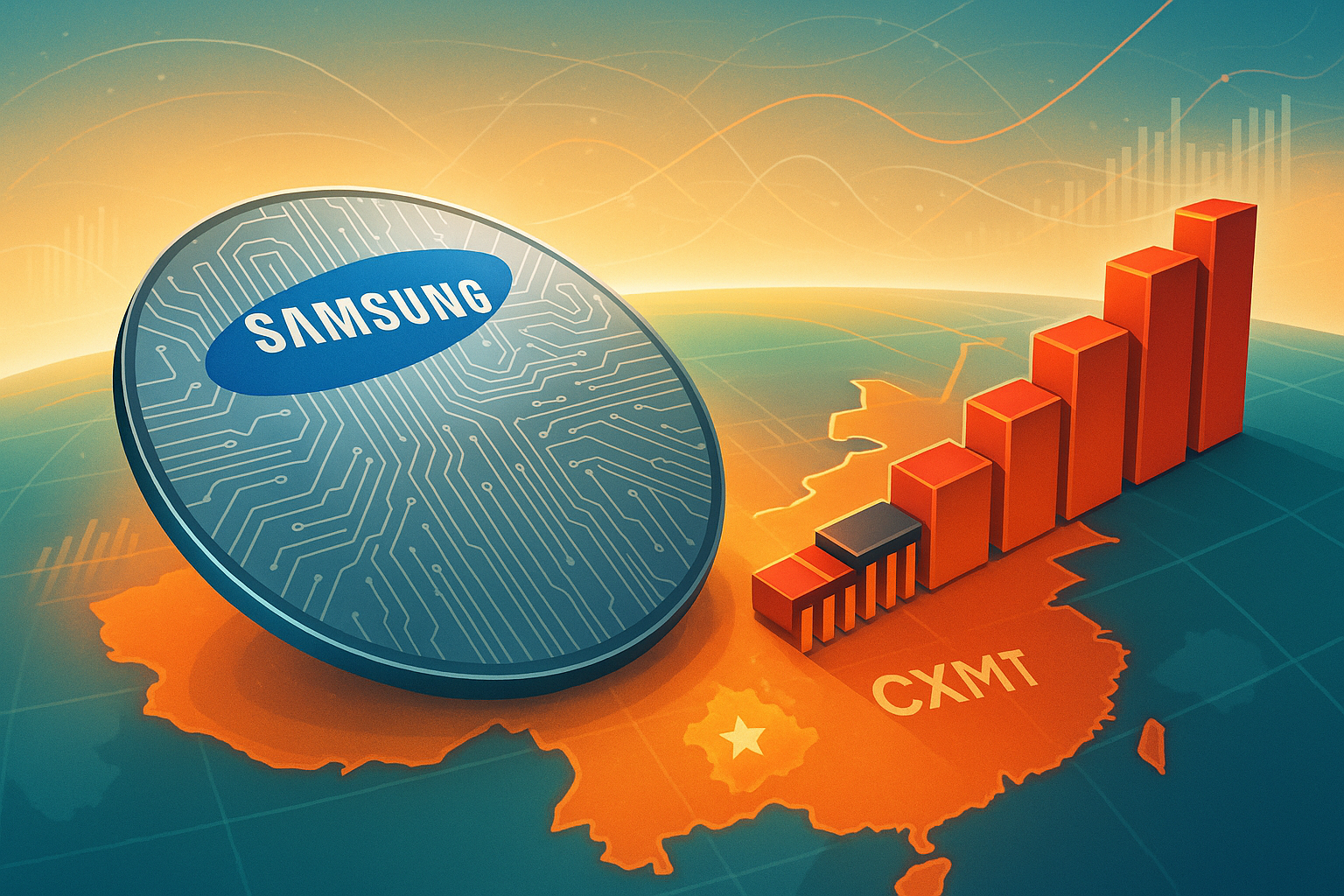
Samsung is clinging to its DRAM crown with unrivaled pricing power, but a turbocharged CXMT is rewriting the rules—and the balance of power—in the global memory market.
What to know
- Samsung will command 39% of the DRAM market by Q2 2026 and rake in $61 billion in quarterly profit, driven by a near-doubling of DDR5 prices and an AI-fueled HBM boom.
- China’s CXMT exploded from 40,000 to 350,000 wafers per month and soared to a $485 billion valuation after its $8.6 billion IPO, bulldozing into the memory big leagues despite export curbs.
- With DRAM suppliers splitting into HBM specialists and commodity juggernauts, OEMs like Apple are testing CXMT chips, signaling a seismic supply chain shakeup as price wars and geopolitical risks intensify.
Samsung’s Dual-Track Dominance
Samsung’s mastery of both commodity DDR5 and high-bandwidth memory lets it profit from price spikes and outmaneuver rivals, cementing its lead even as challengers like CXMT surge.
Samsung has solidified its dominant position in the global DRAM market through 2028, confidently weathering competitive pressures from rapidly expanding players like CXMT. Despite CXMT's aggressive capacity growth and IPO-driven investments, Samsung's control over key capacity and pricing power in the commodity DDR5 segment has allowed it to capitalize on significant market scarcity, with contract prices spiking nearly 100% in early 2026 and pushing industry revenues past $97 billion in a single quarter. This robust pricing environment underpins Samsung's sustained leadership and profitability.
By Q2 2026, Samsung reclaimed and expanded its market share to 39%, a level not seen since 2024, marking its third consecutive quarter at the top of the DRAM market. Senior analyst Jeongku Choi highlighted Samsung's 'exemplary turnaround,' attributing it to strong demand and strategic price hikes in conventional DRAM, alongside an expanding footprint in the high-bandwidth memory (HBM) segment. This dual-segment strength has allowed Samsung to ride the AI-driven surge in conventional DRAM prices more effectively than rivals, even as HBM prices declined, underscoring its versatile product mix that balances server and consumer-grade DRAM.
Samsung's market leadership endures despite intensifying competition from Micron and SK Hynix, both of whom face segment-specific challenges and long-term pricing constraints. Research Director MS Hwang noted that while SK Hynix achieved record earnings, its market share slipped as Samsung and Micron applied pressure from both ends. Looking ahead, Samsung is poised for further earnings growth with anticipated price hikes in Q3 2026, fueled by sustained AI workload demand, reinforcing its position as the dominant DRAM supplier in a rapidly evolving landscape.
Samsung's memory division remains a powerhouse within the company, generating a staggering $61 billion in quarterly profit even as its phone division struggles. This stark contrast highlights Samsung's strategic focus on leveraging its DRAM pricing power amid ongoing market scarcity, particularly in commodity memory segments. The company's ability to translate AI-driven demand into substantial revenue gains cements its role as the linchpin of Samsung's overall financial health and market leadership through 2028.

CXMT’s Relentless Rise
CXMT’s staggering capacity ramp and IPO-fueled war chest are transforming it into a powerful disruptor, undercutting global rivals with aggressive pricing and deep integration in China’s tech ecosystem.
CXMT has demonstrated an extraordinary ramp-up in DRAM wafer production, expanding from a modest 40,000 wafers per month in 2020 to an estimated 350,000 wafers monthly by the end of 2026, closing in on Micron's 385,000 wafers per month capacity. This rapid growth is underpinned by robust AI-driven demand and elevated memory prices, which have alleviated funding constraints and fueled accelerated capacity expansion despite significant challenges posed by EU export restrictions on advanced semiconductor manufacturing equipment.
The company’s blockbuster $8.6 billion IPO—Asia’s largest semiconductor offering in 2026—catapulted CXMT’s market valuation to approximately $485 billion, surpassing Intel and positioning it as China’s most valuable listed firm. This capital influx has empowered CXMT to invest heavily in upgrading existing wafer production lines and advancing DRAM technology, focusing on DDR5 and LPDDR5 segments, while also securing strategic backing from major Chinese tech players like Alibaba Cloud and Xiaomi, thereby embedding CXMT deeply within China’s semiconductor ecosystem.
CXMT’s strategic focus on commodity DRAM markets—where Samsung, Micron, and SK Hynix have shifted capacity toward high-bandwidth memory for AI applications—has allowed it to capture a growing share of the conventional memory segment, with revenues surging 719% year-on-year to $7.5 billion in Q1 2026 and net profits skyrocketing 1,688%. By pricing DDR5 chips 15-20% below Korean competitors and attracting major PC manufacturers like HP and Dell for quality testing, CXMT is emerging as a formidable alternative supplier, especially within Greater China where it accounts for 97% of sales.
Despite its meteoric rise, CXMT faces technological and geopolitical headwinds that temper its near-term ability to challenge incumbents in advanced memory segments. Restricted access to EUV lithography and other cutting-edge equipment limits its progress beyond DRAM nodes two generations behind global leaders, and its current absence from the high-bandwidth memory market constrains participation in the AI memory boom. Nevertheless, with government subsidies, public-market funding, and plans to commercialize HBM within two to three years, CXMT is positioning itself for sustained multi-year capacity growth that could disrupt the traditional DRAM oligopoly.


DRAM Market Splits in Two
A sharp divide is emerging as legacy giants chase high-margin HBM for AI, while CXMT exploits the opening in commodity DRAM, triggering regional realignments and new supplier power plays.
The global DRAM market is witnessing a pronounced bifurcation between commodity DRAM and high-bandwidth memory (HBM) segments, shaped largely by technological barriers and shifting demand dynamics. While commodity DRAM, characterized by standardized products like DDR5 for PCs and mobile LPDDR, faces intense price competition and rapid capacity expansion from Chinese vendors such as CXMT—who have secured multi-year contracts with domestic giants like Huawei and Xiaomi—HBM remains the stronghold of established leaders like Samsung, SK Hynix, and Micron. This technological moat delays Chinese entrants in HBM until at least the first half of 2027, underscoring the segment’s higher barriers to entry and premium pricing driven by AI server demand. As MS Hwang from Counterpoint Research observes, “AI has created two distinct investment stories inside memory,” with HBM benefiting from limited competition and commodity DRAM vulnerable to state-backed entrants clearing capital barriers.
The strategic pivot of major memory suppliers toward HBM production is intensifying supply tightness and price surges in the commodity DRAM market. By early 2026, contract prices for plain DDR5 skyrocketed nearly 100% in a single quarter, propelling DRAM industry revenues past $97 billion, even as Samsung’s memory division posted a staggering $61 billion quarterly profit. This shift is fueled by HBM’s significantly higher profit margins—several times that of commodity DRAM—and its critical role in AI computing servers, prompting companies like Samsung and SK Hynix to allocate up to 29.2% and 23.4% of wafer capacity to HBM respectively. Consequently, commodity DRAM shortages have pushed prices for 64GB server memory up 3.5 times between Q3 2025 and Q1 2026, with mobile device memory costs ballooning to as much as 50% of the bill of materials, reshaping supplier bargaining power and pricing dynamics.
This evolving landscape is fostering a self-reinforcing segmentation where incumbents increasingly prioritize high-value AI and premium memory products, while commodity DRAM becomes a battleground for emerging players like CXMT. As CXMT penetrates PCs, smartphones, and Chinese servers, it challenges the traditional dominance of Samsung, SK Hynix, and Micron in standardized DRAM, prompting these incumbents to further concentrate on HBM and AI-server DRAM to avoid aggressive price competition. The market is thus fragmenting not just by product type but by application and regional dynamics, with HBM becoming more concentrated and strategic, and commodity DRAM growing more diversified and regionalized. Apple’s recent testing of CXMT memory exemplifies this shift, signaling a broader geopolitical and competitive realignment that could redefine capacity allocation and pricing power over the next two to three years.
Supply Chains Upended
CXMT’s IPO shockwaves and Apple’s supplier tests are upending traditional DRAM sourcing, eroding OEM bargaining power as Chinese contracts lock in capacity and AI demand drives prices skyward.
CXMT's explosive 466% IPO surge not only vaulted it to become the second largest China-listed company in history but also sent shockwaves through the global DRAM market, wiping $100 billion off the valuations of established giants like Micron, Samsung, and SK Hynix. This dramatic market reaction reflects investor anxiety over CXMT’s rapid capacity expansion, which threatens to disrupt the long-standing oligopolistic structure and intensify commodity pricing pressures, signaling a fundamental shift in competitive dynamics.
Amid this upheaval, key OEMs such as Apple have begun strategically testing CXMT memory across flagship products like iPhones and MacBooks, marking a pivotal shift in supply chain dynamics. While geopolitical and regulatory uncertainties loom—given CXMT's classification by the Pentagon as a Chinese military operation and Apple’s lobbying efforts—this move introduces a credible fourth supplier into the OEM qualification pool, potentially recalibrating buyer power and negotiation leverage even without CXMT commanding a dominant market share.
However, CXMT’s refusal to meet Apple’s demands for lower DRAM prices underscores a new market reality where buyer power is eroding, especially for traditional consumer electronics customers. With CXMT’s production capacity largely locked by domestic Chinese customers under long-term contracts and major suppliers like Samsung and SK Hynix prioritizing AI-driven high-bandwidth memory (HBM) orders, Apple’s historical strategy of leveraging multiple suppliers for price concessions is losing effectiveness amid soaring DRAM prices fueled by AI demand.
This evolving landscape is further complicated by significant liquidity shifts and volatility in Asian markets, exemplified by SK Hynix’s 45% share plunge and temporary trading halts on South Korea’s Kospi index, reflecting investor concerns over intensified competition and capital expenditure challenges amid AI-driven demand. Concurrently, strategic dialogues between CXMT leadership and U.S. officials highlight the geopolitical undercurrents shaping supply chain realignments, which together suggest that DRAM sourcing strategies and buyer power will continue to be reshaped over the next two to three years as the market bifurcates between concentrated, strategic HBM and a more diversified, regionalized commodity DRAM segment.