Seamless EV charging arrives as networks join forces
The gist
America’s EV charging scene just leveled up—Tesla, GM, and EVgo are joining forces to make fast charging as easy (and everywhere) as filling up with gas.
What to know
- GM’s Energy Pass now covers about 70% of US DC fast chargers, uniting ChargePoint and Tesla Superchargers for seamless app-based charging and payment.
- EVgo, GM, and Pilot have launched over 300 ultra-fast charging sites nationwide, with plans to triple to up to 17,000 ports by 2030—targeting metro and multi-family hotspots.
- Tesla’s NACS has become the US charging standard, now supported by 35+ car models and integrated into major networks for truly universal, road-trip-ready access.
Reliability Fuels EV Loyalty
Record-high EV owner satisfaction in 2026 is driven by a dramatic drop in charging failures and surging infrastructure reliability, as external pressures like rising gas prices accelerate the shift to electric.
By mid-2026, consumer satisfaction with electric vehicles has soared to unprecedented levels, with 96% of current EV owners expressing willingness to choose electric again. This surge in enthusiasm is closely tied to the dramatic improvements in charging infrastructure reliability, which have alleviated one of the biggest barriers to EV adoption. Additionally, external pressures such as soaring gasoline prices—exacerbated by geopolitical tensions like the US-Iran war—have further propelled consumers toward EVs as a practical and cost-effective alternative for daily commuting.
Charging infrastructure in the US has undergone a significant transformation, marked by a 30% expansion in fast-charging stations and a notable decline in failed public charging attempts, which hit their lowest point in four years by 2025. This progress is reflected in user experiences: a recent survey of 209 EV drivers found that 45% rated public charger reliability a perfect five out of five, with Tesla Superchargers leading the pack due to their seamless plug-and-play experience and top reliability rankings. Despite these gains, a perceptual gap remains, as many consumers still underestimate the actual reliability improvements made in recent years.
The evolution of charging infrastructure reliability over the past two years has been so pronounced that industry insiders note a dramatic reduction in charge failures, with disruptions now mostly limited to rare, large-scale outages like the Amazon Web Services incident. This enhanced dependability, combined with the increased availability of multiple charging stalls, has significantly eased range anxiety among EV drivers. As one observer put it, 'So long as there's more than one stall, I really don't worry about it,' underscoring how expanded stall availability fosters greater user confidence and satisfaction.
Charging Deserts Disappear
GM’s Energy Pass and new multi-network partnerships are turning former charging dead zones into accessible, full-service fast-charging hubs with integrated payment and plug-and-charge capabilities.
By mid-2026, GM's strategic integration of ChargePoint into its Energy Pass platform marked a pivotal expansion of the EV charging ecosystem, now encompassing approximately 70% of all U.S. DC fast chargers. This seamless integration allows GM EV owners to locate, activate, and pay for charging sessions through a single app across myChevrolet, myGMC, and myCadillac, eliminating the hassle of managing multiple accounts. Complementing this software unification, the partnership has deployed hundreds of new fast-charging stalls in historically underserved 'charging deserts' along critical travel corridors and regional hubs such as Elmwood Township, Michigan, and Winter Park, Florida, many featuring advanced dual-connector Omniport dispensers that support both NACS and CCS1 vehicles with ISO 15118 Plug & Charge protocols.
The collaboration between Pilot, GM, and EVgo has rapidly expanded to over 300 fast-charging sites across 40 states, now covering roughly 75% of U.S. EV routes and offering 1,300 DC fast-charging stalls, with ambitious plans to reach 2,000 stalls at 500 locations nationwide. These strategically placed Pilot travel centers enhance the charging experience by providing 24/7 staffing, free Wi-Fi, clean restrooms, retail and food options, and driver-friendly features like pull-through stalls for trailers, significantly boosting driver confidence and convenience on long-distance journeys. This milestone underscores a maturing infrastructure, reflected in a high Plugshare user rating of 9.41 out of 10, signaling growing reliability and accessibility in public EV charging.
EVgo's integration into Tesla’s Supercharger for Business program represents a strategic leap forward, enabling interoperability with Tesla’s charging ecosystem and facilitating the rollout of ultra-fast 500-kW Superchargers to reduce wait times and enhance charging speeds. This move, announced in early August 2026, complements the broader network expansion, exemplified by the launch of a flagship 12-stall, 350-kW fast-charging hub in Warren, Michigan, near GM’s Global Technical Center. Equipped with dual CCS and NACS plugs, overhead canopies, and pull-through lanes, this station embodies the partnership’s commitment to convenience and accessibility, supported by GM’s Energy Pass platform for streamlined payments.
The GM and EVgo partnership’s $500 million investment aims to scale the public charging network to over 35,000 stations nationwide by 2030, with plans to open more than 100 flagship stalls by the end of 2026 across key states. This substantial commitment addresses critical EV charging pain points, particularly for drivers lacking home charging options or embarking on long-distance travel, by prioritizing reliability and user-friendly amenities. As EV sales growth moderates and consumer expectations rise, executives emphasize that enhancing charging convenience is essential to sustaining EV adoption momentum and transforming public charging into a seamless, confidence-inspiring experience.
Unified Access, Zero Hassle
Major automakers and charging networks are erasing compatibility headaches by rolling out universal NACS and CCS ports, automatic billing, and single-app access across 70% of U.S. fast chargers.
General Motors has taken a decisive step toward unifying EV charging by fully integrating ChargePoint into its Energy Pass platform, which now covers approximately 70% of all US DC fast chargers. This integration allows GM EV owners to seamlessly find, activate, and pay for charging sessions through their brand-specific apps without juggling multiple accounts, while many ChargePoint stations support ISO 15118 Plug & Charge protocols for automatic billing and charging initiation. Additionally, GM and ChargePoint have strategically deployed hundreds of new fast-charging stalls equipped with ChargePoint's Omniport technology—featuring dual NACS and CCS connectors—to address charging deserts along key travel corridors, enhancing accessibility during the industry’s transition to Tesla’s North American Charging Standard (NACS).
EVgo’s partnership with Tesla marks a significant milestone in the widespread adoption of Tesla’s NACS, as the network plans to deploy Tesla’s V4 Supercharger hardware nationwide under the branded 'EVgo Superchargers' starting in late 2026. These stations will leverage Tesla’s Magic Dock system to support both NACS- and CCS-equipped vehicles without adapters, featuring longer cables for improved user convenience. While Tesla will operate and maintain the chargers—integrating them into Tesla’s navigation and Trip Planner—EVgo retains ownership and pricing control, responding to a 700% surge in network usage over three years and aiming to expand fast-charging options for all EV drivers as NACS adoption accelerates.
The collaboration between EVgo, GM, and Pilot has propelled the US fast-charging infrastructure past 300 DC fast-charging sites, with EVgo joining Tesla’s Supercharger for Business program to deploy 500-kW Superchargers at scale. This integration enables compatibility with both NACS and CCS vehicles, with stations discoverable in Tesla’s app, signaling a unified charging ecosystem. GM’s commitment to NACS is further underscored by equipping all 2027 EV models—including the Cadillac Escalade IQ—with native NACS ports, eliminating the need for adapters and simplifying charging across networks through the Energy Pass app, which consolidates access to Tesla Superchargers, IONNA, Electrify America, EVgo, and ChargePoint.
Industry leaders recognize Tesla’s NACS as the emerging standard that benefits all EV owners by unifying charging infrastructure and simplifying user experience. EVgo’s aggressive expansion plans aim to triple its charging footprint to 15,000–17,000 ports by 2030, focusing on metropolitan and multi-family housing areas to maximize utilization of NACS stations. As Sara Rafalson of EVgo notes, this transition is an industry-wide movement, with hundreds of Tesla Superchargers slated for installation through 2027. Tesla’s Supercharger network remains the largest in the US, boasting over 3,000 stations and 37,000 ports, while NACS is now supported by more than 35 vehicle models, including over three million Teslas, solidifying its dominance in the evolving EV charging landscape.
Flagship Hubs Redefine Charging
Next-generation charging stations mimic gas station convenience—offering ultra-fast charging, retail access, and seamless cross-network payments—to make EV charging as familiar and stress-free as fueling up.
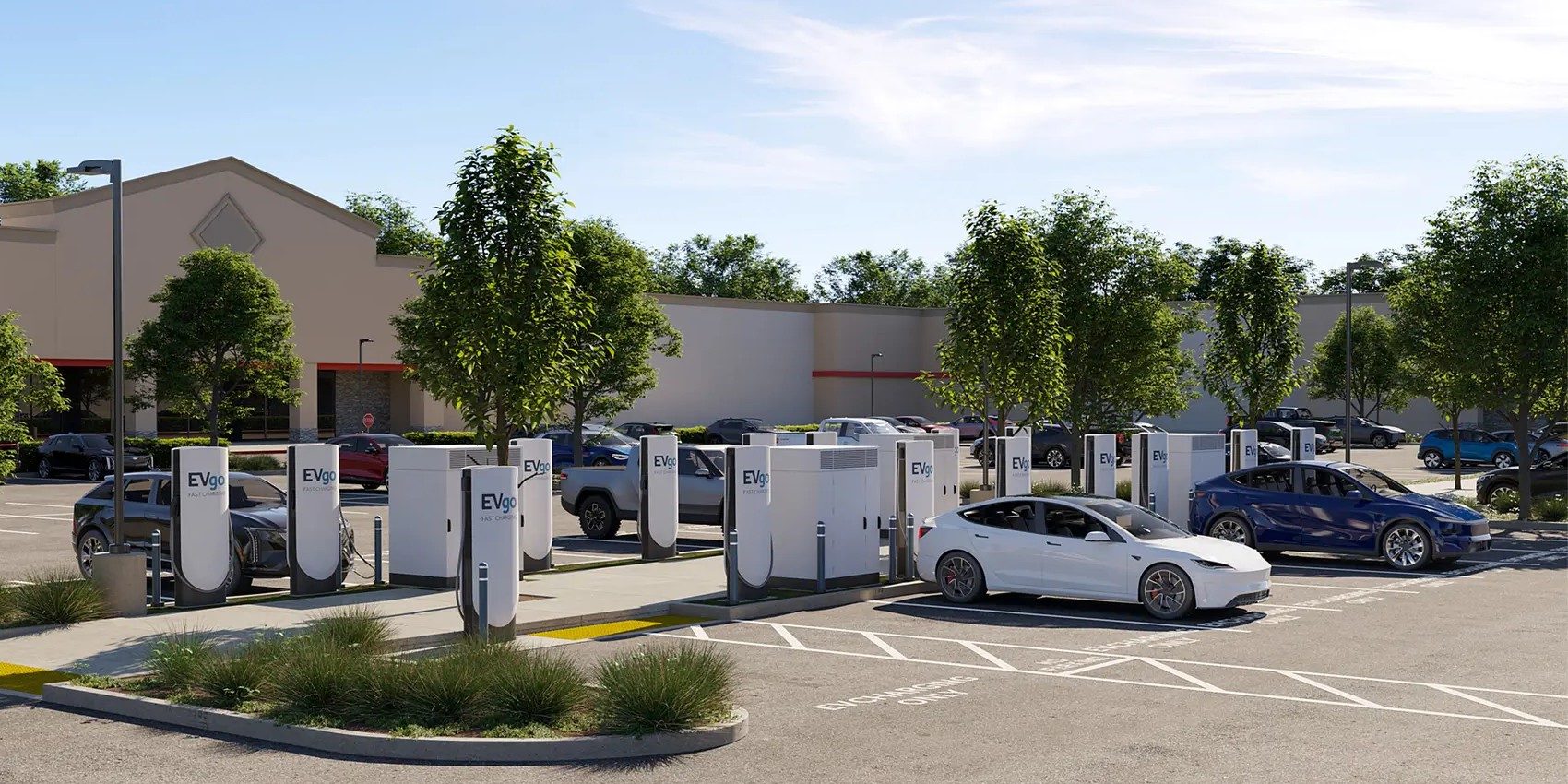
In August 2026, GM and EVgo unveiled a flagship 12-stall, 350 kW fast-charging hub in Michigan that reimagines EV charging with gas-station-style convenience to ease user anxiety. Strategically located in a Meijer Superstore parking lot near GM’s Global Technical Center, this station offers pull-through lanes for trailers, overhead canopies, and enhanced lighting, enabling a full charge in about 15 minutes—perfectly aligning charging time with typical grocery shopping durations. This design not only addresses common pain points but also exemplifies a broader $500 million investment by GM to build over 35,000 charging stations nationwide by 2030, underscoring a strategic push for seamless, reliable public charging infrastructure.
A major leap in charging convenience comes from GM’s 2027 EV models, all equipped with native North American Charging Standard (NACS) DC fast-charging ports, enabling direct, adapter-free access to Tesla Superchargers and other NACS networks. This interoperability is complemented by GM’s new Energy Pass app, which unifies payment and access across multiple networks—including Tesla Supercharger, IONNA, Electrify America, EVgo, and ChargePoint—through a single account. Furthermore, Energy Pass supports Plug & Charge functionality, with an over-the-air update planned to activate automatic authentication and payment at Tesla Superchargers later in 2024, significantly reducing charging friction and simplifying the user experience.
EVgo’s flagship charging station exemplifies the industry’s shift toward user-centric design by supporting both CCS and Tesla’s NACS plugs, eliminating the need for adapters and accommodating a wide range of EVs. This dual-standard approach, combined with convenient retail locations and fast-charging capabilities, reflects EVgo CEO Bader Kahn’s emphasis on building national corridor networks that reduce charging anxiety and encourage broader EV adoption. By mimicking the familiarity of traditional gas stations, these innovations aim to transform EV charging from a source of stress into a seamless part of everyday life.

Ultra-Fast Charging Goes Mainstream
EVgo’s nationwide deployment of 500 kW Tesla Superchargers and proprietary next-gen chargers is tripling the U.S. fast-charging footprint and setting new standards for speed and reliability.
By mid-2026, EVgo embarked on a transformative expansion of high-power fast charging infrastructure through a strategic partnership with Tesla to deploy the latest V4 Supercharger hardware nationwide. These EVgo Superchargers, launching in the second half of 2026, feature Tesla’s Magic Dock system, allowing seamless charging for both NACS- and CCS-equipped vehicles without adapters, and deliver ultra-fast charging speeds up to 500 kW at retail and restaurant locations in major U.S. cities. This collaboration uniquely blends Tesla’s operational expertise and integration into Tesla’s in-car navigation and Trip Planner with EVgo’s ownership and pricing control, creating a user-friendly, accessible charging ecosystem that addresses a 700% surge in EVgo network usage over three years and the influx of NACS-equipped EVs.
Complementing this nationwide rollout, EVgo, General Motors, and Pilot have collectively surpassed 300 DC fast-charging sites across the U.S., marking a significant milestone in scaling ultra-fast charging infrastructure. Notably, GM and EVgo unveiled a flagship 12-stall, 350 kW fast-charging hub near GM’s Global Technical Center in Michigan, equipped with both CCS and NACS plugs and user-centric features like overhead canopies and pull-through lanes. This launch is part of GM’s ambitious $500 million investment to build over 35,000 charging stations by 2030 and aligns with EVgo’s plan to open more than 100 flagship stalls by the end of 2026, underscoring a coordinated industry effort to enhance charging reliability and convenience amid rising EV adoption.
Looking ahead, EVgo aims to triple its charging footprint to between 15,000 and 17,000 ports by 2030, focusing on metropolitan areas and multi-family housing to maximize utilization of high-power fast chargers. Alongside deploying hundreds of Tesla-produced V4 Superchargers, EVgo is retrofitting existing stations with 350 kW Tesla units and developing its own next-generation fast chargers in partnership with Delta Electronics, with initial deployments expected by the end of 2026. This multi-pronged approach not only accelerates infrastructure growth but also drives ongoing innovation to meet escalating consumer expectations for faster, more reliable, and widely accessible EV charging.
NACS Powers a Universal Network
Tesla’s NACS, now embraced by nearly every major network and automaker, is transforming EV charging into a truly interoperable, high-speed experience—especially in metro hubs and along key travel corridors.
Tesla’s North American Charging System (NACS) has emerged as the linchpin in creating a seamless, high-power EV charging ecosystem across the US, with major networks like EVgo embracing and expanding this standard. By focusing installations in metropolitan hubs with dense multi-family housing and along major highway corridors—including over 300 Pilot Flying J truck stops—EVgo is strategically enhancing charging accessibility where it matters most, thereby directly addressing range anxiety and convenience for urban and long-distance travelers alike.
The integration of Tesla’s NACS into other networks and vehicles is transforming the user experience by enabling features like automatic routing through Tesla’s in-car navigation and Trip Planner, which simplifies long-distance EV travel. This seamless interoperability not only benefits Tesla owners but also accelerates broader EV adoption by making charging infrastructure more intuitive and reliable across brands.
The rapid scaling of high-power charging infrastructure is underscored by EVgo’s aggressive plans to install between 1,300 and 1,575 new stalls in 2026, including retrofitting existing stations with Tesla V4 Superchargers capable of 500 kW charging. Collaborations with automakers like General Motors, exemplified by the new 12-stall flagship station in Warren, Michigan featuring both CCS and NACS plugs at 350 kW, highlight a coordinated industry effort to build robust, high-capacity networks in strategic states such as California, Florida, and Texas, ensuring that EV drivers have reliable access to fast charging nationwide.