SEO gets an AI makeover: marketers race to master answer engines and generative optimization
The gist
AI-powered search is upending SEO as marketers scramble to master answer engines, generative optimization, and a new era where AI referrals convert six times better than Google traffic.
What to know
- Technical tactics like llms.txt files, server-side rendering, and token-trimmed 'scrunched' pages have become essential for getting noticed by AI agents such as GPTBot and ClaudeBot—with brands like Tastewise seeing a 600% jump in AI visibility.
- New metrics like 'Share of Model' and 'Citation Share' from tools like Profound are reshaping how marketers measure AI search impact, as 40% report attribution headaches.
- Workflows are being reinvented to blend AI automation with human creativity, while Reddit and YouTube now drive crucial brand authority and AI search visibility—raising the stakes for authentic content and reputation management.
SEO’s Creative Renaissance
Generic, AI-answerable content is out—marketers now win by crafting unique, locally-anchored strategies that blend traditional trust signals with cutting-edge answer optimization.
Traditional SEO has not vanished but is undergoing a significant evolution as marketers recognize that generic, easily AI-answerable content no longer suffices. Early adaptations emphasize crafting unique, creative, and localized content strategies to maintain relevance, with components like Google’s map pack and customer reviews retaining strong consumer trust and importance. As one expert put it, “SEO is dead. By the way, it’s not... If there’s a piece of content that you could easily just ask... that’s certainly probably not going to be a great strategy,” underscoring the shift toward differentiation and local optimization.
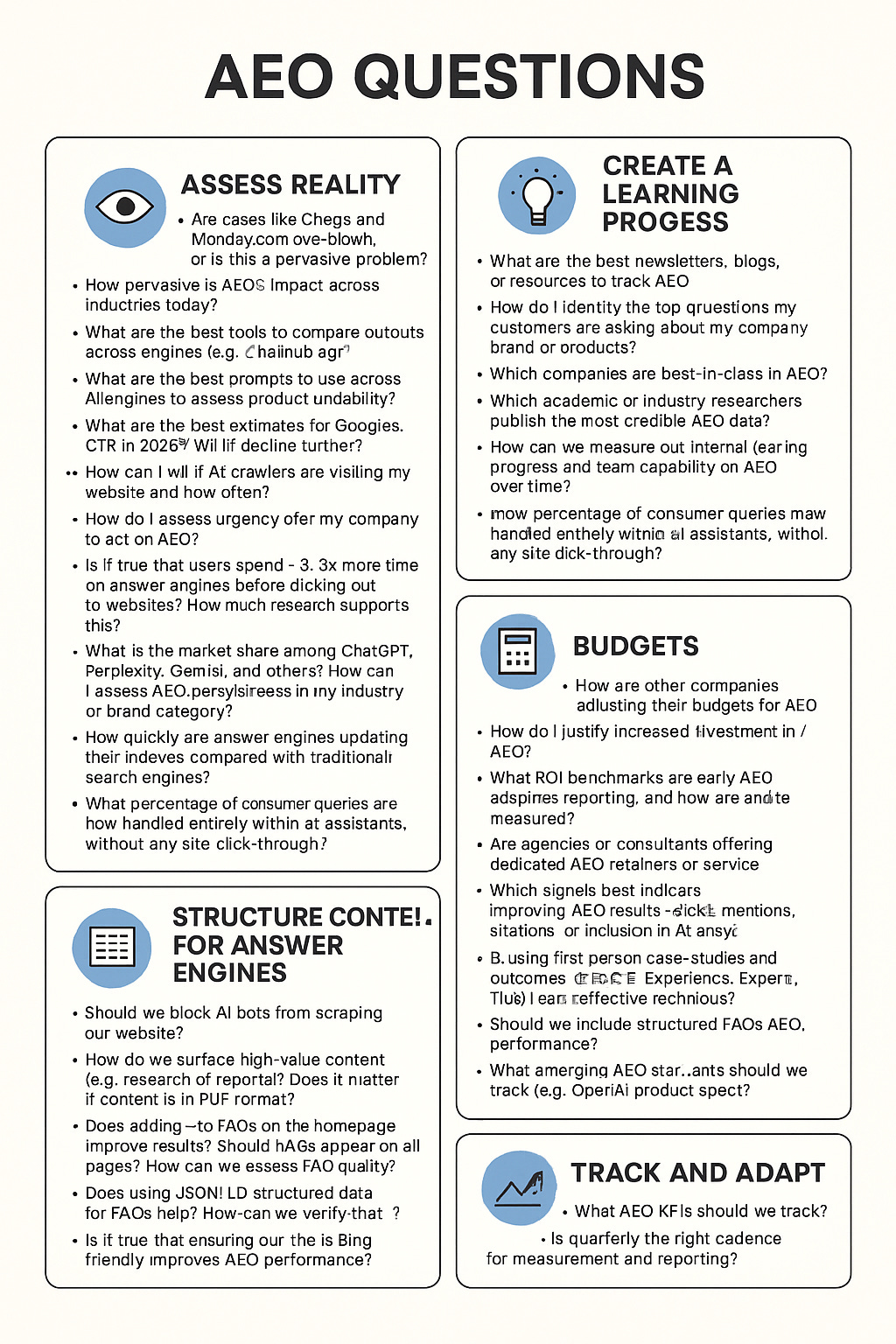
The rise of AI-powered search has given birth to new optimization paradigms such as Answer Engine Optimization (AEO) and Generative Engine Optimization (GEO), which focus on tailoring content for large language models (LLMs) and AI-driven search interfaces. Companies like E2M and platforms such as Scrunch are pioneering strategies to make websites 'agent ready,' ensuring brands appear prominently in AI-generated answers amid the zero-click search phenomenon that has caused up to 37% of marketers to report declines in site referral traffic. Despite this, traditional SEO remains vital, especially local SEO and commercial intent keywords, as consumers often return to standard search engines to deepen their research beyond AI summaries.
Data-driven analyses from early 2026 decisively debunk the myth that SEO is dead, revealing only a modest -2.5% year-over-year decline in organic search traffic among the largest US sites, with Google traffic actually up by 0.8%. This nuanced picture shows a consolidation where top 10 sites and many small sites gained traffic while mid-sized sites saw declines, indicating that low-quality, undifferentiated SEO is fading rather than search itself. Experts advise marketers to pivot toward fewer, higher-quality pages built around specific search intents and original proof that AI models want to cite, blending traditional SEO with AEO tactics to secure visibility in both Google rankings and AI-generated answers.
By mid-2026, the integration of AI-generated answers as a central feature in Google search, officially confirmed at Google I/O, has accelerated the transformation of SEO strategies. Marketers now face the challenge of limited visibility into how AI describes their brands, prompting a focus on managing AI-generated content accuracy and optimizing for AI agents through techniques like 'scrunching' webpages. While 52% of B2B tech marketers prioritize AI search over traditional SEO for content distribution, many still struggle to update content effectively for AI discovery, highlighting the ongoing need for unique, credible human content even as AI reshapes the search landscape.






Rise of Dual Content Streams
AI-focused content built for large language models now drives higher-intent traffic and conversions, forcing marketers to create parallel strategies for both humans and machines.
The emergence of Answer Engine Optimization (AEO) and Generative Engine Optimization (GEO) has fundamentally reshaped digital marketing by shifting focus from traditional SEO’s emphasis on keywords and backlinks to content structured explicitly for AI agents. Early in 2024, researchers demonstrated that adding source citations and expert-edited facts could boost AI summary inclusion by 40%, underscoring the importance of making content quotable and trustworthy rather than merely voluminous. Companies like Webflow have since reported that over 10% of their signups come from AEO and GEO channels, with conversion rates six times higher than traditional SEO traffic, highlighting the superior quality and intent-driven nature of AI-referred visitors. This evolution demands marketers create dual content streams—one for humans and a 'shadow' version optimized for AI agents—emphasizing formats favored by large language models such as FAQs, tables, and glossaries, while minimizing multimedia that AI struggles to parse.
As AI agents like ChatGPT and Claude increasingly act as intermediaries in search and buying journeys, agent-led marketing has emerged as a critical new paradigm. This approach prioritizes AI discoverability and trust signals by structuring content with clear, concise answers placed upfront, often using journalistic inverted pyramid styles and question-based headings to align with AI consumption patterns. Marketers are integrating AI agents directly on websites to facilitate faster interactions and dynamically personalize content based on user identification, addressing the reduced patience and accelerated decision-making typical of AI-driven buyers. Furthermore, proprietary artifacts, rapid editorial cycles, and opinionated points of view give founder-led teams a competitive edge in gaining AI citations and trust, as these elements provide unique, verifiable insights that generic agencies cannot replicate.
The adoption of AEO and GEO strategies is rapidly accelerating among enterprises, with 94% planning increased investment in 2026 and these tactics becoming core strategic priorities rather than experimental efforts. However, challenges remain in measurement and attribution, as AI platforms provide limited data outputs, complicating visibility tracking and optimization. Emerging specialized tools like Profound, BrandRank, and GEOAnalyzer Pro are addressing this gap by offering AI-specific metrics such as 'Share of Model' and 'Citation Share'—new benchmarks that quantify how often a brand is mentioned or cited in AI-generated answers. This shift also entails a mindset change from chasing clicks to managing influence across an AI-driven 'influence portfolio,' where visibility in AI responses and trustworthiness in citations determine competitive advantage.
Technological and structural adaptations are essential for effective AEO and GEO implementation, as traditional CMS platforms and multimedia-heavy websites hinder AI agent consumption. Brands are deploying headless CMS and edge solutions like Cloudflare to serve streamlined, token-efficient versions of pages optimized for AI parsing, a process sometimes called 'scrunching.' This dual delivery preserves rich human experiences while ensuring AI agents receive fast-loading, semantically clear content with proper schema, markdown, and minimal JavaScript interference. Additionally, external platforms such as Reddit, Wikipedia, YouTube, and review sites like Trustpilot play outsized roles in AI citations, making active engagement across these channels vital to building the distributed authority AI models rely on. The cumulative nature of AI training data means brands must maintain consistent, authoritative presence across multiple surfaces to secure and sustain AI visibility.




Technical SEO Goes AI-Native
Brands are overhauling site infrastructure with llms.txt files, server-side rendering, and token-trimmed pages to treat AI bots as VIPs and secure top placement in AI-generated answers.
Technical SEO for AI-driven search has evolved beyond traditional practices to include specialized site infrastructure updates that prioritize AI crawler accessibility and content readability. Innovations such as adopting the llms.txt file format to guide AI bots like GPTBot and ClaudeBot, implementing server-side rendering to ensure critical content is present in HTML, and serving streamlined, token-reduced page versions at the CDN edge have become essential. These advances, exemplified by Tastewise’s 600% visibility surge after optimizing for LLM summarization and FAQ schema, underscore the necessity of treating AI retrieval bots as VIP visitors rather than dismissible traffic, marking a fundamental shift in technical SEO strategy.
Measurement of AI search performance and ROI remains a formidable challenge, prompting the development of new metrics and analytic frameworks tailored to AI’s unique dynamics. Companies like Webflow, through tools such as Profound, track visibility, citation frequency, and narrative comprehension across AI platforms including ChatGPT and Perplexity multiple times weekly, moving beyond traditional click-based KPIs. Meanwhile, emerging solutions like PCCC’s GEOAnalyzer Pro introduce advanced metrics such as Trust Velocity and Hallucination Elimination, addressing attribution difficulties highlighted by 40.6% of marketers who cite measurement as their biggest hurdle. However, as Josh warns, the volatility of AI rankings and the lack of prompt volume data mean that honest measurement demands skepticism and a multi-source approach combining referrer data, self-reports, and bot analytics.
Automation is revolutionizing technical SEO for AI search by enabling scalable, consistent optimization that was previously labor-intensive. Tools like Claude Code empower creators to build AI agents that automatically optimize content with perfect metadata, question-based headings, and answer capsules—recognized as the #1 factor for AI citations—while AI-powered topical map generators from Authority Hacker and others dynamically analyze competitor data and customer queries to produce interactive, refined content plans. This automation not only improves quality and efficiency but also facilitates rapid adaptation to AI search’s fluid landscape, as evidenced by the imminent release of topical map skills and widespread adoption of AI SEO practices by over 80% of organizations.
The technical and measurement innovations for AI search are converging into a comprehensive ecosystem that integrates site infrastructure, content strategy, and off-site authority to shape demand rather than merely capture it. As Christine Liang notes, while technical SEO fundamentals endure, the focus has shifted to becoming an authoritative source for AI language models, requiring new metrics like share of voice and citation frequency to gauge influence upstream of traffic. Platforms such as AirOps and Surfer SEO are evolving to blend traditional SEO with AI Experience Optimization (AEO), enabling marketers to prioritize high-impact pages based on AI visibility data. This holistic approach is critical as Google’s 2026 AI Overviews update introduces source links and citation transparency, enhancing measurement capabilities and signaling a maturing AI search ecosystem.




Workflow Revolution: Human + AI
Marketing teams are retooling around AI automation and ‘frontier knowledge,’ shifting human effort to strategy and creativity while AI handles scale and speed.
Since late 2025, organizations and agencies have fundamentally restructured marketing workflows to integrate AI automation tools such as Clay, Apollo, and Smartlead, shifting human effort towards strategic targeting and content creation rather than building proprietary platforms. This evolution is exemplified by companies like Aerops, which focus on producing 'frontier knowledge'—content that adds new information beyond what large language models already know—to gain visibility in AI-driven search. Meanwhile, enterprises like Pedager Duty are orchestrating hybrid teams of humans, machines, and AI agents, moving away from traditional people-centric models to adapt to the demands of AI marketing.
Human-AI collaboration remains a cornerstone of effective AI-driven marketing, as highlighted by Identity Dental Marketing’s 2024 AI + Human Intent framework and Media Shower’s proprietary AI platform. These models leverage AI to generate approximately 80% of marketing content, with human teams providing the critical final 20% polish involving creativity, compliance, and brand tone. Grace Rizza, CEO of Identity Dental Marketing, emphasizes that AI enhances but does not replace human expertise, underscoring the ongoing need for strategic judgment and empathy in marketing campaigns.
The transition to AI-driven marketing has necessitated new skill sets and organizational mandates, with companies like Media Shower investing heavily in AI research years before the ChatGPT surge and Webflow’s CMO Dave Steer implementing AI agents such as a 'Chief of Staff GPT' to automate workflows. However, this shift requires clear internal alignment and education across all levels, as stressed in 2026 guidance recommending explicit cross-functional ownership and updated KPIs that incorporate LLM visibility metrics alongside traditional SEO measures. Without this alignment, attempts to deploy AI tactics risk wasting resources and eroding credibility.
By mid-2026, agencies and enterprises are embracing sophisticated AI-driven marketing frameworks and tools like PCCC’s GEOAnalyzer Pro and AirOps’ Quill to measure and optimize brand visibility across large language models, while also developing specialized services such as SPM Communications’ Engineered Brand Discovery™ that blend AI optimization with seasoned PR expertise. This comprehensive approach includes adapting to longer, multi-turn AI search queries, leveraging multi-channel strategies, and building authoritative content ecosystems through deliberate question ownership and citation engineering, all while navigating increased manual efforts due to platform crackdowns and formalizing AI leadership roles like 'chief AI officer' to oversee integration.





AI Traffic: Quality Over Quantity
AI referrals—especially from ChatGPT—are rapidly eclipsing traditional search in conversion power, making brand trust and authentic platform presence the new battleground.
The AI search landscape is fundamentally reshaping web traffic quality and brand discovery, with AI referral traffic—especially from ChatGPT—delivering significantly higher conversion rates than traditional Google referrals; for instance, Webflow reports ChatGPT referrals convert at six times the rate of Google traffic, underscoring the shift from volume to quality. This evolution demands a new approach to optimization, termed AI-Enhanced Optimization (AEO), which extends traditional SEO by focusing on clear content structure, authoritative brand signals, and continuous freshness to maintain visibility in highly dynamic AI search rankings. As Josh Blyskal advises, 'AEO is the next evolution of SEO,' emphasizing that brands must now optimize to be understood and cited by AI systems rather than merely ranking for blue links.
Market adoption of AI search is accelerating but remains uneven, making customer data and platform-specific strategies critical for investment decisions. Companies like monday.com demonstrate higher-than-average AI search tool usage among their visitors, signaling the importance of tailoring AEO efforts to audience behavior. Meanwhile, platforms such as Reddit and YouTube have emerged as pivotal arenas for influencing AI-generated recommendations, with Reddit’s organic discussions and YouTube mentions proving to be the strongest signals of AI brand visibility, as shown in Ahrefs’ analysis of 75,000 brands. This platform-specific focus is essential as AI-driven referrals grow rapidly—experiencing a 40x surge from early 2024 to mid-2025—reshaping the shopper discovery funnel and elevating AI as a dominant discovery channel alongside traditional SEO.
The rise of AI-driven search has introduced new risks and competitive dynamics, notably the proliferation of astroturfing on platforms like Reddit, where companies in sectors such as peptides and hormone replacement therapy strategically manipulate discussions to influence AI-generated answers. Moderators have responded by tightening controls, including banning standalone posts on sensitive topics, highlighting the operational challenges brands face in managing AI referral traffic and engagement. Furthermore, this shift elevates the importance of authentic brand signals—such as high review ratings and active local marketing fundamentals—as AI assistants like ChatGPT recommend only a narrow fraction of brands (1.2% compared to 35.9% in traditional local search), making visibility highly selective and contingent on trust and reputation.
As AI agents increasingly supplant human searchers—synthesizing information and steering purchase decisions—marketing is undergoing its biggest platform shift ever, moving beyond traditional SEO into agent-led growth. James Cadwallader of Profound highlights that brands must now provide unique, original insights that AI agents cannot find elsewhere, as the 'front door' remains the internet but the user is an AI agent aggregating and remixing content. This transformation is already impacting diverse industries, especially those with high-consideration purchases like consumer electronics and automotive, and is driving enterprises to rapidly accelerate investments in AEO and Generative Engine Optimization (GEO), with 94% planning increased budgets in 2026. However, challenges around measurement, data quality, and the evolving definition of success metrics remain critical as organizations transition from experimentation to mature AI search strategies.



Authenticity Becomes Survival
Astroturfing and hyper-selective AI recommendations are raising the stakes for genuine brand signals, as only the most trusted brands make the cut in AI-driven search results.
Astroturfing and hyper-selective AI recommendations are raising the stakes for genuine brand signals, as only the most trusted brands make the cut in AI-driven search results.