Soluna’s AI-powered data centers spark a renewable gold rush
The gist
Soluna Holdings is igniting a renewable-powered revolution by transforming wind farms and battery storage into AI data center goldmines—outpacing tech giants like Amazon in the race to merge compute and clean power.
What to know
- By mid-2026, Soluna secured 100% ownership of key Texas wind assets and 150 MW of renewable power, pivoting from bitcoin mining to AI and high-performance computing.
- Soluna’s colocated AI data centers slash interconnection delays by plugging directly into grid-tied wind and solar, while integrating battery storage for speed, reliability, and scale.
- Amazon is no longer just buying renewable power—it dropped $3 billion to become a solar and battery developer, as AI data center energy demand explodes past what grids alone can handle.
Full Control, Full Pivot
Soluna’s aggressive campus buyouts and wind farm acquisitions have enabled a decisive shift from bitcoin mining to AI-first operations, granting it unmatched autonomy over infrastructure and strategy.
By early 2026, Soluna Holdings strategically accelerated its vertical integration by acquiring full ownership of Project Dorothy 1A, purchasing the remaining 85.4% equity for $16.5 million. This move was complemented by the $53 million acquisition of the Briscoe Wind Farm, enabling Soluna to tightly couple renewable energy generation with its AI computing infrastructure on the Dorothy campus. The company’s vision to pivot the campus primarily toward AI workloads underscores a deliberate shift from traditional operations, with plans to secure full ownership of the entire Project Dorothy site and potentially onboard equity partners aligned with its AI-first strategy.
In May 2026, Soluna completed its consolidation by acquiring the remaining 49% equity in Project Dorothy 1B from Navitas Global for $8.8 million, thereby gaining 100% control over both Dorothy 1A and 1B. This full ownership, combined with access to 150 MW of owned renewable power including the Briscoe Wind Farm, unlocked an unencumbered 50 MW capacity at Dorothy 1, facilitating a strategic pivot from bitcoin mining to AI and high-performance computing workloads. CEO John Belizaire highlighted that this consolidation not only grants Soluna full control over development timing but also strengthens its position to attract AI customers and forge partnerships for the forthcoming Dorothy 3 AI campus expansion.

Scaling Up: From Mining to AI
Soluna’s vertical integration and 4.3 GW pipeline are transforming its legacy mining platform into a renewable-powered AI infrastructure giant, attracting new capital and partners for rapid expansion.
By May 2026, Soluna solidified its strategic pivot from bitcoin mining to renewable-powered AI and high-performance computing (HPC) by acquiring full ownership of the Dorothy 1 campus in Silverton, Texas, through an $8.8 million deal for the remaining 49% equity in Project Dorothy 1B. This consolidation granted Soluna unencumbered access to 50 MW of renewable power at Dorothy 1 and strengthened its control over timing and partnership strategies for the next-phase Dorothy 3 AI campus, positioning the company to better market its scalable AI infrastructure offerings.
Leveraging a robust development pipeline exceeding 4.3 gigawatts, Soluna is transitioning its proven bitcoin mining platform into a renewable-powered AI infrastructure powerhouse. CEO John Belizaire emphasized the company’s intent to translate its execution expertise into building a ‘real infrastructure company for the AI future,’ capitalizing on growing AI demand by attracting capital and partners to scale operations sustainably.
Soluna’s vertical integration—owning the wind farm, grid connection, and site roadmap—enables efficient development and energization of AI campuses, a strategic advantage highlighted in a Q1 2026 interview with CEO John Belizaire and CFO Michael Picchi. This integration supports the company’s transition timeline extending through 2026 and beyond, as evidenced by revenue growth and increased megawatts under management driven by hosting AI and HPC workloads, signaling tangible progress in its AI infrastructure strategy.

Speed-to-Power Advantage
By colocating data centers at renewable sites and integrating battery storage, Soluna slashes grid wait times and unlocks reliable, scalable power for energy-hungry AI workloads.
Soluna is pioneering a rapid deployment model for AI data centers by colocating facilities directly at grid-connected renewable energy sites, primarily utilizing stranded wind and solar power. This approach drastically cuts interconnection wait times—modifying existing connections can be completed in about one-fifth the time of securing new grid access—enabling a significant 'speed to power' advantage. Their multiphase campus in Texas exemplifies this strategy, aiming to scale from an initial 100 megawatts of critical IT capacity to a total of 350 megawatts, marking a strategic pivot from bitcoin mining to renewable-powered AI infrastructure.
To address the inherent intermittency of renewable sources and meet the high, fluctuating power demands of AI workloads, Soluna integrates battery storage and is actively evaluating natural gas generation at its Project Kati 2 site. This hybrid approach ensures reliability and grid stability by buffering rapid GPU electricity consumption changes while maintaining a predominantly renewable energy profile. By owning generation assets and focusing on congested grid areas rather than traditional Tier 1 load pockets, Soluna leverages underutilized renewable resources innovatively, signaling a potential industry-wide shift toward stranded wind and solar power combined with energy storage for dependable AI infrastructure.

Battery Storage Powers AI Hubs
Mega-scale battery projects like Flint Grid and Appledale are redefining grid reliability, enabling large AI data centers to thrive on renewable energy even in congested or underserved regions.
The Flint Grid battery project in Ohio, poised to be the largest east of the Mississippi with a 1-GWh capacity delivering 200 MW for up to five hours, exemplifies the strategic deployment of large-scale energy storage to support burgeoning AI data center hubs. Positioned adjacent to a critical substation near New Albany, this initiative by Eolian not only alleviates grid strain and lowers electricity prices but also catalyzes one of the nation’s largest industrial buildouts by enabling further clean energy integration and infrastructure expansion in a region historically underserved by such battery installations.
In Washington State, the Appledale Energy Center represents the industry’s growing trend of pairing substantial renewable generation with battery storage to meet the escalating energy demands of AI data centers. Hawthorne Renewable Energy’s 300 MW solar array coupled with a 300 MW, four-hour battery system aims to provide reliable, flexible power by storing excess solar output for evening peaks and grid stress periods, thereby enhancing grid stability and reducing outage risks. The involvement of engineering firm RINA in early design and bankable energy-yield assessments underscores the increasing emphasis on project dependability and investment confidence in AI-focused clean energy infrastructure.
Soluna’s ambitious pipeline, exceeding 4,300 MW of wind and solar projects with over 1 GW actively under development, reflects a deliberate scaling of renewable energy tailored to AI data center needs. Targeting utility-scale projects averaging 150 to 200 MW aligns with powering data centers sized for 50 to 100 MW IT loads—ideal for large language model facilities. Moreover, Soluna’s innovative approach to co-locating data centers with battery storage transforms batteries into grid shielding mechanisms, mitigating power fluctuations from GPU-intensive loads and enabling more viable deployments in congested or financially challenging grid areas.
Amazon Becomes a Power Producer
Facing grid bottlenecks and regulatory hurdles, Amazon has evolved into a direct developer of utility-scale renewables, securing clean energy for its AI data centers by outbidding utilities and rivals.
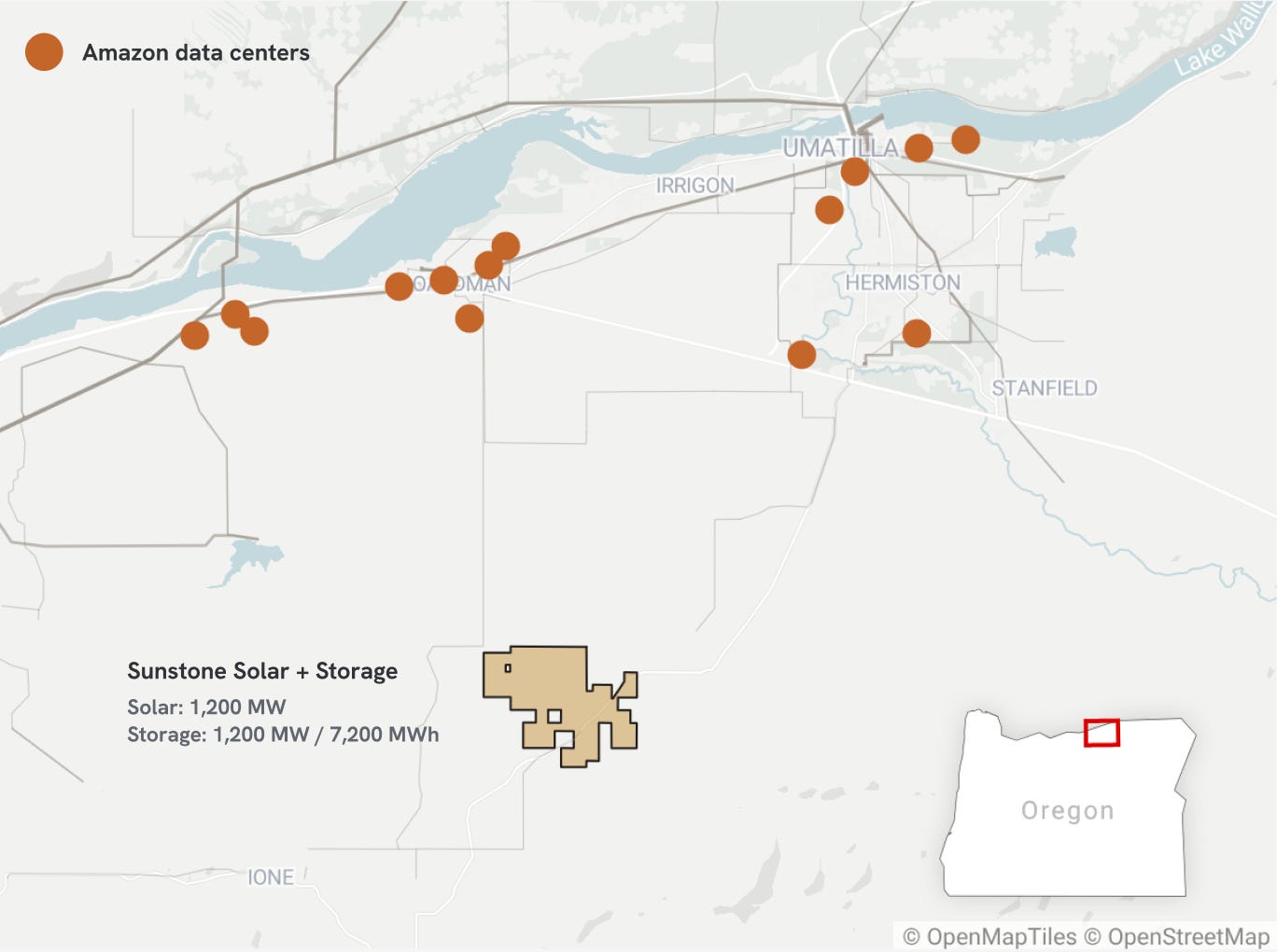
By early 2026, Amazon had evolved from merely purchasing clean energy to becoming a utility-scale renewable energy developer, exemplified by its $3 billion acquisition and operation of the Sunstone Solar and Storage project—a massive 1.2 GW solar and 7.2 GWh battery facility. This strategic move reflects Amazon’s response to the soaring power demands of its AI data centers, particularly in Eastern Oregon, where it has become the largest electricity consumer with 40 data centers totaling 3.3 GW capacity built since 2013. Initially attracted by abundant carbon-free hydroelectric power, Amazon’s rapid expansion outpaced local utility capacity, necessitating direct control over renewable energy generation to secure reliable, clean power for its growing infrastructure.
Amazon’s transition into renewable energy development was catalyzed by stringent public policies and power supply constraints in Oregon, where environmental regulations blocked its attempts to supplement utility power with natural gas fuel cells. For instance, in 2023, Amazon’s PDX109 campus in Boardman sought 266 MW of power but was limited to just 40 MW by the local utility, compelling the company to outbid Puget Sound Energy for the Sunstone project. This shift underscores how tech giants are no longer passive consumers but active developers of utility-scale renewables to overcome grid limitations and environmental hurdles, ensuring uninterrupted, sustainable power for their expanding AI and data center operations.

AI + Renewables: A New Asset Class
Soluna’s fusion of energy and compute is spawning a new industrial paradigm, drawing top tech talent and billions in investment as forecasts call for an unprecedented surge in AI-powered infrastructure.
By 2026, Soluna Holdings is spearheading a transformative shift in digital infrastructure by merging renewable energy generation with high-performance AI computing into a unified 'intelligence platform.' CEO John Belizaire emphasizes this convergence as creating a new asset class that integrates energy and compute at the cost of power, signaling a foundational change in how infrastructure is conceived and valued. This innovative model not only optimizes underutilized renewable assets by colocating AI data centers directly at generation sites—thereby reducing energy curtailment—but also attracts top talent like former Microsoft AI site lead Ryan Carver and significant capital commitments from private equity giants such as KKR and Brookfield, underscoring a robust investment wave fueling this new industrial era.
Industry forecasts from BloombergNEF, Goldman Sachs, S&P Global, and the International Energy Agency project an unprecedented expansion in AI and data supercomputing capacity, estimating between 50 to over 150 gigawatts of new capacity within the next decade. This dramatic surge underscores the urgency of integrating AI workloads with renewable energy infrastructure to meet soaring computational demands sustainably. The scale of this growth not only validates Soluna’s pioneering approach but also highlights a broader market imperative to develop resilient, renewable-powered AI ecosystems that can support the next generation of digital innovation while enhancing grid stability.