Spirit’s shutdown after fuel shock and engine woes
The gist
Spirit Airlines, the original ultra-low-cost trailblazer, has crashed out of the skies after engine failures, fuel shocks, and a blocked merger exposed the fragility of its bargain-basement business model.
What to know
- A 2023 Pratt & Whitney engine recall grounded over half of Spirit’s Airbus fleet, crippling operations and sending costs soaring.
- Jet fuel prices spiked from $2.24 to $4.51 per gallon after Middle East turmoil, torching Spirit’s razor-thin margins and leaving it $360 million over budget.
- The Biden administration’s antitrust crackdown killed Spirit’s merger with JetBlue, sealing the fate of 17,000 jobs and marking the largest U.S. airline collapse in years.
A Brittle Business Model
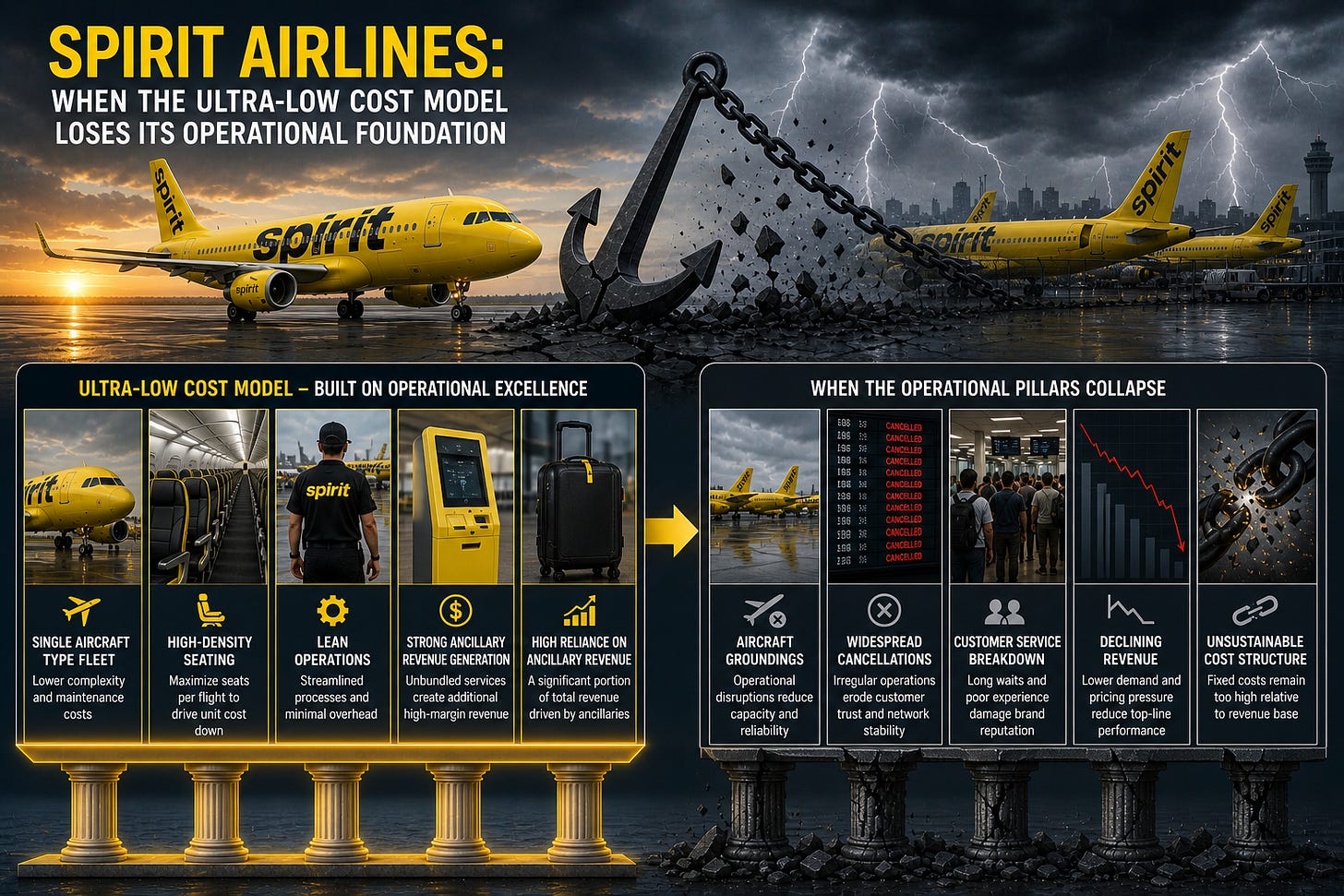
Spirit’s relentless cost-cutting and reliance on a single engine supplier left it dangerously exposed to operational shocks and competitive copycats, turning efficiency into fragility.
Spirit Airlines' Ultra Low Cost Carrier (ULCC) model was engineered for razor-thin cost efficiency, leveraging a uniform Airbus A320 family fleet powered exclusively by Pratt & Whitney PW1100G JM engines, a point-to-point network, and maximized aircraft utilization to achieve the industry's lowest Cost per Available Seat Mile (CASM). This hyper-optimized system, designed to thrive under stable fuel prices and limited direct competition, relied heavily on ancillary revenues, which soared to 50-59% of total revenue by 2024 through aggressive unbundling of services. However, this singular focus on minimizing unit costs created a brittle operational foundation lacking flexibility and resilience, leaving Spirit vulnerable to shifts in external conditions and operational shocks.
The airline’s dependence on a single engine supplier and fleet type exposed it to systemic risks, dramatically illustrated by the 2023 Pratt & Whitney GTF engine recall that grounded over half of Spirit’s fleet—38 Airbus A320/A321neos—reducing daily aircraft utilization from 11.1 to 9.9 hours and slashing available seat miles. This disruption not only crippled operational capacity but also triggered a cascade of financial distress, as Spirit’s already fragile cost structure saw CASM rise nearly 40% since early 2019 while revenue per ASM (RASM) stagnated amid intensified competition from legacy carriers replicating Basic Economy fares. The recall underscored the peril of Spirit’s single points of failure, where a 53% system reliability meant nearly a coin toss chance of operational failure in any cycle.
Compounding Spirit’s vulnerabilities was the 'reverse commoditization' phenomenon, where legacy giants like Delta, American, and United introduced Basic Economy fares mimicking Spirit’s stripped-down service but bolstered by expansive networks and loyalty programs. This strategic encroachment eroded Spirit’s pricing power and revenue growth potential, as RASM barely increased by 8% since 2019 despite rising CASM, squeezing margins and undermining the ULCC’s foundational value proposition. The airline’s rigid, hyper-optimized system lacked the adaptability to pivot or absorb these competitive pressures, ultimately accelerating its operational and financial decline.
Spirit’s operational model, while a marvel of cost efficiency, suffered from critical fragilities due to its narrow optimization focus and multiple single points of failure—including reliance on one engine type, aircraft manufacturer, business model, customer segment, and geographic market. This created a brittle system with limited capacity for self-adjustment or risk diversification, as highlighted by red-alert indicators in capacity reserves, financial buffers, and organizational learning prior to the 2023 shocks. Breaking free from the ensuing negative feedback loops would have required a fundamental business model shift, but Spirit lacked the resources to transition from a pure ULCC to a hybrid model, effectively closing its intervention window and sealing its fate.

Cost Spiral Crushes Spirit
Soaring jet fuel prices and stagnant revenue growth rapidly outpaced Spirit’s ultra-lean structure, driving the airline into a financial tailspin that even a government bailout couldn't reverse.
Spirit Airlines' financial collapse was precipitated by an unprecedented surge in jet fuel prices, which nearly doubled from the $2.24 per gallon assumption in their restructuring plan to $4.51 per gallon at closure, resulting in a staggering $360 million cost overshoot. This commodity shock, driven by geopolitical tensions such as the U.S. war in Iran, exposed the vulnerabilities of Spirit's ultra-low-cost carrier (ULCC) model, which was finely tuned for stable, low-cost conditions and lacked the financial reserves to absorb such shocks, unlike legacy carriers. Despite attempts to secure a $500 million bailout that would have ceded up to 90% equity to the government, bondholders' rejection underscored deep skepticism about Spirit's viability, culminating in the airline ceasing operations and 17,000 job losses.
Spirit’s financial woes were compounded by a chronic imbalance between soaring operating costs and stagnant revenue growth. Since early 2019, its cost per available seat mile (CASM) increased by approximately 40%, nearly double inflation, while revenue per available seat mile (RASM) grew only 8%, pushing the airline into a negative operating margin by 2024. This widening gap was exacerbated by legacy carriers like Delta, American, and United introducing Basic Economy fares that mimicked Spirit’s low-cost offerings but with broader networks and loyalty benefits, effectively eroding Spirit’s pricing power and market share through a process of 'reverse commoditization.'
The failure of the proposed merger with JetBlue in January 2024 dealt a critical blow to Spirit’s strategic restructuring efforts, removing a vital path to scale and premium revenue diversification that could have offset mounting cost pressures. This legal setback, decided by a federal judge concerned about reduced competition and fare increases, left Spirit isolated as a niche player with a pure ULCC model vulnerable to structural headwinds. Moreover, the airline’s near two-year management focus on the merger diverted attention and resources away from addressing fundamental operational challenges such as rising CASM, fleet disruptions, and revenue stagnation, allowing losses to deepen despite prior bankruptcy restructurings that had only addressed balance sheet issues.
Operational disruptions, particularly the 2023 Pratt & Whitney GTF engine recall that grounded over half of Spirit’s Airbus A320neo and A321neo fleet, severely curtailed aircraft utilization from 11.1 to 9.9 block hours per day, translating into millions of lost available seat miles and compounding financial losses. This disruption, combined with the airline’s razor-thin margins—operating costs were $10 to $15 million higher weekly than sustainable—and the absence of a government bailout due to political and creditor resistance, sealed Spirit’s fate. As competitors like Frontier, JetBlue, and United rapidly moved to capture Spirit’s market share, especially in Florida, the airline’s pricing power and market position eroded further, hastening its shutdown.



Politics, Oil, and Wall Street
Geopolitical conflict, regulatory roadblocks, and Wall Street’s asset-driven calculus converged to doom Spirit, as external forces overwhelmed any chance of recovery.
The geopolitical turmoil ignited by the 2026 U.S. and Israeli strikes on Iran severely disrupted global oil supply routes through the Strait of Hormuz, causing jet fuel prices to more than double from $2.30 to $4.51 per gallon by April. For Spirit Airlines, whose Ultra Low Cost Carrier model hinged on razor-thin margins and millions of pre-sold tickets priced at stable fuel costs, this spike was catastrophic—turning every flight into a loss as operating costs surged to consume 20-30% of expenses. This external shock exposed Spirit’s fragile financial footing, forcing a shutdown once average variable costs eclipsed ticket prices, illustrating how geopolitical conflict directly destabilized the airline’s viability.
Political and regulatory decisions compounded Spirit’s woes, with the Biden administration’s antitrust enforcement blocking JetBlue’s $3.8 billion merger bid in 2024—a deal touted by proponents like Transportation Secretary Sean Duffy as a missed lifeline that could have averted bankruptcy. This intervention, coordinated among Senator Elizabeth Warren, the Department of Justice, and the Department of Transportation, aimed to preserve consumer savings by preventing consolidation but instead precipitated Spirit’s financial decline, including two Chapter 11 filings and route cuts. Critics such as Senator Ted Cruz lambasted the administration for killing the merger and denying bailouts, highlighting a fraught political calculus that prioritized antitrust principles and skepticism of federal airline management over Spirit’s survival.
Amid this geopolitical and regulatory maelstrom, Wall Street’s vulture investors—entities like Citadel, Ares, and Cyrus—played a decisive role by rejecting government bailout efforts, calculating that liquidation of Spirit’s valuable airport slots and gates would yield superior returns. This financial strategy, favoring asset stripping over corporate rescue, led to the loss of 17,000 jobs and underscored how private capital interests intersected with political decisions to seal Spirit’s fate. Meanwhile, the partisan blame game between Trump and Biden camps muddied public understanding, with figures like Neera Tanden accused of deflecting responsibility and turning the airline’s collapse into a political football rather than addressing its complex economic underpinnings.





Survival of the Strongest
Spirit’s downfall exposes the vulnerability of pure ULCCs in a volatile market and accelerates industry consolidation, leaving well-capitalized rivals to seize the spoils.
Spirit Airlines' shutdown starkly illustrates the structural fragility inherent in the ultra-low-cost carrier (ULCC) model, which operates under relentless margin pressures due to high fixed costs and cyclical demand volatility. As noted in multiple analyses, labor and fuel costs behave almost like fixed expenses, limiting flexibility, while market overcapacity drives fare collapses that ULCCs struggle to absorb. The blocked 2024 merger between Spirit and JetBlue, prevented on anti-competitive grounds, removed a critical opportunity for consolidation that might have bolstered Spirit's resilience against spiking fuel prices and operational shocks, ultimately exacerbating its vulnerabilities.
The broader airline industry, while shaken by Spirit's exit, remains fundamentally stable, with carriers that serve premium and international markets faring comparatively well. Spirit’s narrow focus on domestic ULCC operations without a premium cabin or international routes left it exposed to energy price surges and operational disruptions, underscoring how specialized low-cost models face heightened risks in volatile environments. This contrasts with other airlines that continue to thrive by catering to front-of-cabin passengers, highlighting a bifurcation in market resilience within the sector.
Spirit’s collapse is emblematic of an accelerating consolidation trend in the U.S. airline industry, driven by rising operational costs and competitive shakeups. Well-capitalized carriers are seizing the opportunity to expand their networks and market share by absorbing weaker competitors, intensifying competition among the survivors. As one industry expert observed, 'there is a very much concerted effort to see airlines which have a better war chest... looking at taking advantage of weaker airlines,' signaling a reshaping of the market landscape where financial strength increasingly dictates survival.

