Stablecoins pivot: market shrinks, yield-bearing tokens surge as USDT holds the line
The gist
As the stablecoin market shrinks by $12.4 billion, investors are ditching old-school dollar tokens for yield-bearing alternatives—while Tether’s USDT shows unshakable dominance.
What to know
- Since mid-May 2026, the stablecoin supply has dropped over $12.4 billion—the sharpest contraction since 2022—led by declines in USDT and USDC.
- Despite the pullback, Tether’s USDT holds strong with a $184 billion market cap and 35% usage, anchoring 82% of the sector alongside USDC.
- Yield-generating stablecoins like USDG and BlackRock’s BUIDL are booming, signaling investors want more than just digital dollars—they want returns.
Stablecoin Shakeup Signals Shift
The recent $12.4 billion contraction marks a structural pivot from passive dollar storage to yield and utility, as investors abandon underperforming tokens in favor of those offering returns.
The stablecoin market has undergone its largest contraction since 2022, with a supply decline exceeding $12.4 billion since mid-May 2026, driven primarily by significant reductions in major tokens like Tether's USDT and Circle's USDC. June 2026 alone saw a $7.7 billion drop, including a $6 billion decrease in USDT and USDC falling from nearly $80 billion in March to about $73 billion, underscoring a substantial structural market adjustment rather than a panic-induced sell-off.
Despite the broad sector-wide pullback, Tether’s USDT has demonstrated remarkable resilience, maintaining a dominant market cap around $184 billion with only minimal weekly declines—down just 0.06% recently—thereby preserving its gravitational pull in the stablecoin ecosystem. Together with Circle’s USDC, which also saw only a slight drop of 0.04%, these two heavyweights now command 82% of the stablecoin market, highlighting their entrenched positions amid ongoing market shifts.
This contraction reflects a deliberate structural evolution in the stablecoin landscape, where tokens are transitioning from mere dollar parking assets to yield-bearing and utility-focused instruments. Capital is migrating toward stablecoins offering returns and enhanced features, as evidenced by the contrasting performances of Sky Dollar (USDS), which plunged 12.3%, versus the yield-bearing Global Dollar (USDG), which surged over 9%, signaling a market increasingly driven by investor appetite for yield and functionality rather than fear.
The reduction in stablecoin supply has broader implications for market liquidity, as diminished circulating tokens translate into lower on-chain liquidity and trading volumes. This tightening of available capital could constrain the market’s ability to absorb selling pressure or support new buying, suggesting that while the contraction is a measured correction within an overall growth trajectory—as analyst Paul Howard notes—it nonetheless signals a more cautious and selective investor stance moving forward.


USDT and USDC: Divergent Strengths
Tether anchors the market as a stable store of value while USDC’s high turnover cements its role as the transactional backbone, revealing a split in user priorities amid sector turbulence.
By early 2026, Tether (USDT) and Circle's USDC continue to dominate the stablecoin landscape, jointly commanding approximately 82-86% of market share and underscoring their entrenched leadership amid ongoing market contractions. While USDT maintains a commanding market cap of $184 billion and a 35% usage rate driven by investor demand for stability amid crypto volatility, USDC distinguishes itself through higher turnover velocity and liquidity, settling about 79% of $38 trillion in adjusted on-chain transfers in H1 2026. This dynamic illustrates a nuanced investor preference: USDT serves as the go-to stable store of value, whereas USDC's extensive network effects and active circulation highlight its role as a transactional backbone across chains and trading venues.
Tether's resilience is particularly notable against sector-wide pullbacks, exemplified by Binance's stable USDT reserves even as its USDC holdings plunged over 40%, signaling robust confidence in USDT’s stability and liquidity. Despite the largest stablecoin market contraction since 2022, USDT’s market cap barely budged, reflecting its deep-rooted investor trust and dominant user base exceeding 550 million wallets. This steadfastness amid volatility reinforces Tether’s position as a cornerstone of stability in an evolving crypto ecosystem.
Investor preferences are gradually shifting beyond mere stability toward yield and utility, as evidenced by the rising prominence of yield-bearing stablecoins like Global Dollar (USDG) and PayPal’s PYUSD, which have gained market share while traditional stablecoins like Sky Dollar (USDS) have declined. This evolution reflects a maturing market where capital seeks not only to preserve value but also to generate returns, challenging the traditional 'parking' role of stablecoins and signaling a broader diversification in stablecoin usage patterns.
Beyond serving as digital cash equivalents, stablecoins are increasingly integral to real-world applications such as micro-payments and international transfers, reinforcing their role as stable, liquid assets amid crypto volatility. For instance, Hyundai’s $20,000 international transfer completed in seven minutes starkly contrasts with traditional banking delays, while Visa anticipates stablecoins dominating sub-dollar micro-payments in the emerging AI agents economy. These practical use cases underscore stablecoins’ growing utility and investor reliance in everyday financial operations.

Yield Drives Stablecoin Evolution
The rise of yield-bearing tokens and vertical integration with traditional finance is transforming stablecoins from simple payment tools into sophisticated, return-generating financial assets.
Yield-bearing stablecoins are rapidly gaining prominence within the stablecoin ecosystem, signaling a structural shift in investor preferences from mere transactional utility to integrated yield generation. Tokens like USDGO surged by $113.7 million (+15.24%) over two consecutive weeks, driven by yield-farming incentives, while institutional-focused tokenized-yield stablecoins such as BlackRock's BUIDL and AUSD quietly compounded assets, adding $42.9 million and $8.9 million respectively. This evolution reflects a growing appetite for stablecoins that not only preserve capital but also generate returns, marking a departure from the outflows seen in traditional transactional stablecoins like USDT and USDC.
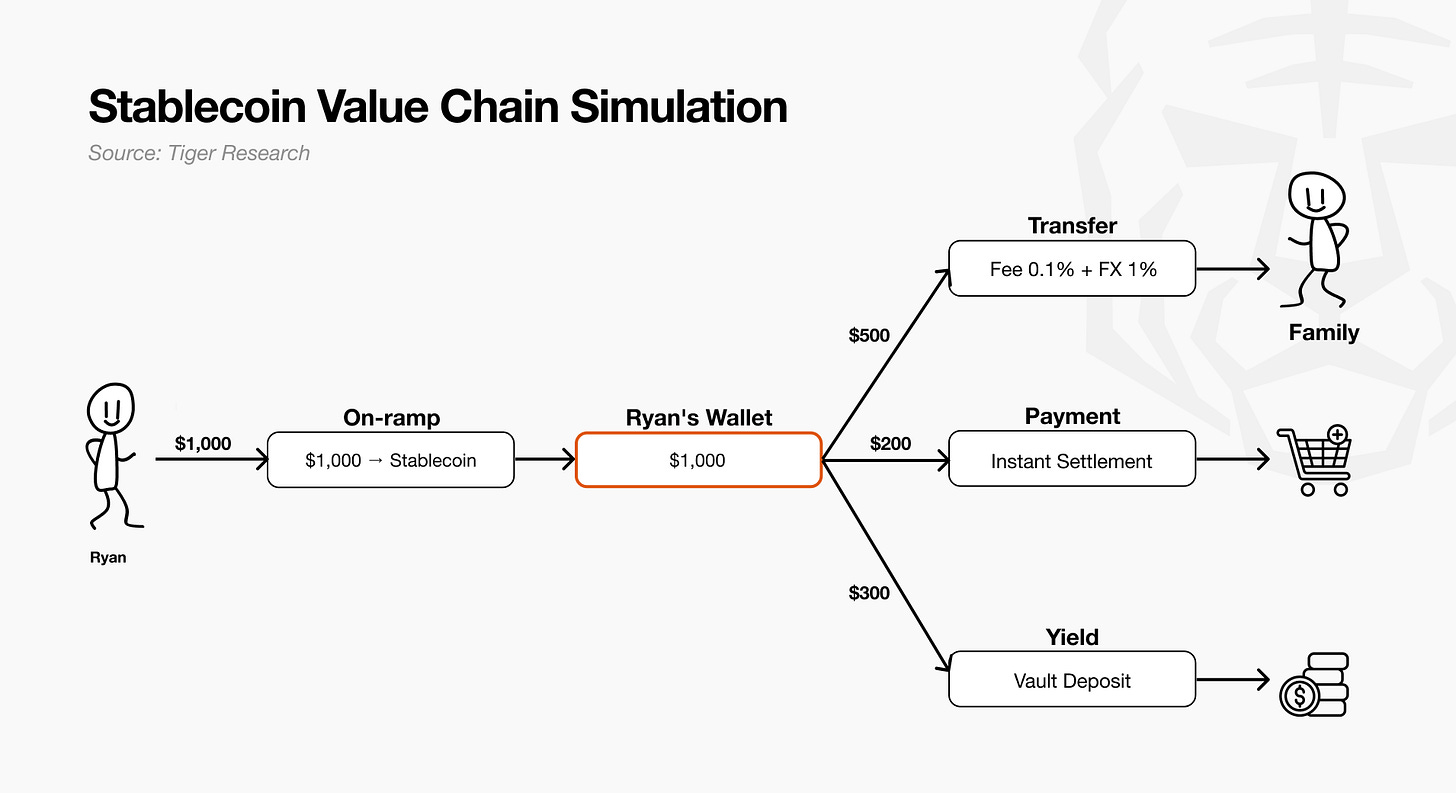
The stablecoin value chain extends well beyond issuance, encompassing five critical stages: issuance, on-ramp, transfer, payment, and yield generation, each fostering innovation and competitive opportunities. While issuance remains dominated by giants like Tether and Circle, downstream layers attract diverse players innovating in liquidity provision, payment solutions, and yield strategies, thereby driving ecosystem evolution. Notably, yield generation emerges as a specialized segment requiring distinct expertise, offering new avenues for investor returns that traditional finance struggles to access, underscoring stablecoins’ transformation from simple payment tools to sophisticated financial assets.
Rather than supplanting traditional finance, stablecoins are increasingly integrated vertically with existing financial infrastructure, enhancing efficiency in payments and settlements. Mainstream strategies, exemplified by Stripe’s acquisition of Bridge, layer stablecoin efficiencies—such as instant settlement and low-cost remittance—onto established rails, facilitating broader adoption without rebuilding systems from scratch. Institutional players and governments, including JPMorgan, Visa, and BlackRock, prefer leveraging proven issuance infrastructure and regional banking corridors, accelerating stablecoin adoption within regulated environments and concentrating trading volume on regulated exchanges like Robinhood.
Stablecoins are driving payments innovation and liquidity by enabling faster, more transparent transactions that compress cross-border settlement times from days to within a day, as seen in corporate treasury functions and international transfers. Visa’s Stablecoin Platform, supporting Open USD, integrates issuance, wallet infrastructure, and payment-network connectivity with institutional-grade security features to lower operational barriers for enterprises. This integration facilitates embedding stablecoin capabilities into existing payment workflows, while central banks like the Swiss National Bank explore DeFi protocols for wholesale FX settlement, signaling stablecoins’ growing role as a unified settlement layer poised to disrupt fragmented legacy systems like SWIFT.