States, businesses push back hard on california plastic law
The gist
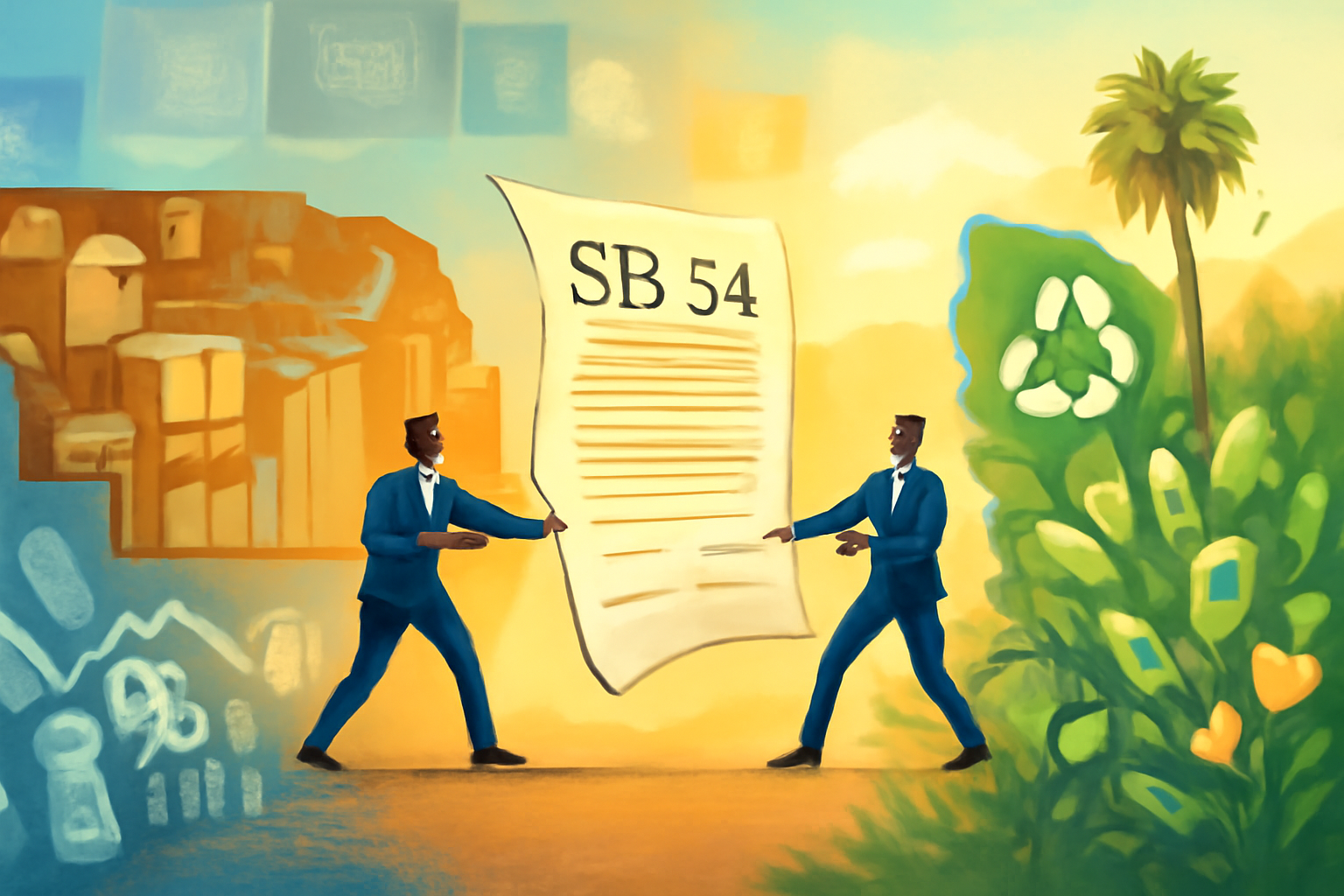
Seventeen states and industry heavyweights are battling California in court, challenging sweeping packaging laws that could set the gold—or plastic—standard nationwide.
What to know
- A Republican-led coalition of 17 states and the National Association of Wholesaler-Distributors are suing to block California’s SB 54, arguing it unfairly burdens interstate commerce and discriminates against small producers.
- Producers face packaging cost hikes of 15–40% under SB 54, with broad compliance obligations hitting brand owners, licensees, distributors, and e-commerce sellers shipping to California.
- Local lawmakers, unions, and food industry groups want to delay the law’s costly packaging fees, warning households could see $190 more per year if costs get passed down.
Legal Showdown Over EPR Laws
A multi-state lawsuit against California’s SB 54 is leveraging recent court wins in Oregon, signaling a coordinated national push to challenge state-led recycling mandates and redefine the limits of interstate regulatory power.
Seventeen states, led by 17 Republican attorneys general and the National Association of Wholesaler-Distributors (NAW), have mounted a coordinated legal challenge against California's SB 54, asserting that the law violates the Commerce Clause by imposing burdensome regulations on interstate commerce. This multi-state lawsuit seeks a preliminary injunction to block enforcement, arguing that the law's small producer exemption is facially discriminatory and infringes on constitutional protections under both the Dormant Commerce Clause and the Due Process Clause.
The challenge to SB 54 is intricately linked to parallel litigation in Oregon and California over related recyclability laws, with plaintiffs amending their complaint to incorporate successful preliminary injunctions against Oregon’s SB 343. This strategic legal weaving highlights how definitions of recyclability and enforcement mechanisms are central battlegrounds, underscoring a broader, interconnected effort by trade groups to undermine extended producer responsibility frameworks across state lines.
Recent developments in the Oregon District Court, where Judge Michael H. Simon has limited additional briefing and declined further oral argument on the Dormant Commerce Clause claim, suggest a judicial narrowing of focus that may result in a nuanced ruling. Experts interpret this as a potential partial affirmation of the EPR framework, possibly carving out specific exemptions while maintaining core regulatory elements, signaling a complex balancing act that could set precedent for California’s SB 54 enforcement and similar laws nationwide.
Producers Face Compliance Maze
Manufacturers are overhauling packaging strategies and scrambling to manage a patchwork of costly, overlapping state rules as SB 54’s sweeping definition of 'producer' triggers far-reaching operational and financial consequences.
Producers and manufacturers are confronting a steep rise in packaging-related costs due to SB 54’s extended producer responsibility fees, with increases potentially ranging from 15 to 40 percent as programs phase in. To mitigate complexity and operational burdens, some companies are streamlining by adopting packaging designs that comply with the strictest state standards, thereby reducing SKU proliferation and simplifying inventory management.
The fragmented landscape of state-level EPR regulations in the U.S. forces producers to navigate a patchwork of varying registration, reporting, and fee requirements, complicating compliance efforts especially for those selling across multiple states. Without nationwide harmonization, manufacturers must develop robust processes to manage diverse rules, echoing challenges seen in the EU where national systems independently evolved, leading to costly administrative overhead and market withdrawal decisions when fixed compliance costs outweigh benefits.
SB 54’s broad definition of 'producer' extends compliance obligations beyond packaging manufacturers to brand owners, licensees, distributors, and out-of-state or e-commerce sellers shipping into California, significantly expanding the compliance universe. This broad scope, combined with phased reduction and recycling targets through 2032 and immediate restrictions on materials like EPS food service ware, demands detailed data management, proactive registration with entities like CalRecycle or the Circular Action Alliance, and early operational adjustments to avoid steep penalties of up to $50,000 per day.
To encourage greener packaging, SB 54 incorporates eco-modulated fees that reward producers using recycled materials with lower charges while penalizing designs that hinder recyclability, such as difficult-to-remove labels. While existing EPR programs have boosted recycling rates, they have struggled to drive packaging redesign; thus, this fee structure innovation aims to incentivize sustainable design changes, though its effectiveness hinges on greater alignment across states to reduce operational complexity and enhance environmental outcomes.
Local Pushback on Packaging Fees
California lawmakers, unions, and food industry leaders are rallying to delay SB 54 fees, warning that a rushed rollout could saddle households and small businesses with steep costs and undermine program success.
Fresno-area lawmakers, including Assemblymember Esmeralda Soria and Senators Melissa Hurtado and Jasmeet Bains, have united with labor unions and agricultural groups to advocate for delaying the implementation of SB 54 packaging fees in 2026 and 2027. This coalition emphasizes the importance of refining the program to avoid premature rollout that could strain household budgets and undermine effectiveness, with labor leaders like Matt Broad of Teamsters California stressing that 'getting this program right matters more than getting it done fast.'
The California Restaurant Association, while supportive of the extended producer responsibility concept, strongly opposes the current fee structure, warning that the costs pose a severe threat to neighborhood restaurants. Matthew Sutton, CRA's senior VP of government affairs, highlights the disproportionate financial burden on small food businesses, underscoring broader concerns about the economic impact of SB 54's fees on local economies.
CalRecycle's projection that SB 54 implementation will cost approximately $21 billion over the next decade, translating to an average annual household expense of $190 if producers fully pass on costs, has intensified worries among regional stakeholders. This significant economic burden fuels the push by lawmakers and allied groups to delay fee collection, aiming to prevent undue financial strain on consumers and businesses while allowing time to adjust the program for greater effectiveness.