States turn up the heat: legal blitz slows ICE’s warehouse detention expansion nationwide
The gist
States across the U.S. are mounting a fierce, bipartisan legal blitz that’s stalling ICE’s $174 million push to turn warehouses into detention centers, forcing federal agencies to admit environmental missteps and hit the brakes nationwide.
What to know
- New Jersey, Michigan, and Arizona kicked off coordinated lawsuits in early 2026, citing ICE's failure to follow environmental laws and local infrastructure limits as they raced to convert massive warehouses into detention facilities.
- Arizona’s high-profile case against a $70 million Surprise, AZ site exposed ICE for skipping environmental reviews and local consultation—despite the facility’s proximity to schools and hazardous sites.
- Federal defense of these projects has sputtered amid DOJ staffing shortages and court-ordered pauses, with ICE conceding in Maryland that rushed, one-day environmental reviews were inadequate and pledging deeper assessments.
States Challenge ICE’s Playbook
New Jersey and Michigan are leveraging lawsuits to expose ICE’s rushed facility conversions, spotlighting bipartisan resistance and the strain on local infrastructure.
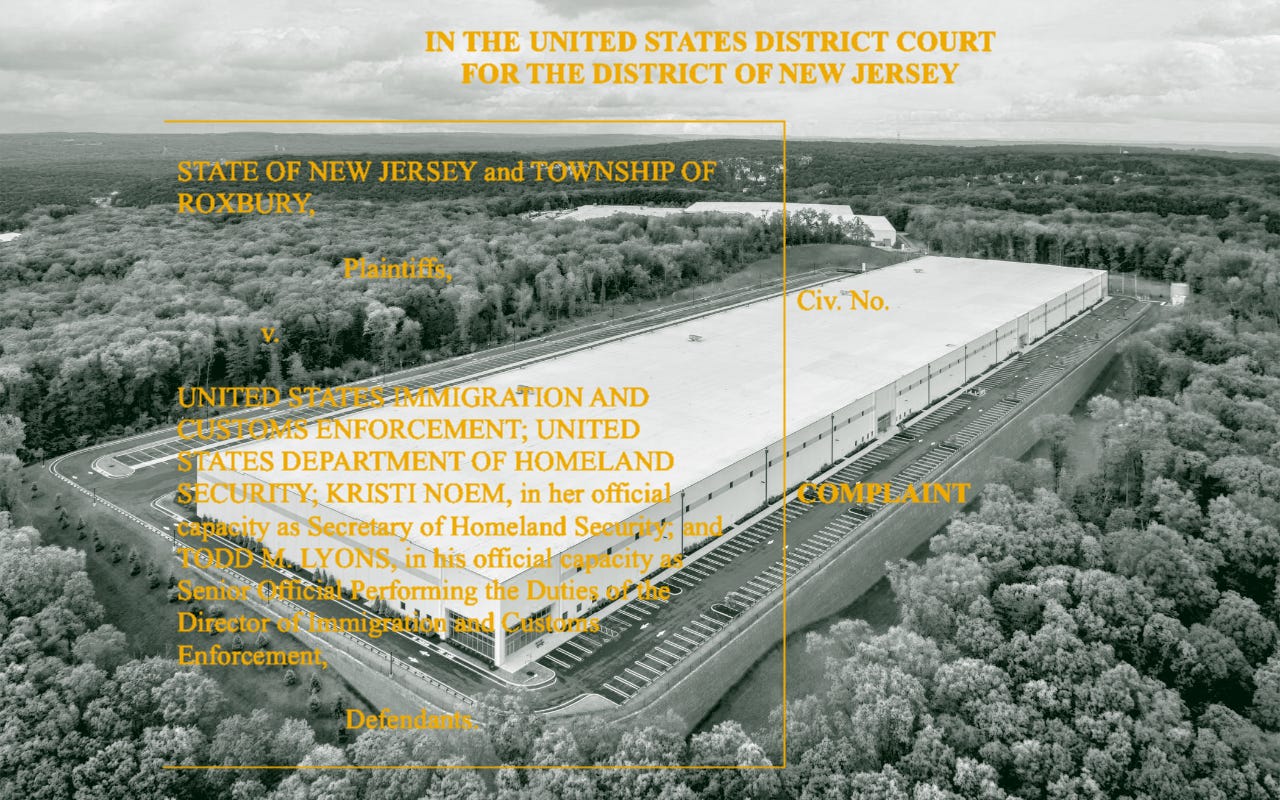
By early 2026, New Jersey emerged as a frontline state in legal opposition to ICE's warehouse detention center conversions, notably filing a federal lawsuit on March 20 to block a $129 million Goldman Sachs-managed facility in Roxbury. The suit alleged violations of four federal laws, including environmental regulations and procedural unfairness, while spotlighting infrastructure inadequacies such as a projected fifteenfold increase in wastewater that local systems could not handle. Governor Mikie Sherrill underscored bipartisan resistance, emphasizing that protecting community and constitutional rights transcended party lines.
Simultaneously, Michigan and the City of Romulus escalated legal resistance by filing a motion on April 1 to freeze construction and operations at a newly acquired 249,000-square-foot warehouse set to become an ICE detention center. Their lawsuit not only challenged the Department of Homeland Security's procedural missteps, including the Department of Justice’s failure to assign counsel amid a significant DOJ staffing shortage, but also highlighted the physical and infrastructural impracticalities of the site. This move reflected growing state and local skepticism about the feasibility and legality of repurposing such facilities under the expansive $45 billion Detention Reengineering Initiative.
Building on these early legal battles, New Jersey and the Township of Roxbury intensified their opposition by May 2026, demanding comprehensive environmental reviews prior to any further construction or demolition at the Morris County site. They argued that DHS's piecemeal approach—conducting segmented environmental assessments and relying on categorical exclusions—failed to meet federal standards, risking the overwhelming of local water and sewer infrastructure even at reduced detention capacity. Their call for emergency depositions of DHS officials highlighted growing frustration with shifting timelines and opaque project management.
Meanwhile, in the South, the town of Social Circle, Georgia, joined the chorus of localities challenging ICE detention center plans by filing a lawsuit focused squarely on the federal government's neglect of mandatory environmental impact assessments under the National Environmental Policy Act (NEPA). This lawsuit went further than many contemporaneous cases by explicitly accusing the federal government of bypassing NEPA requirements, thus reinforcing a nationwide pattern of community-driven legal resistance rooted in environmental and procedural concerns.


Nationwide Legal Uprising
Coordinated lawsuits and grassroots protests from Arizona to Georgia are forcing ICE to face mounting scrutiny over its procedural shortcuts and environmental oversights.
By early 2026, a coordinated nationwide legal and public opposition to ICE's warehouse detention center projects had crystallized, marked by multiple lawsuits and synchronized protests demanding transparency, community consent, and the cancellation of public funding and permits. Arizona Attorney General Kris Mayes spearheaded one of the most prominent federal lawsuits, joined by similar actions in New Jersey, Michigan, Maryland, and Georgia, all invoking the Administrative Procedure Act and the National Environmental Policy Act (NEPA) to challenge federal exemptions and procedural shortcuts. These coordinated efforts reflect a growing nationwide strategy to hold ICE accountable through both legal channels and grassroots activism.
Arizona's lawsuit against the Surprise warehouse detention center stands out for its detailed allegations of procedural violations and environmental negligence, highlighting that no environmental review documents—neither impact statements nor assessments—exist for the facility, unlike other states where hastily produced documents were submitted. The timing of ICE’s $70 million purchase, executed before local authorities were properly notified and while the State Historic Preservation Office had yet to receive consultation letters, underscores the federal government's pattern of bypassing established protocols. This lawsuit also foregrounds intense local opposition, with residents voicing safety concerns about the warehouse’s proximity to Dysart High School and a hazardous materials storage site, issues ICE has yet to address.
Legal challenges in Michigan and Georgia further illustrate the expanding use of procedural and environmental law to confront ICE detention projects. Michigan Attorney General Dana Nessel’s lawsuit against the Romulus facility criticizes the Department of Homeland Security’s use of a controversial patchwork of regulatory exemptions—dubbed “Frankenstein's Exclusion”—to sidestep environmental reviews, a tactic increasingly scrutinized by courts. Meanwhile, the town of Social Circle, Georgia, has pushed the envelope by asserting that the federal government failed to conduct any required NEPA environmental impact assessments, signaling a sharpening legal focus on enforcing environmental compliance nationwide.

Federal Defense Falters
Severe DOJ staffing shortages and contractor delays are crippling the federal government’s ability to defend ICE’s projects, leading to embarrassing reversals and stalled progress.
By early April 2026, the Department of Justice faced significant procedural delays in defending federal detention facility projects, notably at Romulus, Michigan, due to unassigned counsel amid severe staffing shortages. Since the Trump administration began, DOJ lost approximately 5,500 employees—including attorneys and immigration judges—and has only partially replenished these roles, leaving the legal apparatus overwhelmed by the rapid expansion of immigration enforcement efforts that outpaced available legal resources.
In a notable reversal by May 2026, ICE conceded that its initial environmental review for the Maryland detention facility was insufficient, shifting from its prior legal stance that a Categorical Exclusion sufficed to acknowledging the need for a more rigorous Environmental Assessment. This admission followed revelations that the original review was conducted in a single day before property acquisition, a process now criticized by courts and ICE itself for its inadequacy.
Compounding delays at the Maryland site, ICE's contractor, KVG LLC, failed to deliver final design plans essential for compliance with Section 106 of the National Historic Preservation Act, stalling required tribal consultations. ICE stated it cannot proceed with tribal engagement until receiving these design details, highlighting how contractor shortcomings directly impede federal procedural compliance.
Meanwhile, in New Jersey, ICE reached a temporary agreement with state officials in May 2026 to pause major conversion work at the Roxbury detention warehouse, thereby forestalling a federal injunction hearing. This pause allows ICE to complete the mandated Environmental Assessment under NEPA while permitting only limited security and maintenance activities, with strict restrictions on ground disturbance absent state approval, reflecting a cautious federal approach to procedural compliance amid mounting legal scrutiny.
Maryland Site Hits a Wall
Unresolved tribal consultations, overloaded sewers, and ICE’s reversal on environmental reviews have brought the Williamsport detention project to a standstill.
By early May 2026, the ICE detention facility project in Williamsport, Maryland remains mired in legal and procedural uncertainty, primarily due to unresolved tribal consultations and critical infrastructure limitations. The contractor, KVG LLC, has yet to submit essential design documents detailing ground disturbance, impeding ICE's compliance with the National Historic Preservation Act's Section 106 requirements. Compounding these delays, Washington County’s sewer system is operating at over 99% capacity, with the Maryland Department of the Environment flagging its inability to support a facility designed to house up to 1,500 detainees, underscoring significant logistical and environmental hurdles.
In a notable legal pivot, ICE reversed its earlier stance by conceding that the Williamsport project necessitates a full Environmental Assessment (EA) rather than the initially claimed Categorical Exclusion, signaling a deeper environmental review process ahead. This May 5, 2026, admission contradicts the agency's prior court arguments that a one-day Categorical Exclusion sufficed before site acquisition, reflecting growing recognition of the project's complex environmental and legal implications. This shift not only delays the project further but also exemplifies the evolving nature of litigation shaping ICE detention infrastructure nationwide.