Suez comeback boosts shipping profits, but risks persist
The gist
Shipping giants are back on the Suez, fueling profits and cutting detour costs, but global trade is still navigating congestion and geopolitical crosswinds.
What to know
- Maersk, Hapag-Lloyd, and MSC have resumed key Suez Canal routes, restoring about a third of Maersk’s fleet and signaling a major pivot from costly Cape of Good Hope detours.
- Port logjams and ongoing Red Sea tensions still squeeze capacity, with surcharges spiking to $1,000 per container and Suez traffic lingering 60-70% below pre-crisis levels.
- Maersk’s Q1 EBITDA soared 18% to $3.0 billion on record freight rates, but insurance premiums and rerouting costs remain a stubborn drag on global supply chains.
Red Sea Security Reversal
Major carriers like Maersk, Hapag-Lloyd, and MSC are returning to the Suez Canal as improved Red Sea security restores route efficiency and reshapes global shipping strategies.
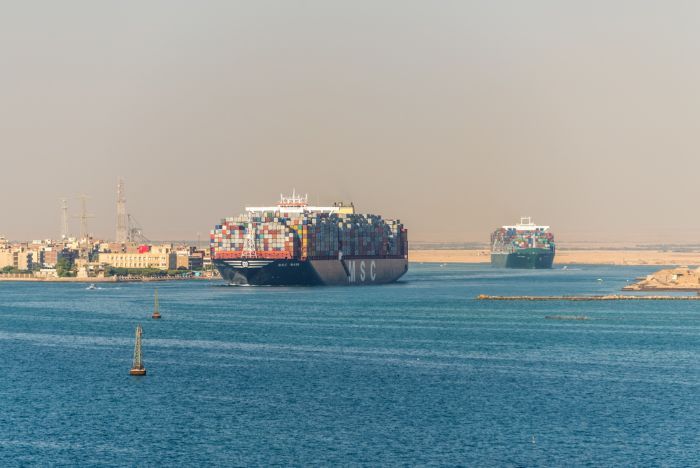
Maersk and Hapag-Lloyd have decisively rerouted their Gemini service back through the Suez Canal, marking an end to the extended detours around the Cape of Good Hope that were necessitated by earlier security concerns. This operational pivot underscores a significant improvement in Red Sea safety conditions, as confirmed by Maersk's CEO, who emphasized that the region is now secure enough to support a full return to traditional transit routes. By resuming these passages, these carriers are reclaiming the efficiency and cost advantages long associated with the Suez Canal corridor.
Following the lead of Maersk and Hapag-Lloyd, MSC has also reinstated its Suez Canal transit for the India-Europe 'Himalaya Express' service, reflecting a broader industry consensus that the Red Sea's security landscape has stabilized sufficiently. This collective shift away from the lengthier Cape of Good Hope detours signals not only improved regional safety but also a strategic recalibration among major shipping lines to optimize route efficiency and reduce transit times. MSC’s move highlights how carriers are closely monitoring security developments to adapt their operational footprints accordingly.

Capacity Crunch Persists
Despite Suez route reopenings, severe port congestion and landside bottlenecks are trapping millions of containers and forcing carriers to impose hefty surcharges to manage demand.
The gradual reopening of the Suez Canal is driving a notable recovery in scheduled shipping capacity, with carriers like Maersk rerouting about a third of their fleet back through the waterway. This shift significantly reduces transit times compared to the longer route around Africa, potentially injecting substantial slack capacity into the market and easing some of the supply constraints that have kept rates elevated. However, carriers are also strategically managing capacity by pulling some vessels off the market to maintain pricing power amid these changes.
Despite the route restoration, persistent port congestion—especially a 12-day backlog in China and severe delays at Middle East hubs like Khor Fakkan and Sohar—continues to throttle effective capacity recovery. This congestion not only sidelines approximately 4.55% of global container vessel capacity, equivalent to 1.85 million TEU waiting outside major ports, but also forces container lines such as MSC and Hapag-Lloyd to impose surcharges up to $1,000 per container to offset operational costs and manage demand.
Operational bottlenecks extend beyond the ports themselves, with landside infrastructure constraints—such as insufficient truck availability for cross-border container movement—exacerbating supply chain delays and limiting the pace of capacity normalization. Shipping lines have responded by tightening booking and clearance protocols, exemplified by Hapag-Lloyd’s requirement for customs clearance within 15 days and indemnity letters before accepting bookings, underscoring ongoing challenges in managing container flows amid a recovering but still fragile market.
Market dynamics remain complex as elevated ocean liner rates are influenced more by capacity constraints and congestion than by demand alone, with geopolitical risks in the Red Sea and rising bunker fuel costs incentivizing carriers to resume Suez transits despite higher insurance premiums. Analysts like Judah Levine and Peter Sand highlight that while port congestion and carrier capacity management currently support high freight rates, the large order book of new vessels and potential normalization of Red Sea routes could lead to overcapacity and downward pressure on rates in the medium term.

Profits Surge Amid Turmoil
Shipping giants are leveraging high freight rates and operational pivots to offset soaring costs and geopolitical shocks, driving record earnings but fueling inflationary pressures downstream.
Maersk and Hapag-Lloyd have navigated significant financial turbulence amid geopolitical disruptions by strategically adjusting their operations and pricing. Maersk's $1.1 billion profit plunge in Q1 prompted a shift of the AE19 service back to the Suez Canal to optimize costs, while Hapag-Lloyd absorbed approximately $600 million in additional expenses from heightened insurance and logistics costs. Both carriers countered these pressures by raising freight rates—Maersk by 22% to $2,746 per 40-foot container and Hapag-Lloyd by 9% to $1,475—demonstrating resilience in a volatile market environment.
Despite soaring bunker fuel prices and operational costs driven by the Strait of Hormuz crisis, Maersk reported a robust EBITDA of $3.0 billion, reflecting an 18% year-on-year earnings surge fueled by the highest freight rates seen in five years. Analysts anticipate this elevated rate environment could boost Maersk's annual earnings by 20%, propelling its stock to three-year highs with B shares gaining over 53% year-to-date. This financial upswing underscores how the reopening of the Suez-Red Sea corridor and the return of mega-ships have enhanced operational efficiency and investor confidence.
The resumption of the Suez Canal and Red Sea routes has not only improved shipping efficiency but also enabled Maersk to reduce emergency surcharges on key trade lanes, such as shipments from the Indian Subcontinent to Europe and the Mediterranean. This cost-structure optimization aligns with broader industry trends toward building resilient supply chains and investing in advanced technologies like blockchain, signaling a transformative shift in global logistics. However, while carriers benefit financially from higher freight rates, these increased costs exacerbate inflationary pressures on manufacturers and retailers, squeezing margins across multiple sectors.
While the short-term financial gains for shipping companies have been substantial amid the crisis-driven freight rate surge, investor caution persists regarding the sustainability of these profits. Analysts warn that as geopolitical tensions ease and shipping lanes normalize, carriers’ pricing power may diminish, potentially tempering future earnings growth. This cautious outlook highlights the delicate balance shipping companies face between capitalizing on current market conditions and preparing for a more stabilized, competitive environment ahead.

New Routes, New Risks
Ongoing geopolitical flashpoints and chokepoint disruptions are accelerating the search for alternative trade corridors, but these new routes introduce fresh strategic and environmental uncertainties.
By mid-2026, improved security conditions in the Red Sea have reached a threshold deemed sufficient by Maersk's CEO to allow a full return of shipping transits, underscoring the route's critical role as a maritime link between the Indian Ocean and Mediterranean Sea. However, this improvement exists against a backdrop of persistent geopolitical tensions, notably the wider US-Israel-Iran conflict, which continues to threaten multiple key shipping corridors in West Asia and compels carriers to maintain alternative routes such as the longer voyage around the Cape of Good Hope.
The compounded disruptions at multiple chokepoints—including the Red Sea and the Strait of Hormuz—have created a bifurcated global shipping landscape where Suez Canal traffic remains 60-70% below pre-crisis levels, forcing an estimated 5-7% of global container capacity to divert around Africa. This rerouting adds 10-14 days to voyages and drives freight and insurance costs sharply higher, with cargo insurance rates surging from 0.6% to as much as 2%, layered with war risk premiums, while ports along the Cape of Good Hope struggle to handle traffic increases exceeding 100%. As Oliver Sawbridge notes, this 'double whammy' eliminates traditional fallback routes and intensifies operational risks for global supply chains.
In response to the vulnerabilities of traditional maritime chokepoints, emerging alternative trade corridors such as the Arctic Northwest Passage and the International North South Transport Corridor through Russia, Azerbaijan, and Iran are gaining strategic attention. While these routes promise to reduce reliance on the Suez Canal and Strait of Hormuz, they introduce new geopolitical dependencies—such as Russia’s control over the Northern Sea Route and its icebreaker fleet—that complicate shipping decisions. Moreover, environmental uncertainties like solar flare activity threaten the long-term viability of Arctic passages, reflecting a broader shift toward multimodal and pipeline conveyance methods less susceptible to regional tensions.
The enduring nature of maritime insecurity in the Red Sea—now exceeding 1,000 days without a durable resolution—highlights that military actions alone cannot restore commercial confidence, necessitating a strategic recalibration by key stakeholders. For instance, India’s trade with Europe, North Africa, and the US East Coast has been significantly slowed and made costlier, prompting calls for strengthened naval protection, expanded domestic shipping capacity, and development of alternative transport corridors. This perspective aligns with expert views that supply chain resilience must be grounded in addressing persistent structural drivers like geopolitics and climate change rather than isolated disruption events.