Supreme court reform push gains steam amid partisan clash
The gist
A high-stakes partisan showdown is erupting as Democrats push to expand the Supreme Court amid mounting outrage over rulings that restrict voting rights and tilt the judicial balance.
What to know
- Rep. James Clyburn and top Democrats are championing a bill to grow the Court from nine to thirteen justices, arguing it's needed to counter a conservative supermajority.
- A recent Marquette poll shows Americans split 50-50 on expanding the Court, with even broader support for term limits—while GOP efforts to lock the Court at nine justices have stalled.
- House Speaker Mike Johnson’s failed amendment to cap the Court at nine was a political maneuver to force Democrats into a tough vote, spotlighting deep party divisions.
Court’s Anti-Democracy Legacy
The Supreme Court’s long history of rulings has repeatedly restricted voting rights and marginalized minority groups, fueling today’s calls for reform.
The Supreme Court has demonstrated a persistent pattern of rulings that undermine democratic rights and voting access, often opposing the majority will of the American people. This trend is not a recent anomaly but a continuation of historical extremism, with the Court frequently blocking popular mandates and restricting voting methods such as mail-in ballots, highlighting a systemic resistance to expanding democratic participation.
Racial bias has been a consistent thread in Supreme Court decisions, as seen in landmark cases like Dred Scott v. Sanford, which denied citizenship to Black Americans, and more recent rulings that permit racial profiling and dismantle affirmative action. The Court’s allowance of ICE to use Latino ethnicity as a factor for detention, alongside rulings that uphold legacy admissions while enabling over-policing in Black communities, reveals a troubling pattern of privileging white interests at the expense of minorities.
The Court’s 21st-century rulings have further entrenched anti-democratic outcomes by facilitating corporate influence in politics and weakening voting protections. The Citizens United decision unleashed billions in political spending, with billionaires pouring $1.2 billion into the 2020 election—70 times the amount spent in 2008—while the Shelby County v. Holder ruling gutted the Voting Rights Act, leading to widespread voter suppression in marginalized communities through polling closures and restrictive laws.
Beyond voting rights, the Supreme Court has expanded government and law enforcement powers at the expense of constitutional protections, disproportionately impacting minority communities. Cases like Utah v. Strieff have allowed evidence from illegal searches, undermining the Fourth Amendment and exacerbating systemic racial disparities in policing. This selective invocation of states’ rights rhetoric—supporting restrictions on abortion and gun control but opposing state efforts to protect voting access—exposes a partisan approach that further erodes democratic governance.

Democrats Rally for Expansion
Democratic leaders argue that expanding the Court is a vital response to decades of partisan maneuvering and a necessary step to restore judicial balance.
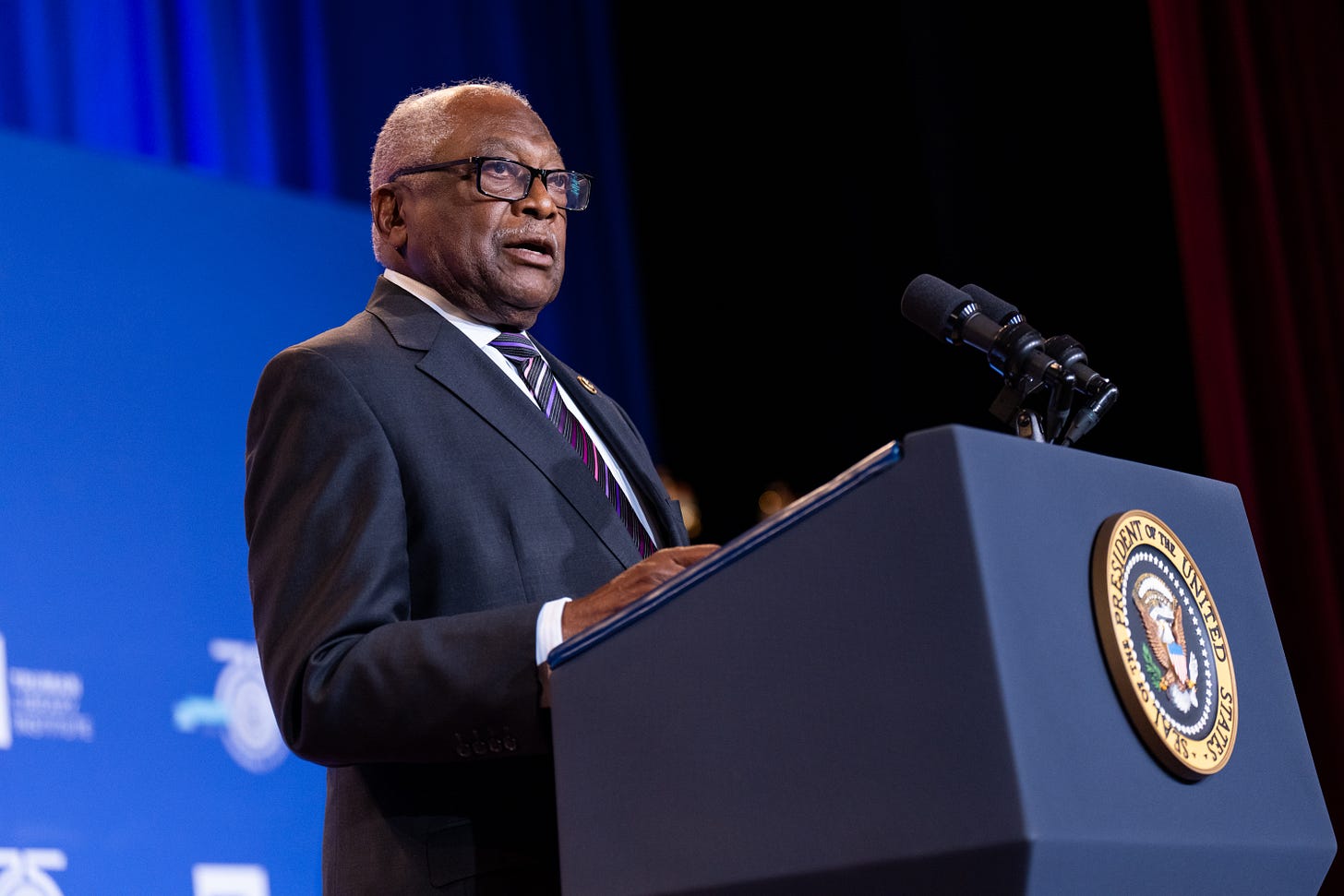
Rep. James Clyburn has emerged as a leading advocate for expanding the Supreme Court from nine to thirteen justices, framing this move as a necessary pro-democracy measure to counteract what he describes as partisan overreach by the current conservative majority. He refers to thirteen as a “baker’s dozen,” suggesting it as a balanced corrective after Senate Majority Leader Mitch McConnell’s strategic blocking of Merrick Garland and swift confirmation of Amy Coney Barrett. This proposal has gained traction among prominent Democrats including Vice President Kamala Harris and House Minority Leader Hakeem Jeffries, who call it “dramatic Supreme Court reform.”
Public support for Supreme Court expansion has notably increased, with a June Marquette Law School poll showing an even 50-50 split on adding seats, up from 42% in 2019, indicating growing acceptance of this reform alongside even more popular proposals like term limits. Progressive advocacy groups such as Demand Justice emphasize that expansion is the only immediate remedy to the entrenched 6-3 conservative supermajority, which they characterize as the result of a partisan power grab. Meanwhile, GOP efforts to constitutionally freeze the court at nine justices have failed to secure the necessary two-thirds majority, underscoring both political resistance and the arbitrary nature of the current court size.
Historical precedent lends weight to the court expansion argument, as the bipartisan commission on the Supreme Court has noted that after President Franklin D. Roosevelt’s court-packing plan, the Court shifted to uphold key New Deal regulations, ending a period of invalidating worker and consumer protections. This historical example is invoked to suggest that expanding the Court today could similarly restore judicial balance and reinforce democratic governance, countering what many see as the current Court’s anti-democratic rulings.

GOP Maneuver Backfires
Republican efforts to lock the Court at nine justices exposed deep party rifts and reminded Congress—and the public—that changing the Court’s size is already within legislative reach.
In a calculated political gambit, House Speaker Mike Johnson spearheaded a constitutional amendment to permanently cap the Supreme Court at nine justices, explicitly aiming to compel Democrats to take a public stance on the contentious issue of court expansion. This move was less about legislative success—given the amendment’s slim chance of passing—and more about framing the debate as a stark partisan divide, with Johnson declaring, “We're going to see where they are on packing the Supreme Court.” By forcing a high-profile vote, Republicans sought to rally their base and spotlight any Democratic support for expanding the Court, thereby politicizing what many view as a structural reform issue.
The narrow passage of the resolution to constitutionally fix the Court size at nine justices, which passed 212-206 with a lone Democrat crossing party lines, underscored the GOP’s strategic use of procedural votes as political theater. While the resolution was doomed from the start due to the stringent two-thirds majority required for constitutional amendments, it effectively placed Democrats in a political bind: opposing the measure risked being labeled pro-expansion, while supporting it meant acquiescing to a Republican-led narrative. This maneuver not only galvanized Republican voters but also highlighted the deep partisan entrenchment surrounding Supreme Court reform.
Interestingly, Johnson’s push to constitutionally fix the Court size inadvertently reminded the public that Congress already holds the power to alter the number of Supreme Court justices through ordinary legislation—a power exercised seven times in U.S. history. This revelation could subtly shift public perception by framing court expansion as a legislative, rather than purely constitutional, matter, potentially opening the door for future reforms outside the high hurdle of constitutional amendments. Such a reminder adds complexity to the partisan narrative, suggesting that structural changes to the Court are more accessible than often portrayed.