Taiwan turbocharges defenses as US policy pivot fuels regional security jitters
The gist
Taiwan is turbocharging its military tech and alliances as shifting U.S. policy and mounting Chinese pressure turn the island into ground zero for Indo-Pacific risk.
What to know
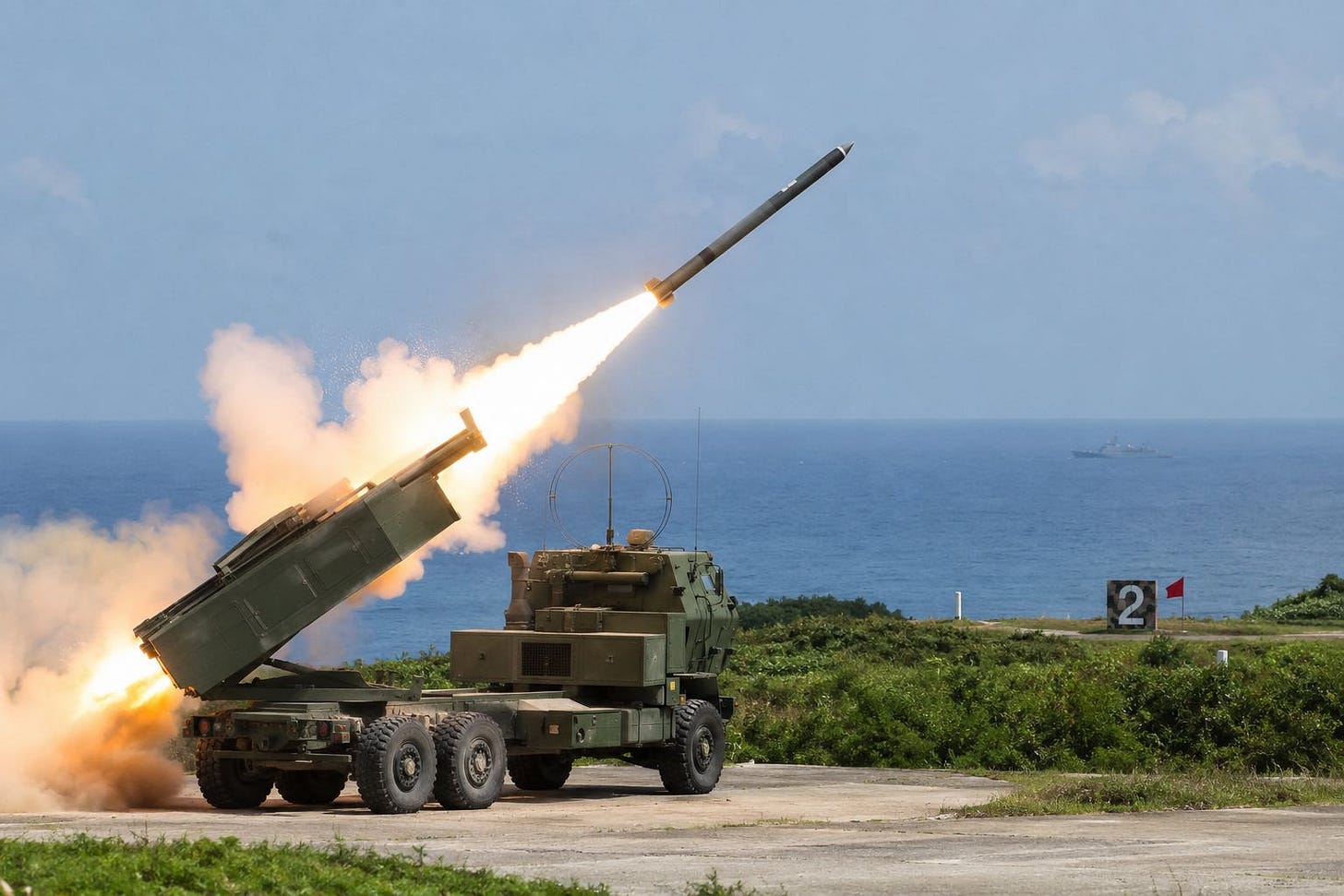
- Taiwan is rolling out HIMARS systems and new attack drones, backed by U.S. arms sales and joint training, to boost its defenses against China.
- China has flexed its muscle by sending up to 48 warships—including the new Fujian carrier—near Taiwan and tightening rare earth controls to keep rivals in check.
- After the June 2026 Trump-Xi summit saw the U.S. dial back direct support for Taiwan independence, Washington is pivoting toward collective security with Japan and Australia—leaving Taipei anxious and supply chains in the crosshairs.
Taiwan’s High-Tech Defense Surge
Taiwan is transforming its military with advanced strike systems, whole-of-society resistance planning, and deeper U.S. alliance ties—yet persistent doubts about Washington’s reliability cast a shadow over its new deterrence strategy.
Taiwan's deployment of advanced precision strike systems like HIMARS, coupled with recent missile drills, underscores a strategic escalation in its defense posture aimed at deterring Chinese aggression. These moves, supported by expanded U.S. arms sales, reflect a sharpened military readiness and a push for smarter defense spending amid rising regional tensions. As highlighted in June 2026 reports, this integration of cutting-edge technology is redefining conflict dynamics in the Indo-Pacific, signaling Taiwan's commitment to maintaining credible deterrence.
Washington is intensifying its support for Taiwan by not only increasing arms sales but also deepening military cooperation with regional allies such as Australia, Japan, and the Philippines. Experts like Ely Ratner advocate for a collective security pact featuring integrated planning, force posture, and command structures, emphasizing burden-sharing to enhance deterrence against China. This strategy is viewed as a cost-effective investment, with Bryan Clark noting that supporting Taiwan’s military yields better returns than direct U.S. military deployments, thereby reducing broader conflict risks.
Beyond hardware, U.S.-Taiwan defense collaboration has evolved into comprehensive whole-of-society resistance planning, including joint training and practical preparations such as internally displaced persons pamphlets, closely coordinated with Taiwan’s Ministry of Defense. However, lingering concerns about U.S. political consistency—exemplified by mixed signals during the Trump administration—continue to affect Taiwan’s confidence in American support, underscoring the importance of credible and sustained commitments in the alliance.
Taiwan is also bolstering its asymmetric maritime defense capabilities through acquisitions like the Penguin Mk2.5 VTOL drones from Redwire Corporation, enhancing the Coast Guard’s operational reach amid escalating Indo-Pacific tensions. This focus on modern, flexible technologies complements Taiwan’s broader defense strategy, allowing for agile responses to gray-zone challenges and reinforcing deterrence in contested maritime domains.


China’s Dual-Front Pressure Tactics
Beijing is escalating its maritime presence and economic coercion near Taiwan, wielding both warships and rare earth sanctions to complicate regional security and disrupt U.S.-allied supply chain plans.
China’s deployment of a coordinated maritime task group east of Taiwan, including the transit of its newest aircraft carrier Fujian through the Taiwan Strait, marks a deliberate escalation aimed at asserting control over critical sea lanes and countering expanding U.S.-Taiwan defense cooperation. This steady ratcheting up—from an average of one combatant vessel per week five years ago to as many as 48 simultaneously by early 2026—reflects Beijing’s strategic push to complicate the fragile U.S.-China dynamics and underscores the urgent need for smarter Taiwan defense strategies amid shifting geopolitical chessboards.
Beyond Taiwan, China’s maritime maneuvers serve as a calculated pushback against regional security arrangements such as the Japan-Philippines maritime deals, while also extending pressure to hotspots like the Scarborough Shoal in the South China Sea. This broad naval presence not only intensifies regional tensions but also sows uncertainty about Beijing’s broader strategic intentions, complicating the security environment and heightening concerns among neighboring states about China’s long-term ambitions.
Complementing its naval coercion, China is leveraging economic pressure by imposing sanctions on major firms involved in developing alternative supply chains for critical minerals, particularly those that the U.S. is promoting to reduce dependency on Chinese rare earths. This dual approach of maritime and economic pressure reveals Beijing’s intent to maintain regional dominance and disrupt strategic stability, complicating efforts by the U.S. and its allies to build resilient supply chains critical to both economic security and defense readiness.

U.S. Policy Recalibrates on Taiwan
The Trump-Xi summit triggered a U.S. strategic shift away from explicit support for Taiwan independence, fueling regional uncertainty as Washington pivots from direct defense to collective security partnerships.
The June 2026 Trump-Xi summit ushered in a fragile truce that temporarily eased US-China tensions but underscored the precarious nature of diplomatic engagement, especially regarding Taiwan. President Trump’s post-summit remarks marked a clear departure from longstanding US commitments by explicitly refusing to back Taiwan independence and signaling that the United States would not deploy troops if conflict erupted due to a unilateral Taiwanese declaration of independence. This shift, characterized by abandoning the 1982 'Six Assurances'—notably the unprecedented consultation with Beijing over arms sales to Taiwan—reflects a strategic recalibration aimed at managing escalating economic and geopolitical pressures while acknowledging the limits of US power vis-à-vis China’s growing influence.
Beijing has framed this détente and the emerging concept of 'constructive strategic stability' as contingent on the 'proper handling' of the Taiwan question, with Xi Jinping warning that mishandling could lead to clashes or conflict. Chinese analysts remain divided on whether the US policy shift signals genuine change or continuity; while some like Cheng Li argue for ongoing strategic ambiguity, others including Shao Yuqun interpret Trump’s rhetoric—such as the '9,500-miles' comment—as a clear signal of non-intervention. This ambiguity fuels mutual suspicion, complicating efforts to stabilize bilateral relations amid broader strategic competition.
The US policy shift also reflects a broader strategic compromise driven by economic pressures and a recognition of the constraints on American global leadership, particularly under the Trump administration’s approach. This recalibration includes postponing arms sales and reducing direct defense engagements with Taiwan, actions that have undermined Taipei’s confidence in Washington’s commitment and raised concerns about the US’s will to defend the island. Concurrently, the US is pivoting towards strengthening alliances with regional partners like Australia and Japan through collective security frameworks that emphasize shared responsibility, signaling a move away from unilateral interventionism.
Despite the tentative truce, the US-China diplomatic dynamic remains fraught with mutual suspicion extending beyond Taiwan to encompass espionage, economic leverage, and influence operations, as highlighted by concerns over spying and covert activities. China is strategically leveraging perceived US distractions and retrenchment to advance its long-term interests without overt escalation, while anticipating that Trump’s summit statements may explicitly reduce US support for Taiwan independence. However, the lack of clear summit preparations and delegation agreements underscores the unpredictability of US policy and its implications for Taiwan’s security posture amid ongoing geopolitical crises.



Chip Supply Chains in the Crosshairs
Taiwan’s semiconductor dominance and China’s rare earth chokehold have exposed critical vulnerabilities in U.S. tech supply chains, prompting a global scramble for resilience as geopolitical risks surge.
Taiwan's semiconductor industry remains the linchpin of US technological sovereignty amid escalating US-China tensions, with the island's advanced manufacturing capabilities underpinning critical supply chains for AI and defense technologies. However, the complexity of semiconductor production—requiring highly skilled labor and cutting-edge equipment like ASML lithography machines—poses formidable challenges to scaling fabs outside Taiwan, demanding massive investments and government backing, as highlighted by the need for 'Elon plus tens of billions of dollars' to establish new US chip fabs. This vulnerability is compounded by the high probability—over 90% in the next decade—of Taiwan facing geopolitical disruption, making semiconductor supply chain resilience a paramount national security priority.
China wields its near-monopoly on rare earth processing—controlling roughly 90% of the global supply—as a potent geopolitical lever by imposing export controls on key US firms like MP Materials Corp. and USA Rare Earth Inc., which are integral to Washington’s efforts to diversify critical mineral supply chains essential for semiconductor manufacturing. These export restrictions extend globally, banning transfers of dual-use items and targeting companies linked to AI and military advancements, thereby intensifying the economic and technological competition that underpins regional security dynamics.
In response to China's strategic export controls, the US and its allies, including the Group of Seven nations, have coordinated to cap rare earth imports from any single non-bloc country to below 60% by 2030, signaling a concerted effort to reduce dependency on Chinese supply chains. This multilateral approach underscores the broader contest for tech sovereignty and supply chain security, with the US simultaneously increasing funding for domestic rare-earth processing and investing in innovative semiconductor technologies—such as Substrate’s novel lithography methods—to mitigate vulnerabilities and strengthen deterrence against potential Chinese aggression.
Despite the geopolitical headwinds, investment firms like Founders Fund are doubling down on growth sectors such as AI and robotics, reflecting the robust economic momentum driving Taiwan's semiconductor industry and its strategic importance in the US-China rivalry. This financial confidence not only fuels technological innovation but also highlights the intertwined nature of economic vitality and regional security, where advancements in semiconductor manufacturing directly influence the balance of power in the Indo-Pacific.