Tariff hike pushes Chinese EV makers to build in Brazil
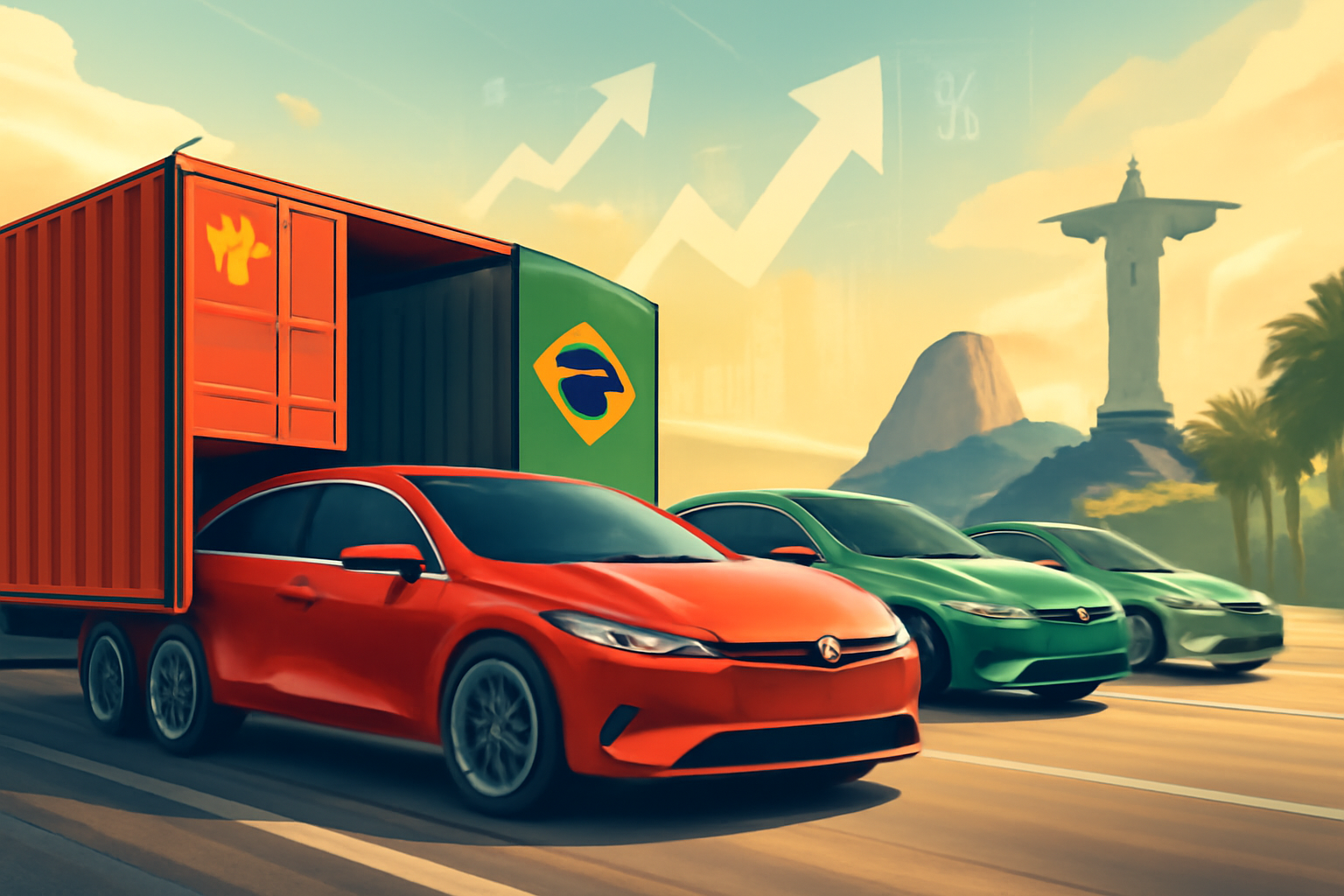
The gist
Tariff hikes are turbocharging Brazil’s EV scene, forcing Chinese automakers like BYD and Chery to swap imports for local factories and sparking a new electric gold rush in South America’s biggest market.
What to know
- Brazil became the world’s largest overseas market for Chinese EVs in early 2026, importing $5.2 billion worth in just five months and doubling Chinese brands’ market share to 18%.
- New tariffs up to 35% are pushing major Chinese automakers to launch local manufacturing, fueling job creation and a homegrown EV supply chain.
- China’s EV exports soared 120% year-on-year even as domestic sales fell 20%, but over one million exported vehicles remain unregistered in foreign markets.
China’s EV Export Paradox
A surge in Chinese EV exports masks swelling foreign inventories and shrinking domestic profits as manufacturers offload excess stock to offset home market contraction.
China’s electric vehicle market is experiencing a profound structural reset in 2026, marked by a sharp contraction in domestic car sales—down over 20% year-on-year in the first half—while EVs now constitute more than 60% of total car sales, up from under 55% in 2025. Despite this domestic slowdown, the rapid surge in EV exports, which jumped over 120% year-on-year in H1 2026, has nearly offset the decline in local demand, limiting the overall drop in vehicle production to around 6%. This dynamic underscores a pivotal shift in the global automotive landscape, with China increasingly pivoting from a domestic growth engine to a dominant global EV supplier.
The explosive growth in Chinese EV exports, however, conceals a complex inventory challenge abroad. While wholesale shipments surged, actual consumer registrations in destination markets grew by only about 75%, leaving over one million exported EVs unregistered and sitting in foreign inventories. This discrepancy reveals that the export boom largely represents manufacturers offloading excess stock amid soft domestic demand and underutilized production capacity—industry capacity utilization hovered at 73.2% in 2025, below the healthy 75% threshold—rather than a pure surge in end-user adoption overseas.
China’s competitive edge in this global EV shuffle stems from its vertically integrated supply chains and advanced battery technology, enabling production costs approximately 35% lower than in advanced economies. Battery prices in China are around 35% cheaper than in Europe and 30% less than in North America, largely due to large-scale manufacturing and the widespread use of lithium iron phosphate batteries. This cost advantage allows Chinese automakers to produce and ship EVs faster and cheaper than competitors worldwide, fueling the export surge even as profitability in the sector faces pressure—Chinese EV makers reported an 18% drop in profits in Q1 2026 on slim margins.
Brazil’s Tariff Gamble Pays Off
Brazil’s sharp tariff hike has forced Chinese EV giants to localize production, driving down car prices and reshaping the country’s auto landscape.
By early 2026, Brazil had surged ahead to become the world's largest overseas market for Chinese electric vehicles, importing $5.2 billion worth of battery-electric and hybrid cars in just the first five months—surpassing Russia and signaling a major shift in global EV demand. This rapid import growth has been accompanied by a notable increase in Chinese brands' market share within Brazil's new-energy-vehicle segment, which more than doubled to 18% by June 2026, contributing to a 3.5% year-over-year decline in average new-car transaction prices, the first drop since 2020.
To capitalize on this momentum while fostering domestic industry, Brazil has strategically raised import tariffs on EVs and hybrids from 25-30% up to 35%, effectively pressuring Chinese automakers such as BYD, Chery, and Great Wall to pivot from importing kits to establishing local manufacturing facilities. This policy leverages import duties not just as a revenue tool but as an incentive to build factories, create jobs, and strengthen Brazil’s clean-car supply chain, reflecting a deliberate government push to anchor the EV production ecosystem within its borders.

BYD’s Global Expansion Playbook
BYD is countering China’s EV slowdown with export-led growth, luxury launches, and local Brazilian manufacturing—despite bottlenecks and shipping limits.
Facing a domestic market contraction driven by China's EV price wars and subsidy phase-outs, BYD has strategically pivoted to export-led growth, with international sales now accounting for about 43% of its monthly volume. In July 2026 alone, exports surged 124.3% year-on-year to a record 179,841 vehicles, underscoring the critical role of overseas demand in offsetting a 9% decline in domestic deliveries. However, this rapid expansion is tempered by production bottlenecks, including the transition to second-generation Blade batteries and limited shipping capacity, which currently cap BYD's ability to fully capitalize on export momentum.
To deepen its global footprint, BYD is aggressively broadening its product portfolio with a dual focus on upscale and niche market segments that promise higher margins. The company’s Fangchengbao, Denza, and Yangwang brands have seen rapid growth—up to 190.6% year-on-year—while new launches like the Tokyo-bound Racco kei car and the luxury Great Han sedan aim to capture distinct overseas markets, from Japan’s microcar segment to premium European competitors. This strategy leverages BYD’s vertically integrated supply chain to undercut rivals on price and establish new standards, exemplified by the Racco’s ambition to redefine electric microcars through scale and cost control.
Beyond exports, BYD is also investing in local production to solidify its presence in key international markets, exemplified by its Camaçari complex in Brazil where the Song Pro Super-Hibrido Flex Fuel plug-in hybrid recently launched. Pilot production began in August 2026 with full-scale manufacturing expected by year-end, aligning with Brazil’s policy incentives that favor local EV assembly. This move not only supports BYD’s global growth ambitions but also mitigates risks associated with shipping constraints and international operational uncertainties, which have affected other markets such as Malaysia and Turkey.
The broader Chinese EV industry mirrors BYD’s export-driven trajectory, with competitors like Leapmotor and Chery accelerating their international deliveries—Leapmotor surpassing 100,000 units and Chery breaking the 200,000 monthly export threshold. This collective surge signals a strategic industry-wide shift toward global market expansion as Chinese automakers seek to compensate for slowing domestic demand and intensifying competition at home.
Brazil Anchors China’s EV Push
China’s automakers are transforming Brazil into a regional export and production hub, leveraging explosive NEV growth to outmaneuver trade barriers and competition.
China’s passenger car export landscape in H1 2026 reveals a strategic geographic diversification, with Brazil emerging as a pivotal hub alongside traditional powerhouses like Russia and Europe. Brazil not only ranks second in total passenger car imports with 394,410 units—a 158.6% surge—but also leads as the top destination for Chinese new energy vehicle (NEV) exports, reaching 293,032 units and growing 158.8% year-on-year. This underscores Brazil’s critical role in China’s regional market leadership, especially as Europe’s UK, Belgium, Italy, and Spain continue to bolster export volumes, reflecting a multi-regional approach that balances volume with localization amid evolving trade policies and competitive pressures.
The explosive growth in Central and South America, spearheaded by Brazil, exemplifies China’s shift from sheer export volume to refined regional operations emphasizing localized production and channel development. BYD’s 142.8% year-on-year export surge to 222,000 units, coupled with Geely’s staggering 445.6% growth and Changan’s rapid expansion, highlights how Chinese automakers are capitalizing on Brazil’s market incentives and demand for NEVs. This strategic pivot not only mitigates trade barriers and demand fluctuations but also positions Brazil as a manufacturing and export base, signaling a broader trend of embedding production closer to key markets.
In Europe and Southeast Asia, dynamic shifts in market leadership illustrate the competitive and evolving nature of China’s export strategy. Established players like Chery, SAIC, and BYD maintain strongholds in Europe, with Chery exporting 262,331 units—a 274.1% increase—while emerging brands such as Leapmotor and Changan are rapidly gaining ground, posting growth rates above 300%. Meanwhile, Southeast Asia remains fiercely contested, with Geely leading exports at nearly 90,000 units (+117.3%), and other brands like Leapmotor and Great Wall Motor also registering robust gains. These patterns reveal a nuanced regional leadership landscape where legacy and emerging players coexist and compete vigorously.