Trump’s power grab: voter purges, DOJ loyalty, and media clampdown
The gist
Trump’s second-term power grab is rewriting the rules of American democracy—gutting constitutional safeguards, purging voters by the millions, and weaponizing the DOJ and media to cement authoritarian control.
What to know
- By early 2026, Supreme Court rulings granted Trump effective criminal immunity and let loyalists like Acting AG Todd Blanche politicize DOJ investigations.
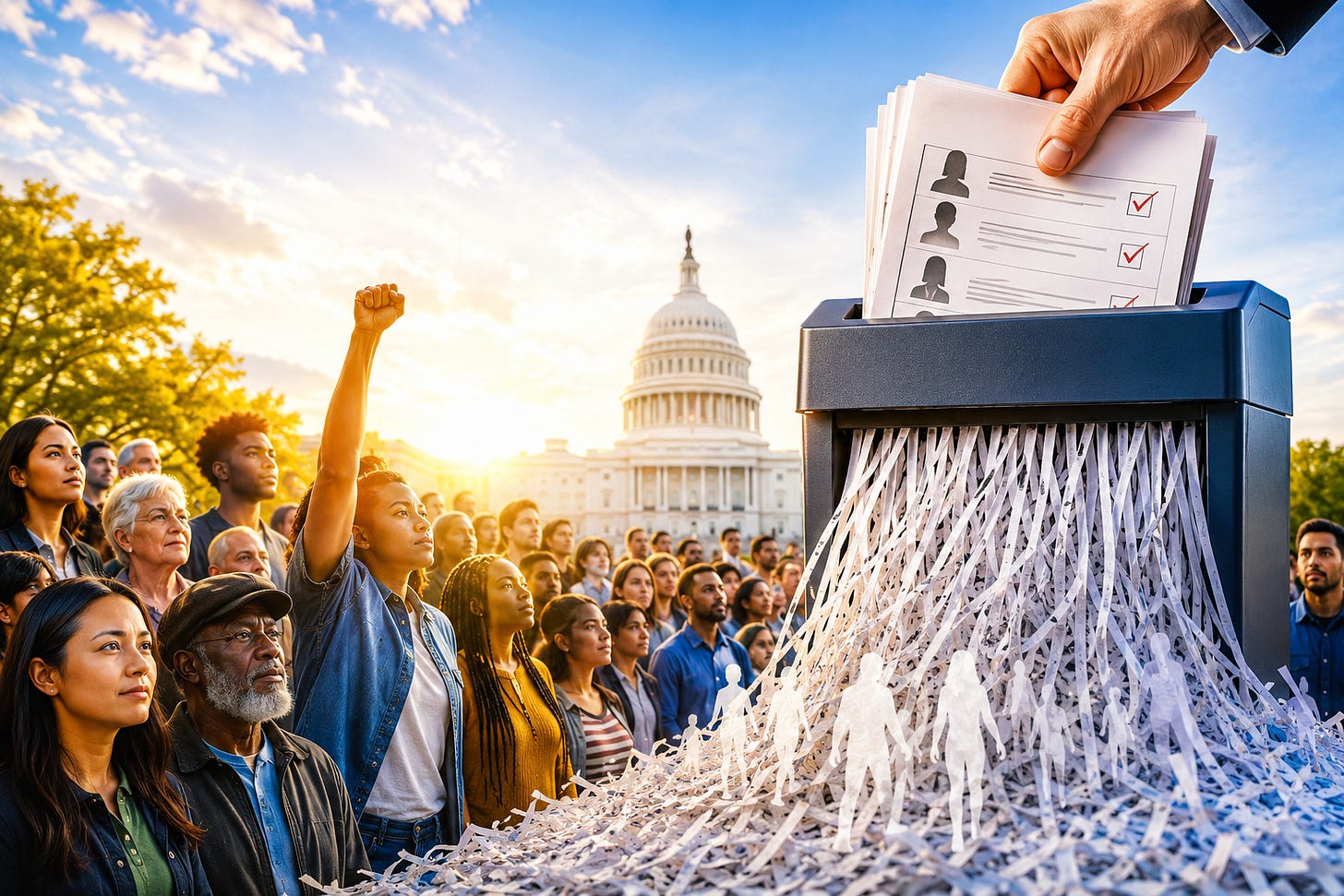
- The administration orchestrated a nationwide purge of tens of millions of mostly Democratic voters and tried to ban Dominion Voting Systems machines using debunked claims.
- Media consolidation under right-wing billionaires and regulatory threats have muzzled independent journalism, eroding electoral trust and U.S. global standing.
Unchecked Executive Overreach
Trump’s loyalist regime uses Supreme Court-blessed immunity to normalize authoritarian rule, funneling billions to insurrectionists and sidelining constitutional checks.
By early 2026, the Trump administration returned with significantly expanded executive power, operating with fewer constraints and a more loyal team willing to push presidential authority beyond traditional limits. This shift has been reinforced by Supreme Court rulings under Chief Justice John Roberts that effectively grant Trump criminal immunity, allowing him to control Department of Justice investigations and undermining the long-standing norm of prosecutorial independence. Acting Attorney General Todd Blanche’s public defense of Trump’s directives to prosecute political opponents further exemplifies the politicization of the DOJ, as he dismissed concerns about impartiality and justified removing federal prosecutors investigating Trump on ethically dubious grounds.
The Trump administration’s blatant violations of constitutional norms extend beyond legal maneuvering to direct financial and military actions that contravene foundational laws. Notably, the creation of a $1.776 billion fund to compensate Trump allies involved in the January 6th Capitol insurrection flagrantly violates the Fourteenth Amendment’s prohibition against paying debts incurred in aid of insurrection. Coupled with unilateral military actions like bombing Iran without Congressional approval, these moves illustrate a broader pattern of executive overreach that disregards constitutional checks and balances, signaling a dangerous erosion of democratic governance.
The normalization of authoritarian governance philosophies within American institutions has become the most insidious threat to democracy, as it fosters an ecosystem of loyalty, retaliation, and ideological enforcement that outlives any single leader. This process, often administrative and legalistic rather than overtly dramatic, dulls public recognition of democratic erosion, leading citizens to accept authoritarian shifts as the new normal. The Trump era’s politicization of the Justice Department, targeting of public servants, and erosion of institutional trust have permeated courts, the press, the military, and even cultural norms, mutating the political landscape into a system where personal loyalty trumps the rule of law.
The Trump administration’s governance mirrors a classic authoritarian playbook, akin to Vladimir Putin’s tactics, characterized by weaponizing government institutions to suppress opposition and protect loyalists. This includes the appointment of Trump’s personal defense attorney Todd Blanche as acting attorney general, signaling a consolidation of executive power that undermines DOJ independence, as well as Supreme Court decisions and administrative actions that shield Trump and his family from scrutiny, such as tax audit protections. The administration’s use of pardons as potential pay-to-play rewards and the reluctance to rule out deploying armed federal agents at polling places further exemplify the deepening erosion of constitutional norms and the entrenchment of authoritarian governance philosophies within the U.S. political system.



Voter Suppression Machine
Mass purges, forced data handovers, and fabricated threats have weaponized election law, targeting millions of Democratic voters and erasing foundational voting protections.
By mid-2026, the Trump administration orchestrated a sweeping and illegal purge of tens of millions of predominantly Democratic voters from national rolls, echoing authoritarian tactics seen in India under Modi and historically in Florida’s 2000 purge of 80,000 Black and Hispanic voters that swung a presidential election. The Department of Justice aggressively demanded states surrender comprehensive voter data—including sensitive personal identifiers—with a mandate to remove 'ineligible voters' within 45 days, weaponizing voter roll maintenance as a tool of suppression. Several GOP-led states complied, handing over intimate details of millions, while the Supreme Court, under Chief Justice Roberts and Justice Alito, dismantled key protections like the Voting Rights Act using misleading data, clearing the legal path for these purges.
Efforts to control election infrastructure intensified as the administration attempted to ban Dominion Voting Systems machines across more than half the country, citing debunked national security threats concocted by election-security czar Kurt Olsen. Despite months of pressure on the Commerce Department, the lack of credible evidence—only a handful of chips sourced from East Asia without any security risk—collapsed the campaign, revealing a pattern of fabricating threats to justify authoritarian control over voting technology. Concurrently, federal officials pressured at least eight states to hand over confidential election records, access voting equipment, and reopen dismissed fraud cases, undermining state authority and constitutional election protections.
Disinformation campaigns have been central to the administration’s strategy, with false claims of rampant mail-in ballot fraud used to justify restrictive voting laws and voter intimidation tactics, including proposals to deploy ICE agents at polling places. These narratives, amplified by figures like Steve Bannon and tacitly supported by White House officials, serve to delegitimize election outcomes and suppress voter turnout, particularly among minority communities. The Postal Service’s attempted enforcement of federal control over mail-in voter lists sparked lawsuits from 23 Democratic-led states, illustrating the broader authoritarian impulse to control who votes and whose votes count, all while echoing global patterns of racialized voter suppression and election manipulation.
The administration’s rhetoric and actions have further eroded public trust in electoral integrity by openly declaring elections 'rigged' and weaponizing government institutions and media to delegitimize democratic processes. Echoing authoritarian playbooks from Putin to Erdogan, the White House has spread disinformation about foreign interference, sought to repeal media ownership caps to consolidate pro-administration messaging, and framed political opponents as internal enemies, fostering an environment ripe for voter suppression. Analysts warn that these tactics aim not to broaden popular support but to bypass elections entirely, with threats to declare national security emergencies to impose restrictive voting measures and to use federal agencies and loyalist violence to intimidate voters, effectively setting the stage to steal upcoming elections.



DOJ Loyalty Networks
Personal loyalty has replaced legal integrity as Trump’s allies transform the Justice Department into a partisan weapon, rewarding cronies and criminalizing dissent.
The Supreme Court ruling led by Chief Justice John Roberts fundamentally altered the Department of Justice's independence by granting former President Trump unprecedented control over DOJ investigations, effectively enabling him to dictate prosecutorial priorities and shield himself from accountability. This shift was exemplified by Trump-appointed officials like Acting Attorney General Todd Blanche, who openly defended the president’s use of the DOJ to target political adversaries and justified the removal of federal prosecutors investigating Trump as an ethical necessity. Such developments reveal a loyalty-based ecosystem within government agencies, where partisan allies like Blanche and Pam Bondi revive debunked voter fraud claims and undermine lawful investigations, weaponizing state institutions to suppress dissent and protect authoritarian interests.
By mid-2026, the administration had repurposed government agencies into instruments of authoritarian control, systematically dismantling constitutional roles and deploying federal enforcement bodies as 'goon squads' to intimidate citizens and immigrants alike. The DOJ’s indictment of the Southern Poverty Law Center for its anti-hate group work, alongside ICE and CBP’s violent suppression tactics, underscores a broader strategy of using state power to silence opposition. Loyalty networks fortified by threats of legal retribution, as articulated by Todd Blanche at CPAC, and the creation of a $1.776 billion slush fund to financially reward January 6 rioters—managed entirely by Trump loyalists—illustrate how taxpayer resources are exploited to reward political allies and suppress dissent, signaling a profound erosion of democratic norms.
Corruption and self-enrichment have become normalized within these loyalty networks, as government officials exploit insider information and financial mechanisms with impunity, blurring ethical boundaries and eroding bipartisan accountability. This cultural shift, where corruption is selectively condemned based on political allegiance, enables authoritarian ecosystems to flourish unchecked, with independent investigations sidelined and partisan loyalty prioritized over the rule of law. The transformation of respected legal professionals like Todd Blanche into personal enforcers of authoritarian agendas exemplifies this dynamic, as they leverage government positions to protect the leader’s interests while dismantling institutional integrity.
The entrenchment of authoritarian governance under Trump is characterized less by overt coups than by the insidious normalization of loyalty, retaliation, and ideological enforcement that reshape institutions into self-sustaining ecosystems of partisan control. This administrative erosion, often procedural and legalistic, makes it difficult for the public to recognize the degradation in real time, leading to dangerous resignation that 'this is just how things are now.' The weaponization of government extends beyond the DOJ to include executive overreach in election administration, suppression of voter participation, and politicization of independent investigations, all facilitated by enablers within the political establishment who knowingly empower these abuses for power and status.




Media Control and Misinformation
Billionaire-driven media consolidation and relentless disinformation campaigns have stifled independent journalism, making public truth a casualty of political power.
By early 2026, the Trump administration aggressively manipulated election narratives by promoting thoroughly debunked conspiracy theories, such as attempts to ban Dominion Voting Systems machines on false national security grounds. This effort was bolstered by right-wing billionaires like Jeff Bezos, the Ellison family, and the Murdochs consolidating media outlets, firing dissenting reporters, and stifling independent journalism, thereby enabling a controlled narrative environment that undermined electoral trust and accountability.
The administration weaponized government institutions to suppress press freedom and democratic checks, exemplified by the Justice Department’s transformation into a personal tool for the president under acting Attorney General Todd Blanche, Trump’s former defense attorney. This shift facilitated protection of the leader’s family from tax audits and blurred lines on deploying armed federal agents at polling places, intensifying fears of voter intimidation and eroding transparency.
A deliberate campaign of misinformation and press intimidation has normalized lying as a display of power, with officials repeatedly asserting disproven claims—such as false narratives about the January 2026 Minneapolis murders—despite clear video evidence. The overwhelming volume and rapid spread of falsehoods, likened to 'catching snowflakes in a blizzard,' disorients the public and renders fact-checking ineffective, a tactic that mirrors autocratic strategies to maintain control over truth and suppress independent journalism.
Media deference to Trump, as seen in programs like Meet the Press, has paradoxically emboldened his authoritarian narrative control, prompting retaliatory threats such as reporting journalists like Kristen Welker to the FCC for unfavorable coverage. This dynamic illustrates how the administration uses regulatory intimidation to punish critical reporting and consolidate a media environment where 'the only news will be the news dictated by him,' further eroding democratic accountability and press independence.

Criminalizing Dissent and Protest
Federal agencies now target civil rights groups and protesters as enemies of the state, using legal intimidation and surveillance to silence opposition voices.
Federal agencies now target civil rights groups and protesters as enemies of the state, using legal intimidation and surveillance to silence opposition voices.
Global Standing in Freefall
America’s diplomatic credibility collapses as authoritarian tactics at home embolden adversaries abroad, eroding alliances and inviting foreign exploitation.
By early 2026, the administration’s dramatic pivot from an anti-globalist stance to being a guest of honor at Davos symbolized a broader unraveling of the post–World War II diplomatic order, severely weakening longstanding U.S. alliances. This shift was compounded by the systematic dismantling of key institutions such as the DOJ, FBI, and State Department, alongside the erosion of constitutional norms and soft power tools like USAID, which collectively diminished America's global standing and created exploitable vulnerabilities for adversaries like Russia.
The consolidation of authoritarian control over the Supreme Court and Congress, which has granted the president near-kinglike powers, not only destabilizes domestic governance but signals to allies and adversaries alike that the U.S. is politically fractured and unreliable. This internal weakening is further exacerbated by the administration’s sanctioning of white supremacist groups and weaponization of government agencies against civil rights organizations, eroding America’s moral authority on the world stage and potentially emboldening authoritarian regimes.
The administration’s creation of a $1.776 billion slush fund to financially reward January 6 rioters exemplifies how domestic authoritarian tactics undermine law enforcement and national security by empowering violent actors and eroding institutional integrity. This is intensified by the weaponization of government institutions and loyalty networks, such as the committee appointed by Todd Blanche to control fund disbursement, which undermines impartial governance and mirrors Vladimir Putin’s step-by-step authoritarian playbook, thereby increasing vulnerabilities that adversaries like Russia and China can exploit.
The administration’s disregard for military readiness—prioritizing vanity projects over the welfare of deployed service members—coupled with the depletion of critical defense resources like Patriot interceptors by at least 65%, directly compromises U.S. national security and the defense of key allies. This neglect, alongside inviting Russia’s finance minister to the G20 despite Russia’s active collaboration with Iran in developing supersonic cruise missiles and providing satellite intelligence to target U.S. troops, further isolates the U.S. internationally and emboldens adversaries, while aggressive rhetoric toward allies like Canada deepens diplomatic fractures.