Trump’s truth API sparks outcry over ‘two-tiered’ markets
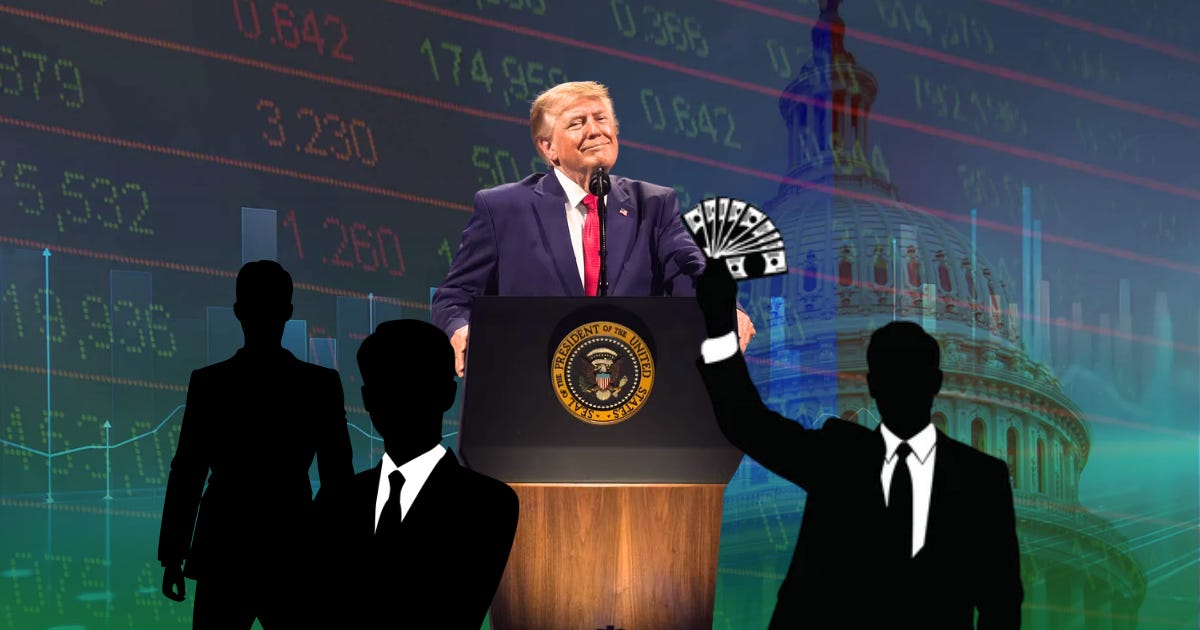
The gist
**Trump’s Truth Social is cashing in on the presidency with a $100,000-per-month API that gives Wall Street early access to his market-moving posts, sparking outrage over fairness, legality, and democracy itself.**
What to know
- Truth Social’s new Truth API lets hedge funds and high-frequency traders see Trump’s posts milliseconds before the public—if they can afford a six-figure monthly fee.
- Market experts and lawmakers warn the API creates a two-tiered market, undermining transparency and granting privileged access to presidential communications for profit.
- With Trump owning 41% of his media company, critics call for an SEC probe into conflicts of interest and market manipulation as the revenue model’s fate hangs on his remaining 2.5 years in office.
Presidential Posts for Profit
Truth Social’s API turns Trump’s real-time posts into an exclusive, high-priced trading asset, fueling ethical outrage as the president profits directly from market-moving messages.
In mid-2026, Truth Social unveiled the Truth API, a paid service granting millisecond-fast access to posts from the platform's 10 most influential accounts, including President Donald Trump’s. This innovation targets hedge funds and high-frequency trading firms eager to capitalize on the market-moving power of presidential communications, which have historically triggered significant stock fluctuations—such as a nearly 5% plunge following tariff announcements and a 9.5% surge after tariff suspensions. By offering this early access, Truth API transforms once-public presidential posts into a proprietary asset, enabling subscribers to execute trades ahead of the broader market and potentially reap outsized returns.
Truth Media & Technology Group, led by interim CEO Kevin McGurn, positions the Truth API as a strategic pivot to monetize presidential communications, aiming to generate meaningful and lasting revenue. With subscription prices reportedly as high as $100,000 per month—approximately 100,000% above comparable services—the pricing reflects the unique value of exclusive, rapid access to Trump’s posts. Discounted rates of $60,000 per month for three-year contracts further underscore the company’s efforts to lock in long-term clients, despite the inherent time limitation tied to Trump’s presidency, which caps the service’s lifespan at roughly 2.5 years unless he secures a third term.
Trump’s 41% ownership stake in Truth Social creates a direct financial incentive for him to post market-moving content, as increased subscriptions to the Truth API would enrich him personally. Unlike traditional data vendors, where profits flow to third parties, this arrangement funnels revenue back to Trump himself, raising profound ethical and financial concerns. Critics have condemned the move as 'odious' and 'brazen corruption,' with some calling it 'absolutely mental' that the sitting president would monetize his tweets for private gain, highlighting broader worries about the financialization of political communication and its corrosive impact on market integrity and democratic norms.




Wall Street’s Speed Divide
The Truth API’s millisecond advantage for hedge funds deepens market inequality, raising alarms that U.S. markets are drifting away from fair access and transparency.
The launch of Trump Media and Technology Group's Truth API has effectively created a two-tiered market by offering millisecond-faster access to market-moving posts from influential accounts like President Trump's, privileging high-frequency traders and hedge funds over ordinary investors. Tyler Gellasch, CEO of Healthy Markets Association, warns this undermines the foundational principle of fair access in U.S. markets, while the paid nature of the feed raises ethical concerns about monetizing presidential communications for profit rather than equitable information dissemination.
Alongside the Truth API's introduction, potential SEC moves to reduce the frequency of public disclosures exacerbate information asymmetry, threatening market transparency and shaking investor confidence. Renée Jones, former SEC director of corporation finance, cautions that perceptions of a rigged system could drive investors away, potentially eroding the integrity of U.S. securities markets and prompting capital flight to jurisdictions with stronger disclosure regimes.
This growing imbalance in information access risks diminishing the United States' competitive edge in global capital markets, as investors may increasingly favor markets like Europe that maintain more robust and equitable disclosure standards. Gellasch predicts a gradual shift of investor focus overseas, highlighting the broader economic consequences of prioritizing speed and exclusivity over fairness and transparency in market communications.
Ethics Collide with Innovation
Selling early access to Trump’s posts converts public presidential communications into a pay-to-play scheme, challenging legal norms and exposing gaping holes in conflict-of-interest laws.
The commodification of presidential communications through platforms like Truth Social’s Truth API creates a stark conflict of interest, as President Trump personally profits from market-moving posts. Owning roughly 41% of Trump Media, Trump stands to gain billions by selling early access to his announcements, which have historically triggered massive market swings—such as a $4 trillion surge following tariff announcements. Experts like Dylan Hedler-Gaudette have condemned this as 'odious' and 'brazen corruption,' highlighting how selling privileged access to the highest Wall Street bidders transforms official communications into a personal revenue stream.
This monetization model fundamentally undermines democratic norms by erecting a paywall around presidential communications, granting wealthy financial firms an unfair advantage in accessing consequential government information. Charging up to $100,000 per month for early access—sometimes discounted to $60,000 for multi-year contracts—Trump Media effectively turns the presidency into a subscription service. Kathleen Clark and other ethics experts warn that this practice erodes the integrity of the presidency by privileging affluent market actors and reducing what should be public information to a commodity accessible only to the highest bidders.
Existing legal frameworks struggle to address this unprecedented scenario, as insider trading laws focus on material non-public information and many conflict-of-interest rules do not apply to the president in the same way they do to other officials. While the arrangement is not classified as insider trading, critics argue it fails fundamental ethical standards, with pricing for early access exceeding normal rates by over 100,000%. This loophole exposes a troubling precedent where presidential communications are effectively sold at exorbitant prices, challenging the foundational principles of transparency and equal access in a democracy.

Regulators Face New Dilemma
Lawmakers and market experts warn the Truth API could violate securities laws and demand SEC scrutiny, as Trump’s dual role as president and media owner blurs ethical and legal boundaries.
The introduction of Trump’s Truth API has sparked significant legal and regulatory controversies by creating a 'two-tiered market' where millisecond-faster access to presidential posts grants a handful of connected insiders an unfair informational advantage. Tyler Gellasch, CEO of Healthy Markets Association, criticized this setup as 'rigged,' while former SEC chief economist Chester Spatt highlighted the asymmetry it introduces compared to the proposed shift from quarterly to semiannual SEC filings, which would affect all investors equally. This unprecedented monetization of real-time presidential communications challenges regulators striving to maintain market fairness and transparency.
Experts and lawmakers have raised alarms that the Truth API may violate securities laws by monetizing material nonpublic information that rightfully belongs to the U.S. government and the American public, not to President Trump or Truth Social. Renée Jones, former SEC director of corporation finance, emphasized this point, warning that such erosion of timely disclosure risks damaging investor confidence and could trigger capital flight to markets with stronger transparency rules, such as Europe. This regulatory uncertainty is compounded by the fact that President Trump holds a 41% ownership stake in TMTG, raising conflicts of interest and market manipulation concerns.
In response to these ethical and legal quandaries, Rep. Ritchie Torres has called on the SEC to investigate Truth Social’s $100,000-per-month Truth API subscription, underscoring risks of market manipulation and unfair advantages for institutional investors over retail traders. The API’s licensing model, granting Wall Street firms real-time access to posts from the platform’s top trending accounts, has drawn bipartisan skepticism about fairness and investor protection, prompting calls for coordinated federal oversight and transparency safeguards to prevent suspicious trading activities.

Stock Surge, Skepticism Lingers
Trump Media’s shares jump on the Truth API rollout, but analysts doubt its staying power as investors weigh regulatory risks and the product’s dependence on Trump’s presidency.
Trump Media & Technology Group (DJT) experienced a notable stock uptick following the July 2026 announcement of its paid Truth API, a premium data product offering institutional investors and hedge funds millisecond-early access to selected posts on Truth Social. Priced at approximately $100,000 per month, this service targets traders who prize rapid insights into politically charged market-moving content, signaling a strategic pivot from traditional social media metrics to monetizing presidential communications as market data.
Despite initial investor enthusiasm, skepticism persists regarding the long-term viability of the Truth API revenue model, which hinges precariously on the frequency and market impact of posts by a single individual—Donald Trump. Analysts caution that this product resembles an experimental premium information service rather than a proven revenue engine, with adoption and sustained demand still untested amid potential regulatory scrutiny and ethical debates over monetizing privileged access to presidential communications.
Meanwhile, the broader market context reveals a surge in bearish sentiment, as short sellers have amassed record positions in U.S. equities by July 2026, reflecting growing pessimism that may temper enthusiasm for speculative data products like the Truth API. Hedge funds and short sellers are closely watching Trump Media’s new offering, recognizing both its lucrative potential and inherent fragility tied to political dynamics and regulatory risks, underscoring a cautious yet opportunistic investor stance.

Countdown on Cashing In
The Truth API’s revenue window closes with Trump’s term, making the business model a short-lived bet on the president’s unique power to move markets for personal gain.
The Truth API’s revenue model is intrinsically tied to Donald Trump’s presidency, with analysts predicting a definitive customer churn within 2.5 years as his term concludes. This time limitation sharply undermines the durability and scalability typically associated with annual recurring revenue (ARR), as the product’s core value hinges on Trump’s unique ability to move markets through his presidential communications. As one analysis bluntly states, “There is a limited amount of time (2.5 years) to milk Trump’s presidential status,” underscoring the ephemeral nature of this revenue stream unless an unprecedented third term occurs.
Truth Social’s valuation and revenue are heavily dependent on Trump’s dual role as both president and a 41% owner of the platform, creating a feedback loop where his frequent, market-moving posts drive demand for the $100,000 subscriptions to the Truth API. This intertwining of presidential power and personal financial gain raises profound ethical questions about the sustainability and propriety of monetizing presidential communications. While the arrangement currently skirts legal prohibitions—given the president’s exemption from conflict of interest laws that bind other officials—this unique setup amplifies concerns about the long-term viability of such a business model once Trump leaves office.